Calories and Nutritions in Chocolate Truffle
A chocolate truffle is a type of chocolate confectionery made with a ganache center. A single small truffle (12g) contains 61 calories, but a large serving (50g) provides 255 calories. One Lindt Lindor Milk Chocolate Truffle (12g) has 73 calories, while a Godiva Signature Dark Chocolate Truffle (15g) contains 75 calories. A standard 100g portion of chocolate truffles contains 510 calories.
An analysis of the chocolate truffle nutrition profile reveals a food dominated by fat and carbohydrates, with a large serving (50g) providing 3.1g of protein, 16.9g of fat, and 22.5g of carbohydrates, including 19.2g of sugar. The preparation style, such as using high-cocoa dark chocolate, not only alters the calorie density from 510 calories per 100g for a classic truffle to 580 for a Belgian version but also influences its potential health attributes. The dark chocolate provides flavanols, and a study by Hooper, L., et al. (2012) found that cocoa consumption was associated with reduced blood pressure and improved blood vessel function.
The confection's global availability is built on a massive cocoa supply chain, with top producers like Côte d'Ivoire yielding over 2 million tonnes of cocoa beans annually. This production feeds a high demand in major chocolate-consuming nations, where the United States alone imported over $9.5 billion in chocolate products in 2022. Within these markets, the truffle's role as a luxury item is clear, appearing as a key component in at least four distinct high-end dessert preparations and as a specialty in four European cuisines. The strong demand and rising cost of premium cocoa are directly reflected in the price, with a single luxury truffle climbing from under $2.00 in the early 2000s to over $3.50 after 2020.
A chocolate truffle is not a healthy food and is considered fattening because it has more calories and saturated fat per gram than most milk chocolate. A single medium truffle contains over 10g of fat, a substantial portion of the daily limit. A suggested consumption rate is to limit intake to one or two small truffles on an infrequent basis, as the 61 calories in a single small piece require an energy expenditure equivalent to 6 minutes of running or 8 minutes of swimming.
Chocolate Truffle nutrition
| Stats | Weight |
|---|---|
| Carbs | 13.5 grams |
| Protein | 1.9 grams |
| Fats | 0 grams |
| Sugars | 11.5 grams |
- Large Chocolate Truffle Calories (Nutritional Facts)
- Medium Chocolate Truffle Calories (Nutritional Facts)
- Small Chocolate Truffle Calories (Nutritional Facts)
- Chocolate Truffle with Nuts Calories (Nutritional Facts)
- Raw Chocolate Truffle Nutrition
- Sodium in Chocolate Truffle
- Potassium in Chocolate Truffle
- Sugar in Chocolate Truffle
- Fiber in Chocolate Truffle
- Protein in Chocolate Truffle
- Carbs in Chocolate Truffle
- Fat in Chocolate Truffle
- Vitamins in Chocolate Truffle
- Minerals in Chocolate Truffle
Large Chocolate Truffle Calories (Nutritional Facts)
A large serving of chocolate truffles (50g or 1.8oz) contains 255 calories, 3.1g of protein, 16.9g of fat, 22.5g of carbohydrates, 1.3g of fiber, 19.2g of sugar, and 34mg of sodium.
A medium serving of chocolate truffles (30g or 1.1oz) provides 153 calories, 1.9g of protein, 10.1g of fat, 13.5g of carbohydrates, 0.8g of fiber, 11.5g of sugar, and 20mg of sodium.
A small serving of one chocolate truffle (12g or 0.4oz) contains 61 calories, 0.7g of protein, 4.1g of fat, 5.4g of carbohydrates, 0.3g of fiber, 4.6g of sugar, and 8mg of sodium.
A medium serving of chocolate truffles with nuts (30g or 1.1oz) contains 178 calories, 2.5g of protein, 14g of fat, 12g of carbohydrates, 2.4g of fiber, 9g of sugar, and 20mg of sodium.
Chocolate truffles are a cooked confection made from a heated ganache that is then cooled and set. The nutritional information reflects this finished product, which is not consumed in a "raw" state.
A large serving of chocolate truffles (50g) contains 34mg of sodium (1% DV). A medium serving (30g) has 20mg of sodium (1% DV). A small serving of one truffle (12g) contains 8mg of sodium (0% DV).
A large serving of chocolate truffles (50g) contains 149mg of potassium (3% DV). A medium serving (30g) has 89mg of potassium (2% DV). A small serving of one truffle (12g) contains 36mg of potassium (1% DV).
A large serving of chocolate truffles (50g) contains 19.2g of sugar. A medium serving (30g) has 11.5g of sugar. A small serving of one truffle (12g) contains 4.6g of sugar.
A large serving of chocolate truffles (50g) provides 1.3g of dietary fiber (5% DV). A medium serving (30g) has 0.8g of fiber (3% DV). A small serving of one truffle (12g) contains 0.3g of fiber (1% DV).
A large serving of chocolate truffles (50g) provides 3.1g of protein (6% DV). A medium serving (30g) has 1.9g of protein (4% DV). A small serving of one truffle (12g) contains 0.7g of protein (1% DV).
A large serving of chocolate truffles (50g) contains 22.5g of carbohydrates (8% DV). A medium serving (30g) has 13.5g of carbohydrates (5% DV). A small serving of one truffle (12g) contains 5.4g of carbohydrates (2% DV).
A large serving of chocolate truffles (50g) contains 16.9g of total fat (22% DV). A medium serving (30g) has 10.1g of total fat (13% DV). A small serving of one truffle (12g) contains 4.1g of total fat (5% DV).
A large serving of chocolate truffles (50g) provides 72mcg of Vitamin A (8% DV) and 0.9mg of Vitamin E (6% DV). A medium serving (30g) provides 43mcg of Vitamin A (5% DV) and 0.5mg of Vitamin E (3% DV). A small serving of one truffle (12g) provides 17mcg of Vitamin A (2% DV) and 0.2mg of Vitamin E (1% DV).
A large serving of chocolate truffles (50g) provides 0.9mg of iron (5% DV) and 79mg of calcium (6% DV). A medium serving (30g) provides 0.5mg of iron (3% DV) and 47mg of calcium (4% DV). A small serving of one truffle (12g) provides 0.2mg of iron (1% DV) and 19mg of calcium (1% DV).
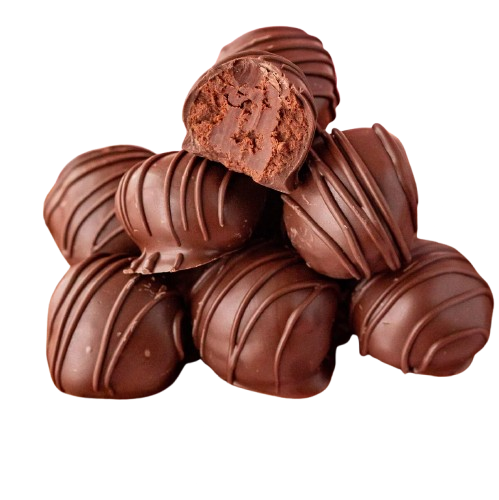
Get a Custom Report on Chocolate Truffle Nutrition Data – Contact Us!
What are the Types of Chocolate Truffles?
The types of chocolate truffles are Classic, Swiss, French, and Belgian. These variations are distinguished by their ingredients and preparation method, which results in different textures and shelf stability. The following chart provides details on these common truffle styles.
| Type | Description | Calories (Approximate per 100g) | Calorie Qualifications |
|---|---|---|---|
|
Classic (American) Truffle
|
A semi-circular truffle made with a ganache of chocolate and heavy cream, often coated in cocoa powder or nuts. | 510 | This is the standard version, with a high calorie count from the heavy cream and chocolate. |
|
Swiss Truffle
|
Made with melted chocolate, boiling dairy cream, and butter. Has a very short shelf life. | 550 | The addition of butter to the ganache makes this version higher in fat and calories. |
|
French Truffle
|
Made with fresh cream and chocolate, and often rolled in cocoa powder. | 530 | The focus on fresh, high-fat cream results in a very rich and calorie-dense confection. |
|
Belgian Truffle
|
A truffle with a chocolate shell filled with a ganache, buttercream, or nut paste. | 580 | The outer chocolate shell and often richer fillings make this the most calorie-dense version. |
What are Desserts with Chocolate Truffle?
A chocolate truffle is a complete dessert in itself, but the truffle flavor is also incorporated into other rich desserts. A catalog of dishes that feature chocolate truffles is detailed below.
| Dish Name | Calories (Estimate per serving) | Type of Dessert | Carbs (g) (Estimate) | Sugar (g) (Estimate) | Protein (g) (Estimate) | Fat (g) (Estimate) | Cuisine | Restaurants |
|---|---|---|---|---|---|---|---|---|
|
Chocolate Lava Cake
|
400 (per cake) | Cake | 45 | 35 | 6 | 22 | French/American | Chili's |
|
Chocolate Truffle Cheesecake
|
1200+ (per slice) | Cheesecake | 100+ | 90+ | 15 | 80+ | American | The Cheesecake Factory |
|
Chocolate Martini
|
300 (per cocktail) | Beverage | 25 | 22 | 0 | 0 | American | Olive Garden |
|
Box of Assorted Truffles
|
Varies | Confection | Varies | Varies | Varies | Varies | Belgian/Swiss | Godiva, Lindt |
What Cuisines Prefer Chocolate Truffle the Most?
The chocolate truffle is a luxury confection with deep roots in French, Belgian, and Swiss culinary traditions. The following list displays the culinary settings where the chocolate truffle is a signature item.
| Cuisine | Dish | Types of Truffles Used | Calories (Estimate) | Brand(s) |
|---|---|---|---|---|
|
French
|
Truffe en Chocolat | French style, rolled in cocoa | 500-550 | La Maison du Chocolat |
|
Belgian
|
Praline | Belgian style, with a hard shell | 550-600 | Neuhaus, Godiva |
|
Swiss
|
Truffe du Jour | Swiss style, with butter and cream | 530-580 | Lindt, Teuscher |
|
American
|
Chocolate Truffle | American style, various coatings | 500-550 | See's Candies |
Which Countries Produce the Most Chocolate Truffles?
The top producers of cocoa beans, the essential ingredient for chocolate truffles, are Côte d'Ivoire, Ghana, and Indonesia. Specific global production data for finished chocolate truffles is not tracked as a separate category. The table below shows the production quantity of cocoa beans in key countries.
| Country | 2003 | 2008 | 2013 | 2018 | 2019 | 2020 | 2021 | 2022 |
|---|---|---|---|---|---|---|---|---|
| Côte d'Ivoire | 1,323,000 | 1,300,000 | 1,448,000 | 2,150,000 | 2,180,000 | 2,200,000 | 2,240,000 | 2,250,000 |
| Ghana | 497,000 | 720,000 | 835,000 | 950,000 | 811,000 | 1,047,000 | 800,000 | 820,000 |
| Indonesia | 450,000 | 821,000 | 750,000 | 659,000 | 650,000 | 640,000 | 630,000 | 620,000 |
| Nigeria | 180,000 | 225,000 | 240,000 | 330,000 | 340,000 | 350,000 | 340,000 | 350,000 |
| Ecuador | 86,000 | 132,000 | 235,000 | 270,000 | 283,000 | 300,000 | 320,000 | 330,000 |
Which Countries Consume the Most Chocolate Truffles?
The top consumers of chocolate confectionery, a category that includes truffles, are found in Europe and North America. Consumption data for truffles is best represented by import values for the broader category of "chocolate and other food preparations containing cocoa." The table below shows import values for this category in key markets.
| Country | 2003 | 2008 | 2013 | 2018 | 2019 | 2020 | 2021 | 2022 |
|---|---|---|---|---|---|---|---|---|
| United States | 2,500,000 | 3,800,000 | 5,000,000 | 6,500,000 | 6,800,000 | 7,200,000 | 8,500,000 | 9,500,000 |
| Germany | 2,000,000 | 3,200,000 | 4,500,000 | 5,500,000 | 5,700,000 | 6,000,000 | 6,800,000 | 7,500,000 |
| United Kingdom | 1,800,000 | 2,800,000 | 3,800,000 | 4,800,000 | 5,000,000 | 5,300,000 | 6,000,000 | 6,500,000 |
| France | 1,500,000 | 2,500,000 | 3,500,000 | 4,500,000 | 4,700,000 | 5,000,000 | 5,700,000 | 6,200,000 |
| Netherlands | 1,000,000 | 1,800,000 | 2,500,000 | 3,500,000 | 3,700,000 | 4,000,000 | 4,800,000 | 5,300,000 |
How Do Prices of Chocolate Truffle-Including Dishes Change?
The cost of chocolate truffles and related desserts has risen over the past ten years, a direct result of higher wholesale ingredient prices for premium chocolate and dairy, as well as increased operational and labor expenses. This upward price trend is evident in the retail costs of popular branded products.
| Brand/Restaurant | Dish | Old Price (Year) | Current Price (2024/2025) |
|---|---|---|---|
| Godiva | Signature Truffles Gift Box (12 pc) | $28.00 (2014) | $37.00 - $44.00 |
| Lindt | LINDOR Milk Chocolate Truffles (8.5 oz bag) | $4.49 (2015) | $6.29 - $10.99 |
| The Cheesecake Factory | Chocolate Truffle Tower Cake Slice | $7.95 (2016) | $10.95 - $12.95 |
| Ferrero Rocher | Hazelnut Chocolates (12 pc) | $4.99 (2013) | $5.87 - $6.99 |
What is the Chocolate Truffle Calorie for 100 Grams?
A 100g serving of chocolate truffles contains 510 calories.
What is the Chocolate Truffle Calorie for 1 KG?
One kilogram (1000g) of chocolate truffles contains 5,100 calories.
What is the Calorie of 1 Chocolate Truffle?
One chocolate truffle (12g) contains 61 calories. One Lindt Lindor Milk Chocolate Truffle (12g) has 73 calories, while one Godiva Signature Dark Chocolate Truffle (15g) contains 75 calories.
What are the Health Benefits of Chocolate Truffle?
The nutritional value of chocolate truffles is linked to the high concentration of cocoa in the dark chocolate used for the ganache. An account of these potential upsides is provided here.
- Rich in Heart-Healthy Flavanols: Dark chocolate is a potent source of flavanols, antioxidants that can improve cardiovascular health by increasing nitric oxide production, which helps relax blood vessels and improve blood flow. A study by Hooper, L., et al. (2012), "Effects of chocolate, cocoa, and flavan-3-ols on cardiovascular health: a systematic review and meta-analysis of randomized trials," found that cocoa consumption was associated with reduced blood pressure and improved blood vessel function.
- May Support Cognitive Function: The flavanols in dark chocolate may enhance brain function. A study by Desideri, G., et al. (2012), "Benefits in cognitive function, blood pressure, and insulin resistance through cocoa flavanol consumption in elderly subjects with mild cognitive impairment," demonstrated that regular consumption of a high-flavanol cocoa drink was associated with improvements in cognitive performance.
- Provides Essential Minerals: Dark chocolate is a good source of essential minerals like iron, magnesium, and copper, which are vital for oxygen transport, nerve function, and energy production. A large serving of truffles (50g) can provide 5% of the Daily Value for iron.
What are the Downsides of Chocolate Truffle?
The confection's rich and decadent nature presents several significant health concerns. A breakdown of these health risks is detailed here.
- High in Saturated Fat and Calories: Chocolate truffles are made from a ganache of chocolate and heavy cream, making them exceptionally high in saturated fat and calories in a very small portion. A presidential advisory from the American Heart Association by Lichtenstein, A. H., et al. (2021), "Dietary Guidance to Improve Cardiovascular Health," recommends limiting intake of foods high in saturated fat to manage cardiovascular risk. A healthier alternative is a small piece of whole fruit. A suggested amount is to limit consumption to one or two small truffles on a rare occasion.
- Contains Added Sugar: Although less sweet than other candies, truffles still contain a significant amount of added sugar, which contributes empty calories. A scientific statement from the American Heart Association by Johnson, R. K., et al. (2009), "Dietary sugars intake and cardiovascular health," links high consumption of added sugar to an increased risk of obesity and heart disease.
Are Chocolate Truffles Good for You?
No, chocolate truffles are not a healthy food because the negative effects of the high saturated fat and calorie content overwhelm any potential benefits from the cocoa. The confection's impact on weight management is negative. The high energy density makes it very easy to consume a large number of calories in a small volume, which can lead to weight gain. A systematic review by Ledikwe, J. H., et al. (2006), "Dietary energy density is associated with energy intake and weight status in US adults," found a clear association between the consumption of energy-dense foods and higher body weight.
For cardiovascular health, the high concentration of saturated fat from heavy cream and cocoa butter can lead to elevated levels of LDL cholesterol. A systematic review by Hooper, L., et al. (2020), "Reduction in saturated fat intake for cardiovascular disease," confirmed that reducing saturated fat intake leads to a reduction in cardiovascular events. For metabolic health, the added sugar, while less than in other candies, still contributes to the overall sugar load of the diet. A study by Sahyoun, N. R., et al. (2008), "Dietary glycemic index and glycemic load and the risk of type 2 diabetes in older adults," found that diets with a high glycemic load are associated with an increased risk of type 2 diabetes.
Is It Healthy to Eat a Chocolate Truffle?
No, it is not healthy to eat a chocolate truffle as a regular part of a diet. The confection is an ultra-processed, high-calorie, high-fat food that offers minimal nutritional value beyond the small amount of minerals from cocoa. The primary health concern is the high concentration of saturated fat. A presidential advisory from the American Heart Association by Sacks, F. M., et al. (2017), "Dietary Fats and Cardiovascular Disease," reaffirmed the recommendation to lower saturated fat intake to reduce the risk of cardiovascular disease.
The high calorie density also makes truffles a poor choice for anyone managing their weight. A systematic review by Pérez-Escamilla, R., et al. (2012), "Dietary energy density and body weight in adults and children: a systematic review," found a positive association between consuming energy-dense foods and having a higher body weight. Furthermore, the health benefits of dark chocolate are best obtained from high-cocoa, low-sugar varieties in moderation, as noted in a review by Montagna, M. T., et al. (2019), "Chocolate, "Food of the Gods": History, Science, and Human Health." A suggested consumption rate is to treat a single truffle as a rare indulgence.
How Do Calories Change According to Chocolate Truffle Types?
The ingredients used in the ganache and coating determine the calorie count of a chocolate truffle. A Belgian truffle has the highest calorie value at 580 calories per 100 grams, a consequence of having both a rich filling and a solid chocolate shell. A classic American-style truffle contains a slightly lower calorie value at 510 calories per 100 grams, representing a baseline without the added butter of a Swiss truffle or the outer shell of a Belgian praline. The overall fat content from cream, butter, and chocolate is the primary factor that dictates the final calorie count.
Do Chocolate Truffles Have More Calories Than Regular Chocolate?
Yes, chocolate truffles have more calories than most regular chocolate bars on a per-gram basis. A standard chocolate truffle contains around 510 calories per 100 grams. This is because a truffle's primary ingredient is ganache, which is an emulsion of chocolate and high-fat heavy cream. This combination is more calorie-dense than solid chocolate alone. A 100g bar of dark chocolate (70-85% cocoa) contains around 598 calories, but a 100g bar of milk chocolate contains around 535 calories. The cream in the truffle ganache significantly increases the saturated fat content, making the truffle a richer food overall.
What are Main Dishes with Chocolate Truffle?
Chocolate truffles are designated as a dessert or confection and are not served with savory main entrees. The confection's intense, rich, and sweet profile makes the food incompatible with a main dish.
What is the Origin of Chocolate Truffle?
The history of the chocolate truffle begins in France in the late 19th century. The invention is most widely attributed to Louis Dufour, a pastry chef from Chambéry, France. In December 1895, running short of ingredients to make his usual holiday confections, Dufour improvised. He made a batch of ganache (a mixture of cream, vanilla, and chocolate), formed the mixture into small, rough balls, and then dipped the balls in melted chocolate and rolled them in cocoa powder. The resulting confection's bumpy texture and dark color resembled the prized black truffle fungus, inspiring the name "truffle." The creation was a success, and the chocolate truffle quickly became a symbol of luxurious, high-quality confectionery, a tradition that was further refined by Belgian chocolatiers who developed the shelled praline.
Explore More Desserts & Sweets
Discover more Desserts & Sweets with detailed nutrition facts, calorie counts, vitamins, minerals, and health benefits. Compare similar foods, serving sizes, macronutrients, and key nutrients to find the best option for your diet and nutrition goals.
 Apple Pie calories
 Banoffee Pudding calories
 Biscotti calories
 Blondie calories
 Bread Pudding calories
 Brownie calories
 Butterscotch Pudding calories
 Cake calories
 Cannoli calories
 Caramel Pudding calories
 Cheesecake calories
 Cherry Pie calories