Calories and Nutritions in Fruit Tart
A fruit tart such as a tart with pastry cream or frangipane fillings are staples of French Pâtisserie and often the centerpiece of bakeries and dessert tables. The calories in fruit tart vary with size and preparation, such as the type of crust, toppings, and filling used. A small tart (100g or 3.5oz) provides 173 calories, a medium slice (158g or 5.6oz) has 273 calories, and a large slice (180g or 6.3oz) contains 311 calories. A single-serving tart from Paris Baguette (113g) has 230 calories, while a slice from a Whole Foods Market tart (156g) contains 330 calories.
The fruit tart nutrition facts show a dessert with moderate fat and high carbohydrates. A medium slice (158g) provides 5.5g of protein (11% DV), 13.9g of fat (18% DV), and 33.2g of carbohydrates (12% DV), which includes 17.6g of sugar. While a study confirmed that fruit consumption is a key contributor to the intake of essential micronutrients and phytochemicals (Slavin, J. L., & Lloyd, B., 2012), the standard macros for a 100g portion of the complete tart are 3.5g of protein, 8.8g of fat, and 21g of carbohydrates.
Fruit tart’s global popularity is supported by leading berry producers like the United States and Russia and major bakery consumers such as Germany and the United Kingdom. The price of a fruit tart reflects rising costs of ingredients and labor, with a whole tart climbing from around $12.00 in the early 2000s to over $25.00 at bakeries after 2020. Bakery chains like La Madeleine and Paris Baguette feature fruit tarts on menus.
The high sugar and refined flour content prompts health advisories for consumption as an occasional indulgence, with a recommended intake limited to one small slice (around 100g). This small slice delivers 173 calories, an energy value equivalent to 17 minutes of jogging or 22 minutes of cycling.
Fruit Tart nutrition
| Stats | Weight |
|---|---|
| Carbs | 33.2 grams |
| Protein | 5.5 grams |
| Fats | 0 grams |
| Sugars | 17.6 grams |
- Large Fruit Tart Calories (Nutritional Facts)
- Medium Fruit Tart Calories (Nutritional Facts)
- Small Fruit Tart Calories (Nutritional Facts)
- Raw Fruit Tart Nutrition
- Sodium in Fruit Tart
- Potassium in Fruit Tart
- Sugar in Fruit Tart
- Fiber in Fruit Tart
- Protein in Fruit Tart
- Carbs in Fruit Tart
- Fat in Fruit Tart
- Vitamins in Fruit Tart
- Minerals in Fruit Tart
Large Fruit Tart Calories (Nutritional Facts)
A large slice of fruit tart (180g or 6.3oz) contains 311 calories, 6.3g of protein (13% DV), 15.8g of fat (20% DV), and 37.8g of carbohydrates (14% DV), which includes 20.2g of sugar.
A medium slice of fruit tart (158g or 5.6oz) provides 273 calories, 5.5g of protein (11% DV), 13.9g of fat (18% DV), and 33.2g of carbohydrates (12% DV), which includes 17.6g of sugar.
A small fruit tart (100g or 3.5oz) contains 173 calories, 3.5g of protein (7% DV), 8.8g of fat (11% DV), and 21g of carbohydrates (8% DV), which includes 11.2g of sugar.
Fruit tart is a baked good and is not consumed raw. The nutritional information provided throughout this article is for a fully prepared pastry.
A large slice of fruit tart (180g) contains 211mg of sodium (9% DV). A medium slice (158g) has 185mg of sodium (8% DV). A small tart (100g) contains 117mg of sodium (5% DV).
A large slice of fruit tart (180g) contains 299mg of potassium (6% DV). A medium slice (158g) has 262mg of potassium (6% DV). A small tart (100g) contains 166mg of potassium (4% DV).
A large slice of fruit tart (180g) contains 20.2g of sugar. A medium slice (158g) has 17.6g of sugar. A small tart (100g) contains 11.2g of sugar.
A large slice of fruit tart (180g) provides 2.5g of dietary fiber (9% DV). A medium slice (158g) has 2.2g of fiber (8% DV). A small tart (100g) contains 1.4g of fiber (5% DV).
A large slice of fruit tart (180g) provides 6.3g of protein (13% DV). A medium slice (158g) has 5.5g of protein (11% DV). A small tart (100g) contains 3.5g of protein (7% DV).
A large slice of fruit tart (180g) contains 37.8g of carbohydrates (14% DV). A medium slice (158g) has 33.2g of carbohydrates (12% DV). A small tart (100g) contains 21g of carbohydrates (8% DV).
A large slice of fruit tart (180g) contains 15.8g of total fat (20% DV). A medium slice (158g) has 13.9g of total fat (18% DV). A small tart (100g) contains 8.8g of total fat (11% DV).
A large slice of fruit tart (180g) provides 36.4mg of Vitamin C (40% DV) and 0.9mcg of Vitamin D (5% DV). A medium slice (158g) provides 31.9mg of Vitamin C (35% DV) and 0.79mcg of Vitamin D (4% DV). A small tart (100g) provides 20.2mg of Vitamin C (22% DV) and 0.5mcg of Vitamin D (3% DV).
A large slice of fruit tart (180g) provides 1.2mg of iron (7% DV) and 95mg of calcium (7% DV). A medium slice (158g) provides 1.1mg of iron (6% DV) and 84mg of calcium (6% DV). A small tart (100g) provides 0.68mg of iron (4% DV) and 53mg of calcium (4% DV).
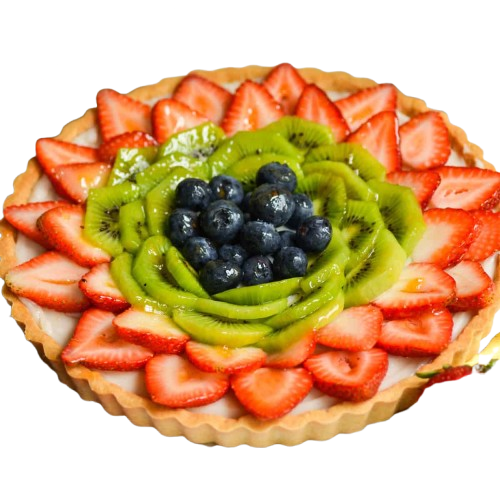
Get a Custom Report on Fruit Tart Nutrition Data – Contact Us!
What are the Types of Fruit Tarts?
Common variations of fruit tarts are defined by their fillings and structure. The table below provides details on these types.
| Type | Description | Calories (Approximate per 100g) | Calorie Qualifications |
|---|---|---|---|
|
Classic Pastry Cream Tart
|
A sweet pastry crust (pâte sucrée) filled with a rich vanilla pastry cream (crème pâtissière) and topped with fresh fruit. | 173 | The relatively light custard filling makes this one of the lower-calorie options. |
|
Frangipane Tart
|
A tart with a layer of frangipane, a rich almond cream made from butter, eggs, sugar, and ground almonds, baked in the crust before being topped with fruit. | 410 | The high fat and calorie content of the almond cream makes this one of the most calorie-dense versions. |
|
Lemon Fruit Tart
|
A tart filled with lemon curd and topped with fresh berries or other fruits that complement the citrus flavor. | 350 | The high amount of sugar and butter in the lemon curd results in a high calorie count. |
|
Mini Fruit Tartlets
|
Small, individual-sized versions of any fruit tart type, most commonly the classic pastry cream version. | 290 | The higher ratio of crust to filling in a smaller format increases the overall calorie density compared to a slice of a large classic tart. |
What are Desserts With Fruit Tarts?
A fruit tart is a complete dessert, yet a slice is sometimes paired with simple accompaniments to enhance the flavor profile. A list of items that complement a fruit tart is detailed in the table below.
| Dish Name | Calories (Estimate per serving) | Type of Dessert | Carbs (g) (Estimate) | Sugar (g) (Estimate) | Protein (g) (Estimate) | Fat (g) (Estimate) | Cuisine | Restaurants |
|---|---|---|---|---|---|---|---|---|
|
Raspberry Sorbet
|
100-140 (per scoop) | Frozen Dessert | 25 | 22 | 0 | 2 | French/Italian | Häagen-Dazs, Talenti |
|
Whipped Cream
|
50-100 (per dollop) | Topping | 2 | 2 | 0 | 8 | French/American | Starbucks, Reddi-wip |
|
Crème Anglaise
|
80-120 (per 2 tbsp) | Sauce | 10 | 9 | 2 | 4 | French | Daniel, Per Se |
|
Pistachio Gelato
|
180-220 (per scoop) | Frozen Dessert | 22 | 20 | 5 | 10 | Italian | Eataly, Amorino Gelato |
|
Lemon Zest
|
<5 (per tsp) | Garnish | <1 | 0 | 0 | 0 | Global | Fine dining restaurants |
|
Apricot Glaze
|
50 (per tbsp) | Glaze/Topping | 13 | 12 | 0 | 0 | French | Paris Baguette, Tous Les Jours |
|
Powdered Sugar
|
30 (per tbsp) | Garnish | 8 | 8 | 0 | 0 | French | La Madeleine |
|
Chocolate Shavings
|
80 (per tbsp) | Garnish | 5 | 4 | 1 | 6 | Swiss/Belgian | Godiva Chocolatier |
|
Toasted Coconut
|
60 (per 2 tbsp) | Topping | 2 | 1 | 1 | 6 | American | The Cheesecake Factory |
|
Mascarpone Cream
|
100 (per 2 tbsp) | Topping | 1 | 1 | 1 | 10 | Italian | Buca di Beppo |
What Cuisines Prefer Fruit Tart the Most?
The fruit tart is a cornerstone of French Pâtisserie, a tradition that has influenced bakeries and restaurants worldwide. The table below presents culinary traditions where the fruit tart is a prominent feature.
| Cuisine | Dish | Types of Fruit Tarts Used | Calories (Estimate) | Restaurant(s) |
|---|---|---|---|---|
|
French (Pâtisserie)
|
Tarte aux Fruits | Classic Pastry Cream, Frangipane | 170-410 | Ladurée, Bouchon Bakery |
|
American (Bakery)
|
Fresh Fruit Tart | Classic Pastry Cream, Cream Cheese base | 200-400 | Whole Foods Market, Magnolia Bakery |
|
Italian
|
Crostata di Frutta | Pastry cream in a pasta frolla crust | 180-350 | Eataly, Balthazar Bakery |
|
Belgian
|
Tarte aux Fruits | Often with a speculoos crust or glaze | 250-400 | Le Pain Quotidien |
|
English
|
Custard Tart with Fruit | Egg custard base with fruit on top | 200-350 | Tea & Sympathy |
|
Japanese (Pâtisserie)
|
Fruit Tart | Lighter cream, meticulous fruit design | 150-300 | Lady M, K. Minamoto |
|
American (Cafe)
|
Fruit Tart Slice | Classic Pastry Cream | 200-450 | Paris Baguette, La Madeleine |
|
Modern American
|
Deconstructed Fruit Tart | Components served separately | 250-450 | The French Laundry |
|
Austrian
|
Linzer Torte (with fruit) | Spiced crust with fruit preserves | 350-450 | Demel (Vienna), Austrian bakeries |
Which Countries Produce the Most Fruit Tarts?
The top producers of fresh berries, a primary component of fruit tarts, are the United States, Russia, and Mexico. Global production data for the finished fruit tart dessert is not tracked as a distinct category. The table below shows the production quantity of berries (excluding strawberries) in leading countries.
| Country | 2003 | 2008 | 2013 | 2018 | 2019 | 2020 | 2021 | 2022 |
|---|---|---|---|---|---|---|---|---|
| United States | 450,810 | 564,440 | 670,901 | 725,330 | 746,210 | 750,110 | 701,310 | 710,250 |
| Russian Federation | 425,000 | 510,000 | 550,000 | 610,000 | 630,000 | 645,000 | 600,000 | 620,000 |
| Mexico | 90,500 | 120,300 | 180,500 | 449,327 | 475,892 | 520,100 | 540,300 | 580,400 |
| Poland | 368,900 | 485,700 | 520,100 | 490,500 | 505,300 | 555,200 | 560,100 | 570,500 |
| Serbia | 150,200 | 180,500 | 210,300 | 320,600 | 340,100 | 350,200 | 330,500 | 340,600 |
Which Countries Consume the Most Fruit Tarts?
The top consumers of fine bakery wares, a category that includes fruit tarts, are the United States, Germany, and the United Kingdom. Consumption data for fruit tarts specifically is best represented by import values for the broader category of pastries, cakes, and sweet biscuits. The table below shows import values for this category in key markets.
| Country | 2003 | 2008 | 2013 | 2018 | 2019 | 2020 | 2021 | 2022 |
|---|---|---|---|---|---|---|---|---|
| United States | 1,300,000 | 2,000,000 | 2,900,000 | 3,800,000 | 4,000,000 | 4,300,000 | 5,000,000 | 5,600,000 |
| Germany | 900,000 | 1,400,000 | 2,000,000 | 2,600,000 | 2,700,000 | 2,900,000 | 3,300,000 | 3,600,000 |
| United Kingdom | 1,000,000 | 1,600,000 | 2,400,000 | 3,100,000 | 3,200,000 | 3,400,000 | 3,800,000 | 4,100,000 |
| France | 700,000 | 1,100,000 | 1,600,000 | 2,100,000 | 2,200,000 | 2,300,000 | 2,600,000 | 2,900,000 |
| Canada | 600,000 | 950,000 | 1,400,000 | 1,800,000 | 1,900,000 | 2,100,000 | 2,400,000 | 2,700,000 |
How Do Prices of Fruit Tart-Including Dishes Change?
Menu prices for individual fruit tarts and slices at cafés and bakeries have risen over the past decade. This change is a direct result of increased wholesale ingredient costs and higher operational expenses. This upward price adjustment is evident on the menus of popular bakery chains.
| Restaurant | Dish | Old Price (Year) | Current Price (2024/2025) |
|---|---|---|---|
| La Madeleine | Fruit Tart | $3.79 (2014) | $3.59 - $5.27 |
| Le Pain Quotidien | Mixed Berry Tart | $5.25 (2016) | $7.99 - $9.90 |
| Paris Baguette | Assorted Fruit Tart | $5.49 (2016) | $7.99 - $12.34 |
| Bouchon Bakery | Fruit Tart | $7.50 (2014) | $8.50 - $11.50 |
What is the Fruit Tart Calorie for 100 Grams?
A 100g serving of fruit tart contains 173 calories.
What is the Fruit Tart Calorie for 1 KG?
One kilogram (1000g) of fruit tart contains 1,730 calories.
What is the Calorie of 1 Fruit Tart?
One whole 9-inch fruit tart (1265g) contains 2188 calories. A single-serving fruit tart from Paris Baguette (113g) has 230 calories, while a Whole Foods Market Fresh Fruit Tart slice (156g) contains 330 calories.
What are the Health Benefits of Fruit Tart?
The nutritional advantages of fruit tarts are concentrated in the fresh fruit topping. A breakdown of these potential benefits is provided here.
- Supplies Essential Vitamins and Antioxidants: The mixed fruits used on tarts are a source of vitamins, particularly Vitamin C, and potent antioxidants like flavonoids and polyphenols. A study by Slavin, J. L., & Lloyd, B. (2012), "Health Benefits of Fruits and Vegetables," confirmed that fruit consumption is a key contributor to the intake of these essential micronutrients and phytochemicals, which help protect cells from oxidative damage.
- Provides Dietary Fiber: Fresh fruit is a natural source of dietary fiber, which is important for digestive health and maintaining regular bowel function. A comprehensive review by Anderson, J. W., et al. (2009), "Health benefits of dietary fiber," established a clear link between higher fiber intake from sources like fruit and a reduced risk for numerous chronic diseases.
- May Support Cardiovascular Health: The potassium and flavonoids present in many fruits can help support heart health by regulating blood pressure and improving blood vessel function. A meta-analysis by Aune, D., et al. (2017), "Fruit and vegetable intake and the risk of cardiovascular disease, total cancer and all-cause mortality—a systematic review and dose-response meta-analysis of prospective studies," found that higher fruit consumption was associated with a significantly lower risk of cardiovascular disease.
What are the Downsides of Fruit Tart?
The pastry's composition presents several health considerations. An examination of these health risks is detailed here.
- High in Refined Carbohydrates and Sugar: The tart crust is made from refined white flour, and the pastry cream filling is high in added sugar, both of which can negatively impact metabolic health. A scientific statement from the American Heart Association by Ludwig, D. S., et al. (2018), "Dietary carbohydrates: role of quality and quantity in chronic disease," details how high consumption of refined carbohydrates and sugars is linked to an increased risk of obesity, type 2 diabetes, and heart disease. A healthier alternative is a bowl of mixed fresh fruit. A suggested amount is to limit consumption to one small slice on an occasional basis.
- Contains Saturated Fat: The butter used in the shortcrust pastry and sometimes in the filling is a source of saturated fat, which can raise LDL (bad) cholesterol levels in the blood. A scientific advisory from the American Heart Association by Sacks, F. M., et al. (2017), "Dietary Fats and Cardiovascular Disease," reaffirmed the recommendation to lower saturated fat intake and replace the fat with unsaturated fats to reduce cardiovascular disease risk.
Are Fruit Tarts Good for You?
No, fruit tarts are not a healthy food choice because the high amounts of sugar, refined flour, and saturated fat in the pastry and filling overshadow the nutritional value of the fruit topping. The dessert's effect on heart health is negative, as the combination of saturated fat and refined carbohydrates can increase risk factors for cardiovascular disease. A systematic review by Mensink, R. P. (1993), "Effects of saturated fatty acids on serum lipids and lipoproteins: a systematic review and regression analysis," confirmed that saturated fats raise LDL cholesterol, a primary risk factor. The dessert is also unfavorable for metabolic health. A review by Malik, V. S., & Hu, F. B. (2022), "The role of sugar-sweetened beverages in the global epidemics of obesity and chronic diseases," details how high intake of added sugars is a principal driver of metabolic dysfunction and weight gain. For digestive health, the tart offers a small amount of fiber from the fruit, but this is minimal compared to the negative effects of the refined flour in the crust. While the vitamins from the fruit topping may offer some antioxidant benefits for brain health, these are negated by the pastry's overall unhealthy profile. A study by Pase, M. P., et al. (2017), "Sugar- and Artificially Sweetened Beverages and the Risks of Incident Stroke and Dementia," linked higher cumulative intake of sugary beverages to an increased risk for incident stroke and dementia.
How Do Calories Change According to Fruit Tart Types?
The calorie content of a fruit tart is determined by the composition of its filling and crust. A tart with a frangipane filling has the highest calorie value at 410 calories per 100 grams, a consequence of the high-fat ground almonds and butter in the baked cream. A classic tart with a simple pastry cream filling contains the lowest calorie value at 173 calories per 100 grams, a reflection of its lighter, milk-based custard compared to nut or high-butter fillings. The overall fat and sugar content of the filling is the main factor that dictates the final calorie count of the dessert.
How Does the Calorie Content of a Fruit Tart Compare to Other Tarts?
A classic fruit tart has a lower calorie content than many other common tarts. The reason for this difference is the filling. A fruit tart's pastry cream is made from milk, eggs, and sugar, which is less calorie-dense than the primary ingredients of other tarts. A pecan tart, for example, is filled with corn syrup, butter, and pecans, pushing its calorie count to over 500 calories per slice. A chocolate silk tart, made with large amounts of chocolate, heavy cream, and butter, or a salted caramel tart, based on sugar and butter, will also have a substantially higher calorie density than a standard fruit tart.
What are the Main Dishes With Fruit Tart?
A fruit tart is served exclusively as a dessert and is not paired with main dishes. The sweet and delicate profile of the pastry, cream, and fruit makes the dessert unsuitable for serving alongside savory main courses. A fruit tart is traditionally offered at the end of a meal, following appetizers and a main course, especially in European and American dining contexts.
What is the Origin of Fruit Tart?
The genesis of the modern fruit tart lies in the medieval European tradition of pie-making. Early pies, known as "tarts," were predominantly savory and featured thick, sturdy crusts designed more as a baking vessel than as an edible part of the dish. During the Renaissance, as sugar became more accessible in Europe, sweet fillings grew in popularity. This period saw the development of fruit preserves and custards, which began to fill these pastry shells. The true evolution of the fruit tart occurred in France, where the arts of Pâtisserie were refined. French chefs in the 18th and 19th centuries perfected delicate, buttery shortcrust pastries like pâte sablée and pâte sucrée. These crusts were a world away from the hard coffins of medieval pies. Alongside the crust, the invention of crème pâtissière (pastry cream) provided the rich, creamy base that is now standard. The final touch was the artful arrangement of fresh, seasonal fruit on top, often finished with a clear apricot glaze to preserve the fruit and add a professional sheen. This combination of a crisp, sweet crust, rich custard, and fresh fruit created the classic Tarte aux Fruits that defines the dessert today.
Explore More Desserts & Sweets
Discover more Desserts & Sweets with detailed nutrition facts, calorie counts, vitamins, minerals, and health benefits. Compare similar foods, serving sizes, macronutrients, and key nutrients to find the best option for your diet and nutrition goals.
 Apple Pie calories
 Banoffee Pudding calories
 Biscotti calories
 Blondie calories
 Bread Pudding calories
 Brownie calories
 Butterscotch Pudding calories
 Cake calories
 Cannoli calories
 Caramel Pudding calories
 Cheesecake calories
 Cherry Pie calories