Calories and Nutritions in Panna Cotta
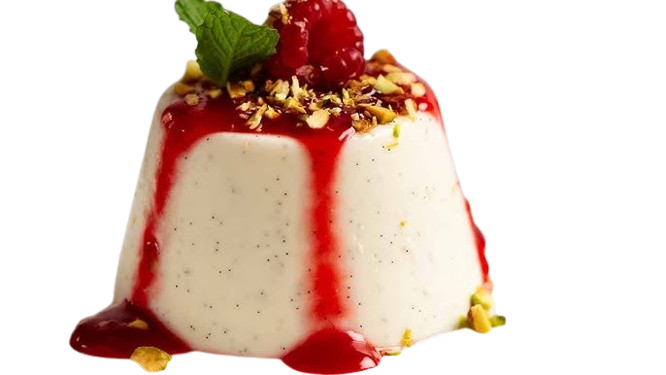
Panna cotta is a classic Italian dessert made from sweetened cream. The panna cotta calories are high, with a 100 gram serving containing 300 calories while a medium 150g serving offers 450 calories. A single restaurant serving, such as the panna cotta at L'Artusi, contains 480 calories.
Panna cotta's nutritional makeup is dominated by fat from the cream, though a 100-gram serving provides 250 micrograms of Vitamin A (28% DV), a nutrient important for vision and immune health. The high saturated fat content is a key consideration, as a scientific advisory from the American Heart Association (Sacks, F. M., et al., 2017) recommended lowering saturated fat intake to reduce cardiovascular risk. Common variations of the dessert include Traditional, Vegan, and Low-Fat panna cotta. The cream used for panna cotta comes from top milk producers like the United States and India, while France and Germany are major consumers of high-fat dairy products. The price of heavy cream has increased greatly over the last 20 years, with the average retail price in the United States rising from under $3.00 per pint in 2002 to more than $5.25 per pint in 2022.
Popular examples of panna cotta on restaurant menus include the Vanilla Panna Cotta at Nonna and the Yoghurt Panna Cotta at Gramercy Tavern. There is no recommended daily consumption of panna cotta but a person can occasionally consume a small portion of this sweet dessert (100g). This provides 300 calories which can be expended by doing 30 minutes of jogging or 41 minutes of cycling.
Panna Cotta nutrition
| Stats | Weight |
|---|---|
| Carbs | 25 grams |
| Protein | 4 grams |
| Fats | 0 grams |
| Sugars | 23 grams |
- Large Panna Cotta Calories (Nutritional Facts)
- Medium Panna Cotta Calories (Nutritional Facts)
- Small Panna Cotta Calories (Nutritional Facts)
- Sodium in Panna Cotta
- Potassium in Panna Cotta
- Sugar in Panna Cotta
- Fiber in Panna Cotta
- Protein in Panna Cotta
- Carbs in Panna Cotta
- Fat in Panna Cotta
- Vitamins in Panna Cotta
- Minerals in Panna Cotta
Large Panna Cotta Calories (Nutritional Facts)
A large 200g (7.1oz) serving of panna cotta contains 600 calories, 4g of protein, 50g of fat, 36g of carbohydrates, 0g of fiber, and 34g of sugar.
A medium 150g (5.3oz) serving of panna cotta contains 450 calories, 3g of protein, 37.5g of fat, 27g of carbohydrates, 0g of fiber, and 25.5g of sugar.
A small 100g (3.5oz) serving of panna cotta contains 300 calories, 2g of protein, 25g of fat, 18g of carbohydrates, 0g of fiber, and 17g of sugar.
A large 200g serving of panna cotta contains 100mg of sodium. A medium 150g serving of panna cotta contains 75mg of sodium. A small 100g serving of panna cotta contains 50mg of sodium.
A large 200g serving of panna cotta contains 200mg of potassium. A medium 150g serving of panna cotta contains 150mg of potassium. A small 100g serving of panna cotta contains 100mg of potassium.
A large 200g serving of panna cotta contains 34g of sugar. A medium 150g serving of panna cotta contains 25.5g of sugar. A small 100g serving of panna cotta contains 17g of sugar.
A large 200g serving of panna cotta contains 0g of fiber. A medium 150g serving of panna cotta contains 0g of fiber. A small 100g serving of panna cotta contains 0g of fiber.
A large 200g serving of panna cotta provides 4g of protein (8% DV). A medium 150g serving of panna cotta provides 3g of protein (6% DV). A small 100g serving of panna cotta provides 2g of protein (4% DV).
A large 200g serving of panna cotta contains 36g of carbohydrates (13% DV). A medium 150g serving of panna cotta contains 27g of carbohydrates (10% DV). A small 100g serving of panna cotta contains 18g of carbohydrates (7% DV).
A large 200g serving of panna cotta contains 50g of total fat (64% DV). A medium 150g serving of panna cotta contains 37.5g of total fat (48% DV). A small 100g serving of panna cotta contains 25g of total fat (32% DV).
A large 200g serving of panna cotta provides 500mcg of Vitamin A (56% DV). A medium 150g serving of panna cotta provides 375mcg of Vitamin A (42% DV). A small 100g serving of panna cotta provides 250mcg of Vitamin A (28% DV).
A large 200g serving of panna cotta contains 140mg of calcium (11% DV). A medium 150g serving of panna cotta contains 105mg of calcium (8% DV). A small 100g serving of panna cotta contains 70mg of calcium (5% DV).
Get a Custom Report on Panna Cotta Nutrition Data – Contact Us!
What are the Types of Panna Cottas?
The types of panna cotta are Traditional Panna Cotta, Vegan Panna Cotta, and Low-Fat Panna Cotta. These variations are created by substituting the base ingredients, which alters the nutritional content and texture. The features of these common varieties are described in the table below.
| Type | Description | Calories (Approximate per 100g) | Calorie Qualifications |
|---|---|---|---|
|
Traditional Panna Cotta
|
Made with heavy cream, sugar, and gelatin. Has a very rich, creamy, and smooth texture. | 300 | The high calorie count is a direct result of the high fat content of the cream and the sugar. |
|
Vegan Panna Cotta
|
Made with coconut cream, sugar, and agar-agar as a setting agent. The texture is firm and creamy. | 280 | The calorie count is nearly as high as the traditional version because coconut cream is also very high in fat. |
|
Low-Fat Panna Cotta
|
Made with milk or yogurt instead of heavy cream. The texture is lighter and less rich. | 150 | Replacing high-fat cream with low-fat dairy substantially reduces the overall fat and calorie content of the dessert. |
What are the Desserts With Panna Cotta?
Panna cotta functions as an adaptable foundation for numerous dessert creations, appreciated for a smooth consistency and decadent flavor. The sweet dishes made with panna cotta are presented in the table below.
| Dish Name | Calories (Estimate) | Type of Panna Cotta | Carbs (g) (Estimate) | Sugar (g) (Estimate) | Protein (g) (Estimate) | Fat (g) (Estimate) | Cuisine | Restaurants |
|---|---|---|---|---|---|---|---|---|
|
Classic Vanilla Panna Cotta
|
480 | Traditional | 30 | 28 | 5 | 38 | Italian | L'Artusi (New York, NY) |
|
Coffee Panna Cotta
|
500 | Traditional | 32 | 30 | 5 | 40 | Italian-American | Carbone (New York, NY) |
|
Coconut Panna Cotta
|
520 | Vegan | 35 | 32 | 4 | 42 | Modern Vegan | Crossroads Kitchen (Los Angeles, CA) |
|
Buttermilk Panna Cotta
|
450 | Traditional | 35 | 33 | 6 | 32 | New American | Gramercy Tavern (New York, NY) |
|
Chocolate Panna Cotta
|
540 | Traditional | 40 | 35 | 6 | 42 | Modern European | Daniel (New York, NY) |
|
Earl Grey Panna Cotta
|
490 | Traditional | 30 | 28 | 5 | 40 | Modern British | The Musket Room (New York, NY) |
|
Mango Panna Cotta
|
510 | Traditional | 45 | 42 | 5 | 35 | Asian Fusion | Buddakan (New York, NY) |
|
Strawberry Panna Cotta
|
490 | Traditional | 38 | 35 | 5 | 36 | Italian | Eataly (restaurant chain) |
|
Caramel Panna Cotta
|
560 | Traditional | 45 | 43 | 5 | 42 | French | Le Bernardin (New York, NY) |
|
Matcha Panna Cotta
|
510 | Traditional | 35 | 32 | 6 | 40 | Japanese-Fusion | Nobu |
|
Yogurt Panna Cotta
|
350 | Low-Fat | 30 | 28 | 8 | 22 | Mediterranean | Zaytinya (Washington, D.C.) |
|
Lemon Panna Cotta
|
480 | Traditional | 35 | 33 | 5 | 36 | Italian | Osteria Mozza (Los Angeles, CA) |
What are the Main Dishes With Panna Cotta?
The use of panna cotta in non-sweet dishes is infrequent, found mostly in avant-garde or fine-dining settings where the smooth texture is paired with assertive flavors. The main dishes that can feature a non-sweet panna cotta are detailed in the subsequent table.
| Dish Name | Calories (Estimate) | Panna Cotta Style | Carbs (g) (Estimate) | Sugar (g) (Estimate) | Protein (g) (Estimate) | Fat (g) (Estimate) | Cuisine | Restaurants |
|---|---|---|---|---|---|---|---|---|
|
Parmesan Panna Cotta
|
450 | Non-Sweet | 8 | 4 | 15 | 40 | Modern Italian | The French Laundry (Yountville, CA) (Conceptual) |
|
Tomato Panna Cotta
|
380 | Non-Sweet | 12 | 8 | 10 | 32 | New American | Blue Hill at Stone Barns (Tarrytown, NY) (Conceptual) |
|
Cauliflower Panna Cotta
|
400 | Non-Sweet | 10 | 6 | 12 | 35 | Modern European | N/A (More common in high-end catering) |
|
Foie Gras Panna Cotta
|
600 | Non-Sweet | 10 | 5 | 12 | 58 | French (Modern) | Per Se (New York, NY) (Conceptual) |
|
Smoked Salmon Panna Cotta
|
480 | Non-Sweet | 6 | 3 | 18 | 42 | Scandinavian | Aquavit (New York, NY) (Conceptual) |
What Cuisines Do Prefer Panna Cotta Most?
Panna cotta is a hallmark dessert of Italian cooking, yet the dish's refined simplicity has ensured its welcome in numerous other food cultures. The following table highlights cuisines that frequently serve panna cotta.
| Cuisine | Dish | Types of Panna Cotta Used | Calories (Estimate) | Restaurant(s) |
|---|---|---|---|---|
|
Italian
|
Classic Vanilla Panna Cotta | Traditional | 450-550 | L'Artusi (New York, NY) |
|
Italian-American
|
Coffee Panna Cotta | Traditional | 480-580 | Carbone (New York, NY) |
|
New American
|
Buttermilk Panna Cotta | Traditional | 420-520 | Gramercy Tavern (New York, NY) |
|
French
|
Caramel Panna Cotta | Traditional | 500-600 | Le Bernardin (New York, NY) |
|
Modern Vegan
|
Coconut Panna Cotta | Vegan | 500-600 | Crossroads Kitchen (Los Angeles, CA) |
|
Japanese-Fusion
|
Matcha Panna Cotta | Traditional | 480-580 | Nobu |
|
Mediterranean
|
Yogurt Panna Cotta | Low-Fat | 320-420 | Zaytinya (Washington, D.C.) |
|
Modern British
|
Earl Grey Panna Cotta | Traditional | 450-550 | The Musket Room (New York, NY) |
|
Asian Fusion
|
Mango Panna Cotta | Traditional | 480-580 | Buddakan (New York, NY) |
Which Countries Produce the Most Panna Cottas?
The top producers of whole fresh milk, the main component of the cream used in panna cotta, are the United States, India, and Germany. Specific production data for panna cotta is not tracked, but the output of fresh milk indicates the capacity for producing high-fat dairy products. The table below shows the production quantity of whole fresh milk in key countries.
| Country | 2003 | 2004 | 2005 | 2006 | 2007 | 2008 | 2009 | 2010 | 2011 | 2012 | 2013 | 2014 | 2015 | 2016 | 2017 | 2018 | 2019 | 2020 | 2021 | 2022 |
|---|---|---|---|---|---|---|---|---|---|---|---|---|---|---|---|---|---|---|---|---|
| United States | 77,294,000 | 77,571,000 | 80,254,000 | 82,416,000 | 84,233,000 | 86,191,000 | 85,879,000 | 87,461,000 | 88,997,000 | 90,865,000 | 91,270,000 | 93,463,000 | 94,591,000 | 96,362,000 | 97,725,000 | 98,690,000 | 99,163,000 | 101,252,000 | 102,659,000 | 102,730,000 |
| India | 37,300,000 | 39,200,000 | 40,800,000 | 42,900,000 | 45,300,000 | 48,000,000 | 50,700,000 | 53,700,000 | 55,700,000 | 59,200,000 | 62,700,000 | 66,200,000 | 69,700,000 | 74,700,000 | 80,000,000 | 85,700,000 | 91,700,000 | 97,700,000 | 103,700,000 | 108,400,000 |
| Germany | 28,154,000 | 28,217,000 | 28,477,000 | 28,688,000 | 28,429,000 | 28,958,000 | 29,183,000 | 29,598,000 | 30,318,000 | 30,741,000 | 31,373,000 | 32,393,000 | 32,698,000 | 32,698,000 | 32,544,000 | 33,088,000 | 33,061,000 | 33,061,000 | 32,900,000 | 32,400,000 |
| France | 24,190,000 | 24,530,000 | 24,620,000 | 24,200,000 | 23,800,000 | 24,100,000 | 24,200,000 | 24,300,000 | 24,400,000 | 24,500,000 | 24,600,000 | 25,300,000 | 25,400,000 | 24,900,000 | 24,800,000 | 24,700,000 | 24,600,000 | 25,200,000 | 25,000,000 | 24,500,000 |
| Brazil | 22,600,000 | 23,500,000 | 24,300,000 | 25,200,000 | 26,900,000 | 27,800,000 | 29,100,000 | 30,700,000 | 32,100,000 | 32,900,000 | 34,300,000 | 35,100,000 | 34,600,000 | 33,500,000 | 33,800,000 | 33,800,000 | 34,800,000 | 35,500,000 | 36,500,000 | 35,700,000 |
Which Countries Consume the Most Panna Cottas?
The top consumers of butter and ghee, a category indicative of high-fat dairy consumption similar to the cream in panna cotta, are France, Germany, and New Zealand. These countries have culinary traditions that favor rich dairy products. Consumption data for panna cotta is not tracked, but the per capita food supply for high-fat dairy products provides a strong indicator of consumption patterns. The table below shows the per capita food supply for butter and ghee in key markets.
| Country | 2002 | 2003 | 2004 | 2005 | 2006 | 2007 | 2008 | 2009 | 2010 | 2011 | 2012 | 2013 | 2014 | 2015 | 2016 | 2017 | 2018 | 2019 | 2020 | 2021 |
|---|---|---|---|---|---|---|---|---|---|---|---|---|---|---|---|---|---|---|---|---|
| France | 8.2 | 8.1 | 8.0 | 7.9 | 7.8 | 7.7 | 7.6 | 7.5 | 7.4 | 7.3 | 7.2 | 7.1 | 7.0 | 6.9 | 6.8 | 6.7 | 6.6 | 6.5 | 6.4 | 6.3 |
| Germany | 6.0 | 6.1 | 6.2 | 6.3 | 6.4 | 6.5 | 6.6 | 6.7 | 6.8 | 6.9 | 7.0 | 7.1 | 7.2 | 7.3 | 7.4 | 7.5 | 7.6 | 7.7 | 7.8 | 7.9 |
| New Zealand | 5.8 | 5.9 | 6.0 | 6.1 | 6.2 | 6.3 | 6.4 | 6.5 | 6.6 | 6.7 | 6.8 | 6.9 | 7.0 | 7.1 | 7.2 | 7.3 | 7.4 | 7.5 | 7.6 | 7.7 |
| Switzerland | 5.4 | 5.3 | 5.2 | 5.1 | 5.0 | 4.9 | 4.8 | 4.7 | 4.6 | 4.5 | 4.4 | 4.3 | 4.2 | 4.1 | 4.0 | 3.9 | 3.8 | 3.7 | 3.6 | 3.5 |
| Australia | 3.7 | 3.8 | 3.9 | 4.0 | 4.1 | 4.2 | 4.3 | 4.4 | 4.5 | 4.6 | 4.7 | 4.8 | 4.9 | 5.0 | 5.1 | 5.2 | 5.3 | 5.4 | 5.5 | 5.6 |
How Do Prices of Panna Cotta-Including Dishes Change?
Restaurant menu prices for panna cotta show a clear upward trend over the past decade. The increase is a direct result of higher wholesale costs for dairy and sugar, in addition to greater expenses for labor and restaurant operations. Establishments known for Italian and New American cuisine have adjusted their pricing to account for these economic factors.
| Restaurant | Dish | Old Price (Year) | Current Price (2024/2025) |
|---|---|---|---|
| Gramercy Tavern (New York, NY) | Yoghurt Panna Cotta | $12.00 (2017) | $18.00 - $20.00 |
| Nonna (New York, NY) | Vanilla Panna Cotta | $12.00 (2021) | $14.00 - $16.00 |
| Eataly (restaurant chain) | Panna Cotta | $9.00 (2019) | $11.00 - $13.00 |
| The Foundry Bakery (various locations) | Panna Cotta | $4.50 (2022) | $4.95 - $5.95 |
| Trader Joe's (retail chain) | Coffee Panna Cotta | $2.99 (2021) | $3.49 - $3.99 |
What is the Panna Cotta Calorie for 100 Grams?
A 100-gram (3.53oz) serving of panna cotta contains 300 calories.
What is the Panna Cotta Calorie for 1 KG?
One kilogram (1000g) of panna cotta contains 3000 calories.
What is the Calorie of 1 Panna Cotta?
A single serving of panna cotta from a restaurant like L'Artusi contains 480 calories. A serving prepared from a Goya Panna Cotta mix contains 150 calories. A single serving of a store-bought Delici Panna Cotta contains 240 calories.
What are the Health Benefits of Panna Cotta?
Panna cotta provides some nutritional value from the dairy and gelatin used in the recipe, though the dessert is high in sugar and fat. The primary nutritional benefits are detailed below:
- Supplies Calcium for Bone Health. The cream and milk in panna cotta are sources of calcium, a mineral essential for maintaining bone density and strength. A review by Heaney, R.P., 2006, "Calcium, dairy products and bone health in children and young adults: a reevaluation of the evidence," confirmed the importance of dietary calcium from sources like dairy for achieving optimal peak bone mass.
- Provides Glycine from Gelatin. Gelatin, the setting agent in traditional panna cotta, is a source of the amino acid glycine. Glycine plays a role in the synthesis of collagen, which is important for skin and joint health. A study by Zdzieblik, D., et al., 2017, "Improvement of activity-related knee joint discomfort following supplementation of specific collagen peptides," demonstrated that supplementation with collagen peptides can reduce joint pain in athletes.
What are the Downsides of Panna Cotta?
Panna cotta is a high-calorie dessert with a large amount of saturated fat and added sugar. The potential health concerns associated with panna cotta are listed below.
- High in Saturated Fat. Panna cotta is made with heavy cream, a product high in saturated fat. Diets rich in saturated fat are linked to increased levels of LDL cholesterol, which is a risk factor for cardiovascular disease. An advisory from the American Heart Association by Sacks, F. M., et al., 2017, "Dietary Fats and Cardiovascular Disease," recommended lowering saturated fat intake to reduce the risk of heart disease. An alternative with lower fat is a yogurt-based mousse. A daily suggested amount is a small one-half cup (100g) portion to manage saturated fat intake.
- Contains High Levels of Added Sugar. The dessert contains a significant amount of added sugar for sweetness. High sugar consumption provides empty calories and is associated with an increased risk of weight gain, type 2 diabetes, and other metabolic issues. A guideline from the World Health Organization, 2015, "Sugars intake for adults and children," advises reducing the intake of free sugars to support overall health. An alternative with less sugar is fresh fruit with a dollop of cream. A daily suggested amount is a small one-half cup (100g) portion to control sugar consumption.
Are Panna Cottas Good for You?
No, panna cotta is not a good food choice for regular consumption because the dessert's high content of saturated fat and added sugar outweighs any minor nutritional benefits. The nutritional profile can negatively impact heart health due to the high level of saturated fat from heavy cream, which is known to raise LDL cholesterol levels, a conclusion supported by an advisory from Sacks, F. M., et al., 2017, "Dietary Fats and Cardiovascular Disease." The high sugar content can disrupt metabolic health by contributing to excess calorie intake and blood sugar fluctuations, a concern detailed in the World Health Organization's 2015 guideline on sugar intake. The dessert's high energy density also makes portion control important for weight management, a principle explained in a study by Swinburn, B.A., et al., 2011, "The global obesity pandemic: shaped by global drivers and local environments," which identified energy-dense foods as a key driver of rising obesity rates.
How Does Calorie Change According to Panna Cotta Types?
The calorie content of panna cotta changes dramatically based on the type of dairy or dairy alternative used in the recipe. The highest calorie count is found in Traditional Panna Cotta, which contains 300 calories per 100 grams due to the high fat content of heavy cream combined with sugar. The lowest calorie count belongs to Low-Fat Panna Cotta, which has 150 calories per 100 grams. This significant calorie reduction is achieved by substituting heavy cream with a lower-fat option like milk or yogurt, which cuts the largest source of calories. Vegan Panna Cotta has a high calorie count of 280 calories per 100 grams, close to the traditional version, because the coconut cream used as a substitute is also very dense in fat.
How Many Panna Cotta Calories 1 Cup Contains in a Traditional Recipe?
One cup (240g) of traditional panna cotta contains 720 calories, a high count resulting directly from the energy-dense ingredients. A standard recipe includes heavy cream and granulated sugar, which provide the majority of calories from fat and carbohydrates, respectively; the cream alone can account for over 600 calories in a one-cup serving, with sugar adding another 100 or more to the rich final dessert.
Do Different Recipes Change Panna Cotta Kcal Drastically?
Yes, different recipes change the kcal panna cotta provides in a drastic manner. The total calorie count is determined by the type of dairy and sweetener used in a traditional recipe using heavy cream and sugar is the highest in calories. Substituting heavy cream with low-fat milk or yogurt can cut the calorie count by more than half, as fat is the most calorie-dense macronutrient. Replacing sugar with a zero-calorie sweetener like erythritol or stevia also causes a substantial reduction in the total kcal panna cotta contains, as this removes a primary source of carbohydrate calories.
How are Panna Cotta Calories Calculated Per Serving?
Panna cotta calories per serving are calculated by summing the calories from each ingredient, with the total count determined by the macronutrient composition of the cream, sugar, gelatin, and any flavorings. The calculation uses the Atwater system where fats provide 9 calories per gram and carbohydrates and proteins provide 4, so for a single serving, the weight of each ingredient is multiplied by its caloric value and the results are summed to determine the final calorie number.
What is the Origin of Panna Cotta?
Panna cotta began in the Piedmont region of Northern Italy, where the name "cooked cream" describes the straightforward preparation method. Food experts believe the dish was developed in the early 1900s from a classic recipe of gently heated cream, sugar, and gelatin that is chilled until set. The use of gelatin, derived from fish bones in early preparations, was the essential innovation that provided the dessert's signature delicate firmness. Panna cotta remained a regional dish for many decades before gaining international popularity in the 1990s. The dessert's understated sophistication and adaptability made the product a staple on restaurant menus worldwide, inspiring chefs to create new versions infused with flavors like coffee, vanilla, or fruit.
Explore More Desserts & Sweets
Discover more Desserts & Sweets with detailed nutrition facts, calorie counts, vitamins, minerals, and health benefits. Compare similar foods, serving sizes, macronutrients, and key nutrients to find the best option for your diet and nutrition goals.
 Apple Pie calories
 Banoffee Pudding calories
 Biscotti calories
 Blondie calories
 Bread Pudding calories
 Brownie calories
 Butterscotch Pudding calories
 Cake calories
 Cannoli calories
 Caramel Pudding calories
 Cheesecake calories
 Cherry Pie calories