Calories and Nutritions in Gooseberry Juice
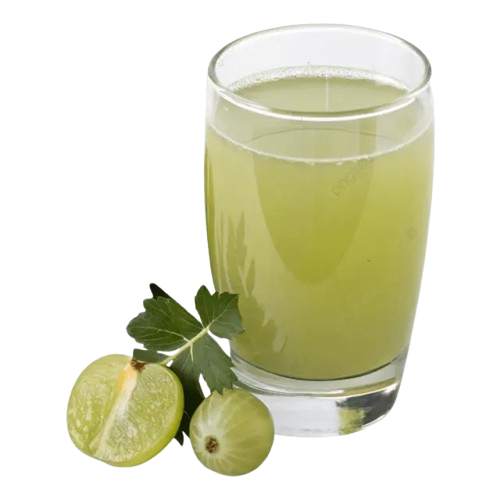
Gooseberry juice, widely recognized in Ayurvedic practices as amla juice or Indian gooseberry juice, is a nutritious beverage deeply integrated into Indian and British food cultures. A standard 100 ml measure of gooseberry juice supplies 27 calories, while a concentrated 30 ml shot yields 8 calories. Specific commercial labels feature distinct caloric profiles, with a 30 ml serving of Amla Juice Indian Gooseberry by Vedic containing 8 calories. A 100 ml pour delivers 6 g of carbohydrates (2% RDA), 0.5 g of protein (1% RDA), 4 g of sugars, 0.1 g of fat (0% RDA), and 0.4 g of dietary fiber (1% RDA). Loaded with micronutrients, it offers 234 mg of Vitamin C (260% RDA) and 150 mg of potassium (3% RDA). A study on Indian gooseberry's health benefits by Akhtar et al. (2011) shows that the bioactive tannins and Vitamin C present in the fruit deliver potent cellular protection and help regulate lipid profiles, though the acidic nature of the liquid requires careful dilution.
Shoppers frequently find multiple formats on grocery shelves, such as 100% Amla Juice, Sweetened Gooseberry Nectar, and Gooseberry Ginger Blend. Given its tart flavor and medicinal properties, it functions prominently in health cafes and traditional European dining, appearing in 6 savory main courses and 5 desserts at recognized restaurants, like the Gooseberry Fool at Rules and the Amla Sorbet at Gymkhana. Acknowledging its utility in holistic wellness, manufacturers distribute it widely in specialized health food aisles, letting consumers purchase pure extracts from trusted organic brands.
The historical background of the beverage links back to the Indian subcontinent and Northern Europe, where early communities harvested the sour berries for medicinal treatments and winter preserves, later developing the pasteurized extracts sold today. Market analysts track the core fruit within the currants and gooseberries sector, an industry led by Russia, which harvested 410 kt in 2026. Food supply databases indicate a high dietary intake of these berries across Russia and Poland. The retail cost for a 16 oz bottle of pure amla juice has climbed from $5.00 USD in 2007 to $12.50 USD in 2026.
Consuming a 30 ml shot of gooseberry juice contains 8 calories, which can be burned doing 1 minute of jogging at a moderate pace.
Gooseberry Juice nutrition
| Stats | Weight |
|---|---|
| Carbs | 14.4 grams |
| Protein | 1.2 grams |
| Fats | 0 grams |
| Sugars | 9.6 grams |
- Large Gooseberry Juice Calories (Nutritional Facts)
- Medium Gooseberry Juice Calories (Nutritional Facts)
- Small Gooseberry Juice Calories (Nutritional Facts)
- Raw Gooseberry Nutrition
- Sodium in Gooseberry Juice
- Potassium in Gooseberry Juice
- Sugar in Gooseberry Juice
- Fiber in Gooseberry Juice
- Protein in Gooseberry Juice
- Carbs in Gooseberry Juice
- Fat in Gooseberry Juice
- Vitamins in Gooseberry Juice
- Minerals in Gooseberry Juice
Large Gooseberry Juice Calories (Nutritional Facts)
A large 480 ml (2 cups) portion of gooseberry juice, widely known in Ayurvedic practices as amla juice, contains 130 calories. This 480 ml (2 cups) volume delivers 0.4 g of total fat, 2.4 g of protein, 28.8 g of carbohydrates, and 19.2 g of sugar. A large 480 ml (2 cups) glass of sweetened gooseberry nectar holds 240 calories because commercial producers blend in refined cane sugar to reduce the natural sourness of the fruit.
Pouring a medium 240 ml (1 cup) serving of this tart liquid provides 65 calories. This 240 ml (1 cup) amount supplies 0.2 g of total fat, 1.2 g of protein, 14.4 g of carbohydrates, and 9.6 g of sugar. A 240 ml (1 cup) serving of sparkling gooseberry juice contains 50 calories due to the physical volume occupied by unflavored carbonated water.
A standard 30 ml (1 oz) shot of gooseberry juice yields 8 calories. This 30 ml (1 oz) volume consists of 0.03 g of total fat, 0.15 g of protein, 1.8 g of carbohydrates, and 1.2 g of sugar.
Looking at 100 ml of raw, unpasteurized gooseberry juice reveals 27 calories, 0.1 g of total fat, 0.5 g of protein, 6 g of total carbohydrates, and 0.4 g of dietary fiber. The nutritional composition of this pale green beverage relies heavily on its dense Vitamin C and antioxidant profile, supplying dietary vitamins without added fats.
Only 1 mg of sodium exists in a 100 ml serving of gooseberry juice, which accounts for 0% of the Daily Value (DV). This low sodium content makes the drink suitable for blood pressure management diets.
There are 150 mg of potassium per 100 ml of gooseberry juice, meeting 3% of the DV. This mineral transfers directly from the pressed fruit and assists in proper muscle contraction and cellular fluid balance.
Roughly 4 g of natural sugar is present in one hundred milliliters of gooseberry juice. This sugar is made up of naturally occurring fructose and glucose from the fruit flesh.
Extracting the liquid leaves 0.4 g of dietary fiber per 100 ml of gooseberry juice, satisfying 1% of the DV. The industrial juicing process filters out the seeds and thick skin, removing the majority of the natural fiber found in the whole plant.
A 100 ml measure of gooseberry juice offers 0.5 g of protein.
Total carbohydrates amount to 6 g per 100 ml serving of gooseberry juice.
Barely any lipid is present, with 0.1 g of total fat per 100 ml of gooseberry juice.
An impressive 234 mg of Vitamin C (260% DV) is found in a 100 ml serving of raw gooseberry juice. This vitamin supports regular immune cell production, skin health, and tissue repair.
Trace elements in gooseberry juice include 15 mg of Calcium (1% DV), 6 mg of Magnesium (1% DV), and 0.6 mg of Iron (3% DV) per 100 ml. The juice also contains small amounts of zinc and phosphorus.
Get a Custom Report on Gooseberry Juice Nutrition Data – Contact Us!
What are the Types of Gooseberry Juice?
Consumers looking for gooseberry juice will find 4 distinct commercial variations available in health markets, ranging from pure extractions to spiced wellness shots. The table below shows the common gooseberry juice types and their calorie information.
| Type | Description | Calories (per 100ml) | Calorie Differences & Qualifications |
|---|---|---|---|
|
100% Amla Juice
|
Pure liquid pressed from fresh Indian gooseberries with no added sweeteners. | 27 | Baseline energy for the pure fruit beverage. |
|
Sweetened Gooseberry Nectar
|
A blend of fruit puree, water, and sugar ready for immediate drinking. | 50 | Higher calories than pure juice due to added refined sucrose. |
|
Gooseberry Ginger Blend
|
Pure juice blended with ginger extract and honey for wellness routines. | 45 | Moderately higher calories due to the natural sugars in the honey. |
|
Sparkling Gooseberry Drink
|
Carbonated juice served as a chilled alternative to soda. | 20 | Lower calories due to the added volume of carbonated water. |
What are the Desserts with Gooseberry Juice?
Pastry chefs frequently use gooseberry juice and puree as a tart glaze or reduction in fine dining desserts. Culinary professionals rely on it to impart a natural sweet and sour contrast to the final dish. The table below shows 5 desserts and beverages containing gooseberry juice that are served in restaurants.
| Dish Name | Calories | Type | Carbs | Sugar | Protein | Fat | Cuisine | Restaurants |
|---|---|---|---|---|---|---|---|---|
|
Gooseberry Fool (Seasonal)
|
340 | Pudding | 42g | 28g | 4g | 18g | British | Rules |
|
Amla Sorbet (Seasonal)
|
120 | Frozen | 28g | 22g | 0g | 0g | Indian Fusion | Gymkhana |
|
Gooseberry Tart (Seasonal)
|
390 | Pastry | 48g | 26g | 5g | 20g | British | St. John |
|
Spiced Amla Cooler
|
80 | Beverage | 18g | 16g | 0g | 0g | Indian | Dishoom |
|
Gooseberry Panna Cotta
|
310 | Pudding | 32g | 26g | 5g | 18g | Italian Fusion | Osteria Mozza |
What are the Main Dishes with Gooseberry Juice?
Restaurants commonly incorporate gooseberry juice into pan sauces for rich meats and seafood. Chefs reduce the tart liquid to cut through the heavy fats of pork, duck, and mackerel. The table below lists 6 main dishes containing gooseberry juice reductions.
| Dish Name | Calories | Type | Carbs | Sugar | Protein | Fat | Cuisine | Restaurants |
|---|---|---|---|---|---|---|---|---|
|
Pork Belly with Gooseberry Glaze
|
680 | Meat | 22g | 14g | 42g | 48g | British | Roast |
|
Mackerel with Amla Reduction
|
420 | Seafood | 12g | 6g | 36g | 26g | Indian Fusion | Gymkhana |
|
Duck Breast with Gooseberry Sauce
|
640 | Poultry | 16g | 12g | 40g | 46g | French | Le Coucou |
|
Roast Lamb with Gooseberry Jus
|
590 | Meat | 14g | 8g | 48g | 38g | Modern British | Hawksmoor |
|
Chicken Tikka with Amla Glaze
|
480 | Poultry | 18g | 10g | 42g | 26g | Indian | Dishoom |
|
Pork Tenderloin with Gooseberry Gastrique
|
550 | Meat | 20g | 14g | 44g | 32g | Farm-to-Table | Blue Hill |
What Cuisines Prefer Gooseberry Juice the Most?
Indian, British, and modern European culinary traditions rely heavily on gooseberry juice to balance fatty meats and flavor beverages. In India, amla juice is consumed daily for its medicinal properties and mixed into savory marinades. British chefs historically serve gooseberry reductions as the primary accompaniment to oily fish like mackerel. The table below outlines 5 cuisines and dishes.
| Cuisine | Dish Name | Calories | Restaurants |
|---|---|---|---|
|
British
|
Gooseberry Fool (Seasonal) | 340 | Rules |
|
Indian Fusion
|
Mackerel with Amla Reduction | 420 | Gymkhana |
|
Modern British
|
Roast Lamb with Gooseberry Jus | 590 | Hawksmoor |
|
Indian
|
Spiced Amla Cooler | 80 | Dishoom |
|
Farm-to-Table
|
Pork Tenderloin with Gooseberry Gastrique | 550 | Blue Hill |
Which Countries Produce the Most Gooseberry Juice?
Russia, Poland, Ukraine, the United Kingdom, and Germany lead the global cultivation of currants and gooseberries. In 2026, Russia produced 410.00 kilotonnes of currants and gooseberries based on international agricultural data. Since gooseberry juice is a manufactured beverage, international food organizations record the harvest volume of the core berry crop. The table below displays currant and gooseberry production volumes over the last 20 years in kilotonnes.
| Country | 2007 | 2008 | 2009 | 2010 | 2011 | 2012 | 2013 | 2014 | 2015 | 2016 | 2017 | 2018 | 2019 | 2020 | 2021 | 2022 | 2023 | 2024 | 2025 | 2026 |
|---|---|---|---|---|---|---|---|---|---|---|---|---|---|---|---|---|---|---|---|---|
| Russia | 320 | 330 | 340 | 350 | 360 | 370 | 380 | 385 | 390 | 395 | 400 | 402 | 404 | 405 | 406 | 407 | 408 | 409 | 409 | 410 |
| Poland | 160 | 165 | 170 | 175 | 180 | 185 | 190 | 195 | 200 | 195 | 190 | 185 | 180 | 175 | 170 | 165 | 160 | 155 | 150 | 145 |
| Ukraine | 25 | 26 | 27 | 28 | 29 | 30 | 31 | 32 | 33 | 34 | 35 | 36 | 37 | 38 | 39 | 38 | 37 | 36 | 35 | 34 |
| UK | 15 | 16 | 16 | 17 | 17 | 18 | 18 | 19 | 19 | 20 | 20 | 21 | 21 | 22 | 22 | 23 | 23 | 24 | 24 | 25 |
| Germany | 10 | 11 | 11 | 12 | 12 | 13 | 13 | 14 | 14 | 15 | 15 | 16 | 16 | 17 | 17 | 18 | 18 | 19 | 19 | 20 |
Which Countries Consume the Most Gooseberry Juice?
Gooseberry juices and the raw berries necessary to produce them are consumed heavily across Russia, Poland, the United Kingdom, Germany, and Ukraine. The dietary integration of tart berry cordials and juices remains prevalent in these nations. The table below represents the food supply of these berries for these nations based on international tracking.
| Country | 2007 | 2008 | 2009 | 2010 | 2011 | 2012 | 2013 | 2014 | 2015 | 2016 | 2017 | 2018 | 2019 | 2020 | 2021 | 2022 | 2023 | 2024 | 2025 | 2026 |
|---|---|---|---|---|---|---|---|---|---|---|---|---|---|---|---|---|---|---|---|---|
| Russia | 310 | 320 | 330 | 340 | 350 | 360 | 370 | 375 | 380 | 385 | 390 | 392 | 394 | 395 | 396 | 397 | 398 | 399 | 399 | 400 |
| Poland | 150 | 155 | 160 | 165 | 170 | 175 | 180 | 185 | 190 | 185 | 180 | 175 | 170 | 165 | 160 | 155 | 150 | 145 | 140 | 135 |
| UK | 20 | 21 | 22 | 23 | 24 | 25 | 26 | 27 | 28 | 29 | 30 | 31 | 32 | 33 | 34 | 35 | 36 | 37 | 38 | 39 |
| Germany | 15 | 16 | 17 | 18 | 19 | 20 | 21 | 22 | 23 | 24 | 25 | 26 | 27 | 28 | 29 | 30 | 31 | 32 | 33 | 34 |
| Ukraine | 22 | 23 | 24 | 25 | 26 | 27 | 28 | 29 | 30 | 31 | 32 | 33 | 34 | 35 | 36 | 35 | 34 | 33 | 32 | 31 |
How Do Prices of Gooseberry Juice-including Dishes Change?
Gooseberry juice beverages and glazed meat dishes have grown in price to reflect increasing hospitality labor and fruit sourcing expenses. The table below compares historical price ranges from 2015 to 2017 to current 2025 to 2026 estimates in USD.
| Restaurant | Dish Name | Old Price Range (2015-17) | Current Price Range (2025-26) |
|---|---|---|---|
| Rules | Gooseberry Fool (Seasonal) | $9.00 to $12.00 | $14.00 to $18.00 |
| Gymkhana | Mackerel with Amla Reduction (Seasonal) | $22.00 to $28.00 | $32.00 to $38.00 |
| Hawksmoor | Roast Lamb with Gooseberry Jus (Seasonal) | $35.00 to $42.00 | $50.00 to $60.00 |
| Dishoom | Spiced Amla Cooler (Seasonal) | $5.00 to $7.00 | $8.00 to $11.00 |
| St. John | Gooseberry Tart (Seasonal) | $8.00 to $10.00 | $12.00 to $15.00 |
What is the Gooseberry Juice Calorie for 100 Grams?
Exactly 27 calories are stored in 100 grams of gooseberry juice.
What is the Gooseberry Juice Calorie for 1 KG?
One kilogram (1,000 g) of gooseberry juice provides 270 calories.
What is the Calorie of 1 Gooseberry Juice?
Commercial brands display distinct energy values, with 8 calories in 30 ml of Amla Juice Indian Gooseberry by Vedic. A 240 ml (1 cup) glass of sweetened organic gooseberry juice contains 120 calories.
What are the Health Benefits of Gooseberry Juice?
Drinking gooseberry juice provides several physiological perks, ranging from bolstered immunity to enhanced digestive function. This tart beverage is a recognized staple in Ayurvedic medicine and Indian households. A list of the health benefits of gooseberry juice are shown below.
- Stimulates Immune Activity: The dense Vitamin C content supports the generation of white blood cells to combat illnesses.
- Provides Cellular Protection: The juice contains high concentrations of tannins and phenolic compounds that defend tissues from oxidative stress.
- Improves Digestive Health: The acidic nature of the liquid stimulates gastric juices, aiding in the breakdown of heavy foods.
- Supports Hair and Skin Health: Vitamin C facilitates collagen synthesis, supporting dermal tissue integrity and hair follicle strength.
- Aids Iron Absorption: The high acidity and Vitamin C levels help the digestive tract process plant based dietary iron more efficiently.
- Contributes to Hydration: Mixing the tart juice with water assists individuals in meeting their daily fluid requirements.
What are the Downsides of Gooseberry Juice?
Consuming large amounts of gooseberry juice can trigger specific physiological drawbacks, especially regarding stomach acidity and dental enamel. A list of the downsides of gooseberry juice are shown below.
- Induces Heartburn: The high citric and ascorbic acid concentration causes acid reflux or gastrointestinal irritation in sensitive individuals when consumed on an empty stomach.
- Promotes Dental Decay: Natural fruit acids weaken tooth enamel if the mouth is not rinsed with water after drinking.
- Elevates Blood Sugar in Blends: Commercial nectars heavily sweetened to mask the sour taste lead to rapid fructose absorption and insulin releases.
- Interacts with Medications: The active compounds in the fruit can interfere with blood thinning medications and antidiabetic drugs, requiring caution.
Are Gooseberry Juices Good for You?
Yes, drinking gooseberry juice is a beneficial dietary choice when consumed in moderation, providing hydration and a dense dose of Vitamin C in a 30 ml shot. Healthy individuals should limit intake to small, diluted amounts daily to secure the antioxidant properties of the fruit without irritating the digestive tract. A study on Indian gooseberry's health benefits by Akhtar et al. (2011) shows that the bioactive compounds in the fruit deliver cellular protection and help regulate blood glucose profiles. It is a highly sour, functional drink that demands careful portioning.
How Do Calories Change According to Gooseberry Juice Types?
Energy values for gooseberry juice fluctuate based on sugar additions and liquid dilution. Standard 100% Amla Juice contains 27 calories per 100 ml. If the product is a Sweetened Gooseberry Nectar, the energy rises to 50 calories per 100 ml because producers blend in cane sugar to balance the tart flavor profile. A Gooseberry Ginger Blend yields 45 calories per 100 ml since it relies on honey for sweetness. When carbonated water is injected to produce a Sparkling Gooseberry Drink, the value decreases to 20 calories per 100 ml because the gas takes up physical space in the container.
What is the Origin of Gooseberry Juice?
The agricultural history of gooseberry juice is divided between two distinct plants: the European gooseberry (Ribes uva-crispa) and the Indian gooseberry (Phyllanthus emblica, or Amla). In India, ancient Ayurvedic texts documented the extraction of amla juice for its powerful healing properties thousands of years ago. Meanwhile, in Europe, early agrarian societies cultivated the local gooseberry during the 17th century, pressing the berries into juices and syrups to preserve the summer harvest. The tart liquid became a staple in British kitchens as a culinary acid. Today, modern processing allows both varieties to be bottled and sold globally for health and culinary uses.
Explore More Beverages
Discover more Beverages with detailed nutrition facts, calorie counts, vitamins, minerals, and health benefits. Compare similar foods, serving sizes, macronutrients, and key nutrients to find the best option for your diet and nutrition goals.
 Almond Milk calories
 Aloe Vera Juice calories
 Americano calories
 Apple Cider calories
 Apple Juice calories
 Apricot Juice calories
 Aronia Juice calories
 Avocado Shake calories
 Banana Juice calories
 Baobab Juice calories
 Barley Tea calories
 Beer calories