Calories and Nutritions in Bearnaise Sauce
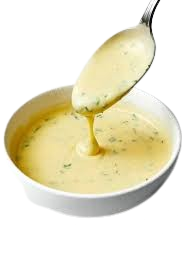
Bearnaise sauce is a classic French emulsion composed of clarified butter, egg yolks, white wine vinegar, and herbs like tarragon. The calories in Bearnaise sauce are substantial due to the high concentration of fat, with a 1 cup serving containing 938 calories, whereas a single tablespoon (14g) supplies 59 calories. Bearnaise sauce calories fluctuate based on the preparation method, as Traditional Bearnaise provides 545 calories per 100g, significantly higher than the 280 calories found in the Powdered Mix variety.
Bearnaise sauce nutrition facts reveal a profile rich in fats and essential micronutrients while lacking significant carbohydrates. A single tablespoon (14g) supplies essential micronutrients such as 57mcg of Vitamin A (6% DV) and 0.6mg of Vitamin C (1% DV), alongside 6.04g of total fat (8% DV) and 0g of dietary fiber (0% DV). The emulsion serves as a carrier for fat-soluble nutrients, delivering 0.11mg of iron (1% DV) and 7mg of calcium (1% DV). Research highlights the role of lipids in nutrient uptake, such as the study by Borel, P., et al. (2013), "Bioavailability of vitamin E in humans: an update," which demonstrates that dietary lipids enhance vitamin absorption. Common types include Traditional Bearnaise, Commercial Jarred Bearnaise, and Powdered Mix Bearnaise.
Due to the immense caloric density and saturated fat content, nutritionists recommend consuming this condiment in moderation. A sensible daily limit is one tablespoon (59 calories) of Bearnaise sauce. Burning the 59 calories from this condiment requires activities like 6 minutes of jogging, 8 minutes of cycling, or 15 minutes of brisk walking.
Bearnaise sauce appears exclusively in savory courses, particularly accompanying grilled meats and rich breakfast dishes. The sauce is essential for the Filet at Ruth's Chris Steak House and serves as the primary condiment for Steak Frites at Mon Ami Gabi. The blend also enriches the Smoked Salmon Benedict at Sarabeth's. The ingredient originated in France in 1836 under Chef Collinet and is primarily produced and consumed in the United States, the United Kingdom, and France. The price of the base ingredient has risen noticeably over the last two decades, with the Producer Price Index for butter increasing from 147.200 in 2015 to 205.768 in 2024.
Bearnaise Sauce nutrition
| Stats | Weight |
|---|---|
| Carbs | 2.8 grams |
| Protein | 5.3 grams |
| Fats | 0 grams |
| Sugars | 0.7 grams |
- Large Bearnaise Sauce Calories (Nutritional Facts)
- Medium Bearnaise Sauce Calories (Nutritional Facts)
- Small Bearnaise Sauce Calories (Nutritional Facts)
- Raw Bearnaise Sauce Nutrition
- Sodium in Bearnaise Sauce
- Potassium in Bearnaise Sauce
- Sugar in Bearnaise Sauce
- Fiber in Bearnaise Sauce
- Protein in Bearnaise Sauce
- Carbs in Bearnaise Sauce
- Fat in Bearnaise Sauce
- Vitamins in Bearnaise Sauce
- Minerals in Bearnaise Sauce
Large Bearnaise Sauce Calories (Nutritional Facts)
A large serving of Bearnaise Sauce (230g or 1 cup) contains 938 calories, 10.51g of protein, 96.87g of fat (124% DV), 5.53g of carbohydrates (2% DV), 0.3g of fiber (1% DV), 1.45g of sugar, and 1117mg of sodium (49% DV).
A medium portion of Bearnaise Sauce (115g or 0.5 cup) provides 469 calories, 5.3g of protein, 48.4g of fat (62% DV), 2.8g of carbohydrates (1% DV), 0.2g of fiber (1% DV), 0.7g of sugar, and 559mg of sodium (25% DV).
A small serving of Bearnaise Sauce (28g or 1 oz) contains 104 calories, 1.17g of protein, 10.77g of fat (14% DV), 0.62g of carbohydrates (0% DV), 0g of fiber (0% DV), 0.16g of sugar, and 124mg of sodium (5% DV).
A single tablespoon of Bearnaise Sauce (14g) contains 59 calories, 0.66g of protein, 6.04g of total fat (8% DV), 0.35g of total carbohydrate (0% DV), 0g of dietary fiber (0% DV), 0.09g of total sugars, and 70mg of sodium (3% DV). The fat provides 57mcg of Vitamin A (6% DV), 0.6mg of Vitamin C (1% DV), 0.11mg of iron (1% DV), 7mg of calcium (1% DV), and 10mg of potassium (0% DV).
A large serving of Bearnaise Sauce (230g or 1 cup) contains 1117mg of sodium (49% DV). A medium portion of Bearnaise Sauce (115g or 0.5 cup) has 559mg of sodium (25% DV). A small serving of Bearnaise Sauce (28g or 1 oz) contains 124mg of sodium (5% DV). A single tablespoon of Bearnaise Sauce (14g) provides 70mg of sodium (3% DV).
A large serving of Bearnaise Sauce (230g or 1 cup) provides 153mg of potassium (3% DV). A medium portion of Bearnaise Sauce (115g or 0.5 cup) has 77mg of potassium (2% DV). A small serving of Bearnaise Sauce (28g or 1 oz) contains 17mg of potassium (0% DV). A single tablespoon of Bearnaise Sauce (14g) supplies 10mg of potassium (0% DV).
A large serving of Bearnaise Sauce (230g or 1 cup) contains 1.45g of sugar. A medium portion of Bearnaise Sauce (115g or 0.5 cup) has 0.7g of sugar. A small serving of Bearnaise Sauce (28g or 1 oz) contains 0.16g of sugar. A single tablespoon of Bearnaise Sauce (14g) provides 0.09g of sugar.
A large serving of Bearnaise Sauce (230g or 1 cup) provides 0.3g of dietary fiber (1% DV). A medium portion of Bearnaise Sauce (115g or 0.5 cup) has 0.2g of fiber (1% DV). A small serving of Bearnaise Sauce (28g or 1 oz) contains 0g of fiber (0% DV). A single tablespoon of Bearnaise Sauce (14g) supplies 0g of fiber (0% DV).
A large serving of Bearnaise Sauce (230g or 1 cup) provides 10.51g of protein. A medium portion of Bearnaise Sauce (115g or 0.5 cup) has 5.3g of protein. A small serving of Bearnaise Sauce (28g or 1 oz) contains 1.17g of protein. A single tablespoon of Bearnaise Sauce (14g) supplies 0.66g of protein.
A large serving of Bearnaise Sauce (230g or 1 cup) contains 5.53g of carbohydrates (2% DV). A medium portion of Bearnaise Sauce (115g or 0.5 cup) has 2.8g of carbohydrates (1% DV). A small serving of Bearnaise Sauce (28g or 1 oz) contains 0.62g of carbohydrates (0% DV). A single tablespoon of Bearnaise Sauce (14g) provides 0.35g of carbohydrates (0% DV).
A large serving of Bearnaise Sauce (230g or 1 cup) contains 96.87g of total fat (124% DV). A medium portion of Bearnaise Sauce (115g or 0.5 cup) has 48.4g of total fat (62% DV). A small serving of Bearnaise Sauce (28g or 1 oz) contains 10.77g of total fat (14% DV). A single tablespoon of Bearnaise Sauce (14g) provides 6.04g of total fat (8% DV).
A large serving of Bearnaise Sauce (230g or 1 cup) provides 910mcg of Vitamin A (101% DV) and 9.9mg of Vitamin C (11% DV). A medium portion of Bearnaise Sauce (115g or 0.5 cup) has 455mcg of Vitamin A (51% DV) and 5mg of Vitamin C (6% DV). A small serving of Bearnaise Sauce (28g or 1 oz) contains 101mcg of Vitamin A (11% DV) and 1.1mg of Vitamin C (1% DV). A single tablespoon of Bearnaise Sauce (14g) supplies 57mcg of Vitamin A (6% DV) and 0.6mg of Vitamin C (1% DV).
A large serving of Bearnaise Sauce (230g or 1 cup) provides 107mg of calcium (8% DV) and 1.79mg of iron (10% DV). A medium portion of Bearnaise Sauce (115g or 0.5 cup) has 54mg of calcium (4% DV) and 0.9mg of iron (5% DV). A small serving of Bearnaise Sauce (28g or 1 oz) contains 12mg of calcium (1% DV) and 0.2mg of iron (1% DV). A single tablespoon of Bearnaise Sauce (14g) provides 7mg of calcium (1% DV) and 0.11mg of iron (1% DV).
Get a Custom Report on Bearnaise Sauce Nutrition Data – Contact Us!
What are the Types of Bearnaise Sauces?
The types of Bearnaise Sauces include Traditional Bearnaise, Commercial Jarred Bearnaise, and Powdered Mix Bearnaise. The table below outlines the nutritional differences.
| Type | Description | Calories (Per 100g) | Calorie Qualifications |
|---|---|---|---|
|
Traditional Bearnaise
|
Emulsion of clarified butter, egg yolks, white wine vinegar, and herbs. | 545 | The reliance on pure butter results in the highest energy density. |
|
Commercial Jarred Bearnaise
|
Ready-to-eat sauce often stabilized with starch and vegetable oils. | 300 | The substitution of water and thickeners for some fat reduces calories. |
|
Powdered Mix Bearnaise
|
Dry mix prepared with milk and a reduced amount of butter. | 280 | The use of milk instead of pure butter significantly lowers the fat load. |
What are Desserts With Bearnaise Sauce?
Bearnaise sauce functions exclusively as a savory condiment due to the vinegar and shallot reduction, rendering the product unsuitable for traditional sugary confectionery. The emulsion appears in rich savory pastries, breakfast dishes, and brunch courses that occupy a similar indulgent niche as desserts. Chefs utilize the sauce to top savory crepes, waffles, and croissants. The list below enumerates savory pastries and brunch items that utilize this dip as a key component.
| Dish Name | Calories | Type of Bearnaise Sauce | Carbs (g) | Sugar (g) | Protein (g) | Fat (g) | Cuisine | Restaurants |
|---|---|---|---|---|---|---|---|---|
|
Crab Cake Benedict
|
850 | Traditional Bearnaise | 45 | 4 | 35 | 60 | American | Ruth's Chris Steak House (National) |
|
Filet Mignon Benedict
|
920 | Traditional Bearnaise | 40 | 3 | 45 | 68 | American | The Cheesecake Factory (National) |
|
Smoked Salmon Benedict
|
780 | Traditional Bearnaise | 38 | 2 | 32 | 55 | French-American | Sarabeth's (New York, NY) |
|
Savory Steak Crepe
|
650 | Traditional Bearnaise | 35 | 4 | 28 | 45 | French | La Madeleine |
|
Lobster Benedict
|
890 | Traditional Bearnaise | 42 | 2 | 40 | 62 | American | The Capital Grille |
|
Savory Croissant
|
450 | Commercial Jarred Bearnaise | 28 | 3 | 12 | 32 | French | Bouchon Bakery (Las Vegas, NV) |
|
Breakfast Poutine
|
950 | Traditional Bearnaise | 55 | 2 | 25 | 70 | Canadian-American | Smoke's Poutinerie |
|
Savory Soufflé
|
320 | Traditional Bearnaise | 8 | 1 | 14 | 26 | French | Rise No. 1 (Dallas, TX) |
|
Steak and Egg Waffle
|
810 | Traditional Bearnaise | 48 | 5 | 38 | 52 | American | The Waffle (Los Angeles, CA) |
|
Short Rib Hash
|
760 | Traditional Bearnaise | 35 | 3 | 30 | 58 | American | First Watch |
|
Fried Green Tomato Benedict
|
720 | Traditional Bearnaise | 45 | 6 | 18 | 54 | Southern | Another Broken Egg Cafe |
|
Savory Danish
|
380 | Commercial Jarred Bearnaise | 32 | 8 | 6 | 24 | European | Ole & Steen (New York, NY) |
|
Eggs Blackstone
|
680 | Traditional Bearnaise | 30 | 2 | 22 | 52 | American | The Smith (New York, NY) |
|
California Benedict
|
640 | Traditional Bearnaise | 32 | 3 | 20 | 48 | American | Snooze, an A.M. Eatery (National) |
|
Savory Bread Pudding
|
550 | Traditional Bearnaise | 42 | 6 | 15 | 35 | American | Commander's Palace (New Orleans, LA) |
What are the Main Dishes With Bearnaise Sauce?
Bearnaise sauce serves as a quintessential accompaniment for grilled red meats and seafood, providing a creamy acidity that cuts through the richness of the protein. The emulsion accompanies steak cuts, poached eggs, and roasted vegetables to enhance the flavor profile. The list below details distinct savory recipes that incorporate this ingredient.
| Dish Name | Calories | Type of Bearnaise Sauce | Carbs (g) | Sugar (g) | Protein (g) | Fat (g) | Cuisine | Restaurants |
|---|---|---|---|---|---|---|---|---|
|
Filet Mignon
|
680 | Traditional Bearnaise | 2 | 0 | 48 | 52 | Steakhouse | Ruth's Chris Steak House (National) |
|
Steak Frites
|
850 | Traditional Bearnaise | 45 | 1 | 42 | 58 | French | Mon Ami Gabi (Las Vegas, NV) |
|
Chateaubriand
|
920 | Traditional Bearnaise | 4 | 0 | 55 | 75 | French-American | The Capital Grille |
|
Oscar Style Steak
|
880 | Traditional Bearnaise | 6 | 1 | 62 | 65 | Steakhouse | Fleming's Prime Steakhouse (National) |
|
Beef Wellington
|
1100 | Traditional Bearnaise | 35 | 2 | 45 | 85 | British | Gordon Ramsay Steak (Las Vegas, NV) |
|
Grilled Salmon
|
620 | Traditional Bearnaise | 2 | 0 | 40 | 48 | American | Seasons 52 |
|
Ribeye Steak
|
1250 | Traditional Bearnaise | 0 | 0 | 65 | 105 | Steakhouse | Morton's The Steakhouse |
|
Veal Chop
|
750 | Traditional Bearnaise | 0 | 0 | 52 | 58 | Italian-American | Sparks Steak House (New York, NY) |
|
Prime Rib
|
1150 | Traditional Bearnaise | 2 | 0 | 60 | 95 | American | Lawry's The Prime Rib (National) |
|
Lamb Chops
|
820 | Traditional Bearnaise | 1 | 0 | 45 | 68 | Steakhouse | The Palm |
|
Surf and Turf
|
950 | Traditional Bearnaise | 3 | 0 | 70 | 72 | American | Del Frisco's Double Eagle (National) |
|
Bearnaise Burger
|
980 | Commercial Jarred Bearnaise | 45 | 6 | 35 | 72 | American | Bobby's Burger Palace |
|
Asparagus with Bearnaise
|
280 | Traditional Bearnaise | 8 | 2 | 6 | 26 | American | Smith & Wollensky |
|
Poached Salmon
|
540 | Traditional Bearnaise | 2 | 0 | 38 | 40 | French | Le Bernardin (New York, NY) |
|
Porterhouse Steak
|
1450 | Traditional Bearnaise | 0 | 0 | 85 | 115 | Steakhouse | Peter Luger Steak House (New York, NY) |
What Cuisines Do Prefer Bearnaise Sauce Most?
French cuisine established Bearnaise sauce as a "Mother Sauce" derivative, while American steakhouses adopted the condiment as a standard pairing for beef. The emulsion appears in European continental dining and modern fusion establishments. The table below outlines the specific culinary traditions that utilize this dip.
| Cuisine | Dish | Types of Bearnaise Sauce | Calories (Estimate) | Restaurant(s) |
|---|---|---|---|---|
|
French Cuisine
|
Steak Frites | Traditional Bearnaise | 850 | Balthazar (New York, NY) |
|
American Steakhouse
|
Filet Oscar | Traditional Bearnaise | 880 | Ruth's Chris Steak House (National) |
|
British Cuisine
|
Beef Wellington | Traditional Bearnaise | 1100 | Gordon Ramsay Steak (Las Vegas, NV) |
|
Continental Cuisine
|
Chateaubriand | Traditional Bearnaise | 920 | The Capital Grille |
|
Belgian Cuisine
|
Steak with Fries | Traditional Bearnaise | 860 | BXL Cafe (New York, NY) |
|
New American
|
Bearnaise Burger | Commercial Jarred Bearnaise | 980 | Umami Burger |
|
Southern Cuisine
|
Crab Cake Benedict | Traditional Bearnaise | 850 | Commander's Palace (New Orleans, LA) |
|
Canadian Cuisine
|
Breakfast Poutine | Traditional Bearnaise | 950 | Smoke's Poutinerie |
|
Scandinavian Cuisine
|
Plankstek (Steak on Plank) | Traditional Bearnaise | 900 | Aquavit (New York, NY - Modern Interpretation) |
|
California Cuisine
|
Grilled Artichokes | Traditional Bearnaise | 320 | Houston's |
|
Italian-American
|
Veal Chop | Traditional Bearnaise | 750 | Carbone (New York, NY) |
|
Fusion Cuisine
|
Steak Sushi Roll | Commercial Jarred Bearnaise | 450 | Sushi Samba (Las Vegas, NV) |
|
Irish-American
|
Corned Beef Hash | Traditional Bearnaise | 720 | The Dead Rabbit (New York, NY) |
|
Australian Cuisine
|
Steak Sandwich | Commercial Jarred Bearnaise | 680 | Bluestone Lane |
|
Danish Cuisine
|
Roast Beef Smørrebrød | Traditional Bearnaise | 420 | Aamanns (Copenhagen/International) |
Which Countries Produce the Most Bearnaise Sauces?
The top producers of butter, which is the primary component of Bearnaise sauce, include India, the European Union, and the United States. India leads global output volumes due to the massive domestic dairy sector, though much of the production remains local. The European Union, specifically France and Germany, functions as a major exporter of high-quality cultured butter used in traditional French sauce preparation. The United States and New Zealand also contribute substantial volumes to the global supply chain, supporting the industrial production of jarred and powdered sauce mixes. The table below shows the production of butter in thousand metric tonnes for the top producing regions over the last two decades.
| Country/Region | 2004 | 2009 | 2014 | 2019 | 2020 | 2021 | 2022 | 2023 |
|---|---|---|---|---|---|---|---|---|
| India | 2,550 | 3,600 | 4,900 | 5,800 | 6,100 | 6,350 | 6,600 | 6,750 |
| European Union | 2,100 | 2,050 | 2,200 | 2,150 | 2,200 | 2,100 | 2,080 | 2,100 |
| United States | 570 | 710 | 850 | 900 | 960 | 930 | 945 | 960 |
| Pakistan | 560 | 620 | 700 | 760 | 780 | 800 | 820 | 840 |
| New Zealand | 450 | 470 | 510 | 515 | 510 | 505 | 495 | 500 |
| Germany | 420 | 440 | 480 | 495 | 515 | 500 | 485 | 490 |
| France | 400 | 410 | 430 | 405 | 400 | 395 | 390 | 395 |
| Russia | 270 | 250 | 240 | 270 | 275 | 280 | 285 | 290 |
Which Countries Consume the Most Bearnaise Sauces?
The top consumers of sauces and mixed condiments, the category encompassing prepared Bearnaise sauce, are the United States, the United Kingdom, and France. The United States absorbs the largest quantity of these products due to the prevalence of steakhouse dining and the demand for convenient, ready-to-eat emulsions. France maintains high consumption rates driven by the cultural staple of Steak Frites and the widespread use of the sauce in home cooking. The United Kingdom and Germany also represent significant markets for savory condiments and table sauces. The table below shows the import value of sauces and mixed condiments (HS Code 210390) in million USD for key markets over the last two decades.
| Country | 2004 | 2009 | 2014 | 2019 | 2020 | 2021 | 2022 | 2023 |
|---|---|---|---|---|---|---|---|---|
| United States | 650 | 920 | 1,400 | 1,850 | 2,050 | 2,400 | 2,800 | 2,950 |
| United Kingdom | 480 | 610 | 850 | 980 | 1,050 | 1,150 | 1,200 | 1,300 |
| France | 320 | 450 | 580 | 720 | 760 | 850 | 910 | 960 |
| Canada | 310 | 480 | 650 | 790 | 850 | 950 | 1,050 | 1,100 |
| Germany | 290 | 410 | 550 | 680 | 740 | 820 | 880 | 920 |
| Japan | 220 | 280 | 340 | 410 | 420 | 440 | 460 | 480 |
| Australia | 150 | 240 | 320 | 410 | 450 | 490 | 530 | 560 |
| Netherlands | 180 | 260 | 350 | 460 | 510 | 560 | 600 | 640 |
How Do Prices of Bearnaise Sauce-Including Dishes Change?
Restaurant costs for dishes accompanied by bearnaise sauce increased due to rising dairy, beef, and labor expenses. The table below illustrates price adjustments for selected items at well-known establishments.
| Brand/Restaurant | Dish | Old Price (Year) | Current Price (2024/2025) |
|---|---|---|---|
| Ruth's Chris Steak House | Filet (w/ Bearnaise) | $58.00 (2014) | $69.00 - $75.00 |
| The Capital Grille | Filet Mignon | $42.00 (2015) | $58.00 - $68.00 |
| Mon Ami Gabi | Steak Frites | $22.95 (2013) | $34.95 - $36.95 |
| Balthazar | Steak Frites | $28.00 (2012) | $41.00 - $49.00 |
| Sarabeth's | Smoked Salmon Benedict | $18.00 (2014) | $29.00 - $32.00 |
| Morton's The Steakhouse | Center-Cut Filet Mignon | $45.00 (2015) | $47.00 - $56.00 |
What is the Bearnaise Sauce Calorie for 100 Grams?
A 100g serving of Bearnaise Sauce provides 367 calories.
What is the Bearnaise Sauce Calorie for 1 KG?
One kilogram (1000g) of Bearnaise Sauce supplies 3670 calories.
What is the Calorie of 1 Bearnaise Sauce?
A single tablespoon of Bearnaise Sauce (14g) contains 59 calories, while a small serving (28g or 1 oz) provides 104 calories. Retail brands offer distinct energy profiles, as a serving of M&S Bearnaise sauce (100g) contains 300 calories. A serving of Wild Fork Bearnaise sauce (60 ml) provides 80 calories, whereas a serving of Waitrose Bearnaise sauce (100g) supplies 537 calories.
What are the Health Benefits of Bearnaise Sauce?
Bearnaise sauce functions as a source of essential lipids and micronutrients derived from egg yolks and herbs, supporting physiological systems when consumed in moderation. The lipid profile aids in the absorption of fat-soluble vitamins found in accompanying vegetables. The points below emphasize these specific health rewards.
- Improves Nutrient Absorption: The lipid matrix acts as a necessary carrier for fat-soluble vitamins A, D, E, and K, ensuring the body utilizes these micronutrients effectively. A study by Borel, P., et al. (2013), "Bioavailability of vitamin E in humans: an update," demonstrated that consuming lipids with fat-soluble vitamins substantially improves absorption rates.
- Supports Cognitive Function: Egg yolks provide choline, a nutrient essential for brain development and neurotransmitter synthesis. Research by Zeisel, S. H. (2006), "Choline: Critical Role During Fetal Development and Dietary Requirements," established that choline intake supports neural tube health and memory function.
- Provides Antioxidant Protection: Tarragon contains polyphenolic compounds that reduce oxidative stress and inflammation. A study by Obolskiy, D., et al. (2011), "Artemisia dracunculus L. (Tarragon): A Critical Review of Its Traditional Use, Chemical Composition, Pharmacology, and Safety," confirmed the antioxidant capacity of the herb.
What are the Downsides of Bearnaise Sauce?
Bearnaise sauce poses risks regarding saturated fat content and caloric density when consumed in excess. Nutritionists advise limiting intake to one tablespoon (14g) per day and choosing a yogurt-based herb sauce as a lower-fat alternative to mitigate potential risks. The table below shows specific negative health implications.
- Increases LDL Cholesterol: Excessive intake raises low-density lipoprotein levels due to the high saturated fat content in butter. Research by Sacks, F. M., et al. (2017), "Dietary Fats and Cardiovascular Disease: A Presidential Advisory from the American Heart Association," noted that reducing saturated fat intake lowers the risk of cardiovascular disease.
- Promotes Weight Gain: The high caloric density leads to a surplus of energy that the body stores as fat if not metabolized. A study by Swinburn, B. A., et al. (2009), "Increased food energy supply is more than sufficient to explain the US epidemic of obesity," identified high-energy-density foods as a major factor in weight management challenges.
- Elevates Sodium Intake: The preparation process involves adding salt, which contributes to hypertension. Research by Aburto, N. J., et al. (2013), "Effect of lower sodium intake on health: systematic review and meta-analyses," found that reducing sodium intake significantly lowers blood pressure and the risk of stroke.
Are Bearnaise Sauces Good for You?
Yes, Bearnaise sauces are good for health because the egg yolks provide essential nutrients like choline and the fats facilitate vitamin absorption, though consumption requires strict moderation. Brain health benefits from the presence of choline which supports neurotransmitter synthesis as explored by Zeisel, S. H. (2006), "Choline: Critical Role During Fetal Development and Dietary Requirements." Satiety signaling strengthens through the action of dietary lipids which trigger appetite-regulating hormones as confirmed by Maljaars, J., et al. (2009), "Effect of fat on satiety and regulation of food intake." Nutrient absorption enhances due to the lipid matrix enabling the uptake of fat-soluble vitamins A, D, E, and K as detailed in the study by Borel, P., et al. (2013), "Bioavailability of vitamin E in humans: an update."
How Does Calorie Change According to Bearnaise Sauce Types?
Energy values in Bearnaise sauce fluctuate based on the ratio of butter to liquid and the use of thickeners like starch. Traditional Bearnaise contains the highest energy load per 100g due to the reliance on pure butter and egg yolks as the primary volume. Commercial Jarred Bearnaise offers a reduced profile as manufacturers often substitute water, vinegar, and starch for a portion of the fat. Powdered Mix Bearnaise provides the lowest caloric density per serving if prepared with milk and a reduced amount of butter compared to the classic emulsion.
What is the Origin of Bearnaise Sauce?
Chef Collinet created Bearnaise sauce in 1836 at the Pavillon Henri IV restaurant located in Saint-Germain-en-Laye, France. The name honors King Henry IV, a native of the Béarn region, serving as a tribute to the monarch's local roots. The recipe evolved as a child sauce of Hollandaise, substituting lemon juice with a reduction of vinegar, shallots, tarragon, and chervil. French culinary tradition solidified the emulsion as a staple for steak and grilled meats during the 19th century. Global gastronomy later adopted the preparation as a standard accompaniment for beef tenderloin and eggs benedict.
Explore More Condiments & Sauces
Discover more Condiments & Sauces with detailed nutrition facts, calorie counts, vitamins, minerals, and health benefits. Compare similar foods, serving sizes, macronutrients, and key nutrients to find the best option for your diet and nutrition goals.
 Agave calories
 Aioli calories
 Apple Butter calories
 Avocado Oil calories
 Baking Powder calories
 Balsamic Vinaigrette calories
 Barbeque Sauce calories
 Blue Cheese Dressing calories
 Brown Rice Syrup calories
 Caesar Dressing calories
 Canola Oil calories
 Chili Oil calories