Calories and Nutritions in Duck Leg
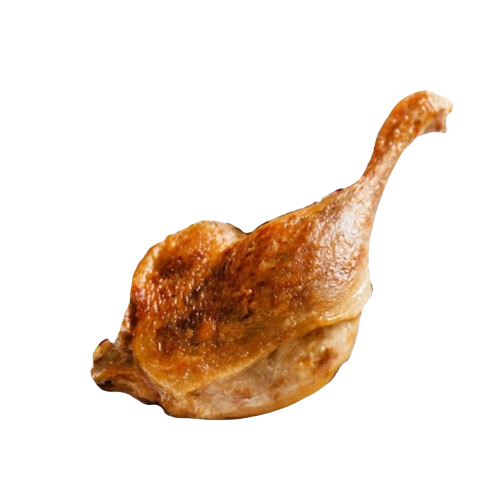
Duck leg is a calorie-dense meat prized for its high protein content. The calories in a duck leg are substantial, with a 100 gram (3.53 ounce) serving containing 295 calories. A small 150g leg has 443 calories, while a large 250g leg contains 738 calories along with 35.7g of protein (71% DV), 64.7g of fat (83% DV), and 190mg of cholesterol (63% DV). Brand-specific preparations differ, one D'Artagnan confit duck leg contains 390 calories and a Maple Leaf Farms roasted half duck portion has 480 calories.
Duck leg nutrition facts reveal a profile rich in complete protein. A study established that adequate protein intake is crucial for muscle protein synthesis and overall physical performance (Pasiakos, S. M., et al., 2015). Key health advantages come from this nutrient profile, including iron and selenium. A 100g serving provides 3.2mg of iron (18% DV) and 25.5mcg of selenium (46% DV), supporting energy production and immune function.
The main types of duck legs are Raw, Roasted, Confit, and Smoked. Top producers and consumers of duck meat include China and France. The price of duck legs has increased over the last 20 years, with the average wholesale price for whole duck rising from under $2.00 per pound to over $4.60 per pound in 2022.
Duck leg is a central component in classic dishes like Duck Confit at Balthazar and Cassoulet at Benoit. A recommended serving size is one small duck leg (150 grams), which provides 443 calories. The energy from this portion can be expended through 44 minutes of jogging or 58 minutes of cycling.
Duck Leg nutrition
| Stats | Weight |
|---|---|
| Carbs | 0 grams |
| Protein | 25.4 grams |
| Fats | 0 grams |
| Sugars | 0 grams |
- Large Duck Leg Calories (Nutritional Facts)
- Medium Duck Leg Calories (Nutritional Facts)
- Small Duck Leg Calories (Nutritional Facts)
- Smoked Duck Leg Calories (Nutritional Facts)
- Roasted Duck Leg Calories (Nutritional Facts)
- Sugar in Duck Leg
- Fiber in Duck Leg
- Protein in Duck Leg
- Carbs in Duck Leg
- Fat in Duck Leg
- Vitamins in Duck Leg
- Minerals in Duck Leg
Large Duck Leg Calories (Nutritional Facts)
A large duck leg (250g) contains 738 calories, 35.7g of protein, 64.7g of fat, 0g of carbohydrates, 190mg of cholesterol (63% DV), and 190mg of sodium (8% DV).
A medium duck leg (200g) contains 590 calories, 28.6g of protein, 51.8g of fat, 0g of carbohydrates, 152mg of cholesterol (51% DV), and 152mg of sodium (6% DV).
A small duck leg (150g) contains 443 calories, 21.4g of protein, 38.8g of fat, 0g of carbohydrates, 114mg of cholesterol (38% DV), and 114mg of sodium (5% DV).
A 268g serving of smoked duck leg contains 535 calories, 33g of total fat, 17g of total carbohydrates, and 15g of total sugars.
One roasted duck leg with the bone removed (92g) contains 200 calories, 25g of protein, 10g of fat, 0g of carbohydrates, 105mg of cholesterol (35% DV), and 101mg of sodium (4% DV).
A large duck leg (250g) contains 0g of sugar. A medium duck leg (200g) contains 0g of sugar. A small duck leg (150g) contains 0g of sugar. A 268g serving of smoked duck leg contains 15g of sugar. A roasted duck leg (92g) contains 0g of sugar.
A large duck leg (250g) contains 0g of fiber (0% DV). A medium duck leg (200g) contains 0g of fiber (0% DV). A small duck leg (150g) contains 0g of fiber (0% DV). A 268g serving of smoked duck leg contains 2g of fiber (7% DV). A roasted duck leg (92g) contains 0g of fiber.
A large duck leg (250g) provides 35.7g of protein (71% DV). A medium duck leg (200g) provides 28.6g of protein (57% DV). A small duck leg (150g) provides 21.4g of protein (43% DV). One roasted duck leg (92g) provides 25g of protein.
A large duck leg (250g) contains 0g of carbohydrates (0% DV). A medium duck leg (200g) contains 0g of carbohydrates (0% DV). A small duck leg (150g) contains 0g of carbohydrates (0% DV). A 268g serving of smoked duck leg contains 17g of carbohydrates (6% DV). A roasted duck leg (92g) contains 0g of carbohydrates (0% DV).
A large duck leg (250g) contains 64.7g of total fat (83% DV), which includes 17.9g of saturated fat (89% DV). A medium duck leg (200g) contains 51.8g of total fat (66% DV), with 14.3g of saturated fat (71% DV). A small duck leg (150g) contains 38.8g of total fat (50% DV), including 10.7g of saturated fat (54% DV). A 268g serving of smoked duck leg contains 33g of total fat (42% DV), with 9.4g of saturated fat (47% DV). One roasted duck leg (92g) contains 10g of total fat (13% DV), including 3g of saturated fat (14% DV).
A large duck leg (250g) provides 670IU of Vitamin A and 0mg of Vitamin C (0% DV). A medium duck leg (200g) provides 536IU of Vitamin A and 0mg of Vitamin C (0% DV). A small duck leg (150g) provides 0mg of Vitamin C (0% DV). One roasted duck leg (92g) provides 5mg of Niacin (33% DV), 1mg of Vitamin C (2% DV), and 20mcg of Selenium (36% DV).
A large duck leg (250g) contains 2.4mg of iron (13% DV), 190mg of sodium (8% DV), and 0mg of calcium (0% DV). A medium duck leg (200g) contains 1.9mg of iron (11% DV), 152mg of sodium (6% DV), and 0mg of calcium (0% DV). A small duck leg (150g) contains 1.4mg of iron (8% DV), 114mg of sodium (5% DV), and 0mg of calcium (0% DV). One roasted duck leg (92g) contains 2mg of iron (24% DV), 9mg of calcium (1% DV), 20mcg of selenium (36% DV), and 101mg of sodium (4% DV).
Get a Custom Report on Duck Leg Nutrition Data – Contact Us!
What are the Types of Duck Legs?
The types of duck legs are Raw, Roasted, Confit, and Smoked. These preparations are distinguished by cooking methods that alter the texture, flavor, and nutritional profile. All duck legs are defined by a rich, dark meat composition. The table below describes the features of common preparations.
| Type | Description | Calories (Approximate per 100g) | Calorie Qualifications |
|---|---|---|---|
|
Raw Duck Leg
|
Uncooked duck leg with skin and bone intact. Serves as the base for other preparations. | 327 | The baseline calorie count before cooking, which alters water and fat content. |
|
Roasted Duck Leg
|
Duck leg cooked with dry heat in an oven, rendering some fat and crisping the skin. | 394 | The cooking process causes water to evaporate, concentrating nutrients and calories per gram. |
|
Confit Duck Leg
|
Duck leg slow-cooked and preserved in its own rendered fat. | 420 | Cooking and storing the leg in duck fat significantly increases the total fat and calorie content. |
|
Smoked Duck Leg
|
Duck leg that has been cured and then cooked with smoke, often with added sugars or flavorings in the cure. | 350 | The curing and smoking process adds flavor and can involve brines that alter the final composition and calorie count. |
What are the Main Dishes With Duck Leg?
Duck leg is a central ingredient in numerous savory dishes worldwide, prized for a rich flavor and tender texture when slow-cooked. Main dishes that use duck leg are described in the table that follows.
| Dish Name | Calories (Estimate) | Type of Cream | Carbs (g) (Estimate) | Sugar (g) (Estimate) | Protein (g) (Estimate) | Fat (g) (Estimate) | Cuisine | Restaurants |
|---|---|---|---|---|---|---|---|---|
|
Duck Confit
|
850 | Duck Leg | 10 | 2 | 55 | 68 | French | Balthazar (New York, NY) |
|
Cassoulet
|
950 | Duck Leg | 70 | 8 | 60 | 55 | French | L'Express (New York, NY) |
|
Roasted Duck Leg with Potatoes
|
780 | Duck Leg | 45 | 5 | 50 | 52 | French Bistro | Raoul's (New York, NY) |
|
Duck Leg Curry
|
820 | Duck Leg | 35 | 10 | 48 | 60 | Thai | Zabb Elee (New York, NY) |
|
Peking Duck Leg
|
650 | Duck Leg | 15 | 10 | 40 | 48 | Chinese | Duck House Chinese Restaurant (Portland, OR) |
|
Duck Leg a l'Orange
|
750 | Duck Leg | 30 | 25 | 45 | 50 | French | Daniel (New York, NY) |
|
Duck Leg Barbacoa Tacos
|
680 | Duck Leg | 40 | 4 | 42 | 45 | Mexican | Cosme (New York, NY) |
|
Smoked Duck Leg with Grits
|
790 | Duck Leg | 50 | 6 | 45 | 54 | Southern American | Commander's Palace (New Orleans, LA) |
|
Duck Leg and Waffles
|
900 | Duck Leg | 80 | 20 | 40 | 50 | American Soul Food | Yardbird Southern Table & Bar (Las Vegas, NV) |
|
Duck Leg Pho
|
650 | Duck Leg | 60 | 8 | 45 | 25 | Vietnamese | Slanted Door (San Francisco, CA) |
|
Duck Leg Risotto
|
880 | Duck Leg | 75 | 5 | 50 | 50 | Italian | Marea (New York, NY) |
|
Braised Duck Leg with Lentils
|
760 | Duck Leg | 40 | 7 | 52 | 48 | French Country | Le Gigot (New York, NY) |
|
Duck Leg Ragu with Pappardelle
|
840 | Duck Leg | 80 | 12 | 45 | 42 | Italian | L'Artusi (New York, NY) |
What Cuisines Prefer Duck Legs the Most?
Duck leg is a favored ingredient in culinary traditions that value rich, flavorful meats, especially within French and Chinese cooking. The table below details cuisines making prominent use of duck leg.
| Cuisine | Dish | Types of Duck Leg Used | Calories (Estimate) | Restaurant(s) |
|---|---|---|---|---|
|
French
|
Duck Confit | Confit Duck Leg | 800-950 | Balthazar (New York, NY) |
|
French
|
Cassoulet | Confit Duck Leg | 900-1100 | Benoit (New York, NY) |
|
Chinese
|
Peking Duck | Roasted Duck Leg | 600-750 | Peking Gourmet Inn (Falls Church, VA) |
|
French Bistro
|
Roasted Duck Leg with Potatoes | Roasted Duck Leg | 750-900 | Mon Ami Gabi (Las Vegas, NV) |
|
Thai
|
Red Curry with Duck | Braised Duck Leg | 750-900 | Lotus of Siam (Las Vegas, NV) |
|
Vietnamese
|
Duck Leg Pho (Vịt tiềm) | Braised Duck Leg | 600-750 | Pho Grand (New York, NY) |
|
Modern American
|
Pan-Seared Duck Breast | Seared Duck Leg | 700-850 | The French Laundry (Yountville, CA) |
|
Southern American
|
Smoked Duck with Grits | Smoked Duck Leg | 750-900 | Husk (Charleston, SC) |
|
Italian
|
Duck Ragu with Pasta | Braised Duck Leg | 800-950 | Babbo (New York, NY) |
|
Mexican (Haute)
|
Duck Carnitas | Confit-style Duck Leg | 650-800 | Pujol (Mexico City) / Cosme (New York, NY) |
|
British Gastropub
|
Duck Shepherd's Pie | Braised Duck Leg | 850-1000 | The Dandelion (Philadelphia, PA) |
Which Countries Produce the Most Duck Legs?
The top producers of duck meat are China, Vietnam, and France. Specific data for "duck legs" is not tracked separately; production is included within the broader "duck meat" category. The table below shows the production quantity of duck meat in key countries.
| Country | 2003 | 2008 | 2013 | 2018 | 2019 | 2020 | 2021 | 2022 |
|---|---|---|---|---|---|---|---|---|
| China | 2,950,000 | 3,500,000 | 4,200,000 | 4,600,000 | 4,750,000 | 4,800,000 | 4,850,000 | 4,900,000 |
| Vietnam | 110,000 | 150,000 | 200,000 | 250,000 | 260,000 | 270,000 | 280,000 | 290,000 |
| France | 233,000 | 240,000 | 250,000 | 220,000 | 210,000 | 200,000 | 190,000 | 180,000 |
| Myanmar | 80,000 | 95,000 | 110,000 | 130,000 | 135,000 | 140,000 | 145,000 | 150,000 |
| United States | 65,000 | 70,000 | 75,000 | 80,000 | 82,000 | 84,000 | 86,000 | 88,000 |
Which Countries Consume the Most Duck Legs?
The top consumers of duck meat are China, France, and Vietnam. These countries have strong culinary traditions that feature duck meat. Consumption data is represented by domestic disappearance, which accounts for production, imports, and exports.
| Country | 2013 | 2015 | 2017 | 2019 | 2020 | 2021 | 2022 |
|---|---|---|---|---|---|---|---|
| China | 4,150,000 | 4,300,000 | 4,450,000 | 4,700,000 | 4,750,000 | 4,800,000 | 4,850,000 |
| France | 245,000 | 240,000 | 230,000 | 205,000 | 195,000 | 185,000 | 175,000 |
| Vietnam | 195,000 | 210,000 | 230,000 | 255,000 | 265,000 | 275,000 | 285,000 |
| Myanmar | 108,000 | 115,000 | 122,000 | 133,000 | 138,000 | 143,000 | 148,000 |
| Germany | 85,000 | 88,000 | 90,000 | 92,000 | 94,000 | 95,000 | 96,000 |
How Do Prices of Duck Leg-Including Dishes Change?
Restaurant menu costs for dishes with duck leg have increased over the last ten years. The rise in price reflects higher wholesale duck meat costs and greater expenses for labor and restaurant operations. Classic French and American dining establishments show these price adjustments on menus.
| Restaurant | Dish | Old Price (Year) | Current Price (2024/2025) |
|---|---|---|---|
| Balthazar (New York, NY) | Duck Confit | $28.00 (2015) | $41.00 - $45.00 |
| The Dandelion (Philadelphia, PA) | Duck Shepherd's Pie | $22.00 (2016) | $23.00 - $32.00 |
| Le Diplomate (Washington, D.C.) | Duck Confit | $29.00 (2016) | $38.00 - $40.00 |
What is the Duck Leg Calorie for 100 Grams?
A 100g serving of duck leg contains 295 calories. A 100g serving of roasted duck leg contains 217 calories. A 100g serving of smoked duck leg contains 200 calories.
What is the Duck Leg Calorie for 1 KG?
One kilogram (1000g) of duck leg contains 2950 calories. One kilogram of roasted duck leg contains 2170 calories. One kilogram of smoked duck leg contains 2000 calories.
What is the Calorie of 1 Duck Leg?
One medium roasted duck leg (200g) contains 788 calories. One Maple Leaf Farms Roasted Half Duck leg portion contains 480 calories. One D'Artagnan confit duck leg contains 390 calories.
What are the Health Benefits of Duck Leg?
Duck leg provides specific health advantages due to a dense concentration of essential nutrients that support bodily functions, from muscle maintenance to immune defense. The main benefits of duck legs are described below.
- Muscle Repair and Growth. Duck legs supply high-quality protein, which is fundamental for building and maintaining tissues. The complete amino acid profile in duck meat supports these processes effectively. A study by Pasiakos, S. M., et al. (2015), "The effects of protein supplements on muscle mass, strength, and aerobic and anaerobic power in healthy adults: a systematic review," established that adequate protein intake is crucial for muscle protein synthesis and overall physical performance.
- Energy Production. Duck leg delivers a rich source of heme iron for energy production and oxygen transport. This type of iron is highly bioavailable, meaning the body can absorb and utilize the iron efficiently to prevent conditions like iron-deficiency anemia. A review by Abbaspour, N., et al. (2014), "Review on iron and its importance for human health," confirmed the critical role of dietary heme iron from animal sources in maintaining healthy hemoglobin levels and supporting metabolic energy.
- Immune Support. Duck legs contain selenium, a powerful antioxidant that supports immune function. Selenium is a vital component of enzymes involved in protecting cells from oxidative damage and regulating immune responses. A study by Hoffmann, P. R., & Berry, M. J. (2008), "The influence of selenium on immune responses," demonstrated that selenium status is a key factor in the strength of the body's immune system and its ability to respond to infections.
What are the Downsides of Duck Leg?
Duck leg is a calorie-dense food with a high content of saturated fat, which may pose health risks for some individuals if consumed in large quantities. Potential concerns associated with duck leg are listed below.
- High Saturated Fat Content. Duck leg contains high levels of saturated fat, which is linked to cardiovascular risk. A 100-gram serving of roasted duck leg with skin contains over 10 grams of saturated fat, and elevated intake is associated with increased LDL cholesterol levels. A scientific advisory from the American Heart Association by Sacks, F. M., et al. (2017), "Dietary Fats and Cardiovascular Disease," recommended reducing saturated fat intake to lower the risk of cardiovascular disease. An alternative with lower fat is a roasted chicken leg without the skin. A daily suggested amount is one small duck leg (150g) to manage saturated fat consumption.
- Potential Weight Gain. Duck leg is high in calories, which can lead to weight gain if consumed excessively. A medium 200-gram roasted duck leg contains 590 calories, making portion control important for weight management. Research by Swinburn, B.A., et al. (2011), "The global obesity pandemic: shaped by global drivers and local environments," confirmed that increased consumption of energy-dense foods is a major driver of rising obesity rates. A lower-calorie alternative is a baked cod fillet. A suggested serving size is one small leg (150g) to control calorie intake.
Are Duck Legs Good for You?
Yes, duck legs are a good food choice when eaten in moderation as part of a balanced diet because of the provision of high-quality protein, essential minerals, and B vitamins. The nutritional composition supports muscle health through a rich supply of complete protein, which provides all the essential amino acids necessary for tissue repair and maintenance, as detailed in a review by Wolfe, R. R. (2017), "Branched-chain amino acids and muscle protein synthesis in humans: myth or reality?". Duck leg's nutrient profile also supports metabolic health. The presence of B vitamins, particularly niacin, is vital for converting food into energy and supporting nervous system function, a process explained in a study by Kirkland, J. B. (2012), "Niacin requirements for genomic stability." The energy density and mineral content of duck leg aid immune function. The high concentration of selenium provides antioxidant protection and supports a robust immune response, as outlined in research by Avery, J. C., & Hoffmann, P. R. (2018), "Selenium, Selenoproteins, and Immunity."
How Do Calories Change According to Duck Leg Types?
The calorie content of duck leg changes based on the cooking method, which affects the final concentration of fat and water. The lowest calorie count for the preparations listed is 327 calories per 100 grams for a Raw Duck Leg. This value represents the baseline before any cooking process alters the composition. The highest calorie count is found in Confit Duck Leg, which has 420 calories per 100 grams. This substantial increase is due to the slow-cooking method where the leg is submerged and preserved in duck fat, causing the meat to absorb additional fat and become far more energy-dense than other preparations. Roasted Duck Leg has a higher calorie count than raw duck leg because the dry heat cooking process reduces the water content, concentrating the fat and protein per gram.
What is the Difference in Nutritional Value Between Duck Leg and Chicken Leg?
The primary nutritional difference between a duck leg and a chicken leg is the higher calorie and fat content in the duck leg. A 100g serving of roasted duck leg with skin contains 394 calories and 30g of fat, while a 100g serving of a roasted chicken leg with skin contains 215 calories and 13g of fat. Duck leg also provides more protein per serving, with 28.5g per 100g compared to the 23g of protein found in a chicken leg. In terms of minerals, duck leg offers a higher concentration of certain nutrients; a 100g serving delivers 3.2mg of iron (18% DV) and 25.5mcg of selenium (46% DV), whereas the same portion of chicken leg provides 1.2mg of iron (7% DV) and 21.6mcg of selenium (39% DV). The richer, darker meat of the duck leg contains more myoglobin, which contributes to its higher iron content.
What are the Desserts With Duck Leg?
Duck leg is a savory meat and is not used as an ingredient in dessert preparations. The rich, gamey flavor profile of the meat does not lend itself to sweet dishes. Culinary traditions instead pair duck leg with sweet elements in savory main courses to create a flavor balance.
What is the Origin of Duck Leg?
The origin of duck leg as a culinary staple is deeply rooted in French peasant cooking, particularly in the Gascony region of southwest France. The practice of preserving meat was a necessity before refrigeration, leading to the development of confit. Duck Confit, the method of salt-curing a duck leg and then cooking the leg slowly in its own rendered fat, dates back centuries as a way to store meat for winter. This preservation technique transformed a tough cut of meat into a tender, flavorful delicacy. The dish became a cornerstone of French cuisine, celebrated for a rich taste and succulent texture. The history of the dish is tied to the agricultural landscape of Gascony, a region known for raising ducks and geese for foie gras. The legs were a valuable byproduct that required a method of preservation. Over time, Duck Confit transitioned from a rustic necessity to a bistro classic, featured on menus worldwide. Other cultures also have long histories with duck; Peking Duck from China, for example, has imperial origins dating back to the Yuan Dynasty in the 13th century, where the whole duck, including the leg, was roasted to achieve a crispy skin and served as a royal delicacy.
Explore More Meat
Discover more Meat with detailed nutrition facts, calorie counts, vitamins, minerals, and health benefits. Compare similar foods, serving sizes, macronutrients, and key nutrients to find the best option for your diet and nutrition goals.
 Bacon calories
 Beef calories
 Beef Brisket calories
 Beef Chuck calories
 Beef Jerky calories
 Beef Liver calories
 Beef Short Ribs calories
 Beef Tenderloin calories
 Beef Tongue calories
 Bison calories
 Buffalo Meat calories
 Chicken calories