Calories and Nutritions in Foie gras
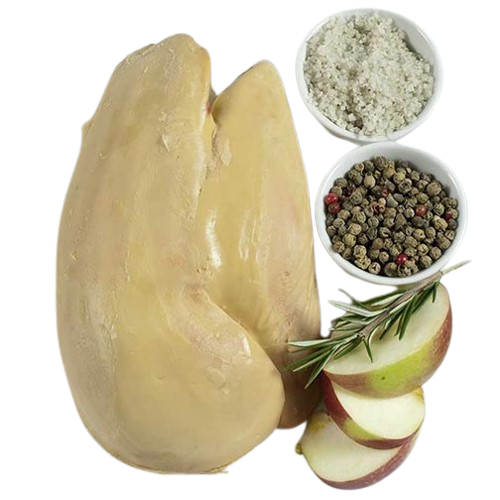
Foie gras is a luxury food product derived from the liver of a duck or goose, and served in fine dining restaurants. A single slice of foie gras (30g) contains 139 calories. Canned smoked pate varies in energy content based on portion size, with a small serving (13g) containing 60 calories. Pan-seared foie gras contains 462 calories per 100g, while raw foie gras provides 411 calories for the same weight. A standard 100g portion of canned smoked foie gras pate has 462 calories. A serving of Rougié Bloc of Duck Foie Gras (40g) has 190 calories, and Hudson Valley Foie Gras Mousse (56g) contains 260 calories.
An evaluation of foie gras nutrition facts highlights a food rich in monounsaturated fats and essential vitamins. A large serving of cooked foie gras (100g) supplies 4.7g of carbohydrates, alongside 11.4g of protein and 43.8g of fat. Liver in duck and goose is notable for its vitamin density, delivering 1001mcg of Vitamin A (111% DV) and 9.4mcg of Vitamin B12 (392% DV) per 100g serving. Mineral content is also significant, offering 5.5mg of iron (31% DV) and 44mcg of selenium (80% DV). Choline is present in substantial amounts, with a cooked serving providing 330mg to support liver and brain function. This high lipid concentration results in a unique physical property where the fat begins to liquefy between 30°C and 40°C.
International supply of foie gras depends on specialized poultry farming, with France leading production, yielding over 14,000 tonnes annually. This output meets substantial demand in major markets, where Japan imported significant quantities of fatty livers in 2022. Foie gras serves as a core component in at least three distinct cooking styles, including French Terrines, Hungarian Libamáj, and Japanese Donburi. Rising feed costs and animal welfare regulations have driven retail prices upward, with a pound of fresh Grade A liver increasing from under $40.00 in the early 2000s to over $70.00 after 2020. Menu prices reflect this trend, as a Foie Gras Terrine at Bouchon moved from $28.00 in 2015 to between $42.00 and $48.50 in 2024.
Foie gras is considered a delicacy with a high concentration of Vitamin B12 and monounsaturated fats. Nutritionists advise consuming foie gras on rare occasions, such as once a month. A large serving of foie gras contains 462 calories, which necessitates 47 minutes of running or 59 minutes of swimming to burn. People with concerns about amyloidosis should limit intake to minimize potential risks.
Foie gras nutrition
| Stats | Weight |
|---|---|
| Carbs | 1.4 grams |
| Protein | 3.5 grams |
| Fats | 0 grams |
| Sugars | 0 grams |
- Large Foie Gras Calories (Nutritional Facts)
- Medium Foie Gras Calories (Nutritional Facts)
- Small Foie Gras Calories (Nutritional Facts)
- Cooked Foie Gras Calories (Nutritional Facts)
- Raw Foie Gras Nutrition
- Choline in Foie Gras
- Sodium in Foie Gras
- Potassium in Foie Gras
- Sugar in Foie Gras
- Fiber in Foie Gras
- Protein in Foie Gras
- Carbs in Foie Gras
- Fat in Foie Gras
- Vitamins in Foie Gras
- Minerals in Foie Gras
Large Foie Gras Calories (Nutritional Facts)
A large serving of canned smoked foie gras pate (60g or 2.1oz) contains 277 calories, 6.9g of protein, 26.3g of fat, 2.8g of carbohydrates, 0g of fiber, and 418mg of sodium.
A medium serving of canned smoked foie gras pate (30g or 1oz) provides 138 calories, 3.5g of protein, 13.2g of fat, 1.4g of carbohydrates, 0g of fiber, and 209mg of sodium.
A small serving of canned smoked foie gras pate (13g or 1 tbsp) contains 60 calories, 1.5g of protein, 5.7g of fat, 0.6g of carbohydrates, 0g of fiber, and 91mg of sodium.
A serving of pan-seared foie gras (100g or 3.5oz) contains 462 calories, 11.4g of protein, 43.8g of fat, 4.7g of carbohydrates, 0g of fiber, 0g of sugar, and 697mg of sodium. The searing process renders some fat, but the calorie density remains high due to the low moisture content.
A serving of raw foie gras (100g or 3.5oz) contains 411 calories, 15g of protein, 39g of fat, 0g of carbohydrates, 0g of fiber, 0g of sugar, and 70mg of sodium.
A large serving of canned foie gras pate (60g) provides 160mg of choline. A medium serving of canned foie gras pate (30g) has 80mg of choline. A small serving of canned foie gras pate (13g) contains 35mg of choline. A serving of cooked foie gras (100g) contains 330mg of choline. A serving of raw foie gras (100g) provides 270mg of choline.
A large serving of canned foie gras pate (60g) contains 418mg of sodium (18% DV). A medium serving of canned foie gras pate (30g) has 209mg of sodium (9% DV). A small serving of canned foie gras pate (13g) contains 91mg of sodium (4% DV). A serving of cooked foie gras (100g) contains 697mg of sodium (30% DV). A serving of raw foie gras (100g) provides 70mg of sodium (3% DV).
A large serving of canned foie gras pate (60g) contains 83mg of potassium (2% DV). A medium serving of canned foie gras pate (30g) has 41mg of potassium (1% DV). A small serving of canned foie gras pate (13g) contains 18mg of potassium (0% DV). A serving of cooked foie gras (100g) contains 138mg of potassium (3% DV). A serving of raw foie gras (100g) provides 138mg of potassium (3% DV).
A large serving of canned foie gras pate (60g) contains 0g of sugar. A medium serving of canned foie gras pate (30g) has 0g of sugar. A small serving of canned foie gras pate (13g) contains 0g of sugar. A serving of cooked foie gras (100g) contains 0g of sugar. A serving of raw foie gras (100g) provides 0g of sugar.
A large serving of canned foie gras pate (60g) provides 0g of dietary fiber (0% DV). A medium serving of canned foie gras pate (30g) has 0g of fiber (0% DV). A small serving of canned foie gras pate (13g) contains 0g of fiber (0% DV). A serving of cooked foie gras (100g) contains 0g of fiber (0% DV). A serving of raw foie gras (100g) provides 0g of fiber (0% DV).
A large serving of canned foie gras pate (60g) provides 6.9g of protein (14% DV). A medium serving of canned foie gras pate (30g) has 3.5g of protein (7% DV). A small serving of canned foie gras pate (13g) contains 1.5g of protein (3% DV). A serving of cooked foie gras (100g) contains 11.4g of protein (23% DV). A serving of raw foie gras (100g) provides 15g of protein (30% DV).
A large serving of canned foie gras pate (60g) contains 2.8g of carbohydrates (1% DV). A medium serving of canned foie gras pate (30g) has 1.4g of carbohydrates (0% DV). A small serving of canned foie gras pate (13g) contains 0.6g of carbohydrates (0% DV). A serving of cooked foie gras (100g) contains 4.7g of carbohydrates (2% DV). A serving of raw foie gras (100g) provides 0g of carbohydrates (0% DV).
A large serving of canned foie gras pate (60g) contains 26.3g of total fat (34% DV). A medium serving of canned foie gras pate (30g) has 13.2g of total fat (17% DV). A small serving of canned foie gras pate (13g) contains 5.7g of total fat (7% DV). A serving of cooked foie gras (100g) contains 43.8g of total fat (56% DV). A serving of raw foie gras (100g) provides 39g of total fat (50% DV).
A large serving of canned foie gras pate (60g) provides 1.2mg of Vitamin C (1% DV). A medium serving of canned foie gras pate (30g) has 0.6mg of Vitamin C (1% DV). A small serving of canned foie gras pate (13g) contains 0.3mg of Vitamin C (0% DV). A serving of cooked foie gras (100g) contains 1001mcg of Vitamin A (111% DV). A serving of raw foie gras (100g) provides 1001mcg of Vitamin A (111% DV).
A large serving of canned foie gras pate (60g) provides 3.3mg of iron (18% DV) and 42mg of calcium (3% DV). A medium serving of canned foie gras pate (30g) has 1.7mg of iron (9% DV) and 21mg of calcium (2% DV). A small serving of canned foie gras pate (13g) contains 0.7mg of iron (4% DV) and 9mg of calcium (1% DV). A serving of cooked foie gras (100g) contains 5.5mg of iron (31% DV). A serving of raw foie gras (100g) provides 5.5mg of iron (31% DV).
Get a Custom Report on Foie gras Nutrition Data – Contact Us!
What are the Types of Foie Gras?
The types of foie gras are Goose (Oie) and Duck (Canard), further categorized by the processing grade such as Entier, Bloc, and Mousse. These variations are distinguished by the animal source and the texture of the final product. Distinctions between these varieties are detailed below.
| Type | Description | Calories (Approximate per 100g) | Calorie Qualifications |
|---|---|---|---|
|
Foie Gras d'Oie (Goose)
|
Liver from a goose, known for a delicate, subtle flavor and pinkish color. | 462 | The standard calorie count reflects the high fat content of the whole lobe. |
|
Foie Gras de Canard (Duck)
|
Liver from a duck, known for a rustic, musky flavor and beige-orange color. | 450 | The nutritional profile is similar to goose, with slight variations in lipid composition. |
|
Bloc de Foie Gras
|
Reconstituted liver made by compressing smaller pieces together. | 440 | The processing may involve a slight reduction in fat density compared to the whole lobe. |
|
Mousse de Foie Gras
|
An emulsion of liver and other fats, often spreadable. | 390 | The addition of water or other ingredients reduces the calorie density per gram. |
What are Main Dishes With Foie Gras?
Foie gras serves as a centerpiece protein or a luxurious topping in steak and poultry dishes across French and fine dining cuisines. The liver's melting texture provides a rich contrast to lean meats. Savory entrees incorporating the ingredient are listed here.
| Dish Name | Calories (Estimate per serving) | Type of Dish | Carbs (g) (Estimate) | Sugar (g) (Estimate) | Protein (g) (Estimate) | Fat (g) (Estimate) | Cuisine | Restaurants |
|---|---|---|---|---|---|---|---|---|
|
Pan-Seared Foie Gras
|
550 | Appetizer/Main | 15 | 8 | 12 | 48 | French | Le Bernardin (New York, NY) |
|
Tournedos Rossini
|
850 | Steak Entree | 25 | 2 | 55 | 60 | French | La Grenouille (New York, NY) |
|
Foie Gras Terrine
|
450 | Cold Appetizer | 8 | 2 | 10 | 42 | French | The French Laundry (Yountville, CA) |
|
Foie Gras Burger
|
950 | Burger | 45 | 6 | 40 | 70 | American Fusion | Burger & Lobster (New York, NY) |
|
Pâté de Foie Gras
|
380 | Spread | 5 | 1 | 12 | 35 | French | Les Halles (New York, NY) |
|
Foie Gras Stuffed Quail
|
600 | Poultry Entree | 10 | 2 | 35 | 45 | French | Daniel (New York, NY) |
|
Beef Wellington with Foie Gras
|
900 | Meat Entree | 35 | 2 | 45 | 65 | British/French | Gordon Ramsay Steak (Las Vegas, NV) |
|
Foie Gras Sushi (Nigiri)
|
180 | Sushi | 15 | 2 | 4 | 12 | Japanese Fusion | Sushi of Gari (New York, NY) |
|
Poutine with Foie Gras
|
1200 | Potato Dish | 85 | 4 | 25 | 80 | Canadian | Au Pied de Cochon (Montreal/Global) |
|
Pasta with Foie Gras Cream
|
750 | Pasta | 65 | 3 | 18 | 45 | Italian Fusion | Marea (New York, NY) |
What are Desserts With Foie Gras?
Foie gras appears in avant-garde and high-end French desserts, utilizing the liver's rich, buttery texture to complement sweet elements like fruit and chocolate. Sweet preparations utilizing this ingredient include the following dishes.
| Dish Name | Calories (Estimate per serving) | Type of Dessert | Carbs (g) (Estimate) | Sugar (g) (Estimate) | Protein (g) (Estimate) | Fat (g) (Estimate) | Cuisine | Restaurants |
|---|---|---|---|---|---|---|---|---|
|
Foie Gras Macaron
|
180 | Pastry | 15 | 12 | 3 | 10 | French Fusion | Pierre Hermé (Paris/Global) |
|
Foie Gras Crème Brûlée
|
450 | Custard | 25 | 20 | 8 | 35 | French | Le Comptoir (Los Angeles, CA) |
|
Foie Gras Ice Cream
|
280 | Frozen Dessert | 22 | 18 | 5 | 20 | Experimental | OddFellows (New York, NY) |
|
Chocolate Foie Gras Truffle
|
150 | Confection | 12 | 10 | 2 | 10 | Fusion | Vosges Haut-Chocolat (Retail) |
|
Foie Gras with Roasted Figs
|
350 | Fruit Dish | 30 | 25 | 8 | 22 | French | The Modern (New York, NY) |
|
Foie Gras Cotton Candy
|
120 | Confection | 28 | 28 | 1 | 2 | Modernist | Bazaar Meat (Las Vegas, NV) |
|
Pain Perdu with Foie Gras
|
550 | Sweet Breakfast | 45 | 20 | 12 | 35 | French | Balthazar (New York, NY) |
|
Foie Gras Profiteroles
|
320 | Pastry | 25 | 15 | 6 | 22 | French | Bouchon (Yountville, CA) |
|
Foie Gras Cheesecake
|
480 | Cake | 35 | 25 | 8 | 32 | Fusion | Spot Dessert Bar (New York, NY) |
|
Seared Foie with Mango Sorbet
|
290 | Plated Dessert | 30 | 25 | 6 | 16 | Fusion | Morimoto (Various Locations) |
What Cuisines Prefer Foie Gras the Most?
Foie gras functions as a foundational staple in French, Hungarian, and Belgian food cultures. The following chart identifies food cultures where this ingredient is essential.
| Cuisine | Dish | Types of Foie Gras Used | Calories (Estimate) | Restaurant |
|---|---|---|---|---|
|
French (Perigord)
|
Terrine de Foie Gras | Duck (Entier/Bloc) | 450 | Per Se (New York, NY) |
|
French (Alsace)
|
Pâté de Foie Gras | Goose (Bloc/Mousse) | 380 | Gabriel Kreuther (New York, NY) |
|
Hungarian
|
Libamáj (Fried Goose Liver) | Goose (Entier) | 550 | Gundel (Global/Imports) |
|
Belgian
|
Filet Pur Rossini | Duck (Slice) | 850 | Belga Café (Washington, D.C.) |
|
Japanese
|
Foie Gras Donburi | Duck (Seared) | 700 | Ootoya (New York, NY) |
|
Spanish (Basque)
|
Foie a la Plancha | Duck (Seared) | 500 | Arzak (Global Influence) |
|
American (Fine Dining)
|
Seared Foie Gras | Duck (Entier) | 550 | The French Laundry (Yountville, CA) |
|
Canadian (Quebecois)
|
Poutine au Foie Gras | Duck (Entier) | 1200 | Au Pied de Cochon (Montreal) |
|
Vietnamese (Fusion)
|
Banh Mi Pate | Mousse/Pâté | 450 | Banh Mi Saigon (New York, NY) |
|
Chinese (Cantonese)
|
Braised Foie Gras | Goose (Entier) | 480 | Hakkasan (New York, NY) |
Which Countries Produce the Most Foie Gras?
The top producers of foie gras are France, Hungary, and Bulgaria. France dominates the global market, producing the majority of the world's supply, primarily focusing on duck liver (mulard). Data regarding the production quantity of fatty livers in key countries follows.
| Country | 2003 | 2008 | 2013 | 2018 | 2019 | 2020 | 2021 | 2022 |
|---|---|---|---|---|---|---|---|---|
| France | 18,000 | 19,500 | 19,200 | 18,000 | 16,500 | 14,000 | 11,000 | 9,000 |
| Hungary | 2,200 | 2,500 | 2,600 | 2,800 | 3,000 | 2,900 | 3,100 | 3,200 |
| Bulgaria | 1,500 | 2,000 | 2,400 | 2,600 | 2,700 | 2,500 | 2,600 | 2,500 |
| Spain | 800 | 900 | 850 | 700 | 650 | 600 | 550 | 500 |
| Belgium | 100 | 120 | 110 | 90 | 80 | 70 | 60 | 50 |
Which Countries Consume the Most Foie Gras?
The top consumers of foie gras are France, Belgium, and Japan. Consumption is highest in Western Europe where the product is a traditional holiday delicacy. Trade values for fatty livers in key markets reflect the demand for this luxury item.
| Country | 2003 | 2008 | 2013 | 2018 | 2019 | 2020 | 2021 | 2022 |
|---|---|---|---|---|---|---|---|---|
| France | 40,000 | 50,000 | 60,000 | 70,000 | 65,000 | 50,000 | 55,000 | 60,000 |
| Belgium | 20,000 | 25,000 | 30,000 | 35,000 | 32,000 | 28,000 | 30,000 | 32,000 |
| Japan | 15,000 | 20,000 | 25,000 | 30,000 | 28,000 | 20,000 | 22,000 | 25,000 |
| Spain | 10,000 | 15,000 | 18,000 | 20,000 | 18,000 | 15,000 | 16,000 | 18,000 |
| Switzerland | 8,000 | 10,000 | 12,000 | 14,000 | 13,000 | 11,000 | 12,000 | 13,000 |
How Do Prices of Foie Gras-Including Dishes Change?
Menu pricing for dishes containing foie gras has increased significantly over the past decade, reflecting higher procurement costs and the exclusivity of the ingredient. The table below displays the price changes for specific menu items.
| Brand/Restaurant | Dish | Old Price (Year) | Current Price (2024/2025) |
|---|---|---|---|
| Au Pied de Cochon (Montreal) | Poutine Foie Gras | $23.00 CAD (2013) | $34.00 - $36.00 CAD |
| Bouchon (Las Vegas, NV) | Foie Gras Terrine | $28.00 (2015) | $42.00 - $48.50 |
| Hudson Valley Foie Gras (Retail) | Whole Foie Gras | $95.00 (2012) | $110.00 - $115.00 |
| D'Artagnan (Retail) | Medallions of Foie Gras | $18.00 (2013) | $22.49 - $24.99 |
What is the Foie Gras Calorie for 100 Grams?
A 100g serving of canned smoked foie gras pate contains 462 calories, while a 100g serving of pan-seared foie gras also provides 462 calories. A 100g serving of raw foie gras contains 411 calories.
What is the Foie Gras Calorie for 1 KG?
One kilogram (1000g) of canned smoked foie gras pate contains 4,620 calories, whereas one kilogram (1000g) of pan-seared foie gras provides 4,620 calories. One kilogram (1000g) of raw foie gras contains 4,110 calories.
What is the Calorie of 1 Foie Gras?
A single small slice of foie gras (30g) contains 139 calories. A whole raw liver lobe (600g) contains 2,466 calories. Commercial varieties vary, as a serving of Rougié Bloc of Duck Foie Gras (40g) provides 190 calories, while a serving of Hudson Valley Foie Gras Mousse (56g) contains 260 calories.
What are the Health Benefits of Foie Gras?
The nutritional profile of foie gras is defined by a high concentration of monounsaturated fats, Vitamin A, and Vitamin B12. Key physiological advantages include the ones listed below.
- Supports Cardiovascular Health: The liver serves as a rich source of oleic acid, a monounsaturated fatty acid that helps manage cholesterol levels. A study by Uhlířová, L., et al. (2019), "Fatty acid composition of goose meat depending on genotype and sex", established that the lipid profile of the liver is dominated by oleic acid, which exerts a neutral or beneficial effect on blood lipids compared to saturated fats.
- Enhances Nerve Function: The organ meat contains significant levels of Vitamin B12, which is essential for myelin sheath maintenance and nerve impulse transmission. A review by Gille, D., & Schmid, A. (2015), "Vitamin B12 in meat and dairy products," confirms that liver products provide a highly bioavailable form of cobalamin necessary for neurological health.
- Boosts Vision Health: The food provides a dense source of preformed Vitamin A (retinol), which supports low-light vision and corneal integrity. A study by Tanumihardjo, S. A. (2011), "Vitamin A: biomarkers of nutrition for development," highlights the critical role of retinol in maintaining healthy eyesight and immune function.
What are the Downsides of Foie Gras?
The food's composition presents specific health risks related to amyloid proteins and high caloric density. Specific dietary concerns are outlined here.
- Potential Amyloidosis Risk: The liver contains amyloid fibrils, which may accelerate the accumulation of amyloid proteins in susceptible individuals. A study by Solomon, A., et al. (2007), "Amyloidogenic potential of foie gras," found that consumption of the product enhanced amyloid deposition in mouse models, suggesting a potential risk for human secondary amyloidosis. A safer alternative for those concerned is chicken liver mousse. A suggested daily amount is to limit consumption to a single small slice (30g) on rare occasions.
Is Foie Gras Good for You?
Yes, foie gras is good for health in moderation because the organ meat offers a dense profile of Vitamin A, Vitamin B12, and healthy monounsaturated fats that support multiple physiological systems. The high oleic acid content supports heart health by improving the ratio of good to bad cholesterol, as noted in the research by Uhlířová, L., et al. (2019), " Fatty acid composition of goose meat depending on genotype and sex." The presence of choline supports brain health by aiding in neurotransmitter synthesis, a benefit highlighted by Zeisel, S. H. (2006), "Choline: Critical role during fetal development and dietary requirements in adults." The food also aids in energy metabolism due to the high B-vitamin density. A review by Gille, D., & Schmid, A. (2015), "Vitamin B12 in meat and dairy products," confirmed that liver consumption prevents fatigue associated with B12 deficiency.
How Do Calories Change According to Foie Gras Types?
The calorie count varies between the whole lobe preparations and the processed emulsions of foie gras. A serving of Whole Foie Gras (Entier) contains 462 calories per 100 grams, representing the highest energy density due to the pure fat content of the liver. Bloc de Foie Gras contains a similar value at 440 calories per 100 grams, as the product consists of compressed liver pieces. Mousse de Foie Gras presents a lower profile at approximately 390 calories per 100 grams, a consequence of the incorporation of water, cream, or other fillers during the emulsification process. Raw Foie Gras contains 411 calories per 100 grams, as some fat renders out during the cooking process.
What Temperature Causes Foie Gras Fat to Liquefy?
The fat in foie gras begins to liquefy between 30°C and 40°C (86°F and 104°F). The liver consists largely of lipids, which have a melting point lower than human body temperature. A study by Hrdinka, C., et al. (1996), " Effects of dietary fatty acid pattern on melting point and composition of adipose tissues and intramuscular fat of broiler carcasses," confirmed that the lipid composition causes the fat to soften significantly at room temperature and melt completely upon slight heating. This physical property requires chefs to sear the liver at high heat rapidly to caramelize the exterior before the interior renders away completely.
What is the Origin of Foie Gras?
The origin of foie gras traces back to Ancient Egypt around 2500 BC. Frescoes in the necropolis of Saqqara depict farmers hand-feeding waterfowl, a practice inspired by the observation that birds naturally gorged themselves before migration. The technique spread to the Mediterranean, where the Romans adopted the practice, feeding geese with figs to enlarge the liver. Jewish communities in Europe preserved the tradition during the Middle Ages as a source of cooking fat. French gastronomy codified the preparation in the 18th century, establishing the dish as a hallmark of luxury cuisine.
Explore More Meat
Discover more Meat with detailed nutrition facts, calorie counts, vitamins, minerals, and health benefits. Compare similar foods, serving sizes, macronutrients, and key nutrients to find the best option for your diet and nutrition goals.
 Bacon calories
 Beef calories
 Beef Brisket calories
 Beef Chuck calories
 Beef Jerky calories
 Beef Liver calories
 Beef Short Ribs calories
 Beef Tenderloin calories
 Beef Tongue calories
 Bison calories
 Buffalo Meat calories
 Chicken calories