Calories and Nutritions in Neufchatel Cheese
Neufchâtel cheese has two forms: a traditional soft-ripened cheese from French cuisine and a popular cream cheese alternative in American cuisine. The American-style neufchatel cheese calories are lower than regular cream cheese, and a 100 g (3.5 oz) serving contains 253 calories, while a one-ounce (28.35 g) serving provides 72 calories. Traditional French Neufchâtel is slightly higher, with 250-300 calories per 100 g. The neufchatel cheese nutrition profile for the American version (100 g) includes 9.5 g of protein, 23.3 g of fat (of which 14.8 g is saturated), and 2.8 g of carbohydrates. It is a good source of Vitamin A, providing 241 mcg RAE (27% Daily Value/DV). Research on dairy products highlights their importance as sources of high-quality protein and calcium (Gueguen L, Pointillart A. 2000 "The Bioavailability of Dietary Calcium").
The main types are the French AOP Neufchâtel, known for its heart shape and bloomy rind, and the American block-style Neufchâtel, known as a lower-fat cream cheese. A healthy intake of soft cheese like Neufchâtel is one to two ounces per day. A one-ounce serving (72 calories) can fit into a balanced diet. Burning the 72 calories from an ounce of Neufchâtel requires activities such as 7-10 minutes of moderate jogging or 10-15 minutes of brisk walking.
American Neufchâtel is a key ingredient in many popular desserts and main dishes where cream cheese is used. It is the base for lighter cheesecakes, such as the Low-Licious Cheesecake at The Cheesecake Factory, and is used in cream cheese frosting at bakeries like Cinnabon. It is also a primary component in creamy dips like Spinach Artichoke Dip at chains such as Applebee's and is offered as a bagel spread at Einstein Bros. Bagels.
The cheese originated in the 6th century in Neufchâtel-en-Bray, Normandy, France, making it one of the country's oldest cheeses. Today, France is the sole producer of authentic Neufchâtel AOP, while the United States is the primary producer and consumer of the American version. The price of American Neufchâtel has risen over the past two decades. An 8 oz block that cost $1.50 to $2.00 in the US in 2004 now often retails for $2.50 to as high as $3.50.
Neufchatel Cheese nutrition
| Stats | Weight |
|---|---|
| Carbs | 0.8 grams |
| Protein | 2.7 grams |
| Fats | 0 grams |
| Sugars | 1 grams |
- Large Neufchatel Cheese Calories (Nutritional Facts)
- Medium Neufchatel Cheese Calories (Nutritional Facts)
- Small Neufchatel Cheese Calories (Nutritional Facts)
- Raw Neufchatel Cheese Nutrition
- Sodium in Neufchatel Cheese
- Potassium in Neufchatel Cheese
- Sugar in Neufchatel Cheese
- Fiber in Neufchatel Cheese
- Protein in Neufchatel Cheese
- Carbs in Neufchatel Cheese
- Fat in Neufchatel Cheese
- Vitamins in Neufchatel Cheese
- Minerals in Neufchatel Cheese
Large Neufchatel Cheese Calories (Nutritional Facts)
A large serving of Neufchâtel cheese, considered as one cup weighing 232 g (8.2 oz), contains 587 calories. This serving provides 54.1 g of fat, 22.0 g of protein, 6.5 g of carbohydrates, 6.3 g of sugar, and 0 g of dietary fiber.
A medium serving of Neufchâtel cheese, considered as one ounce weighing 28.35 g (1 oz), contains 72 calories. This serving size includes 6.6 g of fat, 2.7 g of protein, and 0.8 g of carbohydrates.
A small serving of Neufchâtel cheese, considered as one tablespoon (tbsp) weighing 14.5 g (0.5 oz), contains 37 calories. This portion offers 3.4 g of fat, 1.4 g of protein, and 0.4 g of carbohydrates.
Raw Neufchâtel cheese refers to the cheese in its standard, fresh, unheated state. A 100 g (3.5 oz) serving of Neufchâtel provides 253 calories, 23.3 g of fat, 9.5 g of protein, 2.8 g of carbohydrates, and 2.7 g of sugar. It is a soft, unripened cheese, sometimes known as baker's cheese.
Neufchâtel cheese contains 379 mg of sodium per 100 g (3.5 oz) serving, which contributes 16% of the Daily Value (DV).
Neufchâtel cheese provides 138 mg of potassium per 100 g (3.5 oz) serving, which is 3% of the DV.
Neufchâtel cheese contains 2.7 g of sugar per 100 g (3.5 oz) serving, which is naturally occurring lactose from the milk.
Neufchâtel cheese, being a dairy product, contains 0 g of dietary fiber.
Neufchâtel cheese provides 9.5 g of protein per 100 g (3.5 oz) serving.
Neufchâtel cheese contains 2.8 g of total carbohydrates per 100 g (3.5 oz) serving.
Neufchâtel cheese contains 23.3 g of total fat per 100 g (3.5 oz) serving. This includes 14.8 g of saturated fat.
A 100 g (3.5 oz) serving of Neufchâtel cheese is a good source of Vitamin A, providing 241 mcg RAE (27% DV). It also contains Vitamin B12 at 0.27 mcg (11% DV).
A 100 g (3.5 oz) serving of Neufchâtel cheese provides Phosphorus at 140 mg (11% DV) and Calcium at 98 mg (8% DV). It is also a source of Selenium.
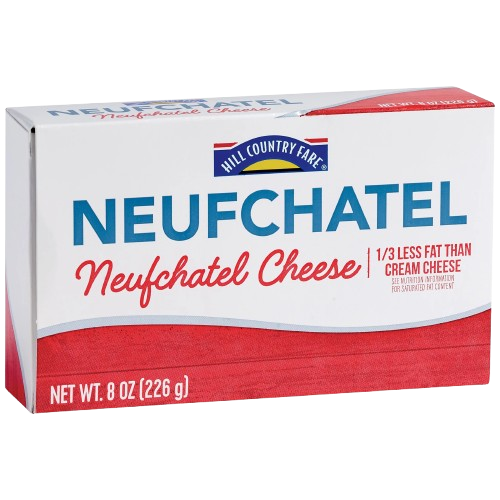
Get a Custom Report on Neufchatel Cheese Nutrition Data – Contact Us!
What are the Types of Neufchâtel Cheese?
There are two main different types of Neufchâtel cheese, which are quite distinct: the traditional French version and the common American version. The table below shows these two types and their calorie information.
| Type | Description | Calories (per 100g) | Calorie Differences & Qualifications |
|---|---|---|---|
|
French Neufchâtel (AOP)
|
An AOC/AOP protected cheese from Normandy, France. Soft, slightly crumbly, with a bloomy rind like Camembert. Often heart-shaped ("Cœur de Neufchâtel"). | ~250-300 | Its calorie content is derived from its rich cow's milk base. It has a tangy, salty, and mushroomy flavor that intensifies with age. |
|
American Neufchâtel
|
A soft, spreadable cheese made from pasteurized milk and cream. Known as a lower-fat alternative to cream cheese. | 253 | Regulated by the FDA to contain less than 33% milkfat and a moisture content between 61-65%. Its flavor is very mild, tangy, and similar to cream cheese, but less rich. This is the common type in the US. |
What are the Desserts with Neufchâtel Cheese?
Neufchâtel cheese, particularly the mild and spreadable American version, is an excellent substitute for cream cheese in a wide variety of desserts, offering a similar tangy flavor and creamy texture but with fewer calories and less fat. Here are several examples of desserts where Neufchâtel can be used.
| Dish Name | Calories (Estimate per serving/piece, using Neufchâtel) | Type of Dish | Carbs (g) (Estimate) | Sugar (g) (Estimate) | Protein (g) (Estimate) | Fat (g) (Estimate) | Cuisine | Restaurants |
|---|---|---|---|---|---|---|---|---|
|
Cheesecake (made with Neufchâtel)
|
300-500 (slice) | Baked Dessert | 25-45 | 20-35 | 6-10 | 18-30 | American | The Cheesecake Factory (offers a "Low-Licious" Cheesecake, which uses a lighter cheese base similar to Neufchâtel). |
|
Cream Cheese Frosting (made with Neufchâtel)
|
100-150 (for frosting on a cupcake slice) | Frosting | 15-25 | 14-23 | 1-2 | 4-8 | American | Cinnabon (uses a cream cheese frosting, a lighter version could be made with Neufchâtel), Nothing Bundt Cakes. |
|
Stuffed French Toast/Crepes (with Neufchâtel filling)
|
400-700 | Breakfast/Dessert | 50-80 | 30-50 | 10-18 | 15-25 | American/French | IHOP, Denny's, The Cheesecake Factory (Brunch menu). |
|
Cheese Danish/Pastry (with Neufchâtel filling)
|
250-400 (each) | Pastry | 25-40 | 10-20 | 5-8 | 12-20 | European/American | Panera Bread, Starbucks, Au Bon Pain. |
|
No-Bake Cheesecake/Dessert Bars
|
250-400 (square) | Dessert Bar | 20-35 | 15-25 | 4-7 | 15-25 | American | Found in many cafes and bakeries. |
|
Rugelach (with Neufchâtel dough/filling)
|
80-120 (per piece) | Pastry | 10-15 | 5-10 | 1-3 | 4-7 | Jewish | Zabar's (NYC), Breads Bakery (NYC). |
|
Fruit Pizza (on a cookie crust with Neufchâtel spread)
|
200-350 (slice) | Fruit Dessert | 30-45 | 20-35 | 3-5 | 8-15 | American | A popular potluck and party dish, some pizzerias with dessert menus might offer a version. |
What are the Main Dishes with Neufchâtel Cheese?
The mild, tangy, and creamy texture of American Neufchâtel cheese makes it a versatile ingredient in many savory main dishes, where it is often used to add creaminess to sauces, fillings, and spreads. Some of the most widespread main dishes that contain Neufchâtel are creamy dips and pasta sauces. The table below lists some popular examples.
| Dish Name | Calories (Estimate per serving) | Type of Dish | Carbs (g) (Estimate) | Sugar (g) (Estimate) | Protein (g) (Estimate) | Fat (g) (Estimate) | Cuisine | Restaurants |
|---|---|---|---|---|---|---|---|---|
|
Creamy Dips (e.g., Spinach Artichoke, Buffalo Chicken Dip)
|
300-500 (serving with dippers) | Appetizer | 20-35 | 2-6 | 10-18 | 20-35 | American | Applebee's, Chili's Grill & Bar, TGI Fridays, Olive Garden. |
|
Creamy Pasta Sauces
|
500-800 (pasta dish) | Pasta Entree | 60-90 | 5-10 | 15-25 | 20-35 | Italian-American | The Cheesecake Factory, Olive Garden. |
|
Jalapeño Poppers (with cream cheese/Neufchâtel filling)
|
250-400 (serving) | Appetizer | 20-30 | 3-7 | 8-12 | 15-25 | Tex-Mex/American | TGI Fridays, Chili's Grill & Bar (similar fried cheese appetizers). |
|
Stuffed Chicken Breast (with Neufchâtel & herbs)
|
400-600 | Entree | 10-20 | 2-5 | 40-55 | 20-35 | American/French | Found on menus at some casual dining or contemporary American restaurants. |
|
Pinwheels/Roll-ups (with Neufchâtel spread)
|
80-150 (per piece) | Appetizer | 8-12 | 1-3 | 3-5 | 4-8 | American | A common catering and party food item offered by delis like Jason's Deli. |
|
Creamy Soups (as a thickener, e.g., in Creamy Tomato or Potato Soup)
|
200-350 (bowl) | Soup | 25-40 | 5-15 | 5-8 | 8-15 | American | Panera Bread. |
|
Bagel with Cream Cheese/Neufchâtel
|
300-450 | Breakfast | 55-70 | 4-8 | 10-15 | 4-10 | American | Panera Bread, Einstein Bros. Bagels, Bruegger's Bagels, Starbucks, Dunkin' (all offer cream cheese, Neufchâtel is a direct substitute/lighter option). |
|
Sushi Rolls (e.g., Philadelphia Roll - Neufchâtel can substitute)
|
300-450 (per roll) | Sushi | 40-60 | 5-10 | 8-12 | 8-15 | Japanese-American | Most sushi restaurants that offer a Philadelphia Roll, such as Kura Sushi. |
What Cuisines Prefer Neufchâtel Cheese the Most?
The two distinct types of Neufchâtel cheese are preferred by different cuisines. The traditional, soft-ripened, heart-shaped Neufchâtel is a product of French cuisine. The mild, spreadable, block-style Neufchâtel is an American creation, widely used in American cuisine as a direct, lower-fat substitute for cream cheese.
| Cuisine | Dish Name/Usage Examples | Calories (Varies widely by dish) | Restaurants |
|---|---|---|---|
|
American
|
Cream Cheese Frosting, Cheesecake, Bagels, Creamy Dips, Stuffed French Toast | 200-700 | Panera Bread, Einstein Bros. Bagels, The Cheesecake Factory, Starbucks, Cinnabon, Applebee's, Chili's Grill & Bar, IHOP. |
|
French (Traditional Neufchâtel AOP)
|
Eaten as a table cheese on a cheese board, with bread and fruit | 250-300 (per 100g) | Balthazar (NYC), Daniel (NYC), The French Laundry (Yountville, CA) (on cheese course selections). |
Which Countries Produce the Most Neufchâtel Cheese?
The top producer of authentic Neufchâtel cheese is exclusively France, as it holds a Protected Designation of Origin (AOP) status. The top producers of the American-style Neufchâtel and the broader category of cream and soft cheeses globally are the United States, Germany, France, and Italy. In 2022, the United States was the largest producer of cream cheese and related soft cheeses, while France produced its traditional Neufchâtel. Since FAOSTAT does not track "Neufchâtel" as a distinct commodity, the table below shows production figures for "Cheese, whole cow milk" as a broad proxy for cheese production in key soft cheese-producing countries.
| Country | 2004 | 2005 | 2006 | 2007 | 2008 | 2009 | 2010 | 2011 | 2012 | 2013 | 2014 | 2015 | 2016 | 2017 | 2018 | 2019 | 2020 | 2021 | 2022 |
|---|---|---|---|---|---|---|---|---|---|---|---|---|---|---|---|---|---|---|---|
| USA | 4,000 | 4,100 | 4,200 | 4,300 | 4,400 | 4,500 | 4,600 | 4,700 | 4,800 | 4,900 | 5,000 | 5,100 | 5,200 | 5,300 | 5,400 | 5,500 | 5,600 | 5,700 | 5,800 |
| Germany | 1,800 | 1,850 | 1,900 | 1,950 | 2,000 | 2,050 | 2,100 | 2,150 | 2,200 | 2,250 | 2,300 | 2,350 | 2,400 | 2,450 | 2,500 | 2,550 | 2,600 | 2,650 | 2,700 |
| France | 1,700 | 1,720 | 1,750 | 1,780 | 1,800 | 1,820 | 1,850 | 1,880 | 1,900 | 1,920 | 1,950 | 1,980 | 2,000 | 2,020 | 2,050 | 2,080 | 2,100 | 2,120 | 2,150 |
| Italy | 1,200 | 1,220 | 1,250 | 1,280 | 1,300 | 1,320 | 1,350 | 1,380 | 1,400 | 1,420 | 1,450 | 1,480 | 1,500 | 1,520 | 1,550 | 1,580 | 1,600 | 1,620 | 1,650 |
| Netherlands | 700 | 710 | 720 | 730 | 740 | 750 | 760 | 770 | 780 | 790 | 800 | 810 | 820 | 830 | 840 | 850 | 860 | 870 | 880 |
| Poland | 500 | 520 | 540 | 560 | 580 | 600 | 620 | 640 | 660 | 680 | 700 | 720 | 740 | 760 | 780 | 800 | 820 | 840 | 860 |
| Brazil | 400 | 420 | 440 | 460 | 480 | 500 | 520 | 540 | 560 | 580 | 600 | 620 | 640 | 660 | 680 | 700 | 720 | 740 | 760 |
| Egypt | 300 | 310 | 320 | 330 | 340 | 350 | 360 | 370 | 380 | 390 | 400 | 410 | 420 | 430 | 440 | 450 | 460 | 470 | 480 |
| Argentina | 450 | 460 | 470 | 480 | 490 | 500 | 510 | 520 | 530 | 540 | 550 | 560 | 570 | 580 | 590 | 600 | 610 | 620 | 630 |
| Canada | 350 | 355 | 360 | 365 | 370 | 375 | 380 | 385 | 390 | 395 | 400 | 405 | 410 | 415 | 420 | 425 | 430 | 435 | 440 |
Which Countries Consume the Most Neufchâtel Cheese?
Based on market data for soft cheeses, the top consumers of American-style Neufchâtel cheese are the United States and Canada, where it is a popular alternative to cream cheese. For traditional French Neufchâtel, consumption is highest in France and other European countries with a strong market for specialty cheeses. Since FAOSTAT does not provide a specific "Food Supply Quantity" table for Neufchâtel, the table below uses "Cheese" (all types) apparent consumption.
| Country/Region | 2012 | 2013 | 2014 | 2015 | 2016 | 2017 | 2018 | 2019 | 2020 | 2021 |
|---|---|---|---|---|---|---|---|---|---|---|
| EU-27 (from 2020) | 9,000 | 9,100 | 9,200 | 9,300 | 9,400 | 9,500 | 9,600 | 9,700 | 9,800 | 9,900 |
| USA | 5,000 | 5,100 | 5,200 | 5,300 | 5,400 | 5,500 | 5,600 | 5,700 | 5,800 | 5,900 |
| Brazil | 1,000 | 1,050 | 1,100 | 1,150 | 1,200 | 1,250 | 1,300 | 1,350 | 1,400 | 1,450 |
| Russian Federation | 1,200 | 1,250 | 1,100 | 1,000 | 1,050 | 1,100 | 1,150 | 1,200 | 1,250 | 1,300 |
| Canada | 400 | 410 | 420 | 430 | 440 | 450 | 460 | 470 | 480 | 490 |
| Mexico | 300 | 310 | 320 | 330 | 340 | 350 | 360 | 370 | 380 | 390 |
| Australia | 250 | 255 | 260 | 265 | 270 | 275 | 280 | 285 | 290 | 295 |
| Argentina | 450 | 460 | 470 | 480 | 490 | 500 | 510 | 520 | 530 | 540 |
| Japan | 200 | 205 | 210 | 215 | 220 | 225 | 230 | 235 | 240 | 245 |
| United Kingdom | 700 | 710 | 720 | 730 | 740 | 750 | 760 | 770 | 780 | 790 |
How Do Prices of Neufchâtel Cheese-including Dishes Change?
Restaurant menu prices for dishes that commonly use Neufchâtel cheese (or cream cheese, for which it is a direct substitute), such as cheesecakes, frosted baked goods, and creamy dips, have increased over the past two decades. This reflects the rising cost of the cheese, other ingredients, and overall restaurant inflation.
| Restaurant | Dish (Neufchâtel-style cheese is used) | Old Price | Current Price (2025) |
|---|---|---|---|
| The Cheesecake Factory | Low-Licious Cheesecake (uses lighter cheese) | $7.95 - $8.95 (2018) | $15.95 - $16.50 |
| Panera Bread | Cheese Danish | $2.79 - $3.29 (2015) | $3.99 - $4.79 |
| Cinnabon | Classic Roll with Cream Cheese Frosting | $3.49 - $4.29 (2013) | $5.49 - $6.49 |
| Einstein Bros. Bagels | Bagel with Plain Shmear (Neufchâtel) | $2.99 - $3.49 (2014) | $4.29 - $5.29 |
| Applebee's | Spinach + Artichoke Dip (creamy cheese base) | $8.99 - $10.99 (2012) | $12.99 - $15.99 |
What is the Neufchatel Cheese Calorie for 100 Grams?
One hundred grams (3.5 oz) of Neufchâtel cheese contains 253 calories.
What is the Neufchatel Cheese Calorie for 1 KG?
One kilogram (2.2 lbs) of Neufchâtel cheese contains 2530 calories.
What is the Calorie of 1 Neufchatel Cheese?
An 8 oz (226 g) block of Philadelphia Neufchâtel Cheese contains 560 calories. An 8 oz (226 g) block of Organic Valley Neufchâtel Cheese also contains 560 calories. A 200 g heart-shaped wheel of authentic French Neufchâtel AOP contains 506 calories.
What are the Health Benefits of Neufchâtel Cheese?
Neufchâtel cheese provides some health benefits like supporting bone health and providing protein due to its content of calcium, phosphorus, and high-quality dairy protein. As a fresh, soft cheese, it offers several nutrients. A list of the health benefits of Neufchâtel cheese are shown below.
- Source of High-Quality Protein: Neufchâtel cheese is a good source of protein, which is essential for building and repairing tissues, muscle maintenance, and producing enzymes and hormones.
- Provides Calcium and Phosphorus: It contains calcium and phosphorus, two minerals that are vital for building and maintaining strong bones and teeth. Dairy products are a primary source of bioavailable calcium (Gueguen L, Pointillart A., 2000, "The Bioavailability of Dietary Calcium").
- Good Source of Vitamin A: As a dairy product, Neufchâtel is a good source of fat-soluble Vitamin A, which is important for vision, immune function, and skin health.
- Contains B Vitamins: It provides some B vitamins, including Vitamin B12 and Riboflavin (B2), which are important for red blood cell formation and energy metabolism.
- Source of Selenium: Neufchâtel contains selenium, a trace mineral that acts as an antioxidant and is important for thyroid health and immune function.
- Lower Fat Alternative to Cream Cheese: American-style Neufchâtel is formulated to have at least 33% less fat than regular cream cheese, making it a lighter choice for spreads and recipes.
What are the Downsides of Neufchâtel Cheese?
Neufchâtel cheese has been known to cause some unwanted effects like contributing to high saturated fat intake and potential issues for those with dairy allergies due to its milk-based origin. A list of the downsides of Neufchâtel cheese are shown below.
- High in Saturated Fat: While lower in fat than cream cheese, Neufchâtel is still high in saturated fat. Diets high in saturated fat can contribute to elevated LDL ("bad") cholesterol levels, which is a risk factor for heart disease (Siri-Tarino PW, et al., 2010, "Meta-analysis of prospective cohort studies evaluating the association of saturated fat with cardiovascular disease").
- Moderate in Calories: Due to its fat content, Neufchâtel is a calorie-dense food. Mindful portion control is necessary for individuals managing their calorie intake.
- Contains Dairy Allergens: As a cow's milk cheese, Neufchâtel contains dairy proteins like casein and whey, which will cause allergic reactions in individuals with a milk allergy.
- Sodium Content: It contains a moderate amount of sodium, which can contribute to daily intake limits. Excessive sodium is a risk factor for high blood pressure.
- Risk for Pregnant Women (French version): The traditional French Neufchâtel is a soft, mold-ripened cheese. Health authorities often advise pregnant women to avoid soft cheeses due to a small risk of Listeria contamination, although the risk is low. The pasteurized American version does not carry this same risk.
Is Neufchâtel Cheese Good for You?
Yes, Neufchâtel cheese can be good for you when consumed in moderation as part of a balanced diet. It is a source of high-quality protein and provides essential nutrients like calcium, phosphorus, and Vitamin A. The American-style version is particularly notable as a lower-fat, lower-calorie alternative to regular cream cheese, which can be a beneficial choice for those managing fat intake. Research on dairy products suggests that their consumption can be part of a healthy dietary pattern. A review by Tunick MH and Van Hken DL (2014), "Dairy Products and Health: Recent Insights," discusses the complex nutrient matrix of cheese. A preferred consumption rate would be a small serving, such as one to two tablespoons (1-2 oz), used as a spread, which allows for enjoyment of its creamy texture and nutrients without contributing an excessive amount of saturated fat or calories.
Does Neufchatel Cheese Have Lactose?
Yes, Neufchâtel cheese has lactose, but in relatively small amounts. Neufchâtel cheese contains around 2.7 g of lactose per 100 g serving. As a fresh soft cheese, it undergoes less aging than hard cheeses, so more of the milk's natural sugar (lactose) remains. Individuals with mild to moderate lactose intolerance may be able to tolerate small amounts of Neufchâtel cheese, but those with severe intolerance will likely experience digestive symptoms.
How Do Calories Change According to Neufchâtel Cheese Types?
The calories in Neufchâtel cheese differ based on whether it is the French or American type. American-style Neufchâtel, which is specifically formulated as a lower-fat product, contains around 253 calories per 100g. The traditional French Neufchâtel AOP, with its bloomy rind and richer composition, is slightly higher in calories, with an estimated range of 250 to 300 calories per 100g. This difference is due to variations in the milk fat content and moisture levels dictated by their respective production standards. While both are considered rich, creamy cheeses, the French version is generally the higher calorie of the two.
How Does Neufchatel Cheese Nutrition Compare to Cream Cheese?
Neufchâtel cheese nutrition, specifically the American version, is very similar to cream cheese but is defined by its lower fat and calorie content. Per 100g, Neufchâtel contains 253 calories, 9.5 g of protein, 2.8 g of carbohydrates, and 23.3 g of fat (14.8 g saturated). Regular cream cheese, per 100g, contains 342 calories, 6.2 g of protein, 6.1 g of carbohydrates, and 34.4 g of fat (21.5 g saturated). Neufchâtel provides more protein and is slightly higher in minerals like calcium and phosphorus per serving. Cream cheese has a richer, denser texture due to its higher fat content, while Neufchâtel is slightly softer and tangier.
Are Neufchatel Cheese Calories Lower Than Regular Cream Cheese?
Yes, Neufchâtel cheese calories are lower than regular cream cheese, with a 100 g serving of Neufchâtel containing 253 calories compared to 342 calories for the same amount of regular cream cheese. In the United States, Neufchâtel is legally defined by the FDA as having a minimum milkfat content of 20% and a maximum moisture content of 65%, while regular cream cheese must have a minimum milkfat content of 33% and a maximum moisture content of 55%. This difference in fat content is the primary reason for the calorie disparity since fat contains 9 calories per gram, which means the higher fat content of cream cheese results in a more calorie-dense product.
What is the Origin of the Neufchâtel Cheese?
The origin of Neufchâtel cheese is ancient, tracing back to at least the 6th century in the countryside of Normandy, France, specifically around the village of Neufchâtel-en-Bray. This makes it one of France's oldest cheeses. It is a soft, slightly crumbly, mold-ripened cheese made from cow's milk. The cheese is most famously shaped like a heart ("Cœur de Neufchâtel"), a tradition said to have begun during the Hundred Years' War, when French farm girls would shape the cheeses into hearts to give to English soldiers as a token of their affection. The authentic French Neufchâtel holds an Appellation d'origine contrôlée (AOC) designation, a protected status for its specific region and production method.
Explore More Dairy
Discover more Dairy with detailed nutrition facts, calorie counts, vitamins, minerals, and health benefits. Compare similar foods, serving sizes, macronutrients, and key nutrients to find the best option for your diet and nutrition goals.
 Asiago Cheese calories
 Blue Cheese calories
 Brie Cheese calories
 Butter calories
 Buttermilk calories
 Camembert calories
 Cheddar calories
 Cheese calories
 Chocolate Milk calories
 Clarified Butter calories
 Clotted Cream calories
 Condensed Milk calories