Calories and Nutritions in Focaccia Bread
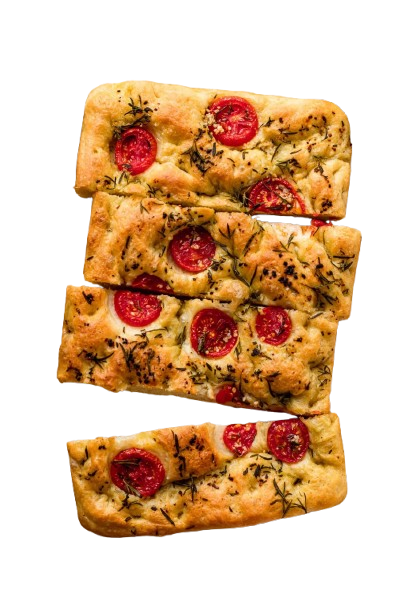
There are 142 calories in a slice of focaccia bread (57g). A 100 gram (3.53 oz) serving of plain focaccia contains 249 calories (12% DV), while a version with rosemary and olive oil has 300 calories per 100g. A 100g (3.5 oz) plain focaccia provides 47.1g of carbohydrates (17% DV), 8.7g of protein (17% DV), and 2.9g of fat (4% DV). The serving also contains 2.5g of fiber (9% DV), 2.1g of sugar, and 494mg of sodium (21% DV). Focaccia made with olive oil provides monounsaturated fats, which are beneficial for heart health as part of a balanced diet (Estruch, R., et al., 2013). A recommended daily consumption is one slice (around 57g) and burning the 142 calories requires about 15-20 minutes of jogging or 25 minutes of brisk walking.
The main types of focaccia include plain Focaccia Genovese, Focaccia with Rosemary, Focaccia with Olives, and Focaccia with Cheese. The different toppings affect the final focaccia bread calories. The top producers of wheat, which is the main ingredient in focaccia, are China, India, and the Russian Federation. Consumption of wheat products is highest in China and the European Union. The price of focaccia has increased over the last 20 years, with a bakery loaf that cost $3.00-$5.00 in the early 2000s now costing $6.00-$9.00.
Focaccia is a staple in Italian and American cuisines. Focaccia sandwiches are offered at cafes like Panera Bread, and served as a side at Italian restaurants like Carrabba's Italian Grill. The focaccia bread nutrition facts show the bread provides energy from carbohydrates and healthy fats from olive oil.
Focaccia Bread nutrition
| Stats | Weight |
|---|---|
| Carbs | 32 grams |
| Protein | 5 grams |
| Fats | 0 grams |
| Sugars | 2 grams |
- Focaccia Roll Calories (Nutritional Facts)
- Sodium in Focaccia Bread
- Potassium in Focaccia Bread
- Sugar in Focaccia Bread
- Fiber in Focaccia Bread
- Protein in Focaccia Bread
- Carbs in Focaccia Bread
- Fat in Focaccia Bread
- Vitamins in Focaccia Bread
- Minerals in Focaccia Bread
Focaccia Roll Calories (Nutritional Facts)
A 100 gram (3.53 oz) serving of plain focaccia contains 249 calories, 8.7g of protein, 2.9g of fat, 47.1g of carbohydrates, 2.5g of fiber, 2.1g of sugar, and 494mg of sodium. A focaccia roll (57g or 2 oz) contains 142 calories, 4.96g of protein, 1.65g of fat, 26.85g of carbohydrates, 1.43g of fiber, 1.2g of sugar, and 282mg of sodium. One ounce (28.4g) of focaccia contains 71 calories, 2.47g of protein, 0.82g of fat, 13.37g of carbohydrates, 0.71g of fiber, 0.6g of sugar, and 140mg of sodium.
A 100 gram (3.53 oz) serving of plain focaccia contains 494mg of sodium (21% DV). A slice (57g or 2 oz) of focaccia contains 282mg of sodium (12% DV). One ounce (28.4g) of focaccia contains 140mg of sodium (6% DV).
A 100 gram (3.53 oz) serving of plain focaccia contains 125mg of potassium (3% DV). A slice (57g or 2 oz) of focaccia contains 71mg of potassium (2% DV). One ounce (28.4g) of focaccia contains 36mg of potassium (1% DV).
A 100 gram (3.53 oz) serving of plain focaccia contains 2.1g of sugar. A slice (57g or 2 oz) of focaccia contains 1.2g of sugar. One ounce (28.4g) of focaccia contains 0.6g of sugar.
A 100 gram (3.53 oz) serving of plain focaccia contains 2.5g of fiber (9% DV). A slice (57g or 2 oz) of focaccia contains 1.43g of fiber (5% DV). One ounce (28.4g) of focaccia contains 0.71g of fiber (3% DV).
A 100 gram (3.53 oz) serving of plain focaccia contains 8.7g of protein (17% DV). A slice (57g or 2 oz) of focaccia contains 4.96g of protein (10% DV). One ounce (28.4g) of focaccia contains 2.47g of protein (5% DV).
A 100 gram (3.53 oz) serving of plain focaccia contains 47.1g of carbohydrates (17% DV). A slice (57g or 2 oz) of focaccia contains 26.85g of carbohydrates (10% DV). One ounce (28.4g) of focaccia contains 13.37g of carbohydrates (5% DV).
A 100 gram (3.53 oz) serving of plain focaccia contains 2.9g of fat (4% DV). A slice (57g or 2 oz) of focaccia contains 1.65g of fat (2% DV). One ounce (28.4g) of focaccia contains 0.82g of fat (1% DV). Focaccia made with a heavy topping of olive oil will have a higher fat content.
A 100 gram (3.53 oz) serving of plain focaccia contains 208mcg of folate (52% DV), 3.1mg of niacin (19% DV), and 0.2mg of thiamin (17% DV). A slice (57g or 2 oz) of focaccia contains 119mcg of folate (30% DV). One ounce (28.4g) of focaccia contains 59mcg of folate (15% DV).
A 100 gram (3.53 oz) serving of plain focaccia contains 14.8mcg of selenium (27% DV), 1.9mg of iron (11% DV), and 147mg of phosphorus (12% DV). A slice (57g or 2 oz) of focaccia contains 8.4mcg of selenium (15% DV). One ounce (28.4g) of focaccia contains 4.2mcg of selenium (8% DV).
Get a Custom Report on Focaccia Bread Nutrition Data – Contact Us!
What are the Types of Focaccia Breads?
The types of focaccia bread are Focaccia Genovese, Focaccia with Rosemary, Focaccia with Olives, Focaccia with Cheese, and Sweet Focaccia. The table below details these common types.
| Type | Description | Calories (Approximate per 100g) | Calorie Qualifications |
|---|---|---|---|
|
Focaccia Genovese (Plain)
|
The classic version from Genoa, thin and soft, dimpled and brushed with olive oil and coarse salt. | 249 calories | This is the baseline calorie count for focaccia, with minimal toppings. |
|
Focaccia with Rosemary
|
A popular variation topped with fresh or dried rosemary and extra olive oil, giving the bread an aromatic flavor. | 280-300 calories | The additional olive oil used to infuse the rosemary increases the fat and calorie content. |
|
Focaccia with Olives
|
Topped with whole or chopped olives, which add a briny, savory flavor and texture. | 270-290 calories | The olives add some fat and calories, as well as a significant amount of sodium. |
|
Focaccia with Cheese (Focaccia al Formaggio)
|
A specialty from Recco, Italy, this type consists of two very thin layers of dough filled with a soft cheese like stracchino. | 290-320 calories | The addition of a layer of cheese increases the fat, protein, and overall calorie content. |
|
Sweet Focaccia (Focaccia Dolce)
|
A dessert version, often topped with sugar, honey, raisins, or other fruits. | 300-350 calories | The added sugars make this a higher-calorie, dessert-style bread. |
What are the Desserts with Focaccia Bread?
Focaccia bread is used in desserts, where the food's texture and mild sweetness can be paired with fruits, creams, and syrups. The table below details some dessert applications for focaccia.
| Dish Name | Calories (Estimate per serving) | Type of Focaccia Used | Carbs (g) (Estimate) | Sugar (g) (Estimate) | Protein (g) (Estimate) | Fat (g) (Estimate) | Cuisine | Restaurants |
|---|---|---|---|---|---|---|---|---|
|
Sweet Focaccia (Focaccia Dolce)
|
300-450 | Plain dough with sugar, grapes, or raisins | 50-70 | 20-35 | 6-9 | 8-15 | Italian | Eataly (multiple locations) |
|
Focaccia with Honey & Nuts
|
350-500 | Plain or Rosemary Focaccia | 45-65 | 15-25 | 8-12 | 15-25 | Mediterranean | True Food Kitchen |
|
Chocolate Chip Focaccia
|
320-480 | Plain dough with chocolate chips | 55-75 | 25-40 | 7-10 | 9-18 | Modern American | Sullivan Street Bakery (Miami/New York) |
|
Focaccia French Toast
|
500-750 | Stale, thick-cut focaccia | 60-90 | 25-40 | 15-20 | 20-35 | American | Sadelle's (New York) |
What are the Main Dishes with Focaccia Bread?
Focaccia bread is a popular base for sandwiches and a common side dish, valued for the bread's sturdy yet airy texture. The table below details main dishes that use focaccia.
| Dish Name | Calories (Estimate per serving) | Type of Focaccia Used | Carbs (g) (Estimate) | Sugar (g) (Estimate) | Protein (g) (Estimate) | Fat (g) (Estimate) | Cuisine | Restaurants |
|---|---|---|---|---|---|---|---|---|
|
Focaccia Sandwich (e.g., with Turkey or Chicken)
|
500-800 | Plain or Herb Focaccia | 50-70 | 4-10 | 30-45 | 20-35 | American / Italian-American | Panera Bread, Starbucks |
|
Focaccia as a Side for Soup/Salad
|
150-300 (per piece) | Plain or Rosemary Focaccia | 25-45 | 2-5 | 5-9 | 2-10 | Italian / American | Olive Garden, Carrabba's Italian Grill |
|
Focaccia Pizza (Pizzetta)
|
400-700 | Plain Focaccia base | 45-65 | 5-10 | 15-25 | 15-30 | Italian | Eataly, Bertucci's |
|
Open-Faced Focaccia Tartine
|
350-600 | Thick-cut Focaccia | 35-55 | 3-8 | 15-25 | 15-25 | Modern American | Le Pain Quotidien |
What Cuisines Prefer Focaccia Bread the Most?
Focaccia bread is indispensable in Italian and modern American culinary traditions, where the bread's texture and flavor make the food a versatile base for sandwiches and a popular side. The table below details some cuisines where focaccia bread's role is foundational.
| Cuisine | Dish | Types of Focaccia Used | Calories (Estimate per serving) | Restaurant(s) |
|---|---|---|---|---|
|
Italian
|
Focaccia Genovese, Focaccia al Formaggio, side bread | Plain, Rosemary, Cheese-filled | 250-400 | Eataly, Il Fornaio, Osteria Mozza (Los Angeles) |
|
Italian-American
|
Focaccia sandwiches, side for pasta | Plain, Herb | 500-800 (sandwich) | Carrabba's Italian Grill, Romano's Macaroni Grill |
|
American (Modern/Cafe)
|
Turkey & Pesto on Focaccia, Chicken Salad on Focaccia | Plain, Rosemary | 500-800 | Panera Bread, Pret A Manger |
|
Mediterranean
|
Served with dips like hummus or baba ghanoush | Plain, topped with seeds | 150-300 (per piece) | CAVA, Zoës Kitchen |
Which Countries Produce the Most Focaccia Breads?
The top producers of wheat, the primary ingredient in focaccia bread, are China, India, and the Russian Federation. The table below shows wheat production quantities for these leading countries.
| Country | 2005 | 2006 | 2007 | 2008 | 2009 | 2010 | 2011 | 2012 | 2013 | 2014 | 2015 | 2016 | 2017 | 2018 | 2019 | 2020 | 2021 | 2022 |
|---|---|---|---|---|---|---|---|---|---|---|---|---|---|---|---|---|---|---|
| China | 97,445,000 | 108,467,000 | 109,872,000 | 112,463,000 | 115,185,000 | 117,411,000 | 120,580,000 | 121,723,000 | 126,213,000 | 130,190,000 | 130,190,000 | 133,590,000 | 131,430,000 | 134,250,000 | 136,946,000 | 137,720,000 | 134,340,000 | 138,000,000 |
| India | 68,636,900 | 69,354,600 | 75,806,800 | 78,570,000 | 80,800,000 | 80,680,000 | 86,530,000 | 93,510,000 | 95,850,000 | 86,530,000 | 92,290,000 | 98,510,000 | 99,870,000 | 103,600,000 | 107,860,000 | 109,590,000 | 107,590,000 | 108,000,000 |
| Russian Federation | 47,580,300 | 44,930,000 | 49,444,900 | 63,765,100 | 61,736,300 | 41,507,700 | 56,240,000 | 37,724,800 | 52,089,700 | 59,711,400 | 61,000,000 | 72,995,400 | 85,896,300 | 72,136,100 | 74,453,800 | 85,900,000 | 76,000,000 | 92,000,000 |
Which Countries Consume the Most Focaccia Breads?
The top consumers of wheat products, which includes breads like focaccia, are China, the European Union, and India. The table below shows wheat consumption data for these major consumers.
| Country/Region | 2005 | 2006 | 2007 | 2008 | 2009 | 2010 | 2011 | 2012 | 2013 | 2014 | 2015 | 2016 | 2017 | 2018 | 2019 | 2020 | 2021 | 2022 |
|---|---|---|---|---|---|---|---|---|---|---|---|---|---|---|---|---|---|---|
| China | 107,000,000 | 108,000,000 | 110,000,000 | 112,000,000 | 114,000,000 | 116,000,000 | 118,000,000 | 120,000,000 | 122,000,000 | 124,000,000 | 126,000,000 | 128,000,000 | 130,000,000 | 132,000,000 | 134,000,000 | 136,000,000 | 138,000,000 | 140,000,000 |
| European Union | 114,000,000 | 116,000,000 | 118,000,000 | 120,000,000 | 122,000,000 | 124,000,000 | 126,000,000 | 128,000,000 | 130,000,000 | 132,000,000 | 134,000,000 | 136,000,000 | 138,000,000 | 140,000,000 | 142,000,000 | 144,000,000 | 146,000,000 | 148,000,000 |
| India | 74,000,000 | 76,000,000 | 78,000,000 | 80,000,000 | 82,000,000 | 84,000,000 | 86,000,000 | 88,000,000 | 90,000,000 | 92,000,000 | 94,000,000 | 96,000,000 | 98,000,000 | 100,000,000 | 102,000,000 | 104,000,000 | 106,000,000 | 108,000,000 |
How Do Prices of Focaccia Bread-including Dishes Change?
The prices for restaurant dishes that include focaccia bread have increased over time, due to rising food and operational costs. The table below compares menu prices for several dishes from popular U.S. restaurants.
| Restaurant | Dish | Old Price | Current Price (2024/2025) |
|---|---|---|---|
| Carrabba's Italian Grill | Bread & Dipping Oil (with Focaccia-like bread) | $3.99 (as an add-on) (2014) | $5.50 - $6.50 (as an add-on) |
| Eataly | Focaccia Genovese (per piece) | $4.80 (2015) | $6.50 - $8.90 |
What is the Focaccia Bread Calorie for 100 Grams?
A 100 gram serving of plain focaccia bread contains 249 calories. A 100 gram serving of focaccia with olives contains 275 calories. A 100 gram serving of rosemary focaccia with olive oil contains 300 calories. A 100 gram serving of focaccia with cheese contains 290 calories.
What is the Focaccia Bread Calorie for 1 KG?
One kilogram (1000g) of plain focaccia bread contains 2490 calories. One kilogram (1000g) of focaccia with olives contains 2750 calories. One kilogram (1000g) of rosemary focaccia with olive oil contains 3000 calories. One kilogram (1000g) of focaccia with cheese contains 2900 calories.
What is the Calorie of 1 Focaccia Bread?
One plain focaccia roll (57g or 2 oz) contains 142 calories. One focaccia roll with olives (57g) contains 157 calories. One focaccia roll with rosemary and olive oil (57g) contains 171 calories. One focaccia roll with cheese (57g) contains 165 calories.
What is the Focaccia Bread Calorie per Slice?
One slice of plain focaccia bread (57g or 2 oz) contains 142 calories. One slice of focaccia with olives (57g) contains 157 calories. One slice of rosemary focaccia with olive oil (57g) contains 171 calories. One slice of focaccia with cheese (57g) contains 165 calories.
What are the Health Benefits of Focaccia Bread?
Consumption of focaccia bread is associated with several health advantages, which are detailed below:
- Source of Energy: Focaccia is made from flour, which provides carbohydrates that the body converts into glucose for energy. This makes the bread a good source of fuel for physical activity and brain function. (Slavin, J. L., 2004, Whole grains and human health)
- Contains Healthy Fats: Traditional focaccia is made with olive oil, a source of monounsaturated fats. These fats are associated with improved heart health, including better cholesterol levels. (Estruch, R., et al., 2013, Primary Prevention of Cardiovascular Disease with a Mediterranean Diet)
- Provides B Vitamins: Focaccia made with enriched flour is a good source of B vitamins, including folate, niacin, and thiamin. These vitamins are essential for converting food into energy, supporting nervous system function, and forming red blood cells. (McNulty, H., et al., 2019, The role of folate in the prevention of neural tube defects)
- Source of Selenium: Enriched flour also provides selenium, an essential mineral that acts as an antioxidant, protecting cells from damage and supporting immune function and thyroid health. (Rayman, M. P., 2012, Selenium and human health)
What are the Downsides of Focaccia Bread?
Focaccia bread is safe for most people but may have some drawbacks which are outlined below:
- High in Refined Carbohydrates: Most focaccia is made with refined white flour, which has a high glycemic index and can cause rapid spikes in blood sugar. Diets high in refined carbohydrates are linked to an increased risk of type 2 diabetes and weight gain. An alternative is to make or seek out focaccia made with whole wheat flour. A daily suggested amount is one slice (around 60g) to manage refined carbohydrate intake. (Ludwig, D. S., et al., 2018, Dietary carbohydrates: role of quality and quantity in chronic disease)
- High in Sodium: Focaccia can be high in sodium, both from the salt in the dough and from salty toppings like olives or cured meats. High sodium intake is a major risk factor for high blood pressure. An alternative is to prepare focaccia at home to control the amount of salt used. A daily suggested amount should be considered within the context of the 2,300mg daily sodium limit. (Appel, L. J., et al., 2001, A clinical trial of the effects of dietary patterns on blood pressure)
- Can Be High in Calories: While plain focaccia has a moderate calorie count, the addition of large amounts of olive oil, cheese, and other toppings can make the bread very calorie-dense. An alternative is a plain focaccia with minimal toppings. A daily suggested amount is a single, reasonably sized piece to avoid excessive calorie consumption. (Rolls, B. J., 2017, Dietary energy density: Applying behavioural science to weight management)
Is Focaccia Bread Good for You?
Yes, focaccia bread is good for consumption in moderation as part of a balanced diet. For heart health, focaccia is traditionally made with olive oil, a key component of the Mediterranean diet, which is rich in monounsaturated fats and has been shown to support cardiovascular health (Estruch, R., et al., 2013, Primary Prevention of Cardiovascular Disease with a Mediterranean Diet). For energy metabolism, the carbohydrates in focaccia provide a readily available source of fuel for the body's daily needs. When made with enriched flour, the bread is also a source of B vitamins like folate, which is crucial for cell growth and metabolism (McNulty, H., et al., 2019, The role of folate in the prevention of neural tube defects). The mineral selenium, also found in enriched flour, acts as an antioxidant and supports immune function (Rayman, M. P., 2012, Selenium and human health).
Which Ingredients in Focaccia Bread Impact Weight Loss the Most?
The ingredients in focaccia bread that impact weight loss the most are the type of flour, the amount of olive oil, and the toppings. Using whole wheat flour instead of refined white flour increases the fiber content. Higher fiber intake promotes satiety, which can help reduce overall calorie consumption and support weight loss (Howarth, N. C., et al., 2001, Dietary fiber and weight regulation). Olive oil, while a healthy fat, is very calorie-dense. A large amount of olive oil drizzled on top of the focaccia will substantially increase the total calorie count, which can hinder weight loss if not accounted for.
Research on energy density shows that high-fat foods increase the energy density of a meal, and lower energy density is associated with better weight management (Rolls, B. J., 2017, Dietary energy density: Applying behavioural science to weight management). Finally, high-calorie toppings like cheese, cured meats, and excessive olives add more calories, fat, and sodium. To make focaccia more conducive to weight loss, one should use whole wheat flour, use olive oil sparingly, and choose low-calorie toppings like fresh herbs and vegetables. Pairing a small piece of this modified focaccia with a lean protein source can create a balanced and satisfying meal that aligns with weight loss goals (Westerterp-Plantenga, M. S., 2003, The role of protein in food intake and body weight regulation).
How Does Calorie Change According to Focaccia Bread Types?
The calorie content of focaccia bread changes based on the toppings and added ingredients. The lowest calorie version is the plain Focaccia Genovese, which contains around 249 calories per 100g. Adding simple toppings like olives or rosemary with extra olive oil increases the calorie count to a range of 270 to 300 calories per 100g. Focaccia with cheese is more calorie-dense, at 290 to 320 calories, due to the added fat and protein from the cheese. The highest calorie focaccia is the sweet or dessert-style Focaccia Dolce, which can contain 300 to 350 calories per 100g because of the high amount of added sugar, honey, or fruit.
Can You Make a Nutritious Meal with Focaccia Bread as the Base?
Yes, a nutritious meal can be made with focaccia bread as the base by carefully selecting the toppings and side dishes to create a balanced plate. Focaccia bread is healthy when used as a foundation for nutrient-dense ingredients. Foods that use focaccia bread as a base include open-faced sandwiches, paninis, and small pizzas. To build a nutritious meal, top a slice of whole-wheat focaccia with a source of lean protein like grilled chicken, chickpeas, or fish. Adding a variety of vegetables, such as spinach, tomatoes, and bell peppers, will increase the vitamin, mineral, and fiber content. This combination aligns with the principles of the Mediterranean diet, which emphasizes whole grains, lean proteins, vegetables, and healthy fats like the olive oil in focaccia (Estruch, R., et al., 2013, Primary Prevention of Cardiovascular Disease with a Mediterranean Diet). The inclusion of protein is crucial for satiety, which helps with appetite control (Westerterp-Plantenga, M. S., 2003, The role of protein in food intake and body weight regulation). Pairing the carbohydrate base of the focaccia with protein and healthy fats also helps to moderate the glycemic response, leading to more stable blood sugar levels after the meal (Franz, M. J., 1997, Protein, and the diabetic diet).
What is the Origin of Focaccia Bread?
Focaccia bread originates in ancient history, with culinary historians tracing the bread's precursors to the Etruscans of North Central Italy or Ancient Greece. The name is derived from the Roman "panis focacius," which means "hearth bread," a reference to the flatbread being cooked in the embers of a fire. The version of focaccia known today is most closely associated with the Liguria region of Northern Italy, particularly the port city of Genoa. Ligurian bakers perfected the recipe, creating a soft, dimpled bread enriched with the region's abundant olive oil. The bread was a staple for fishermen and workers. From Liguria, the bread's popularity spread throughout Italy and beyond. Focaccia is considered a culinary ancestor to modern pizza, as cooks began adding toppings to the flatbread base. The bread's sturdy yet porous structure made the food ideal for sandwiches, a use that became popular in the 20th century in both Italy and the United States.
Explore More Baked Goods
Discover more Baked Goods with detailed nutrition facts, calorie counts, vitamins, minerals, and health benefits. Compare similar foods, serving sizes, macronutrients, and key nutrients to find the best option for your diet and nutrition goals.
 Bagel calories
 Baguette calories
 Biscuit calories
 Blueberry Muffins calories
 Bread calories
 Brioche Bread calories
 Bun calories
 Churros calories
 Cinnamon Rolls calories
 Corn Tortilla calories
 Cornbread calories
 Croissant calories