Calories and Nutritions in Jicama
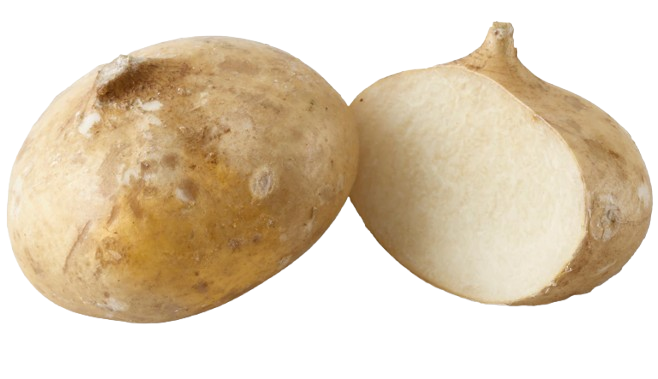
A 100g serving (3.53oz) of raw jicama contains 38 calories, making it a low-calorie root vegetable. There are 250 calories in a medium jicama (659g), while a single slice (6g) contains just 2.3 calories. One cup of sliced jicama (120g) provides 46 calories, 0.86g of protein, 0.11g of fat, 10.6g of carbohydrates, 5.88g of fiber, and 2.16g of sugar.
Jicama nutrition profiles show it is a good source of Vitamin C, providing 20.2mg per 100g serving (22% DV). The root may also support digestive health, with a study finding that its prebiotic fiber, inulin, promotes the growth of beneficial gut bacteria (Roberfroid, M. B., 2007). The majority of the health benefits of jicama come from its profile of vitamin C and prebiotic fiber, which supports immune function and digestive health.
The main types of jicama are categorized as Jicama de Agua or Jicama de Leche. The top producer of this root vegetable is Mexico, while the United States is a major consumer. The price of jicama has increased over the last 20 years, with the average retail price rising from under $1.00 per pound to over $1.49 per pound in 2023.
Jicama is a key ingredient in Mexican cuisine, used in popular dishes like Shrimp Tacos and Mango Salad available at restaurants like Rubio's Coastal Grill and Rosa Mexicano. A good recommendation for consumption is one cup (120g) of sliced raw jicama daily. This serving size provides 46 jicama calories, which can be burned by doing 5 minutes of jogging or 6 minutes of cycling.
Jicama nutrition
| Stats | Weight |
|---|---|
| Carbs | 32 grams |
| Protein | 2.5 grams |
| Fats | 0 grams |
| Sugars | 6 grams |
- Jicama Root Calories (Nutritional Facts)
- Jicama Fruit Calories (Nutritional Facts)
- Jicama Sticks Calories (Nutritional Facts)
- Raw Jicama Nutrition
- Sodium in Jicama
- Potassium in Jicama
- Sugar in Jicama
- Fiber in Jicama
- Protein in Jicama
- Carbs in Jicama
- Fat in Jicama
- Vitamins in Jicama
- Minerals in Jicama
Jicama Root Calories (Nutritional Facts)
A 100 gram (3.53 ounce) serving of raw jicama root contains 38 calories, 0.72g of protein, 0.09g of fat, and 8.82g of carbohydrates.
Jicama is a root vegetable, not a fruit, so the nutritional information is the same as for jicama root. A 100 gram (3.53 ounce) serving of raw jicama contains 38 calories, 0.72g of protein, 0.09g of fat, and 8.82g of carbohydrates.
A one cup serving of jicama sticks (120 grams) contains 46 calories, 0.86g of protein, 0.11g of fat, and 10.6g of carbohydrates. A four ounce serving of jicama sticks (113 grams) contains 45 calories, 1g of protein, 0g of fat, and 10g of carbohydrates. A serving of Trader Joe's Jicama Sticks (88 grams) contains 35 calories, 0.5g of protein, 0g of fat, and 8g of carbohydrates.
A 100 gram (3.53 ounce) serving of raw jicama provides 38 calories, 0.72g of protein, 0.09g of fat, and 8.82g of carbohydrates. A one cup serving of sliced raw jicama (120 grams) provides 46 calories, 0.86g of protein, 0.11g of fat, and 10.6g of carbohydrates. One slice of jicama (6 grams) provides 2.3 calories, 0.04g of protein, 0.005g of fat, and 0.53g of carbohydrates. A small jicama (365 grams) provides 139 calories, 2.63g of protein, 0.33g of fat, and 32.2g of carbohydrates. A medium jicama (659 grams) provides 250 calories, 4.74g of protein, 0.59g of fat, and 58.1g of carbohydrates. A large jicama (1200 grams) provides 456 calories, 8.64g of protein, 1.08g of fat, and 106g of carbohydrates.
A 100 gram serving of raw jicama contains 4mg of sodium (0% DV). A one cup serving of sliced raw jicama (120 grams) contains 4.8mg of sodium (0% DV). A four ounce serving of jicama sticks (113 grams) contains 5mg of sodium (0% DV). A small jicama (365 grams) contains 14.6mg of sodium (1% DV). A medium jicama (659 grams) contains 26.4mg of sodium (1% DV). A large jicama (1200 grams) contains 48mg of sodium (2% DV).
A 100 gram serving of raw jicama contains 150mg of potassium (3% DV). The jicama potassium content helps support healthy blood pressure levels. A one cup serving of sliced raw jicama (120 grams) contains 180mg of potassium (4% DV). A four ounce serving of jicama sticks (113 grams) contains 188mg of potassium (4% DV). A small jicama (365 grams) contains 548mg of potassium (12% DV). A medium jicama (659 grams) contains 988mg of potassium (21% DV). A large jicama (1200 grams) contains 1800mg of potassium (38% DV).
A 100 gram serving of raw jicama contains 1.8g of sugar. A one cup serving of sliced raw jicama (120 grams) contains 2.16g of sugar. A four ounce serving of jicama sticks (113 grams) contains 2g of sugar. A small jicama (365 grams) contains 6.57g of sugar. A medium jicama (659 grams) contains 11.9g of sugar. A large jicama (1200 grams) contains 21.6g of sugar.
A 100 gram serving of raw jicama provides 4.9g of dietary fiber (18% DV). A one cup serving of sliced raw jicama (120 grams) provides 5.88g of dietary fiber (21% DV). A four ounce serving of jicama sticks (113 grams) provides 6g of dietary fiber (21% DV). A small jicama (365 grams) provides 17.9g of dietary fiber (64% DV). A medium jicama (659 grams) provides 32.3g of dietary fiber (115% DV). A large jicama (1200 grams) provides 58.8g of dietary fiber (210% DV).
A 100 gram serving of raw jicama has 0.72g of protein (1% DV). A one cup serving of sliced raw jicama (120 grams) has 0.86g of protein (2% DV). A four ounce serving of jicama sticks (113 grams) has 1g of protein. A small jicama (365 grams) has 2.63g of protein (5% DV). A medium jicama (659 grams) has 4.74g of protein (9% DV). A large jicama (1200 grams) has 8.64g of protein (17% DV).
A 100 gram serving of raw jicama contains 8.82g of total carbohydrates (3% DV). A one cup serving of sliced raw jicama (120 grams) contains 10.6g of total carbohydrates (4% DV). A four ounce serving of jicama sticks (113 grams) contains 10g of total carbohydrates (4% DV). A small jicama (365 grams) contains 32.2g of total carbohydrates (12% DV). A medium jicama (659 grams) contains 58.1g of total carbohydrates (21% DV). A large jicama (1200 grams) contains 106g of total carbohydrates (39% DV).
A 100 gram serving of raw jicama contains 0.09g of total fat (0% DV). A one cup serving of sliced raw jicama (120 grams) contains 0.11g of total fat (0% DV). A four ounce serving of jicama sticks (113 grams) contains 0g of total fat (0% DV). A small jicama (365 grams) contains 0.33g of total fat (0% DV). A medium jicama (659 grams) contains 0.59g of total fat (1% DV). A large jicama (1200 grams) contains 1.08g of total fat (1% DV).
A 100 gram serving of raw jicama provides 22% of the DV for vitamin C, 3% of the DV for folate, and 2% of the DV for vitamin E. A one cup serving of sliced raw jicama (120 grams) provides 27% of the DV for vitamin C. A small jicama (365 grams) provides 82% of the DV for vitamin C and 11% of the DV for folate. A medium jicama (659 grams) provides 148% of the DV for vitamin C and 20% of the DV for folate. A large jicama (1200 grams) provides 269% of the DV for vitamin C and 36% of the DV for folate.
A 100 gram serving of raw jicama provides 3% of the DV for manganese, 3% of the DV for magnesium, and 3% of the DV for iron. A one cup serving of sliced raw jicama (120 grams) provides 4% of the DV for iron. A four ounce serving of jicama sticks (113 grams) provides 13% of the DV for iron and 1% of the DV for calcium. A small jicama (365 grams) provides 12% of the DV for iron and 3% of the DV for calcium. A medium jicama (659 grams) provides 22% of the DV for iron and 6% of the DV for calcium. A large jicama (1200 grams) provides 40% of the DV for iron and 11% of the DV for calcium.
Get a Custom Report on Jicama Nutrition Data – Contact Us!
What are the Types of Jicamas?
The types of jicamas are two main cultivated species, though one is far more common. The table below details the characteristics of these jicama varieties.
| Type | Description | Calories (Approximate per 100g) | Calorie Qualifications |
|---|---|---|---|
|
Jicama de Agua (Pachyrhizus erosus)
|
The most common variety, with a round shape and clear, watery juice. | 38 calories | Low in calories. This is the type found in most grocery stores. |
|
Jicama de Leche (Pachyrhizus tuberosus)
|
A less common variety with an elongated shape and milky white juice. | 38 calories | Low in calories. The calorie count is identical to the common type. |
What are the Desserts with Jicama?
Jicama is a versatile ingredient in desserts, where the root's crisp texture and subtly sweet flavor pair well with fruits and spices. The table below outlines examples of these dessert creations.
| Dish Name | Calories (Estimate per serving) | Type of Jicama Used | Carbs (g) (Estimate) | Sugar (g) (Estimate) | Protein (g) (Estimate) | Fat (g) (Estimate) | Cuisine | Restaurants |
|---|---|---|---|---|---|---|---|---|
|
Jicama and Mango Salad with Lime
|
120-180 | Jicama de Agua | 28-35 | 22-28 | 1-2 | 0-1 | Mexican | Rosa Mexicano (restaurant chain) |
|
Jicama with Chili Powder and Lime
|
80-130 | Jicama de Agua | 18-24 | 12-18 | 1-2 | 0-1 | Mexican Street Food | Local taquerias and street vendors |
What are the Main Dishes with Jicama?
Jicama is a common ingredient in savory main dishes, adding a refreshing crunch to salads, slaws, and stir-fries. The table below details main course dishes made with jicama.
| Dish Name | Calories (Estimate per serving) | Type of Jicama Used | Carbs (g) (Estimate) | Sugar (g) (Estimate) | Protein (g) (Estimate) | Fat (g) (Estimate) | Cuisine | Restaurants |
|---|---|---|---|---|---|---|---|---|
|
Jicama Slaw with Grilled Chicken
|
350-500 | Jicama de Agua | 15-25 | 8-15 | 30-40 | 15-25 | New American | True Food Kitchen (restaurant chain) |
|
Shrimp Tacos with Jicama Slaw
|
400-550 | Jicama de Agua | 35-50 | 5-10 | 20-30 | 18-28 | Mexican-American | Rubio's Coastal Grill (restaurant chain) |
|
Vegan Jicama Wraps
|
250-400 | Jicama de Agua | 20-30 | 10-18 | 8-12 | 12-20 | Vegan / Health Food | By Chloe. (restaurant chain) |
What Cuisines Do Prefer Jicama Most?
Jicama is indispensable in many Latin American, particularly Mexican, and Southeast Asian culinary traditions, where the crisp root is used in a wide range of salads, fresh snacks, and cooked dishes. Cuisines where jicama is a foundational ingredient are detailed in the table below.
| Cuisine | Dish | Types of Jicama Used | Calories (Estimate) | Restaurant(s) |
|---|---|---|---|---|
|
Mexican
|
Jicama Salad with Orange and Cilantro | Jicama de Agua | 150-250 | Oyamel Cocina Mexicana (Washington, D.C.) |
|
Vietnamese
|
Goi Cuon (Summer Rolls with Jicama) | Jicama de Agua | 100-150 per roll | Slanted Door (San Francisco, CA) |
|
Filipino
|
Lumpiang Sariwa (Fresh Spring Rolls) | Jicama de Agua | 180-280 per roll | Isla Pilipina (Chicago, IL) |
Which Countries Produce the Most Jicamas?
The countries that produce the most root and tuber vegetables, the broad agricultural category that includes jicama, are Nigeria, Thailand, and Indonesia. Specific global production data for jicama is not tracked as a distinct commodity by organizations like the FAO. The table below shows production numbers for this general category according to FAOSTAT data. This data provides a regional context for root vegetable cultivation but is not exclusive to jicama.
| Country | 2003 | 2004 | 2005 | 2006 | 2007 | 2008 | 2009 | 2010 | 2011 | 2012 | 2013 | 2014 | 2015 | 2016 | 2017 | 2018 | 2019 | 2020 | 2021 | 2022 |
|---|---|---|---|---|---|---|---|---|---|---|---|---|---|---|---|---|---|---|---|---|
| Nigeria | 2,850,000 | 2,900,000 | 3,000,000 | 3,100,000 | 3,200,000 | 3,300,000 | 3,400,000 | 3,500,000 | 3,600,000 | 3,700,000 | 3,800,000 | 3,900,000 | 4,000,000 | 4,100,000 | 4,200,000 | 4,300,000 | 4,400,000 | 4,500,000 | 4,600,000 | 4,700,000 |
| Thailand | 1,200,000 | 1,250,000 | 1,300,000 | 1,350,000 | 1,400,000 | 1,450,000 | 1,500,000 | 1,550,000 | 1,600,000 | 1,650,000 | 1,700,000 | 1,750,000 | 1,800,000 | 1,850,000 | 1,900,000 | 1,950,000 | 2,000,000 | 2,050,000 | 2,100,000 | 2,150,000 |
| Indonesia | 950,000 | 1,000,000 | 1,050,000 | 1,100,000 | 1,150,000 | 1,200,000 | 1,250,000 | 1,300,000 | 1,350,000 | 1,400,000 | 1,450,000 | 1,500,000 | 1,550,000 | 1,600,000 | 1,650,000 | 1,700,000 | 1,750,000 | 1,800,000 | 1,850,000 | 1,900,000 |
Which Countries Consume the Most Jicamas?
The top consumers of jicama are Mexico, the United States, and countries in Southeast Asia. Comprehensive global consumption data for jicama is not available. The only available data is for import values, which serve as a strong indicator of consumer demand in non-producing countries. The table below shows import values for the United States, the largest documented importer, according to the USDA Economic Research Service.
| Year | 2014 | 2015 | 2016 | 2017 | 2018 | 2019 | 2020 | 2021 | 2022 | 2023 |
|---|---|---|---|---|---|---|---|---|---|---|
| Import Value (USD) | 18,100,000 | 19,500,000 | 21,300,000 | 22,900,000 | 24,500,000 | 26,100,000 | 28,300,000 | 30,700,000 | 33,200,000 | 35,800,000 |
How Do Prices of Jicama-Including Dishes Change?
Menu pricing for dishes containing jicama has climbed over the last decade. This upward trend is a result of increased costs for all ingredients, labor, and general restaurant operations. Establishments such as Rubio's Coastal Grill have modified menu prices to reflect these broader economic shifts.
| Restaurant | Dish | Old Price (Year) | Current Price (2024/2025) |
|---|---|---|---|
| Rubio's Coastal Grill | Shrimp Tacos with Jicama Slaw | $9.50 (2017) | $10.99 - $14.50 |
| True Food Kitchen | Seasonal Ingredient Salad | $14.00 (2016) | $15.25 - $20.00 |
What is the Jicama Calorie for 100 Grams?
A 100 gram serving of raw jicama contains 38 calories.
What is the Jicama Calorie for 1 KG?
One kilogram (1000g) of raw jicama contains 380 calories.
What is the Calorie of 1 Jicama?
A single slice of jicama (6 grams) contains 2.3 calories. A small jicama (365 grams) contains 139 calories. A medium jicama (659 grams) contains 250 calories. A large jicama (1200 grams) contains 456 calories.
What are the Health Benefits of Jicama?
Jicama delivers multiple health advantages because of a high concentration of dietary fiber, Vitamin C, and beneficial plant compounds. The list below details some of the key health benefits of jicama.
- Jicama supports digestive health. The root vegetable is exceptionally rich in inulin, a type of prebiotic fiber that nourishes beneficial gut bacteria. A healthy gut microbiome is essential for proper digestion and overall wellness. A review by Roberfroid, M. B. (2007), "Inulin-Type Fructans: Functional Food Ingredients," details how these prebiotic fibers promote the growth of bifidobacteria in the gut, leading to improved bowel function.
- Jicama boosts immune function. Jicama is an excellent source of Vitamin C, a powerful antioxidant that protects cells from damage and is critical for a strong immune system. A single 100-gram serving provides a substantial amount of this vitamin. A study by Carr, A. C., & Maggini, S. (2017), "Vitamin C and Immune Function," explains that Vitamin C supports various cellular functions of both the innate and adaptive immune systems.
- Jicama aids heart health. The potassium in jicama helps to regulate blood pressure by counteracting the effects of sodium. The high soluble fiber content also helps to lower cholesterol levels. A clinical trial by Appel, L. J., et al. (1997), "A clinical trial of the effects of dietary patterns on blood pressure," demonstrated that diets rich in fruits, vegetables, and low-fat dairy, which provide high levels of potassium, can substantially lower blood pressure.
What are the Downsides of Jicama?
The jicama root is a nutritious vegetable, but other parts of the plant are toxic and should not be eaten. The points below detail these potential concerns.
- The leaves, stems, and seeds of the jicama plant are poisonous. These parts of the plant contain rotenone, a natural insecticide that is toxic to humans if ingested. A study by Ling, H. C., et al. (2021), "Toxic Effects of Rotenone on the Digestive System," discusses the cellular damage that rotenone can cause. The tuberous root, which is the part sold for consumption, is perfectly safe to eat.
- Jicama can cause digestive discomfort in some individuals. The high inulin fiber content, while beneficial for gut health, can cause gas and bloating in people who are not accustomed to a high-fiber diet, especially when consumed in large amounts. An alternative vegetable with lower inulin content is the daikon radish. A daily suggested amount is one cup (120g) of sliced jicama.
Are Jicamas Good for You?
Yes, jicamas are a good food choice because the root vegetable provides numerous singkamas benefits for digestive health, immune function, and blood sugar control. The jicama nutrition profile is notable for a high concentration of prebiotic fiber called inulin. This fiber promotes the growth of healthy gut bacteria, which is essential for proper digestive function, a mechanism detailed in a review by Slavin, J. L. (2013), "Fiber and Prebiotics: Mechanisms and Health Benefits." For immune health, jicama is an excellent source of Vitamin C, an antioxidant that supports the body's defense systems, as explained in research by Carr, A. C., & Maggini, S. (2017), "Vitamin C and Immune Function." The combination of high fiber and low sugar content helps to moderate blood sugar absorption after a meal, supporting stable glucose levels.
Is Jicama Good for Diabetics?
Yes, jicama is good for diabetics. The root vegetable has a low glycemic index, meaning the carbohydrates are absorbed slowly and do not cause a rapid spike in blood sugar levels. A study by Brand-Miller, J. C., et al. (2003), "Low-glycemic index diets in the management of diabetes," concluded that low-GI diets improve overall blood glucose control in individuals with diabetes. Jicama's high fiber content, particularly inulin, further supports blood sugar management. A randomized controlled trial by Guess, N. D., et al. (2015), "A randomized controlled trial: the effect of inulin on glucose homeostasis in subtypes of prediabetes," found that inulin supplementation improved glucose control in prediabetic individuals. The low calorie and carbohydrate count of jicama makes the vegetable an excellent choice for a diabetic-friendly eating plan, a concept supported by research from the American Diabetes Association (2019) on the benefits of non-starchy vegetables.
How Do Calories Change According to Jicama Types?
The calorie content of jicama does not change between the different common types. Both the Jicama de Agua and the Jicama de Leche varieties contain an identical number of calories in their raw state. The primary factor that alters the calorie count is the preparation method. The lowest calorie form of jicama is raw, containing 38 calories per 100 grams. The highest calorie form would result from cooking methods that add fats or sugars, such as frying jicama into chips or glazing the vegetable with a sugary sauce.
Can Jicama Be Eaten Raw?
Yes, jicama can be eaten raw. The tuberous root of the jicama plant is safe and is most commonly consumed raw to preserve the crisp, juicy texture. Eating jicama raw provides the maximum amount of Vitamin C, as this nutrient is sensitive to heat and can be diminished during cooking, a point detailed in research by Lesková, E., et al. (2006), "Vitamin losses: Retention during heat treatment." The raw root is also an excellent source of prebiotic fiber, which supports gut health. A study by Slavin, J. L. (2013), "Fiber and Prebiotics: Mechanisms and Health Benefits," explains how these fibers nourish beneficial bacteria. A significant risk is that only the white, fleshy root is edible. The skin, stem, leaves, and seeds of the jicama plant contain rotenone, a natural toxin, and must be discarded.
What is the Origin of Jicama?
The origin of jicama (Pachyrhizus erosus) is in Mexico and Central America, where the root has been cultivated for centuries by indigenous cultures, including the Aztecs and Mayans. The name jicama comes from the Nahuatl word xīcamatl. The root was a staple food, valued for the refreshing, hydrating properties of the crisp flesh. Spanish traders introduced jicama to Asia in the 17th century via the Manila-Acapulco galleon trade route. The plant adapted well to the climate of the Philippines, where the vegetable became known as singkamas and was integrated into local dishes like lumpiang sariwa (fresh spring rolls). From the Philippines, the cultivation of jicama spread throughout Southeast Asia and China. In the United States, jicama gained popularity in the latter half of the 20th century, largely through the influence of Mexican cuisine, where the root is a classic ingredient in salads and is famously served as a street food snack, sliced and sprinkled with chili powder, salt, and lime juice.
Explore More Vegetables
Discover more Vegetables with detailed nutrition facts, calorie counts, vitamins, minerals, and health benefits. Compare similar foods, serving sizes, macronutrients, and key nutrients to find the best option for your diet and nutrition goals.
 Artichoke calories
 Arugula calories
 Asparagus calories
 Beetroot calories
 Bell Pepper calories
 Broccoli calories
 Brussels Sprouts calories
 Cabbage calories
 Caesar Salad calories
 Carrot calories
 Cassava Root calories
 Cauliflower calories