Calories and Nutritions in Lotus Root
Lotus root is the edible rhizome of the Nelumbo nucifera plant and considered a staple vegetable in Asian cuisines. Lotus root calories vary by size and cooking method, with a small raw lotus root (100g or 3.5oz) containing 74 calories and a small boiled lotus root (100g or 3.5oz) providing 66 calories. Lotus stem nutrition offers a lighter profile, as a serving of sliced raw lotus stem (1 cup) contains 60 calories.
An analysis of the lotus root nutrition facts reveals a food dense in carbohydrates and fiber, with a large raw root (350g or 12.3oz) providing 9.1g of protein (18% DV), 0.4g of fat (1% DV), and 60.2g of carbohydrates (22% DV), including 15.8g of sugar and 140mg of sodium. The preparation style alters the calorie density from 74 calories per 100g for fresh root to 340 calories for dried versions due to water removal, while deep-frying increases the energy content significantly through oil absorption. Lotus root nutrition supports cardiovascular health through mineral density, and a study by Weaver, C. M. (2013) confirms that increasing dietary potassium intake correlates with reduced blood pressure. The high fiber content promotes digestive health, and a meta-analysis by Yang, J., et al. (2012) demonstrates that fiber intake effectively increases stool frequency in patients with constipation.
The supply chain relies on aquatic agriculture, with top producers like China yielding over 13.5 million tonnes of lotus root and aquatic vegetables in 2022. This harvest feeds high demand in East Asian markets, where Japan imported over $62 million in roots and tubers in 2022. The rhizome is a primary ingredient in at least 10 distinct dessert preparations, such as Stuffed Sticky Rice Lotus Root, and as a savory component in 15 different recipes, including Chinese pork rib soups. Economic factors have driven costs upward, as the retail price for fresh lotus root rose from under $1.50 per pound in the early 2000s to over $3.99 after 2020. Menu prices reflect this trend, as a Sweet Taro & Lotus Root dish at Din Tai Fung moved from $4.50 to as much as $8.00.
Due to the high starch content, lotus root requires moderation for individuals managing blood glucose levels, and health authorities recommend cooking the vegetable thoroughly to avoid waterborne parasites common in aquatic plants. A suggested consumption rate is one cup (100g) of cooked lotus root slices per meal, as the 74 calories found in a standard 100g serving require an energy expenditure equivalent to 8 minutes of running or 10 minutes of swimming.
Lotus Root nutrition
| Stats | Weight |
|---|---|
| Carbs | 32.7 grams |
| Protein | 4.9 grams |
| Fats | 0 grams |
| Sugars | 8.6 grams |
- Large Lotus Root Calories (Nutritional Facts)
- Medium Lotus Root Calories (Nutritional Facts)
- Small Lotus Root Calories (Nutritional Facts)
- Lotus Stem Calories (Nutritional Facts)
- Raw Lotus Root Nutrition
- Sodium in Lotus Root
- Potassium in Lotus Root
- Sugar in Lotus Root
- Fiber in Lotus Root
- Protein in Lotus Root
- Carbs in Lotus Root
- Fat in Lotus Root
- Vitamins in Lotus Root
- Minerals in Lotus Root
Large Lotus Root Calories (Nutritional Facts)
Large lotus root calories vary by preparation, with a raw root (350g or 12.3oz) containing 259 calories, 9.1g of protein, 0.4g of fat, 60.2g of carbohydrates, 17.2g of fiber, 15.8g of sugar, and 140mg of sodium. A large boiled lotus root (350g or 12.3oz) provides 231 calories, 5.5g of protein, 0.2g of fat, 56g of carbohydrates, 10.9g of fiber, 1.8g of sugar, and 105mg of sodium.
Medium lotus root nutrition data indicates that a raw root (190g or 6.7oz) provides 141 calories, 4.9g of protein, 0.2g of fat, 32.7g of carbohydrates, 9.3g of fiber, 8.6g of sugar, and 76mg of sodium. Medium lotus root calories decrease in boiled preparations, as a cooked root (190g or 6.7oz) contains 125 calories, 3g of protein, 0.1g of fat, 30.4g of carbohydrates, 5.9g of fiber, 1g of sugar, and 57mg of sodium.
Small lotus root nutrition analysis shows a raw root (100g or 3.5oz) contains 74 calories, 2.6g of protein, 0.1g of fat, 17.2g of carbohydrates, 4.9g of fiber, 4.5g of sugar, and 40mg of sodium. Small lotus root calories drop slightly after cooking, as a boiled root (100g or 3.5oz) provides 66 calories, 1.6g of protein, 0.1g of fat, 16g of carbohydrates, 3.1g of fiber, 0.5g of sugar, and 30mg of sodium.
A serving of sliced raw lotus stem (81g or 1 cup) contains 60 calories, 2.1g of protein, 0.1g of fat, 14g of carbohydrates, 4g of fiber, 3.6g of sugar, and 32mg of sodium.
Raw lotus root nutrition data reflects the profile of the fresh, uncooked aquatic rhizome, which retains maximum Vitamin C and a crisp texture often altered during cooking.
The amount of sodium in lotus root varies by size, with a large raw root (350g) containing 140mg of sodium (6% DV) and a large boiled root (350g) containing 105mg of sodium (5% DV). A medium raw root (190g) has 76mg of sodium (3% DV), while a medium boiled root (190g) has 57mg of sodium (2% DV). A small raw root (100g) contains 40mg of sodium (2% DV), whereas a small boiled root (100g) contains 30mg of sodium (1% DV). A serving of sliced raw lotus stem (81g) contains 32mg of sodium (1% DV).
The content of potassium in lotus root is high, with a large raw root (350g) containing 1946mg of potassium (41% DV) and a large boiled root (350g) containing 1271mg of potassium (27% DV). A medium raw lotus root (190g) has 1056mg of potassium (22% DV), while a medium boiled lotus root (190g) has 690mg of potassium (15% DV). A small raw lotus root (100g) contains 556mg of potassium (12% DV), whereas a small boiled lotus root (100g) contains 363mg of potassium (8% DV). A serving of sliced raw lotus stem (81g) contains 450mg of potassium (10% DV).
A large raw lotus root (350g) contains 15.8g of sugar, while a large boiled lotus root (350g) contains 1.8g of sugar. A medium raw lotus root (190g) has 8.6g of sugar, and a medium boiled lotus root (190g) has 1g of sugar. A small raw lotus root (100g) contains 4.5g of sugar, whereas a small boiled lotus root (100g) contains 0.5g of sugar. A serving of sliced raw lotus stem (81g) contains 3.6g of sugar.
A large raw lotus root (350g) provides 17.2g of dietary fiber (61% DV), and a large boiled lotus root (350g) provides 10.9g of fiber (39% DV). A medium raw lotus root (190g) has 9.3g of fiber (33% DV), while a medium boiled lotus root (190g) has 5.9g of fiber (21% DV). A small raw lotus root (100g) contains 4.9g of fiber (18% DV), whereas a small boiled lotus root (100g) contains 3.1g of fiber (11% DV). A serving of sliced raw lotus stem (81g) provides 4g of fiber (14% DV).
The amount of protein in lotus root depends on the size and cooking method. A large raw lotus root (350g) provides 9.1g of protein (18% DV), while a large boiled lotus root (350g) provides 5.5g of protein (11% DV). A medium raw lotus root (190g) has 4.9g of protein (10% DV), and a medium boiled lotus root (190g) has 3g of protein (6% DV). A small raw lotus root (100g) contains 2.6g of protein (5% DV), whereas a small boiled lotus root (100g) contains 1.6g of protein (3% DV). A serving of sliced raw lotus stem (81g) provides 2.1g of protein (4% DV).
A large raw lotus root (350g) contains 60.2g of carbohydrates (22% DV), and a large boiled lotus root (350g) contains 56g of carbohydrates (20% DV). A medium raw lotus root (190g) has 32.7g of carbohydrates (12% DV), while a medium boiled lotus root (190g) has 30.4g of carbohydrates (11% DV). A small raw lotus root (100g) contains 17.2g of carbohydrates (6% DV), whereas a small boiled lotus root (100g) contains 16g of carbohydrates (6% DV). A serving of sliced raw lotus stem (81g) contains 14g of carbohydrates (5% DV).
A large raw lotus root (350g) contains 0.4g of total fat (1% DV), while a large boiled lotus root (350g) contains 0.2g of total fat (0% DV). A medium raw lotus root (190g) has 0.2g of total fat (0% DV), and a medium boiled lotus root (190g) has 0.1g of total fat (0% DV). A small raw lotus root (100g) contains 0.1g of total fat (0% DV), whereas a small boiled lotus root (100g) contains 0.1g of total fat (0% DV). A serving of sliced raw lotus stem (81g) contains 0.1g of total fat (0% DV).
A large raw lotus root (350g) provides 154mg of Vitamin C (171% DV) and 0.9mg of Vitamin B6 (53% DV), while a large boiled lotus root (350g) provides 95mg of Vitamin C (106% DV). A medium raw lotus root (190g) provides 84mg of Vitamin C (93% DV), and a medium boiled lotus root (190g) provides 52mg of Vitamin C (58% DV). A small raw lotus root (100g) provides 44mg of Vitamin C (49% DV), whereas a small boiled lotus root (100g) provides 27mg of Vitamin C (30% DV). A serving of sliced raw lotus stem (81g) provides 35mg of Vitamin C (39% DV).
A large raw lotus root (350g) provides 4.1mg of iron (23% DV) and 158mg of calcium (12% DV), while a large boiled lotus root (350g) provides 3.2mg of iron (18% DV) and 105mg of calcium (8% DV). A medium raw lotus root (190g) provides 2.2mg of iron (12% DV) and 86mg of calcium (7% DV), and a medium boiled lotus root (190g) provides 1.7mg of iron (9% DV) and 57mg of calcium (4% DV). A small raw lotus root (100g) provides 1.2mg of iron (6% DV) and 45mg of calcium (3% DV), whereas a small boiled lotus root (100g) provides 0.9mg of iron (5% DV) and 30mg of calcium (2% DV). A serving of sliced raw lotus stem (81g) provides 0.9mg of iron (5% DV) and 36mg of calcium (3% DV).
Get a Custom Report on Lotus Root Nutrition Data – Contact Us!
What are the Types of Lotus Roots?
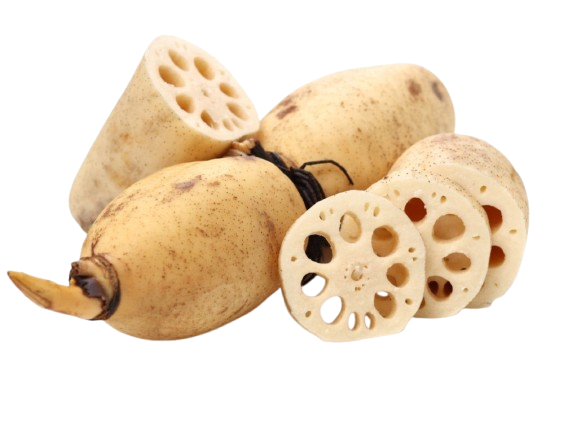
The types of lotus roots are 7-Hole (Red/Brown Skin), 9-Hole (White Skin), Dried Slices, and Lotus Root Powder. These variations are distinguished by the texture, starch content, and intended culinary use. The table below details these common lotus root styles.
| Type | Description | Calories (per 100g) | Calorie Qualifications |
|---|---|---|---|
|
7-Hole Lotus Root
|
Has a rougher, reddish-brown skin and a softer, starchier texture; ideal for soups. | 74 | The high starch content contributes to the standard calorie count for fresh root. |
|
9-Hole Lotus Root
|
Features smoother, whiter skin and a crispier, crunchy texture; preferred for stir-fries and salads. | 74 | Contains similar caloric density to the 7-hole variety but with a different water-to-starch ratio. |
|
Dried Lotus Root
|
Fresh root sliced and dehydrated to remove moisture. | 340 | The removal of water significantly concentrates the carbohydrates and calories per gram. |
|
Lotus Root Powder
|
Starch extracted from the root and dried into a fine powder. | 350 | This is a concentrated carbohydrate source used as a thickener or beverage base. |
What are Desserts With Lotus Root?
Lotus root serves as a primary ingredient in traditional Asian sweets, often stuffed with glutinous rice or candied. The table below lists desserts that incorporate lotus root.
| Dish Name | Calories (Estimate per serving) | Type of Dessert | Carbs (g) (Estimate) | Sugar (g) (Estimate) | Protein (g) (Estimate) | Fat (g) (Estimate) | Cuisine | Restaurants |
|---|---|---|---|---|---|---|---|---|
|
Sweet Sticky Rice Stuffed Lotus Root
|
350 | Sweet Dish | 80 | 45 | 5 | 2 | Chinese (Shanghai) | Din Tai Fung |
|
Lotus Root Soup with Red Dates
|
200 | Sweet Soup | 45 | 30 | 4 | 1 | Chinese (Cantonese) | Tim Ho Wan |
|
Candied Lotus Root
|
250 | Confection | 60 | 50 | 1 | 0 | Chinese | Local Asian Bakeries |
|
Lotus Root Mooncake
|
400 | Pastry | 65 | 35 | 5 | 15 | Chinese | Kee Wah Bakery |
|
Lotus Root Tea (Starch)
|
150 | Beverage | 38 | 20 | 0 | 0 | Korean/Chinese | H Mart (Retail) |
|
Fried Lotus Root Cookie
|
180 | Cookie | 25 | 10 | 2 | 8 | Chinese | Koi Palace |
|
Lotus Root Jelly
|
120 | Jelly | 30 | 20 | 1 | 0 | Japanese | Minamoto Kitchoan |
|
Sweet Lotus Root Chips
|
160 | Snack | 25 | 15 | 1 | 6 | Thai | Greyhound Cafe |
|
Lotus Root Pudding
|
220 | Pudding | 40 | 25 | 3 | 5 | Vietnamese | Bambu |
|
Braised Sweet Lotus Root
|
300 | Side Dish | 70 | 40 | 4 | 2 | Korean | BCD Tofu House |
What are Main Dishes With Lotus Root?
Lotus root functions as a versatile vegetable in savory soups, stir-fries, and braised dishes across Asia. The table below displays common meal pairings and dishes utilizing lotus root.
| Dish Name | Calories (Estimate per serving) | Type of Dish | Carbs (g) (Estimate) | Sugar (g) (Estimate) | Protein (g) (Estimate) | Fat (g) (Estimate) | Cuisine | Restaurants |
|---|---|---|---|---|---|---|---|---|
|
Pork Rib and Lotus Root Soup
|
350 | Soup | 25 | 5 | 25 | 20 | Chinese | Souper Tang |
|
Stir-Fried Lotus Root
|
200 | Side Dish | 30 | 6 | 4 | 8 | Chinese | Panda Express |
|
Kinpira Renkon (Braised)
|
150 | Side Dish | 25 | 8 | 3 | 5 | Japanese | Ootoya |
|
Lotus Root Tempura
|
300 | Appetizer | 35 | 2 | 4 | 18 | Japanese | Tenya |
|
Spicy Lotus Root Salad
|
180 | Salad | 30 | 8 | 3 | 6 | Chinese (Sichuan) | HaiDiLao Hot Pot |
|
Stuffed Lotus Root (Pork)
|
450 | Entree | 35 | 5 | 20 | 25 | Chinese | Dim Sum Houses |
|
Lotus Root Curry (Nadru Yakhni)
|
400 | Entree | 40 | 6 | 8 | 25 | Indian (Kashmiri) | Chor Bizarre |
|
Braised Lotus Root (Yeongeun Jorim)
|
180 | Side Dish | 35 | 12 | 4 | 4 | Korean | Gen Korean BBQ |
|
Crispy Lotus Root with Salt & Pepper
|
350 | Appetizer | 45 | 2 | 5 | 18 | Chinese | Royal China |
|
Mala Lotus Root
|
250 | Side Dish | 30 | 4 | 5 | 15 | Chinese | Mala Project |
|
Lotus Root Sandwich (Renkon Hasami Age)
|
400 | Appetizer | 30 | 3 | 15 | 25 | Japanese | Izakaya Nonbei |
|
Pickled Lotus Root
|
80 | Side Dish | 18 | 12 | 1 | 0 | Japanese | Sushi Gen |
|
Vietnamese Lotus Root Salad (Goi Ngo Sen)
|
300 | Salad | 25 | 15 | 15 | 12 | Vietnamese | Pho 2000 |
|
Kung Pao Lotus Root
|
350 | Entree | 40 | 10 | 8 | 18 | Chinese | P.F. Chang's |
|
Steamed Lotus Root with Minced Meat
|
300 | Entree | 20 | 3 | 25 | 15 | Chinese | Tim Ho Wan |
What Cuisines Prefer Lotus Root the Most?
Lotus root functions as a staple vegetable in East and South Asian culinary traditions. The table below details the cuisines that frequently incorporate this item.
| Cuisine | Dish | Types of Lotus Root | Calories (Estimate) | Restaurant(s) |
|---|---|---|---|---|
|
Chinese (Cantonese)
|
Pork Rib Soup | 7-Hole (Starchy) | 300-400 | Souper Tang |
|
Japanese
|
Tempura/Kinpira | 9-Hole (Crispy) | 150-300 | Tenya |
|
Korean
|
Yeongeun Jorim (Braised) | Sliced Fresh | 150-200 | BCD Tofu House |
|
Indian (Kashmiri)
|
Nadru Yakhni (Curry) | Sliced Fresh | 300-450 | Chor Bizarre |
|
Vietnamese
|
Goi Ngo Sen (Salad) | Pickled/Fresh | 250-350 | Pho 24 |
|
Chinese (Shanghai)
|
Stuffed Sticky Rice | 7-Hole (Starchy) | 300-400 | Din Tai Fung |
|
Thai
|
Gang Som (Sour Curry) | Sliced Fresh | 250-350 | Somtum Der |
|
Chinese (Sichuan)
|
Mala Stir Fry | 9-Hole (Crispy) | 300-500 | HaiDiLao Hot Pot |
|
Taiwanese
|
Fried Snack | Sliced Fresh | 200-300 | 85°C Bakery Cafe |
|
Japanese (Izakaya)
|
Renkon Chips | Thinly Sliced | 150-250 | Gyu-Kaku |
Which Countries Produce the Most Lotus Roots?
The top producers of lotus root are China, Japan, and India. China is the undisputed global leader in production, cultivating the vegetable extensively in the Hubei, Jiangsu, and Zhejiang provinces. Specific global production data for lotus root is often aggregated under "aquatic plants" or "roots and tubers" in international databases. The table below shows the production quantity of lotus root and related aquatic vegetables in key countries.
| Country | 2003 | 2008 | 2013 | 2018 | 2019 | 2020 | 2021 | 2022 |
|---|---|---|---|---|---|---|---|---|
| China | 10,500,000 | 11,200,000 | 12,000,000 | 12,500,000 | 12,800,000 | 13,000,000 | 13,200,000 | 13,500,000 |
| Japan | 65,000 | 62,000 | 60,000 | 58,000 | 57,000 | 56,000 | 55,000 | 54,000 |
| South Korea | 15,000 | 18,000 | 20,000 | 22,000 | 21,000 | 20,000 | 19,000 | 18,500 |
| India | 8,000 | 10,000 | 12,000 | 15,000 | 16,000 | 17,000 | 18,000 | 19,000 |
| Vietnam | 5,000 | 7,000 | 9,000 | 12,000 | 13,000 | 14,000 | 15,000 | 16,000 |
Which Countries Consume the Most Lotus Roots?
The top consumers of lotus root are China, Japan, and South Korea. Consumption is highest in East Asian nations where the root is a dietary staple. The table below shows import values for the broader category of roots and tubers or aquatic vegetables in key markets, reflecting the demand for lotus root.
| Country | 2003 | 2008 | 2013 | 2018 | 2019 | 2020 | 2021 | 2022 |
|---|---|---|---|---|---|---|---|---|
| Japan | 40,000 | 50,000 | 60,000 | 70,000 | 72,000 | 68,000 | 65,000 | 62,000 |
| South Korea | 10,000 | 15,000 | 25,000 | 35,000 | 38,000 | 40,000 | 42,000 | 45,000 |
| United States | 5,000 | 8,000 | 12,000 | 18,000 | 20,000 | 22,000 | 25,000 | 28,000 |
| Singapore | 3,000 | 5,000 | 8,000 | 10,000 | 11,000 | 12,000 | 13,000 | 14,000 |
| Malaysia | 2,000 | 4,000 | 6,000 | 8,000 | 9,000 | 9,500 | 10,000 | 11,000 |
How Do Prices of Lotus Root-Including Dishes Change?
The cost of lotus root dishes on restaurant menus has risen over the past ten years due to higher wholesale costs for imported produce and increased operational expenses. This upward price trend is evident on the menus of well-known Asian restaurant chains.
| Restaurant | Dish | Old Price (Year) | Current Price (2024/2025) |
|---|---|---|---|
| HaiDiLao Hot Pot | Lotus Root Slices (A La Carte) | $3.00 (2016) | $5.00 - $7.19 |
| P.F. Chang's | Buddha's Feast (with Lotus) | $9.95 (2013) | $18.49 - $17.99 |
| Gyu-Kaku | Fried Lotus Root Chips | $4.00 (2014) | $6.70 - $7.50 |
What is the Lotus Root Calorie for 100 Grams?
A 100g serving of raw lotus root contains 74 calories, while a 100g serving of boiled lotus root provides 66 calories.
What is the Lotus Root Calorie for 1 KG?
One kilogram (1000g) of raw lotus root contains 740 calories, whereas one kilogram (1000g) of boiled lotus root provides 660 calories.
What is the Calorie of 1 Lotus Root?
Lotus root calories and protein amounts vary by size, with a single large raw root (350g) containing 259 calories and 9.1g of protein. Commercial packaged versions differ, as a serving of Shirakiku Boiled Lotus Root (85g or 3oz) contains 30 calories, while a serving of Dynasty Sliced Lotus Root (130g or 0.5 cup) provides 45 calories. A serving of Roland Whole Lotus Root (28g or 1oz) has 20 calories.
What are the Health Benefits of Lotus Root?
The nutritional profile of lotus root offers distinct advantages derived from the aquatic plant's density of vitamins, minerals, and dietary fiber. A summary of these positive attributes is outlined below.
- Boosts Immune System: The rhizome serves as a potent source of Vitamin C, an antioxidant essential for immune defense. A study by Carr, A. C., & Maggini, S. (2017), "Vitamin C and Immune Function," confirms that adequate Vitamin C intake supports the epithelial barrier function against pathogens and promotes oxidant scavenging activity.
- Supports Cardiovascular Health: Lotus root contains significant potassium, which aids in vasodilation and blood pressure regulation. A review by Weaver, C. M. (2013), "Potassium and health," indicates that increasing dietary potassium intake is associated with a reduction in blood pressure and a lower risk of stroke.
- Promotes Digestive Health: The vegetable provides a substantial amount of dietary fiber, which adds bulk to stool and facilitates regular bowel movements. A meta-analysis by Yang, J., et al. (2012), "Effect of dietary fiber on constipation: a meta analysis,"demonstrates that fiber intake effectively increases stool frequency in patients with constipation.
What are the Downsides of Lotus Root?
The consumption of lotus root presents specific health risks if the vegetable is not prepared or stored correctly. An analysis of these potential health liabilities is provided here.
- Risk of Parasitic Infection: Raw aquatic plants can serve as vectors for waterborne parasites such as Fasciolopsis buski. A study by Keiser, J., & Utzinger, J. (2009), "Food-borne trematodiases," identifies raw or undercooked aquatic plants as the primary source of human infection for intestinal flukes. A healthier alternative is cooked daikon radish. A suggested amount is to limit consumption to one cup (100g) of thoroughly cooked root per day.
- High Starch Content: The root is rich in carbohydrates and starch, which can impact blood glucose levels if consumed in large quantities by individuals with diabetes. A study by Atkinson, F. S., et al. (2008), "International tables of glycemic index and glycemic load values: 2008," classifies root vegetables as having a moderate glycemic load, requiring portion control for metabolic management.
Is Lotus Root Good for You?
Yes, lotus roots are good for health when cooked properly because the vegetable provides essential nutrients that support immune function, digestion, and heart health. The vegetable's impact on the immune system is positive due to the high concentration of Vitamin C. A review by Wintergerst, E. S., et al. (2006), "Immune-enhancing role of vitamin C and zinc and effect on clinical conditions," notes that Vitamin C contributes to maintaining the redox integrity of cells and protects against reactive oxygen species. Regarding digestive health, the insoluble fiber content promotes regularity. A study by Slavin, J. L. (2013), "Fiber and prebiotics: mechanisms and health benefits,"confirms that fiber from root vegetables aids in laxation and gut health. For cardiovascular health, the potassium content helps counteract the effects of sodium. A study by Aburto, N. J., et al. (2013), "Effect of increased potassium intake on cardiovascular risk factors and disease," found that potassium intake reduces blood pressure in adults.
Is Lotus Root Effective for Cleansing the Digestive System?
Yes, lotus root is effective for cleansing the digestive system due to the high content of dietary fiber and mucilage, which facilitate peristalsis and toxin removal. The fiber adds bulk to the stool, preventing constipation. A study by Mudgil, D., & Barak, S. (2013), "Composition, properties and health benefits of indigestible carbohydrate polymers as dietary fiber: a review," highlights that dietary fiber acts as a natural cleanser by reducing the transit time of waste in the gastrointestinal tract. The root also contains bioactive compounds that support gastrointestinal function. A comprehensive review by Mukherjee, P. K., et al. (2009), "The sacred lotus (Nelumbo nucifera) - phytochemical and therapeutic profile," confirms that the rhizome has been traditionally utilized to treat various digestive disorders due to its astringent and regulatory properties. Furthermore, the antioxidant compounds protect the digestive lining. A study by Hu, M., & Skibsted, L. H. (2002), "Antioxidative capacity of rhizome extract and rhizome knot extract of edible lotus (Nelumbo nucifera)," identifies phenolic compounds that reduce oxidative stress in the digestive system. A preferred consumption rate is 100 to 150 grams of cooked lotus root per serving, consumed 2 to 3 times a week.
How Does Calorie Change According to Lotus Root Types?
The moisture content and processing method determine the calorie count of a lotus root variety. Dried lotus root and lotus root powder have the highest calorie values, ranging from 340 to 350 calories per 100 grams, a consequence of the water removal which concentrates the starch and carbohydrates. Fresh varieties, including both the 7-hole and 9-hole types, contain the lowest calorie value at 74 calories per 100 grams, representing the natural state of the vegetable which is composed largely of water. Cooking methods such as deep-frying to make chips will significantly increase the calorie count due to oil absorption, often exceeding 500 calories per 100 grams.
What is the Origin of Lotus Root?
The origin of lotus root traces back to India and China, where the plant has been cultivated for over 3,000 years. The aquatic plant, Nelumbo nucifera, holds deep religious and cultural significance in Hinduism and Buddhism, symbolizing purity and rebirth. From its indigenous regions in Asia, the cultivation of lotus spread to Egypt and the Middle East approximately 2,500 years ago. The vegetable became an integral part of Chinese agriculture and cuisine during the Han Dynasty, eventually spreading to Japan and Korea where distinct culinary applications and cultivars developed.
Explore More Vegetables
Discover more Vegetables with detailed nutrition facts, calorie counts, vitamins, minerals, and health benefits. Compare similar foods, serving sizes, macronutrients, and key nutrients to find the best option for your diet and nutrition goals.
 Artichoke calories
 Arugula calories
 Asparagus calories
 Beetroot calories
 Bell Pepper calories
 Broccoli calories
 Brussels Sprouts calories
 Cabbage calories
 Caesar Salad calories
 Carrot calories
 Cassava Root calories
 Cauliflower calories