Calories and Nutritions in Purple Yam
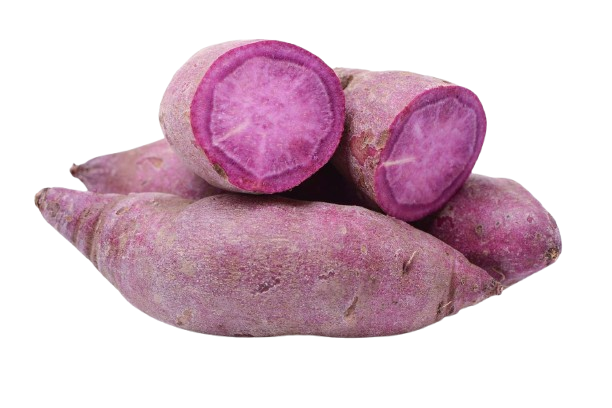
Purple yam is a violet colored starchy root vegetable used as a key ingredient in several Southeast Asian desserts. A large raw purple yam tuber weighing 300g contains 420 calories, while a 100g portion has 140 calories. Cooking methods alter the caloric density of this tuber, and a cup of boiled purple yam cubes weighing 135g provides 162 calories while steamed purple yam (150g) contains 188 calories. Processed versions like the purple yam jam or Ube Halaya contain 71 calories in just a 20g tablespoon due to added sweeteners. Giron Foods Powdered Purple Yam can go as high as 400 calories per 100g serving.
An examination of purple yam nutrition facts reveals a food rich in carbohydrates and dietary fiber. A large raw portion (300g) delivers 83.7g of carbohydrates and 12g of fiber along with 4.5g of protein and only 0.6g of fat. This root vegetable is packed with essential micronutrients providing 33% of the Daily Value for Vitamin C and Vitamin A which helps immune function and vision. Potassium content is very high at 2448mg or 52% of the Daily Value per 300g serving of purple yam.
Global production of purple yam is concentrated in West Africa where Nigeria and Ghana lead the cultivation of Dioscorea alata. The Philippines focuses on the Ube variety for sweets. Major consumers of purple yam include the Philippines, the United States, and Japan, using it as a core component in at least three distinct food cultures featuring in the Filipino Halo-Halo, Vietnamese Canh Khoai Mo, and Indian Undhiyu. Market prices have increased drastically over the last twenty years. Farmgate costs in the Philippines quadrupled from 20 PHP to over 80 PHP per kilogram. Retail jam prices in the US rose from under $5.00 to between $10.00 and $15.00 per jar. Menu prices show this inflation as a whole Ube Roll at Goldilocks moved from $12.00 in 2015 to over $19.95 in 2025.
Purple yam is prized for its antioxidant anthocyanins and resistant starch that helps regulate blood sugar. Dietitians suggest eating boiled or steamed tubers as part of a healthy diet but advise limiting processed jams because of the sugar. A small serving of raw purple yam (100g) contains 140 calories which takes about 14 minutes of running or 18 minutes of swimming to burn off.
Purple Yam nutrition
| Stats | Weight |
|---|---|
| Carbs | 55.8 grams |
| Protein | 3 grams |
| Fats | 0 grams |
| Sugars | 1 grams |
- Large Purple Yam Calories (Nutritional Facts)
- Medium Purple Yam Calories (Nutritional Facts)
- Small Purple Yam Calories (Nutritional Facts)
- Boiled Purple Yam Calories (Nutritional Facts)
- Steamed Purple Yam Calories (Nutritional Facts)
- Purple Yam Jam Calories (Nutritional Facts)
- Raw Purple Yam Nutrition
- Sodium in Purple Yam
- Potassium in Purple Yam
- Sugar in Purple Yam
- Fiber in Purple Yam
- Protein in Purple Yam
- Carbs in Purple Yam
- Fat in Purple Yam
- Vitamins in Purple Yam
- Minerals in Purple Yam
Large Purple Yam Calories (Nutritional Facts)
A large raw purple yam (300g or 10.6oz) contains 420 calories, 4.5g of protein, 0.6g of fat, 83.7g of carbohydrates, 12g of dietary fiber, 1.5g of sugar, and 27mg of sodium.
A medium raw purple yam (200g or 7oz) provides 280 calories, 3g of protein, 0.4g of fat, 55.8g of carbohydrates, 8g of dietary fiber, 1g of sugar, and 18mg of sodium.
A small raw purple yam (100g or 3.5oz) contains 140 calories, 1.5g of protein, 0.2g of fat, 27.9g of carbohydrates, 4g of dietary fiber, 0.5g of sugar, and 9mg of sodium.
A serving of boiled purple yam cubes (135g or 1 cup) contains 162 calories, 1.9g of protein, 0.3g of fat, 36.5g of carbohydrates, 5.4g of fiber, 0.7g of sugar, and 14mg of sodium. The boiling process introduces water into the tuber, which slightly reduces the caloric density per gram compared to the raw state.
A serving of steamed purple yam (150g or 5.3oz) provides 188 calories, 2.3g of protein, 0.3g of fat, 42g of carbohydrates, 6g of fiber, 0.8g of sugar, and 15mg of sodium.
A serving of purple yam jam, also known as Ube Halaya (20g or 1 tbsp), contains 71 calories, 0.6g of protein, 1.8g of fat, 13.4g of carbohydrates, 0.4g of fiber, 8.8g of sugar, and 17mg of sodium. This preparation involves added sugars and dairy, significantly increasing the calorie and fat content compared to the vegetable in its natural form.
A serving of raw purple yam cubes (133g or 1 cup) contains 186 calories, 2g of protein, 0.3g of fat, 37.1g of carbohydrates, 5.3g of fiber, 0.7g of sugar, and 12mg of sodium.
A large serving of raw purple yam (300g) contains 27mg of sodium (1% DV). A medium serving of raw purple yam (200g) has 18mg of sodium (1% DV). A small serving of raw purple yam (100g) contains 9mg of sodium (0% DV). A serving of purple yam jam (20g) contains 17mg of sodium (1% DV). A serving of boiled purple yam cubes (135g) provides 14mg of sodium (1% DV).
A large serving of raw purple yam (300g) contains 2448mg of potassium (52% DV). A medium serving of raw purple yam (200g) has 1632mg of potassium (35% DV). A small serving of raw purple yam (100g) contains 816mg of potassium (17% DV). A serving of raw purple yam cubes (133g) contains 1085mg of potassium (23% DV). A serving of steamed purple yam (150g) provides 1224mg of potassium (26% DV).
A large serving of raw purple yam (300g) contains 1.5g of sugar. A medium serving of raw purple yam (200g) has 1g of sugar. A small serving of raw purple yam (100g) contains 0.5g of sugar. A serving of purple yam jam (20g) contains 8.8g of sugar. A serving of boiled purple yam cubes (135g) provides 0.7g of sugar.
A large serving of raw purple yam (300g) provides 12g of dietary fiber (43% DV). A medium serving of raw purple yam (200g) has 8g of fiber (29% DV). A small serving of raw purple yam (100g) contains 4g of fiber (14% DV). A serving of raw purple yam cubes (133g) contains 5.3g of fiber (19% DV). A serving of purple yam jam (20g) provides 0.4g of fiber (1% DV).
A large serving of raw purple yam (300g) provides 4.5g of protein (9% DV). A medium serving of raw purple yam (200g) has 3g of protein (6% DV). A small serving of raw purple yam (100g) contains 1.5g of protein (3% DV). A serving of purple yam jam (20g) contains 0.6g of protein (1% DV). A serving of boiled purple yam cubes (135g) provides 1.9g of protein (4% DV).
A large serving of raw purple yam (300g) contains 83.7g of carbohydrates (30% DV). A medium serving of raw purple yam (200g) has 55.8g of carbohydrates (20% DV). A small serving of raw purple yam (100g) contains 27.9g of carbohydrates (10% DV). A serving of purple yam jam (20g) has 13.4g of carbohydrates (5% DV). A serving of boiled purple yam cubes (135g) contains 36.5g of carbohydrates (13% DV).
A large serving of raw purple yam (300g) contains 0.6g of total fat (1% DV). A medium serving of raw purple yam (200g) has 0.4g of total fat (1% DV). A small serving of raw purple yam (100g) contains 0.2g of total fat (0% DV). A serving of purple yam jam (20g) provides 1.8g of total fat (2% DV). A serving of boiled purple yam cubes (135g) contains 0.3g of total fat (0% DV).
A large serving of raw purple yam (300g) provides 30mg of Vitamin C (33% DV) and 300mcg of Vitamin A (33% DV). A medium serving of raw purple yam (200g) has 20mg of Vitamin C (22% DV) and 200mcg of Vitamin A (22% DV). A small serving of raw purple yam (100g) contains 10mg of Vitamin C (11% DV) and 100mcg of Vitamin A (11% DV). A serving of purple yam jam (20g) contains 0.4mg of Vitamin C (0% DV).
A large serving of raw purple yam (300g) provides 0.54mg of copper (60% DV) and 1.6mg of iron (9% DV). A medium serving of raw purple yam (200g) has 0.36mg of copper (40% DV) and 1.1mg of iron (6% DV). A small serving of raw purple yam (100g) contains 0.18mg of copper (20% DV) and 0.5mg of iron (3% DV). A serving of purple yam jam (20g) contains 8mg of calcium (1% DV).
Get a Custom Report on Purple Yam Nutrition Data – Contact Us!
What are the Types of Purple Yams?
The types of purple yam are Raw (Fresh), Boiled, Steamed, and Jam (Ube Halaya). These variations differ based on the cooking method and the addition of other ingredients like sugar or milk. The following chart illustrates the differences among these forms.
| Type | Description | Calories (Per 100g) | Calorie Qualifications |
|---|---|---|---|
|
Raw Purple Yam
|
Unprocessed tuber requiring cooking before consumption. | 140 | The calorie count reflects the natural starch and moisture content of the fresh root. |
|
Boiled Purple Yam
|
Cooked in water, causing slight moisture absorption. | 120 | The absorption of water during boiling reduces the caloric density per gram. |
|
Steamed Purple Yam
|
Cooked with steam, retaining natural sugars and starch. | 125 | The gentle cooking method preserves the nutrient profile with minimal moisture change. |
|
Purple Yam Jam (Ube Halaya)
|
Processed mash with added sugar, milk, and butter. | 356 | The addition of sweeteners and fats drastically increases the energy density. |
What are Desserts With Purple Yam?
Purple yam appears ubiquitously in Filipino and Southeast Asian confectionery, utilizing the tuber's vibrant violet hue and nutty vanilla flavor to create visually striking sweets. The table below outlines confectioneries that incorporate purple yam.
| Dish Name | Calories (Estimate) | Type of Dish | Carbs (g) (Estimate) | Sugar (g) (Estimate) | Protein (g) (Estimate) | Fat (g) (Estimate) | Cuisine | Restaurants |
|---|---|---|---|---|---|---|---|---|
|
Ube Halaya
|
360 | Jam/Pudding | 67 | 44 | 3 | 9 | Filipino | Goldilocks |
|
Halo-Halo
|
450 | Shaved Ice | 85 | 50 | 8 | 10 | Filipino | Jollibee |
|
Ube Cheesecake
|
480 | Cake/Pastry | 45 | 30 | 8 | 32 | Filipino Fusion | Hood Famous Bakeshop (Seattle, WA) |
|
Ube Mamon
|
180 | Muffin | 28 | 18 | 2 | 7 | Filipino | Red Ribbon Bakeshop |
|
Ube Ice Cream
|
240 | Frozen Dessert | 25 | 22 | 4 | 14 | Filipino | Magnolia Ice Cream (Retail/Parlors) |
|
Ube Mochi Donut
|
320 | Fried Dough | 40 | 18 | 3 | 16 | Japanese Fusion | Mochinut |
|
Ube Tart
|
210 | Pastry | 30 | 15 | 3 | 9 | Filipino Fusion | Cafe 86 (California/Nevada) |
|
Ube Ensaymada
|
350 | Sweet Bread | 45 | 20 | 6 | 16 | Filipino | Starbread Bakery |
|
Ube Leche Flan
|
310 | Custard | 35 | 32 | 6 | 12 | Filipino | Grill City |
|
Ube Tres Leches
|
400 | Soaked Cake | 50 | 35 | 7 | 18 | Fusion | Trader Oreos (New York, NY) |
|
Ube Polvoron
|
160 | Shortbread | 20 | 10 | 2 | 8 | Filipino | Goldilocks |
|
Ube Hopia
|
220 | Filled Pastry | 32 | 14 | 4 | 8 | Filipino | Eng Bee Tin (Imports/Retail) |
|
Ube Roll Cake
|
300 | Sponge Cake | 42 | 24 | 5 | 12 | Filipino | Red Ribbon Bakeshop |
|
Ube Biko
|
380 | Rice Cake | 65 | 25 | 4 | 10 | Filipino | Kakanin (Various Local Vendors) |
What are Main Dishes With Purple Yam?
Purple yam serves as a primary starch or vegetable component in savory stews, soups, and breakfast entrees across Asian and fusion cuisines. The dense texture allows the tuber to hold shape in curries or create thick, creamy soups. The table below displays savory meals and breakfast items that feature purple yam.
| Dish Name | Calories (Estimate) | Type of Dish | Carbs (g) (Estimate) | Sugar (g) (Estimate) | Protein (g) (Estimate) | Fat (g) (Estimate) | Cuisine | Restaurants |
|---|---|---|---|---|---|---|---|---|
|
Ube Pancakes
|
550 | Breakfast Main | 95 | 35 | 10 | 15 | Hawaiian Fusion | YogurStory (Honolulu, HI) |
|
Undhiyu (Mixed Veg)
|
350 | Vegetable Curry | 45 | 12 | 8 | 18 | Indian (Gujarati) | Rajbhog Sweets & Snacks (National) |
|
Canh Khoai Mo (Soup)
|
200 | Meat Soup | 25 | 4 | 15 | 6 | Vietnamese | Saigon Social (New York, NY) |
|
Ube Gnocchi
|
420 | Pasta Dish | 75 | 6 | 10 | 12 | Italian Fusion | Aina (San Francisco, CA) |
|
Ube Waffles
|
480 | Breakfast Main | 80 | 28 | 9 | 16 | Fusion | Cafe 86 (California) |
|
Ratalu Puri (Fried Bread)
|
280 | Fried Bread | 35 | 3 | 4 | 14 | Indian | Honest Restaurant |
|
Ube Pandesal (Savory)
|
220 | Bread Roll | 38 | 8 | 6 | 5 | Filipino | Pan de Manila (Imports/Local) |
|
Mashed Purple Yam
|
250 | Side Dish | 45 | 6 | 3 | 8 | American Fusion | The Park's Finest (Los Angeles, CA) |
|
Purple Yam Fries
|
260 | Fried Side | 35 | 8 | 2 | 12 | Fusion | The Loop |
|
Ratalu Tikki (Patties)
|
300 | Fried Snack | 32 | 4 | 5 | 18 | Indian | Nitus Kitchen (New York, NY) |
|
Ube Bao Buns
|
280 | Steamed Bun | 45 | 10 | 6 | 4 | Asian Fusion | Harumama Noodles (California) |
|
Purple Yam Tempura
|
320 | Fried Veg | 40 | 5 | 4 | 16 | Japanese Fusion | Marugame Udon |
|
Ube Grits
|
300 | Breakfast Side | 45 | 4 | 5 | 12 | Southern Fusion | FOB Kitchen (Oakland, CA) |
What Cuisines Prefer Purple Yam the Most?
Purple yam functions as a foundational staple in Filipino, Vietnamese, and Indian food cultures. The table below highlights culinary traditions that prioritize purple yam.
| Cuisine | Dish | Types of Purple Yam | Calories (Estimate) | Restaurant(s) |
|---|---|---|---|---|
|
Filipino
|
Ube Halaya | Boiled/Mashed | 360 | Goldilocks |
|
Vietnamese
|
Canh Khoai Mo | Minced/Soup | 200 | Pho Grand (New York, NY) |
|
Indian (Gujarati)
|
Undhiyu | Cubed/Stewed | 350 | Vitan (New Jersey) |
|
Hawaiian (Fusion)
|
Ube Pancakes | Batter/Sauce | 550 | YogurStory (Honolulu, HI) |
|
Japanese (Okinawa)
|
Beni Imo Tart | Paste/Baked | 280 | Blue Seal (Imports/Hawaii) |
|
Thai
|
Khanom Man Muang | Steamed/Cake | 220 | Bhan Kanom Thai (Los Angeles, CA) |
|
Indonesian
|
Es Teler | Cubed/Jelly | 300 | Simpang Asia (Los Angeles, CA) |
|
Chinese (Dim Sum)
|
Ube Sesame Balls | Paste/Fried | 250 | Nom Wah Tea Parlor (New York, NY) |
|
Sri Lankan
|
Raja Ala Curry | Cubed/Curried | 280 | Sigiri (New York, NY) |
|
Malaysian
|
Bubur Cha Cha | Boiled/Dessert | 380 | PappaRich (New York, NY) |
|
American (Fusion)
|
Ube Cheesecake | Baked/Creamed | 480 | Hood Famous Bakeshop (Seattle, WA) |
|
French (Fusion)
|
Ube Macaron | Meringue/Fill | 180 | Tous Les Jours |
|
Taiwanese
|
Taro/Ube Balls | Boiled/Chewy | 250 | Meet Fresh |
|
Caribbean
|
Provisions (Yam) | Boiled/Side | 200 | The Door (Queens, NY) |
Which Countries Produce the Most Purple Yams?
The top producers of purple yam (Dioscorea alata) are Nigeria, Ghana, and the Ivory Coast. While the Philippines is culturally synonymous with the specific "Ube" variety used in desserts, West African nations dominate the global volume of Dioscorea alata (water yam), cultivating it as a staple calorie source rather than a specialty ingredient. The Philippines remains the primary exporter of the processed purple yam used in global confectionery, though domestic production has faced challenges, declining from over 30,000 metric tons in 2006 to approximately 14,000 tons in 2020 due to climate factors. The table below shows the total yam production for the leading countries, which includes significant quantities of the purple-fleshed water yam.
| Country | 2003 | 2008 | 2013 | 2018 | 2019 | 2020 | 2021 | 2022 |
|---|---|---|---|---|---|---|---|---|
| Nigeria | 31,500 | 35,000 | 40,500 | 47,500 | 48,300 | 49,000 | 50,200 | 52,000 |
| Ghana | 3,800 | 4,800 | 6,600 | 7,800 | 8,000 | 8,200 | 8,500 | 8,800 |
| Ivory Coast | 4,500 | 5,000 | 5,700 | 7,200 | 7,300 | 7,400 | 7,600 | 7,700 |
| Benin | 2,100 | 2,400 | 2,800 | 3,000 | 3,100 | 3,200 | 3,300 | 3,400 |
| Togo | 600 | 700 | 800 | 850 | 860 | 880 | 900 | 950 |
| Cameroon | 300 | 350 | 450 | 550 | 580 | 600 | 620 | 650 |
| Philippines | 28 | 30 | 25 | 16 | 15 | 14 | 13 | 14 |
| Colombia | 250 | 280 | 320 | 380 | 390 | 400 | 410 | 420 |
Which Countries Consume the Most Purple Yams?
The top consumers of purple yam are the Philippines, the United States, and Japan. The Philippines utilizes the majority of its domestic "Ube" supply for traditional production of halaya, ice cream, and pastries. The United States stands as the largest importer of processed purple yam products, driven by the growing popularity of Filipino cuisine and the tuber's photogenic appeal in social media food trends. Japan and Canada also maintain steady import volumes to serve their diaspora communities and fusion dessert markets. The table below shows the estimated import values for processed purple yam products in key markets.
| Country | 2003 | 2008 | 2013 | 2018 | 2019 | 2020 | 2021 | 2022 |
|---|---|---|---|---|---|---|---|---|
| United States | 2.5 | 4.2 | 8.5 | 15.6 | 18.2 | 22.4 | 28.5 | 32.1 |
| Japan | 1.8 | 2.5 | 3.4 | 5.2 | 5.8 | 6.1 | 7.2 | 8.4 |
| Canada | 0.8 | 1.2 | 2.1 | 3.8 | 4.2 | 5.5 | 6.8 | 7.5 |
| Australia | 0.5 | 0.8 | 1.5 | 2.9 | 3.1 | 3.8 | 4.5 | 5.2 |
| United Arab Emirates | 0.3 | 0.6 | 1.2 | 2.4 | 2.6 | 2.9 | 3.4 | 3.9 |
| Saudi Arabia | 0.4 | 0.7 | 1.1 | 2.1 | 2.3 | 2.5 | 2.8 | 3.1 |
| United Kingdom | 0.2 | 0.4 | 0.9 | 1.8 | 2.0 | 2.4 | 2.9 | 3.3 |
| South Korea | 0.1 | 0.3 | 0.6 | 1.2 | 1.4 | 1.8 | 2.2 | 2.6 |
How Do Prices of Purple Yam-Including Dishes Change?
Menu pricing for dishes containing purple yam has increased significantly, reflecting the rising procurement costs of the raw ingredient and its elevation to a trendy "superfood" status. The table below displays the price changes for specific menu items at established restaurants.
| Brand/Restaurant | Dish | Old Price (Year) | Current Price (2024/2025) |
|---|---|---|---|
| Hood Famous Bakeshop (Seattle, WA) | Ube Cheesecake (Mini) | $4.99 (2017) | $6.39 - $8.00 |
| Goldilocks | Ube Roll (Whole) | $12.00 (2015) | $19.95 - $24.95 |
| Red Ribbon (Philippines) | Ube Bloom Cake | $5.50 (2018) | $7.24 - $8.20 |
| Chowking | Halo-Halo (Regular) | ₱5.50 (2012) | $7.99 - $8.50 |
| Magnolia (Retail US) | Ube Ice Cream (1.42L) | $8.99 (2015) | $12.00 - $17.49 |
| Cafe 86 (California) | Ube Truffles | $4.80 (2016) | $6.75 - $8.00 |
| Trader Joe's (Retail US) | Ube Mochi Pancake Mix | $2.99 (2020) | $3.99 - $5.99 |
What is the Purple Yam Calorie for 100 Grams?
A 100g serving of raw purple yam contains 140 calories, while a 100g serving of boiled purple yam provides 120 calories. A 100g serving of purple yam jam contains 356 calories.
What is the Purple Yam Calorie for 1 KG?
One kilogram (1000g) of raw purple yam contains 1,400 calories, whereas one kilogram (1000g) of boiled purple yam provides 1,200 calories. One kilogram (1000g) of purple yam jam contains 3,560 calories.
What is the Calorie of 1 Purple Yam?
A single small raw portion of purple yam (100g) contains 140 calories. One large portion of raw purple yam (300g) contains 420 calories. Commercial products vary, as a serving of Giron Foods Powdered Purple Yam (100g) provides 400 calories.
What are the Health Benefits of Purple Yam?
The nutritional profile of purple yam offers specific advantages related to antioxidant protection, glycemic control, and digestive maintenance. The root vegetable serves as a dense source of anthocyanins and resistant starch.
- Provides Antioxidant Protection: The tuber contains high levels of anthocyanins, which reduce oxidative stress and cellular damage. A study by Cornago, D. F., et al. (2011), "Philippine Yam (Dioscorea spp.) Tubers Phenolic Content and Antioxidant Capacity," established that the pigments in the flesh possess significant radical-scavenging activity comparable to potent antioxidants like Vitamin C.
- Regulates Blood Glucose: The food supplies complex carbohydrates with a moderate glycemic index, supporting stable insulin responses. Research by Ramdath, D. D., et al. (2004), "Glycaemic index of selected staples commonly eaten in the Caribbean," highlights that yam consumption results in a slower rise in blood sugar compared to refined grains, aiding in metabolic management.
- Reduces Inflammation: The vegetable delivers bioactive compounds that assist in weight management and glucose regulation. A study by Helen, O., et al. (2013), "Dioscorea alata L. reduces body weight by reducing food intake and fasting blood glucose level," confirms that consumption of the tuber can improve metabolic parameters and reduce risk factors associated with obesity.
What are the Downsides of Purple Yam?
Purple yam presents health risks linked to oxalate content and high caloric density in processed forms. These components require monitoring to prevent renal issues and weight gain. Purple yam consumption’s distinct health risks are presented below.
- Increases Kidney Stone Risk: The root contains oxalates, antinutrients that may contribute to stone formation in susceptible individuals. A study by Wanasundera, J. P., & Ravindran, G. (1994), "Nutritional assessment of yam (Dioscorea alata) tubers," found that yams contain calcium oxalate crystals, necessitating proper cooking to reduce concentration and minimize renal stress.
- Elevates Caloric Intake in Processed Forms: The vegetable is frequently consumed as a sweetened jam (Ube Halaya), which significantly increases sugar and fat consumption. Research by Chandrasekara, A., & Kumar, T. J. (2016), "Roots and Tuber Crops as Functional Foods: A Review on Phytochemical Constituents and Their Potential Health Benefits," suggests that while the raw tuber is healthy, traditional processing methods often add excessive calories, negating the metabolic benefits. A safer alternative for individuals monitoring carbohydrate or oxalate intake is steamed pumpkin. A suggested daily amount involves limiting consumption to a single small serving (100g) on rare occasions.
Is Purple Yam Good for You?
Yes, purple yam is good for health because the root vegetable offers a dense profile of anthocyanins, potassium, and resistant starch that support multiple physiological systems. The high anthocyanin content supports cardiovascular health by reducing oxidative stress and improving blood vessel function, a benefit highlighted by Cornago, D. F., et al. (2011), "Philippine Yam (Dioscorea spp.) Tubers Phenolic Content and Antioxidant Capacity." The presence of resistant starch supports digestive health by modulating glucose absorption and improving gut function, as noted by Melese, A. D., et al. (2022), " Impacts of Pretreatment Techniques on the Quality of Tuber Flours." The food also aids in blood pressure regulation due to the high potassium concentration, which Wanasundera, J. P., & Ravindran, G. (1994), "Nutritional assessment of yam (Dioscorea alata) tubers," identified as a critical mineral for maintaining fluid balance and vascular tone.
How Do Calories Change According to Purple Yam Types?
The calorie count varies significantly between the natural and processed preparations of purple yam. A serving of Purple Yam Jam (Ube Halaya) contains 356 calories per 100 grams, representing the highest energy density due to the incorporation of sugar, condensed milk, and butter. Raw Purple Yam presents a moderate profile at 140 calories per 100 grams, reflecting the dense starch content of the uncooked tuber. Steamed Purple Yam provides a slightly lower value at 125 calories per 100 grams, as the cooking process alters the texture without adding fats. Boiled Purple Yam provides the lowest profile at 120 calories per 100 grams, a result of water absorption expanding the volume and diluting the caloric concentration.
What is the Origin of Purple Yam?
The cultivation of purple yam traces back to Southeast Asia, specifically the Philippines and Indonesia, where the tuber served as a vital starch source for Austronesian voyagers. Archaeological evidence suggests the domestication of Dioscorea alata occurred independently in these regions before spreading to the Pacific Islands, Madagascar, and Africa via maritime trade routes. Indigenous communities valued the crop for its durability and high yield, establishing the root as a staple in tropical diets. The vibrant purple variety, distinct from the white greater yam, gained cultural prominence in the Philippines, eventually becoming synonymous with the country's dessert heritage in the form of Ube. Modern globalization introduced the ingredient to Western markets, where the unique color and flavor profile fueled a surge in popularity within fusion gastronomy.
Explore More Vegetables
Discover more Vegetables with detailed nutrition facts, calorie counts, vitamins, minerals, and health benefits. Compare similar foods, serving sizes, macronutrients, and key nutrients to find the best option for your diet and nutrition goals.
 Artichoke calories
 Arugula calories
 Asparagus calories
 Beetroot calories
 Bell Pepper calories
 Broccoli calories
 Brussels Sprouts calories
 Cabbage calories
 Caesar Salad calories
 Carrot calories
 Cassava Root calories
 Cauliflower calories