Calories and Nutritions in Romanesco
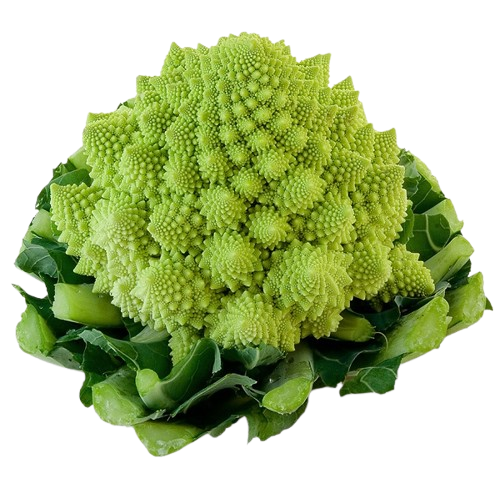
Romanesco is an edible flower bud of the species Brassica oleracea known for its fractal patterns and nutty flavor. The calories in romanesco vary by size and cooking method, with a small raw romanesco head (300g or 10.6oz) containing 93 calories and a small boiled romanesco head (300g or 10.6oz) providing 84 calories. A standard 100g portion of raw Romanesco contains 31 calories, whereas boiled versions provide 28 calories.
An analysis of romanesco nutrition reveals a food dense in fiber and Vitamin C, with a large raw romanesco head (800g or 28.2oz) providing 20g of protein (40% DV), 2.4g of fat (3% DV), and 48g of carbohydrates (17% DV), including 20g of sugar and 240mg of sodium. The preparation style alters the calorie density from 31 calories per 100g for fresh raw vegetable to 28 calories for boiled versions due to water absorption, while roasting increases the energy content significantly to 100 calories per 100g through oil absorption. The vegetable belongs to the same species as cauliflower and possesses a nearly identical texture, allowing for substitution in recipes where a nuttier flavor and firmer structure are desired. The green pigment indicates the presence of carotenoids, and a review by Podsędek, A. (2007) confirms that green Brassica vegetables serve as significant sources of lutein and beta-carotene which protect the retina.
The supply chain depends on brassica agriculture, with top producers like China yielding over 9.9 million tonnes of cauliflower and broccoli in 2022. This harvest feeds high demand in European markets, where the United Kingdom imported over $360 million in brassica vegetables in 2022. The flower bud serves as a primary ingredient in at least 10 distinct dessert preparations, such as Romanesco Lemon Cake, and as a savory component in 15 different culinary preparations, including Italian braised dishes. Economic factors have driven costs upward, as the retail price for a head of Romanesco rose from under $2.00 in the early 2000s to over $4.99 after 2020. Menu prices reflect this trend, as a Garlic Parm Romanesco side at Sweetgreen moved from $2.95 to between $3.95 and $4.95.
The presence of raffinose means Romanesco consumption requires moderation for individuals with sensitive digestive systems to prevent bloating. Health authorities recommend cooking the vegetable to improve digestibility and reduce goitrogens. A suggested consumption rate is to limit intake to one cup (100g) of cooked romanesco florets per meal, as the 31 calories found in a standard 100g raw serving require an energy expenditure equivalent to 3 minutes of running or 4 minutes of swimming.
Romanesco nutrition
| Stats | Weight |
|---|---|
| Carbs | 30 grams |
| Protein | 12.5 grams |
| Fats | 0 grams |
| Sugars | 12.5 grams |
- Large Romanesco Calories (Nutritional Facts)
- Medium Romanesco Calories (Nutritional Facts)
- Small Romanesco Calories (Nutritional Facts)
- Raw Romanesco Nutrition
- Sodium in Romanesco
- Potassium in Romanesco
- Sugar in Romanesco
- Fiber in Romanesco
- Protein in Romanesco
- Carbs in Romanesco
- Fat in Romanesco
- Vitamins in Romanesco
- Minerals in Romanesco
Large Romanesco Calories (Nutritional Facts)
A large raw romanesco head (800g or 28.2oz) contains 248 calories, 20g of protein, 2.4g of fat, 48g of carbohydrates, 24g of fiber, 20g of sugar, and 240mg of sodium. A large boiled romanesco head (800g or 28.2oz) provides 224 calories, 16g of protein, 1.6g of fat, 40g of carbohydrates, 20g of fiber, 16g of sugar, and 160mg of sodium.
A medium raw romanesco head (500g or 17.6oz) provides 155 calories, 12.5g of protein, 1.5g of fat, 30g of carbohydrates, 15g of fiber, 12.5g of sugar, and 150mg of sodium. A medium boiled romanesco head (500g or 17.6oz) contains 140 calories, 10g of protein, 1g of fat, 25g of carbohydrates, 12.5g of fiber, 10g of sugar, and 100mg of sodium.
A small raw romanesco head (300g or 10.6oz) contains 93 calories, 7.5g of protein, 0.9g of fat, 18g of carbohydrates, 9g of fiber, 7.5g of sugar, and 90mg of sodium. A small boiled romanesco head (300g or 10.6oz) provides 84 calories, 6g of protein, 0.6g of fat, 15g of carbohydrates, 7.5g of fiber, 6g of sugar, and 60mg of sodium.
Romanesco is a flower bud vegetable consumed raw or cooked, and the nutritional data reflects the fresh state which retains maximum Vitamin C and a firm, crunchy texture.
A large raw romanesco head (800g) contains 240mg of sodium (10% DV), while a large boiled romanesco head (800g) contains 160mg of sodium (7% DV). A medium raw romanesco head (500g) has 150mg of sodium (7% DV), and a medium boiled romanesco head (500g) has 100mg of sodium (4% DV). A small raw romanesco head (300g) contains 90mg of sodium (4% DV), whereas a small boiled romanesco head (300g) contains 60mg of sodium (3% DV).
A large raw romanesco head (800g) contains 2400mg of potassium (51% DV), and a large boiled romanesco head (800g) contains 1800mg of potassium (38% DV). A medium raw romanesco head (500g) has 1500mg of potassium (32% DV), while a medium boiled romanesco head (500g) has 1125mg of potassium (24% DV). A small raw romanesco head (300g) contains 900mg of potassium (19% DV), whereas a small boiled romanesco head (300g) contains 675mg of potassium (14% DV).
A large raw romanesco head (800g) contains 20g of sugar, while a large boiled romanesco head (800g) contains 16g of sugar. A medium raw romanesco head (500g) has 12.5g of sugar, and a medium boiled romanesco head (500g) has 10g of sugar. A small raw romanesco head (300g) contains 7.5g of sugar, whereas a small boiled romanesco head (300g) contains 6g of sugar.
A large raw romanesco head (800g) provides 24g of dietary fiber (86% DV), and a large boiled romanesco head (800g) provides 20g of fiber (71% DV). A medium raw romanesco head (500g) has 15g of fiber (54% DV), while a medium boiled romanesco head (500g) has 12.5g of fiber (45% DV). A small raw romanesco head (300g) contains 9g of fiber (32% DV), whereas a small boiled romanesco head (300g) contains 7.5g of fiber (27% DV).
A large raw romanesco head (800g) provides 20g of protein (40% DV), while a large boiled romanesco head (800g) provides 16g of protein (32% DV). A medium raw romanesco head (500g) has 12.5g of protein (25% DV), and a medium boiled romanesco head (500g) has 10g of protein (20% DV). A small raw romanesco head (300g) contains 7.5g of protein (15% DV), whereas a small boiled romanesco head (300g) contains 6g of protein (12% DV).
A large raw romanesco head (800g) contains 48g of carbohydrates (17% DV), and a large boiled romanesco head (800g) contains 40g of carbohydrates (15% DV). A medium raw romanesco head (500g) has 30g of carbohydrates (11% DV), while a medium boiled romanesco head (500g) has 25g of carbohydrates (9% DV). A small raw romanesco head (300g) contains 18g of carbohydrates (7% DV), whereas a small boiled romanesco head (300g) contains 15g of carbohydrates (5% DV).
A large raw romanesco head (800g) contains 2.4g of total fat (3% DV), while a large boiled romanesco head (800g) contains 1.6g of total fat (2% DV). A medium raw romanesco head (500g) has 1.5g of total fat (2% DV), and a medium boiled romanesco head (500g) has 1g of total fat (1% DV). A small raw romanesco head (300g) contains 0.9g of total fat (1% DV), whereas a small boiled romanesco head (300g) contains 0.6g of total fat (1% DV).
A large raw romanesco head (800g) provides 704mg of Vitamin C (782% DV) and 1.6mg of Vitamin B6 (94% DV), while a large boiled romanesco head (800g) provides 480mg of Vitamin C (533% DV). A medium raw romanesco head (500g) provides 440mg of Vitamin C (489% DV), and a medium boiled romanesco head (500g) provides 300mg of Vitamin C (333% DV). A small raw romanesco head (300g) provides 264mg of Vitamin C (293% DV), whereas a small boiled romanesco head (300g) provides 180mg of Vitamin C (200% DV).
A large raw romanesco head (800g) provides 5.6mg of iron (31% DV) and 176mg of calcium (14% DV), while a large boiled romanesco head (800g) provides 5mg of iron (28% DV) and 160mg of calcium (12% DV). A medium raw romanesco head (500g) provides 3.5mg of iron (19% DV) and 110mg of calcium (8% DV), and a medium boiled romanesco head (500g) provides 3.1mg of iron (17% DV) and 100mg of calcium (8% DV). A small raw romanesco head (300g) provides 2.1mg of iron (12% DV) and 66mg of calcium (5% DV), whereas a small boiled romanesco head (300g) provides 1.9mg of iron (11% DV) and 60mg of calcium (5% DV).
Get a Custom Report on Romanesco Nutrition Data – Contact Us!
What are the Types of Romanescos?
The types of Romanesco are primarily distinguished by specific cultivars and the method of preparation, as the vegetable itself is a distinct variety of Brassica oleracea. The table below details common cultivars and preparation styles.
| Type | Description | Calories (per 100g) | Calorie Qualifications |
|---|---|---|---|
|
Fresh Raw Romanesco
|
The uncooked, firm flower head with maximum water content. | 31 | The natural state retains water, resulting in the lowest calorie density. |
|
Boiled/Steamed Romanesco
|
Cooked in water or steam without added fat. | 28 | Water absorption during cooking slightly lowers the calorie density per gram. |
|
Roasted Romanesco
|
Tossed in olive oil and baked until tender and browned. | 100 | The addition of oil significantly increases the calorie count compared to fat-free methods. |
|
Veronica (Cultivar)
|
A classic, vigorous variety with uniform, spiraled heads. | 31 | Nutritional profile remains consistent with the standard raw vegetable. |
|
Minaret (Cultivar)
|
A variety known for precise fractal patterns and a milder flavor. | 31 | Caloric content is identical to other cultivars of the same species. |
What are Main Dishes With Romanesco?
Romanesco serves as a visually striking and flavorful component in pasta, roasts, and stir-fries. The table below displays common meal pairings and dishes utilizing Romanesco.
| Dish Name | Calories (Estimate per serving) | Type of Dish | Carbs (g) (Estimate) | Sugar (g) (Estimate) | Protein (g) (Estimate) | Fat (g) (Estimate) | Cuisine | Restaurants |
|---|---|---|---|---|---|---|---|---|
|
Roasted Romanesco Steak
|
250 | Entree | 15 | 6 | 8 | 18 | Vegan/American | Crossroads Kitchen |
|
Romanesco Pasta (Orecchiette)
|
550 | Pasta | 75 | 4 | 18 | 20 | Italian | L'Artusi |
|
Romanesco & Cauliflower Gratin
|
400 | Side/Entree | 20 | 5 | 12 | 30 | French | Balthazar |
|
Romanesco Stir-Fry
|
300 | Entree | 25 | 6 | 10 | 15 | Chinese | Panda Express |
|
Grilled Romanesco Salad
|
350 | Salad | 20 | 5 | 8 | 25 | Mediterranean | Cava |
|
Romanesco Risotto
|
600 | Rice Dish | 65 | 3 | 15 | 28 | Italian | North Italia |
|
Curry Roasted Romanesco
|
280 | Side Dish | 18 | 5 | 6 | 20 | Indian Fusion | Gjelina |
|
Romanesco Soup
|
250 | Soup | 25 | 6 | 5 | 12 | American | Panera Bread |
|
Pickled Romanesco Jar
|
40 | Condiment | 8 | 4 | 2 | 0 | American | Momofuku Noodle Bar |
|
Romanesco Pizza Topping
|
300 | Pizza (Slice) | 35 | 2 | 12 | 14 | Italian | Blaze Pizza |
|
Sautéed Romanesco with Garlic
|
150 | Side Dish | 10 | 3 | 4 | 10 | Italian | Olive Garden |
|
Romanesco Tempura
|
350 | Appetizer | 30 | 2 | 5 | 22 | Japanese | Nobu |
|
Romanesco Quiche
|
450 | Egg Dish | 30 | 4 | 18 | 30 | French | La Madeleine |
|
Steamed Romanesco Bowl
|
100 | Side Dish | 12 | 4 | 6 | 2 | Health Food | Sweetgreen |
|
Romanesco Tacos
|
400 | Entree | 45 | 5 | 12 | 18 | Mexican Fusion | Tocaya Organica |
What are Desserts With Romanesco?
Romanesco primarily functions as a savory vegetable, but modern and fusion cuisines occasionally incorporate the ingredient into sweet preparations to utilize the unique texture and mild flavor. The table below lists rare dessert or sweet-savory applications.
| Dish Name | Calories (Estimate per serving) | Type of Dessert | Carbs (g) (Estimate) | Sugar (g) (Estimate) | Protein (g) (Estimate) | Fat (g) (Estimate) | Cuisine | Restaurants |
|---|---|---|---|---|---|---|---|---|
|
Romanesco Lemon Cake
|
350 | Cake | 45 | 25 | 5 | 18 | Modern American | Blue Hill at Stone Barns |
|
Sweet Pickled Romanesco
|
80 | Preserve | 18 | 15 | 2 | 0 | New Nordic | Noma (Experimental) |
|
Romanesco & Apple Muffin
|
280 | Pastry | 35 | 18 | 4 | 12 | Health Food | Local Organic Bakeries |
|
Candied Romanesco Florets
|
150 | Confection | 30 | 25 | 1 | 2 | Fusion | Molecular Gastronomy Labs |
|
Romanesco Smoothie
|
180 | Beverage | 25 | 15 | 4 | 2 | Health Food | Juice Press |
|
Romanesco Panna Cotta
|
300 | Custard | 20 | 15 | 6 | 22 | Italian Fusion | Osteria Mozza |
|
Sweet Romanesco Puree
|
120 | Side/Dessert | 15 | 8 | 3 | 5 | French | Le Bernardin |
|
Romanesco Citrus Salad
|
150 | Fruit Salad | 25 | 18 | 3 | 4 | Californian | Chez Panisse |
|
Romanesco Sorbet
|
120 | Frozen Dessert | 28 | 25 | 1 | 0 | Modernist | Alinea |
|
Honey Roasted Romanesco
|
180 | Sweet Side | 22 | 18 | 3 | 8 | American | True Food Kitchen |
What Cuisines Prefer Romanesco the Most?
Romanesco functions as a prized ingredient in Italian cuisine, particularly in the Lazio region where the vegetable originated. The table below details the cuisines that frequently incorporate this item.
| Cuisine | Dish | Types of Romanesco | Calories (Estimate) | Restaurant(s) |
|---|---|---|---|---|
|
Italian (Roman)
|
Broccolo Romanesco Affogato | Braised | 200-300 | Roscioli (Rome/NYC) |
|
French
|
Romanesco Gratin | Baked | 350-500 | Balthazar |
|
Modern American
|
Roasted Vegetable Plate | Roasted | 150-250 | True Food Kitchen |
|
Vegan/Plant-Based
|
Romanesco "Steak" | Roasted/Grilled | 200-350 | Crossroads Kitchen |
|
Californian
|
Farmers Market Salad | Raw/Blanched | 300-450 | Chez Panisse |
|
Japanese (Fusion)
|
Tempura Vegetables | Fried | 300-400 | Nobu |
|
Mediterranean
|
Roasted Veggie Bowl | Roasted | 400-600 | Cava |
|
British (Modern)
|
Sunday Roast Side | Steamed/Buttered | 100-200 | The Spotted Pig |
|
Chinese (Fusion)
|
Mixed Vegetable Stir-fry | Stir-fried | 200-300 | P.F. Chang's |
|
New Nordic
|
Pickled Vegetable Plate | Pickled | 50-100 | Aquavit |
Which Countries Produce the Most Romanescos?
The top producers of cauliflower and broccoli, a category that includes Romanesco, are China, India, and the United States. Specific global production data for Romanesco is aggregated under these broader brassica categories. The table below shows the production quantity of cauliflower and broccoli in key countries.
| Country | 2003 | 2008 | 2013 | 2018 | 2019 | 2020 | 2021 | 2022 |
|---|---|---|---|---|---|---|---|---|
| China | 7,000,000 | 8,500,000 | 9,300,000 | 9,500,000 | 9,600,000 | 9,700,000 | 9,800,000 | 9,900,000 |
| India | 5,000,000 | 6,000,000 | 7,500,000 | 8,500,000 | 8,800,000 | 9,000,000 | 9,200,000 | 9,400,000 |
| United States | 1,300,000 | 1,200,000 | 1,250,000 | 1,300,000 | 1,320,000 | 1,350,000 | 1,300,000 | 1,280,000 |
| Spain | 450,000 | 500,000 | 550,000 | 600,000 | 620,000 | 640,000 | 660,000 | 680,000 |
| Mexico | 300,000 | 350,000 | 400,000 | 450,000 | 480,000 | 500,000 | 520,000 | 550,000 |
Which Countries Consume the Most Romanescos?
The top consumers of brassica vegetables based on import volumes are the United Kingdom, Canada, and Germany. Consumption data for Romanesco is best represented by import values for the broader category of cauliflower and headed broccoli. The table below shows import values for this category in key markets.
| Country | 2003 | 2008 | 2013 | 2018 | 2019 | 2020 | 2021 | 2022 |
|---|---|---|---|---|---|---|---|---|
| United Kingdom | 150,000 | 200,000 | 250,000 | 300,000 | 310,000 | 320,000 | 340,000 | 360,000 |
| Canada | 100,000 | 150,000 | 200,000 | 250,000 | 260,000 | 280,000 | 300,000 | 320,000 |
| Germany | 120,000 | 180,000 | 220,000 | 260,000 | 270,000 | 280,000 | 290,000 | 310,000 |
| United States | 50,000 | 80,000 | 120,000 | 180,000 | 190,000 | 200,000 | 220,000 | 240,000 |
| France | 80,000 | 100,000 | 130,000 | 150,000 | 155,000 | 160,000 | 170,000 | 180,000 |
How Do Prices of Romanesco-Including Dishes Change?
The cost of Romanesco dishes on restaurant menus has risen over the past ten years due to higher wholesale costs for specialty produce and increased operational expenses. This upward price trend is evident on the menus of well-known restaurant chains and bistros.
| Restaurant | Dish | Old Price (Year) | Current Price (2024/2025) |
|---|---|---|---|
| True Food Kitchen | Roasted Seasonal Vegetables (Side) | $4.00 (2014) | $6.00 - $7.50 |
| Sweetgreen | Garlic Parm Romanesco (Side) | $2.95 (2016) | $3.95 - $4.95 |
| North Italia | Seasonal Vegetable Side | $6.00 (2015) | $9.00 - $11.00 |
| Whole Foods Market | Romanesco (Retail per lb) | $2.99 (2013) | $3.99 - $5.99 |
| Trader Joe's | Cruciferous Crunch (Mix) | $1.99 (2014) | $2.79 - $3.49 |
What is the Romanesco Calorie for 100 Grams?
A 100g serving of raw romanesco contains 31 calories, while a 100g serving of boiled romanesco provides 28 calories.
What is the Romanesco Calorie for 1 KG?
One kilogram (1000g) of raw romanesco contains 310 calories, whereas one kilogram (1000g) of boiled romanesco provides 280 calories.
What is the Calorie of 1 Romanesco?
A single medium raw romanesco head (500g) contains 155 calories. Commercial produce options vary, as a serving of Melissa's Produce Romanesco (85g or 3oz) contains 25 calories, while a serving of Frieda's Romanesco (85g or 3oz) provides 20 calories.
What are the Health Benefits of Romanesco?
The nutritional profile of Romanesco offers distinct advantages derived from the dense concentration of vitamins and bioactive compounds in the flower buds. A summary of these positive attributes is outlined below.
- Boosts Immune Defense: The vegetable serves as a potent source of Vitamin C, providing over 700mg per large head. A study by Carr, A. C., & Maggini, S. (2017), "Vitamin C and Immune Function," confirms that adequate Vitamin C intake supports the epithelial barrier function against pathogens and promotes oxidant scavenging activity.
- Supports Cellular Health: Romanesco contains glucosinolates, sulfur-containing compounds that aid in detoxification. A review by Kapusta-Duch, J., et al. (2012), "The beneficial effects of Brassica vegetables on human health," highlights that the breakdown products of glucosinolates exhibit strong anticarcinogenic properties.
- Promotes Eye Health: The green pigment indicates the presence of carotenoids like lutein and zeaxanthin. A review by Podsędek, A. (2007), "Natural antioxidants and antioxidant capacity of Brassica vegetables: A review," confirms that green Brassica vegetables are significant sources of lutein and beta-carotene, antioxidants known to accumulate in the retina and protect against age-related macular degeneration.
What are the Downsides of Romanesco?
The consumption of cruciferous vegetables presents specific health liabilities for individuals with certain sensitivities. An analysis of these potential health risks is provided here.
- Digestive Discomfort: Romanesco contains raffinose, a complex carbohydrate that ferments in the large intestine, causing gas and bloating. A study by Gibson, P. R., & Shepherd, S. J. (2010), "Evidence-based dietary management of functional gastrointestinal symptoms: The FODMAP approach," identifies fermentable carbohydrates in brassica vegetables as common triggers for irritable bowel syndrome symptoms. A healthier alternative for sensitive individuals is zucchini or cucumber. A suggested amount is to limit consumption to one cup (100g) of cooked florets per meal.
- Interference with Thyroid Function: Raw brassica vegetables contain goitrogens, which can inhibit iodine uptake by the thyroid gland. A review by Bajaj, J. K., et al. (2016), "Various possible toxicants involved in thyroid dysfunction: A review," suggests that excessive consumption of raw cruciferous vegetables may exacerbate thyroid issues in iodine-deficient populations.
Is Romanesco Good for You?
Yes, Romanesco is good for health because the vegetable provides a high density of fiber, vitamins, and antioxidants that support multiple bodily systems. The vegetable's impact on cardiovascular health is positive due to the fiber and potassium content. A study by Blekkenhorst, L. C., et al. (2018), "Cruciferous and total vegetable intake are inversely associated with subclinical atherosclerosis in older adult women," found that higher intake of cruciferous vegetables correlates with reduced thickness of the carotid artery wall.
When it comes to metabolic health, the low caloric density and high fiber aid in weight management and blood sugar control. A cohort study by Muraki, I., et al. (2013), "Fruit and vegetable consumption and risk of type 2 diabetes mellitus," links the consumption of green leafy and cruciferous vegetables to a lower risk of developing type 2 diabetes. For cellular protection, the sulforaphane content triggers antioxidant enzymes. A review by Jeffery, E. H., & Araya, M. (2009), "Physiological effects of broccoli consumption," confirms that bioactive compounds in Brassica oleracea cultivars induce detoxification enzymes in the body.
How Do Calories Change According to Romanesco Types?
The preparation method determines the calorie count of a Romanesco dish. Roasted Romanesco has the highest calorie value at approximately 100 calories per 100 grams, a consequence of the florets absorbing olive oil or butter during the cooking process. Boiled or steamed Romanesco contains the lowest calorie value at 28 calories per 100 grams, representing a version prepared with only water. Raw Romanesco falls in the middle at 31 calories per 100 grams, as the vegetable retains its natural structure and sugar content without the dilution of boiling water or the addition of cooking fats.
Can Romanesco Be Used in Place of Cauliflower in Recipes?
Yes, Romanesco can be used in place of cauliflower in recipes because the two vegetables belong to the same species (Brassica oleracea) and possess a nearly identical texture and water content. A culinary comparison reveals that Romanesco holds its shape better than white cauliflower when cooked, making the vegetable ideal for curries and gratins where texture is paramount. The flavor profile of Romanesco is slightly nuttier and earthier than the neutral taste of cauliflower, which adds depth to dishes like roasted vegetable medleys or purees.
What is the Origin of Romanesco?
The origin of Romanesco traces back to the Lazio region of Italy, specifically the area surrounding Rome, in the 16th century. The vegetable was historically known as Broccolo Romanesco and was cultivated by Italian farmers who selectively bred wild cabbage plants. The distinct fractal shape and chartreuse color made the vegetable a local specialty for centuries before gaining broader European popularity in the 20th century. Botanical classification places the plant within the Brassica oleracea species, sharing a lineage with both cauliflower and broccoli.
Explore More Vegetables
Discover more Vegetables with detailed nutrition facts, calorie counts, vitamins, minerals, and health benefits. Compare similar foods, serving sizes, macronutrients, and key nutrients to find the best option for your diet and nutrition goals.
 Artichoke calories
 Arugula calories
 Asparagus calories
 Beetroot calories
 Bell Pepper calories
 Broccoli calories
 Brussels Sprouts calories
 Cabbage calories
 Caesar Salad calories
 Carrot calories
 Cassava Root calories
 Cauliflower calories