Calories and Nutritions in Basmati Rice
Basmati rice is a popular long-grain rice and the calorie count for basmati rice changes based on preparation. A 100-gram (3.53-ounce) serving of uncooked basmati rice has 354 calories, with one kilogram (1000 grams) containing 3540 calories. Cooked portions differ, with one cup of white basmati rice (158 grams or 5.57 ounces) containing 205 calories and one cup of cooked brown basmati rice (195 grams or 6.88 ounces) having 240 calories. A small one-quarter cup (45 grams or 1.59 ounces) uncooked serving contains 150 calories, while a 125-gram serving of Target Brands, Inc. white basmati rice offers 170 calories.
The basmati rice nutrition facts reveal a profile rich in essential minerals and B vitamins. A single one-cup (195g) serving of cooked brown basmati rice provides manganese (83% DV), niacin (31% DV), and thiamin (29% DV). This nutritional composition underpins the grain's health advantages. A study on the glycemic index of basmati rice confirmed the grain's lower glycemic index compared to other rice types, which supports better blood sugar management (Kumar, S., et al., 2019). The main health benefits of basmati rice come from the overall basmati rice macros and micronutrient profile, supporting digestive health and brain function.
The main types of basmati rice are White Basmati, Brown Basmati, and Parboiled (Sella) Basmati. Top producers of basmati rice are India and Pakistan, which supply a global market. Major consumers of basmati rice include Saudi Arabia, Iran, the United Kingdom, and the United States. This international trade dynamic influences the price of basmati rice, which has increased over the last 20 years, from a range of $600 to $700 per tonne in the early 2000s to over $1,100 per tonne in 2022.
Basmati rice is a central ingredient in dishes like Lamb Biryani at Rasika and Tahdig at Rumi's Kitchen, showcasing the grain's culinary importance. A good recommendation for consumption is one cup of cooked basmati rice (158 grams) containing 205 calories. The energy from this portion can be expended through 21 minutes of jogging or 28 minutes of cycling.
Basmati Rice nutrition
| Stats | Weight |
|---|---|
| Carbs | 37.5 grams |
| Protein | 5.3 grams |
| Fats | 0 grams |
| Sugars | 0.15 grams |
- White Basmati Rice Calories (Nutritional Facts)
- Brown Basmati Rice Calories (Nutritional Facts)
- Small Basmati Rice Calories (Nutritional Facts)
- Uncooked Basmati Rice Calories (Nutritional Facts)
- Sodium in Basmati Rice
- Potassium in Basmati Rice
- Sugar in Basmati Rice
- Fiber in Basmati Rice
- Protein in Basmati Rice
- Carbs in Basmati Rice
- Fat in Basmati Rice
- Vitamins in Basmati Rice
- Minerals in Basmati Rice
White Basmati Rice Calories (Nutritional Facts)
A one-cup serving of cooked white basmati rice (158 grams) contains 205 calories. This serving size provides 4.3 grams of protein, 0.4 grams of total fat (1% DV), and 45 grams of total carbohydrates (16% DV).
A one-cup serving of cooked brown basmati rice (195 grams) has 240 calories. This portion contains 5 grams of protein (11% DV), 1.9 grams of total fat (2% DV), and 50 grams of total carbohydrates (18% DV).
A small one-quarter cup serving of uncooked basmati rice (45 grams) contains 150 calories. This serving includes 4 grams of protein (8% DV), 0 grams of total fat (0% DV), and 35 grams of total carbohydrates (13% DV).
A 100-gram serving of uncooked basmati rice has 354 calories. This amount provides 9 grams of protein, 3 grams of total fat (4% DV), and 71 grams of total carbohydrates (26% DV).
A one-cup (195g) serving of cooked brown basmati rice contains 8 milligrams of sodium. A one-cup (158g) serving of cooked white basmati rice contains 1.6 milligrams of sodium (0% DV). A 100-gram serving of uncooked basmati rice has 0 milligrams of sodium (0% DV).
A one-cup (195g) serving of cooked brown basmati rice contains 168 milligrams of potassium (4% DV). A one-cup (158g) serving of cooked white basmati rice has 55.3 milligrams of potassium (1% DV).
A one-cup (158g) serving of cooked white basmati rice contains 0.1 grams of sugar. A one-cup (195g) serving of cooked brown basmati rice and a 100-gram serving of uncooked basmati rice both contain 0 grams of sugar.
A one-cup (195g) serving of cooked brown basmati rice provides 3 grams of dietary fiber (11% DV). A 100-gram serving of uncooked basmati rice contains 2 grams of dietary fiber (8% DV). A one-quarter cup (45g) uncooked serving of basmati rice has 1 gram of dietary fiber (4% DV). A one-cup (158g) serving of cooked white basmati rice has 0.6 grams of dietary fiber (2% DV).
A 100-gram serving of uncooked basmati rice contains 9 grams of protein. A one-cup (195g) serving of cooked brown basmati rice has 5 grams of protein (11% DV). A one-cup (158g) serving of cooked white basmati rice provides 4.3 grams of protein. A one-quarter cup (45g) uncooked serving of basmati rice contains 4 grams of protein (8% DV).
A 100-gram serving of uncooked basmati rice contains 71 grams of total carbohydrates (26% DV). A one-cup (195g) serving of cooked brown basmati rice has 50 grams of total carbohydrates (18% DV). A one-cup (158g) serving of cooked white basmati rice provides 45 grams of total carbohydrates (16% DV). A one-quarter cup (45g) uncooked serving of basmati rice contains 35 grams of total carbohydrates (13% DV).
A 100-gram serving of uncooked basmati rice contains 3 grams of total fat (4% DV). A one-cup (195g) serving of cooked brown basmati rice has 1.9 grams of total fat (2% DV). A one-cup (158g) serving of cooked white basmati rice provides 0.4 grams of total fat (1% DV). A one-quarter cup (45g) uncooked serving of basmati rice contains 0 grams of total fat (0% DV).
A one-cup (195g) serving of cooked brown basmati rice provides niacin (31% DV), thiamin (29% DV), pantothenic acid (15% DV), and vitamin B-6 (14% DV). A one-cup (158g) serving of cooked white basmati rice contains 0 micrograms of Vitamin D (0% DV). A 100-gram serving of uncooked basmati rice contains 0 micrograms of Vitamin A (0% DV) and 0 milligrams of Vitamin C (0% DV).
A one-cup (195g) serving of cooked brown basmati rice provides manganese (83% DV), copper (23% DV), selenium (21% DV), magnesium (18% DV), and phosphorus (16% DV). A one-cup (158g) serving of cooked white basmati rice contains 1.9 milligrams of iron (11% DV) and 16 milligrams of calcium (1% DV). A one-quarter cup (45g) uncooked serving of basmati rice has 0.4 milligrams of iron (2% DV). A 100-gram serving of uncooked basmati rice contains 0 milligrams of calcium (0% DV) and 0 milligrams of iron (0% DV).
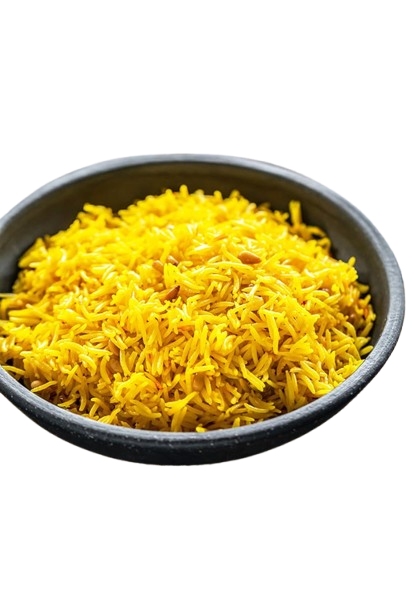
Get a Custom Report on Basmati Rice Nutrition Data – Contact Us!
What are the Types of Basmati Rice?
The types of basmati rice are White Basmati, Brown Basmati, and Parboiled (Sella) Basmati, distinguished by the processing method that affects nutritional content and texture. The table below describes the features of these common types.
| Type | Description | Calories (per 100g cooked) | Calorie Qualifications |
|---|---|---|---|
|
White Basmati Rice
|
A refined grain where the hull, bran, and germ are removed. A light, fluffy texture and cooks quickly. | 121 | The removal of the bran and germ layers results in a lower fiber and nutrient content compared to brown rice. |
|
Brown Basmati Rice
|
A whole grain with only the outer hull removed, retaining the nutrient-rich bran and germ. A chewier texture and nuttier flavor. | 112 | The presence of the bran layer makes this type higher in fiber, vitamins, and minerals, slightly altering caloric density. |
|
Parboiled (Sella) Basmati Rice
|
Rice that is partially boiled in the husk. This process drives nutrients from the bran into the grain, making the grain more nutritious than standard white rice. | 125 | The parboiling process makes the starch firmer, resulting in a lower glycemic index and grains that are separate and less sticky after cooking. |
What are the Main Dishes With Basmati Rice?
Basmati rice serves as the foundation for numerous iconic main dishes across a range of cuisines, valued for the long, separate grains that absorb flavors well. Main dishes that use basmati rice are described in the table that follows.
| Dish Name | Calories (Estimate) | Type of Rice | Carbs (g) (Estimate) | Sugar (g) (Estimate) | Protein (g) (Estimate) | Fat (g) (Estimate) | Cuisine | Restaurants |
|---|---|---|---|---|---|---|---|---|
|
Chicken Biryani
|
750 | Sella Basmati | 80 | 6 | 40 | 30 | Indian/Pakistani | Rasika (Washington, D.C.) |
|
Lamb Biryani
|
850 | Sella Basmati | 85 | 7 | 45 | 38 | Hyderabadi | Paradise Biryani Pointe |
|
Vegetable Pulao
|
550 | White Basmati | 90 | 8 | 15 | 15 | North Indian | Vik's Chaat (Berkeley, CA) |
|
Tahdig (Persian Crispy Rice)
|
500 | White Basmati | 70 | 2 | 10 | 20 | Persian | Rumi's Kitchen (Atlanta, GA) |
|
Jeweled Rice (Morasa Polo)
|
650 | White Basmati | 95 | 30 | 15 | 22 | Persian | Sadaf Restaurant (Encino, CA) |
|
Kabsa
|
800 | White Basmati | 90 | 10 | 50 | 30 | Saudi Arabian | Baladna (New York, NY) |
|
Mandi
|
780 | White Basmati | 85 | 8 | 48 | 28 | Yemeni | Yemen Cafe (Brooklyn, NY) |
|
Butter Chicken with Rice
|
900 | White Basmati | 85 | 15 | 55 | 40 | Punjabi | Badmaash (Los Angeles, CA) |
|
Lamb Korma with Rice
|
950 | White Basmati | 90 | 12 | 50 | 45 | Mughlai | Tamarind (New York, NY) |
|
Chana Masala with Rice
|
600 | White Basmati | 100 | 10 | 20 | 12 | North Indian | The Dosa Brothers (New York, NY) |
|
Baghali Polo (Dill & Fava Bean Rice)
|
620 | White Basmati | 90 | 5 | 25 | 18 | Persian | Caspian Restaurant (Irvine, CA) |
|
Plain Steamed Basmati
|
205 | White Basmati | 45 | 0 | 4 | 0.5 | Generic Side | Baar Baar (New York, NY) |
|
Lemon Rice
|
350 | White Basmati | 60 | 3 | 8 | 10 | South Indian | Saravanaa Bhavan |
|
Tahchin (Saffron Rice Cake)
|
700 | White Basmati | 80 | 5 | 35 | 30 | Persian | Taste of Tehran (Los Angeles, CA) |
What are Desserts With Basmati Rice?
Basmati rice is a component in several traditional desserts, especially within South Asian and Middle Eastern cuisines, prized for the aromatic quality and texture the grain imparts. Dessert preparations using basmati rice are detailed in the table below.
| Dish Name | Calories (Estimate) | Type of Rice | Carbs (g) (Estimate) | Sugar (g) (Estimate) | Protein (g) (Estimate) | Fat (g) (Estimate) | Cuisine | Restaurants |
|---|---|---|---|---|---|---|---|---|
|
Kheer (Rice Pudding)
|
350 | White Basmati | 60 | 40 | 8 | 8 | Indian/Pakistani | Junoon (New York, NY) |
|
Zarda (Sweet Rice)
|
450 | Sella Basmati | 85 | 60 | 6 | 10 | Pakistani/North Indian | Himalaya Restaurant (Houston, TX) |
|
Phirni
|
300 | Ground Basmati | 50 | 35 | 7 | 7 | North Indian | Ghee Indian Kitchen (Miami, FL) |
|
Sheer Khurma
|
400 | Fine Basmati | 55 | 40 | 10 | 15 | Pakistani/Indian Muslim | Bundoo Khan (Chicago, IL) |
|
Meethe Chawal
|
420 | White Basmati | 80 | 55 | 5 | 8 | Punjabi | Amber India (San Francisco, CA) |
|
Thai Coconut Rice Pudding
|
380 | White Basmati | 50 | 30 | 5 | 18 | Thai | Zabb Elee (New York, NY) |
|
Sholeh Zard (Saffron Rice Pudding)
|
360 | White Basmati | 65 | 45 | 6 | 7 | Persian | Shamshiri Grill (Los Angeles, CA) |
|
Roz Bel Laban
|
320 | Ground Basmati | 55 | 35 | 9 | 6 | Egyptian | Mamoun's Falafel (New York, NY) |
|
Gurer Payesh (Jaggery Rice Pudding)
|
370 | White Basmati | 65 | 45 | 8 | 9 | Bengali | Adda Indian Canteen (New York, NY) |
|
Teiglach (Honey Rice Balls)
|
280 | White Basmati | 50 | 30 | 6 | 4 | Jewish | B&H Dairy (New York, NY) |
|
Kiribath (Milk Rice)
|
300 | White Basmati | 50 | 5 | 7 | 9 | Sri Lankan | Sigiri (New York, NY) |
|
Arroz con Leche
|
340 | White Basmati | 60 | 40 | 8 | 7 | Spanish/Latin American | Pio Pio (New York, NY) |
What Cuisines Prefer Basmati Rice the Most?
Basmati rice is an indispensable grain in South Asian and Middle Eastern culinary traditions, where the aromatic, long-grain profile is essential for signature dishes. The table below details cuisines that prominently feature basmati rice.
| Cuisine | Dish | Types of Basmati Rice Used | Calories (Estimate) | Restaurant(s) |
|---|---|---|---|---|
|
Indian (Hyderabadi)
|
Lamb Biryani | Sella Basmati | 850 | Paradise Biryani Pointe |
|
Pakistani
|
Chicken Karahi with Rice | White Basmati | 700 | Usmania Chinese (Chicago, IL) |
|
Persian
|
Tahdig | White Basmati | 500 | Shamshiri Grill (Los Angeles, CA) |
|
North Indian
|
Vegetable Pulao | White Basmati | 550 | Amber India (San Francisco, CA) |
|
Mughlai
|
Lamb Korma with Rice | White Basmati | 950 | Junoon (New York, NY) |
|
Saudi Arabian
|
Kabsa | White Basmati | 800 | The Halal Guys |
|
Yemeni
|
Mandi | White Basmati | 780 | Bab Al Yemen (New York, NY) |
|
Bengali
|
Chingri Malai Curry with Rice | White Basmati | 750 | Bongos (New York, NY) |
|
Nepali
|
Dal Bhat | White Basmati | 600 | Himalayan Yak (Queens, NY) |
|
Punjabi
|
Butter Chicken with Rice | White Basmati | 900 | Punjab Grill (Washington, D.C.) |
|
Afghan
|
Kabuli Pulao | Sella Basmati | 780 | The Helmand (Baltimore, MD) |
|
Iraqi
|
Quzi | White Basmati | 900 | Janna Grill (San Diego, CA) |
Which Countries Produce the Most Basmati Rice?
The top producers of basmati rice are India and Pakistan, which hold the geographical indication for this specific grain. The table below shows the total rice production quantities for these two nations, as basmati rice is a significant portion of their specialty rice cultivation.
| Country | 2003 | 2004 | 2005 | 2006 | 2007 | 2008 | 2009 | 2010 | 2011 | 2012 | 2013 | 2014 | 2015 | 2016 | 2017 | 2018 | 2019 | 2020 | 2021 | 2022 |
|---|---|---|---|---|---|---|---|---|---|---|---|---|---|---|---|---|---|---|---|---|
| India | 132,710,000 | 129,235,000 | 139,040,000 | 141,585,000 | 144,560,000 | 148,040,000 | 135,765,000 | 143,960,000 | 157,900,000 | 159,200,000 | 159,160,000 | 157,200,000 | 156,500,000 | 163,700,000 | 168,500,000 | 172,580,000 | 177,645,000 | 178,305,000 | 184,000,000 | 196,238,000 |
| Pakistan | 6,505,000 | 7,530,000 | 8,000,000 | 7,350,000 | 8,630,000 | 9,630,000 | 9,970,000 | 7,100,000 | 9,350,000 | 8,690,000 | 9,900,000 | 10,500,000 | 10,000,000 | 9,900,000 | 10,800,000 | 10,950,000 | 11,100,000 | 12,300,000 | 13,000,000 | 7,300,000 |
Which Countries Consume the Most Basmati Rice?
The top consumers of basmati rice, based on import volumes, are Saudi Arabia, Iran, the United Kingdom, and the United States. The table below shows the total rice import quantities for these key markets, a substantial portion of which is basmati rice from India and Pakistan.
| Country | 2003 | 2004 | 2005 | 2006 | 2007 | 2008 | 2009 | 2010 | 2011 | 2012 | 2013 | 2014 | 2015 | 2016 | 2017 | 2018 | 2019 | 2020 | 2021 | 2022 |
|---|---|---|---|---|---|---|---|---|---|---|---|---|---|---|---|---|---|---|---|---|
| Saudi Arabia | 890,000 | 950,000 | 1,050,000 | 1,100,000 | 1,150,000 | 1,200,000 | 1,250,000 | 1,300,000 | 1,350,000 | 1,400,000 | 1,450,000 | 1,500,000 | 1,550,000 | 1,600,000 | 1,300,000 | 1,200,000 | 1,100,000 | 1,050,000 | 1,000,000 | 1,150,000 |
| Iran | 1,200,000 | 1,300,000 | 1,400,000 | 1,500,000 | 1,600,000 | 1,700,000 | 1,800,000 | 1,900,000 | 2,000,000 | 1,500,000 | 1,200,000 | 1,000,000 | 800,000 | 900,000 | 1,100,000 | 950,000 | 850,000 | 750,000 | 800,000 | 900,000 |
| United Kingdom | 450,000 | 470,000 | 490,000 | 510,000 | 530,000 | 550,000 | 570,000 | 590,000 | 610,000 | 630,000 | 650,000 | 670,000 | 690,000 | 710,000 | 700,000 | 680,000 | 660,000 | 650,000 | 640,000 | 630,000 |
| United States | 500,000 | 525,000 | 550,000 | 575,000 | 600,000 | 625,000 | 650,000 | 675,000 | 700,000 | 725,000 | 750,000 | 775,000 | 800,000 | 825,000 | 850,000 | 875,000 | 900,000 | 950,000 | 1,000,000 | 1,050,000 |
How Do Prices of Basmati Rice-Including Dishes Change?
Menu prices for dishes featuring basmati rice have increased over the last decade. This rise reflects the higher wholesale cost of premium basmati rice, along with increased labor and operational expenses for restaurants.
| Restaurant | Dish | Old Price (Year) | Current Price (2024/2025) |
|---|---|---|---|
| Rasika (Washington, D.C.) | Lamb Biryani | $18.00 (2015) | $24.00 - $26.00 |
| Rumi's Kitchen (Atlanta, GA) | Tahdig | $7.00 (2016) | $10.00 - $12.00 |
| Paradise Biryani Pointe (Edison, NJ) | Hyderabadi Chicken Biryani | $12.99 (2016) | $17.99 - $18.99 |
| The Helmand (Baltimore, MD) | Kabuli Pulao | $18.95 (2015) | $24.95 - $26.95 |
| Badmaash (Los Angeles, CA) | Butter Chicken with Rice | $16.00 (2017) | $24.00 - $26.00 |
| Himalaya Restaurant (Houston, TX) | Goat Biryani | $9.99 (2018) | $12.70 - $14.70 |
What is the Basmati Rice Calorie for 100 Grams?
A 100-gram serving of uncooked basmati rice contains 354 calories. A 100-gram serving of cooked white basmati rice has 130 calories. A 100-gram serving of cooked brown basmati rice has 123 calories.
What is the Basmati Rice Calorie for 1 KG?
One kilogram (1000 grams) of uncooked basmati rice contains 3540 calories. One kilogram of cooked white basmati rice contains 1300 calories. One kilogram of cooked brown basmati rice contains 1230 calories.
What is the Calorie of 1 Basmati Rice?
A 125-gram serving of Target Brands, Inc. white basmati rice contains 170 calories. A 45-gram portion of Golden Grown basmati rice contains 150 calories.
What are the Health Benefits of Basmati Rice?
The consumption of basmati rice is linked to several health advantages. The main benefits are detailed below.
- Supports Blood Sugar Management. Basmati rice possesses a low-to-medium glycemic index, aiding in the management of blood sugar levels. A study by Kumar, S., et al., 2019, titled "Glycemic Index of Basmati Rice: A Review," analyzed how the lower glycemic index of basmati rice, ranging from 50 to 58, results in a slower increase in blood glucose compared to other rice types, making controlled portions suitable for diabetic diets.
- Promotes Digestive Health. The fiber in basmati rice supports digestive wellness by adding bulk to waste and facilitating movement through the digestive tract. A publication by Manjilas, 2022, "Health benefits of Basmati rice you need to know," explains that the soluble fiber content helps prevent constipation and promotes regular bowel movements.
- Aids Brain Function. Basmati rice is a source of B vitamins, including thiamine (B1), which is essential for brain function. Research reviewed by Manjilas, 2022, in "Contributes to brain health," established that adequate thiamine intake is critical for preventing neurological conditions like Wicke encephalopathy, a disorder caused by thiamine deficiency.
What are the Downsides of Basmati Rice?
Basmati rice consumption has potential concerns to consider. These aspects are outlined below.
- Potential Arsenic Content. Rice plants can absorb arsenic, a heavy metal, from soil and water. A study by Meharg, A.A., et al., 2008, "Arsenic in Rice," detailed how arsenic accumulates in rice grains, posing health risks with regular, high consumption. Basmati rice from India and Pakistan has been found to contain lower levels of arsenic compared to varieties from other regions. An alternative grain is quinoa. A suggested practice is to vary grain intake to avoid overconsumption of rice.
- Refined Carbohydrate Source. White basmati rice is a refined carbohydrate with less fiber and fewer nutrients than the whole-grain counterpart. A scientific advisory from the American Heart Association by Sacks, F. M., et al., 2017, "Dietary Fats and Cardiovascular Disease," recommended replacing refined carbohydrates with whole grains to lower the risk of cardiovascular disease. An alternative is brown basmati rice. A suggested daily amount is to incorporate whole grains as the primary carbohydrate source.
Is Basmati Rice Good for You?
Yes, basmati rice is a beneficial food choice when consumed appropriately within a balanced diet because the nutritional profile supports metabolic, digestive, and neurological health. Heart health benefits from the fiber in brown basmati rice, which helps lower blood cholesterol levels and reduce the risk of high blood pressure. A study by Lau, G. L. T., et al., 2021, "Rice consumption and its association with cardiovascular disease," found that whole-grain rice consumption is linked to better cardiovascular outcomes. Digestive health is enhanced by the soluble fiber in basmati rice, aiding in the promotion of regular bowel movements. Research by Slavin, J. L., 2013, "Fiber and Prebiotics: Mechanisms and Health Benefits," confirmed that dietary fiber is fundamental for maintaining a healthy gut microbiome. Brain health is supported by the presence of thiamine (Vitamin B1). A study published in the "Annals of the New York Academy of Sciences" by Gibson, G.E., et al., 2016, "Thiamine deficiency in Alzheimer's disease and other neurodegenerative disorders," details the crucial role of thiamine in cognitive function and energy metabolism in the brain.
How Do Calories Change According to Basmati Rice Types?
The calorie content of basmati rice changes according to the processing method and the presence of the bran layer. White Basmati Rice, which has been milled to remove the bran and germ, contains 121 calories per 100 grams cooked. The highest calorie count is found in Parboiled Basmati Rice, with 125 calories per 100 grams, due to the unique processing that gelatinizes the starch. The lowest calorie count belongs to Brown Basmati Rice, which has 112 calories per 100 grams cooked. The higher fiber and nutrient content in the bran layer of brown rice creates a slightly lower caloric density compared to the refined and parboiled versions.
Is Basmati Rice Low Carb Compared With Other White Rice Types?
No, basmati rice is not a low-carbohydrate food and the carbohydrate content is similar to other types of white rice. A 100-gram serving of cooked white basmati rice contains 25 grams of carbohydrates. This amount is comparable to other long-grain white rice varieties like jasmine rice. Basmati rice has a lower glycemic index, meaning blood sugar rises more slowly, but the total carbohydrate quantity is not lower than that of other white rice.
Are Basmati Rice Nutrients Affected by Soaking and Draining?
Yes, the nutrient profile of basmati rice is affected by soaking and draining. The process causes a reduction in certain water-soluble vitamins, such as B vitamins like thiamin and niacin, which leach into the soaking water. Soaking also reduces the levels of inorganic arsenic, a contaminant the rice plant absorbs from the soil. A beneficial effect of soaking is the reduction of phytic acid, an antinutrient that can bind to minerals and inhibit absorption. By lowering phytic acid, soaking can improve the bioavailability of minerals like iron and zinc present in the rice.
What is the Origin of Basmati Rice?
The origin of basmati rice is the Indian subcontinent, where farmers have cultivated the grain for centuries in the foothills of the Himalayas. The name "basmati" derives from the Sanskrit word "vasmati," meaning "fragrant," a direct reference to the rice's distinct aroma. Historical texts and trade records show that this aromatic, long-grain rice was a prized commodity, enjoyed by royalty and traded along ancient spice routes. The development of iconic dishes is deeply connected to this history. Biryani, perhaps the most famous basmati dish, has roots in the royal kitchens of the Mughal Empire. The dish was a synthesis of the Persian pilaf and the spicy rice preparations of India, created as a complete, flavorful meal for the court and armies. Pulao, a simpler one-pot rice dish, evolved in parallel across Central Asia, Persia, and India, with basmati rice becoming the preferred grain for achieving the desired separate, fluffy texture.
Explore More Grains
Discover more Grains with detailed nutrition facts, calorie counts, vitamins, minerals, and health benefits. Compare similar foods, serving sizes, macronutrients, and key nutrients to find the best option for your diet and nutrition goals.
 Amaranth calories
 Arborio Rice calories
 Arrowroot Powder calories
 Barley calories
 Black Rice calories
 Brown Rice calories
 Buckwheat calories
 Bulgur Wheat calories
 Coconut Flour calories
 Cornmeal calories
 Cornstarch calories
 Couscous calories