Calories and Nutritions in Cornmeal
Cornmeal is a type of ground flour used in Southern American, Mexican, and Italian cuisines. The cornmeal calories for a 1 tablespoon serving of whole-grain yellow cornmeal (7.6g) are 28 calories, while a 100g serving has 362 calories. Whole grain white cornmeal contains the same calories per serving. The calories in enriched degerminated cornmeal are slightly higher, with a one-tablespoon serving (8.6g) providing 31 calories. One kilogram (1000g) of whole-grain yellow cornmeal provides 3620 calories. A quarter-cup serving of Quaker Yellow Corn Meal contains 110 calories, while a quarter-cup serving of Bob's Red Mill Medium Grind Cornmeal has 120 calories.
The cornmeal nutrition profile is notable for being a good source of fiber and essential minerals, with a 100g serving of whole-grain cornmeal providing 7.3g of fiber (26% DV) and 24% of the DV for magnesium. A study on whole grains established a clear link between higher intake and a reduced risk of colorectal cancer (Aune, D., et al., 2011). Major health benefits come from the nutrient density of enriched cornmeal, including a rich supply of iron and selenium. A 100g serving of enriched degerminated cornmeal delivers 5.23mg of iron (29% DV) and 13.3mcg of selenium (24% DV), supporting oxygen transport and antioxidant functions.
Cornmeal is available in whole-grain, degerminated, self-rising, and blue forms. The United States and China are the leading producers of maize, the grain used to create cornmeal. A steady price increase has marked the last 20 years, with average retail costs in the U.S. climbing from under $0.40 per pound in the early 2000s to more than $0.60 per pound by 2022.
Cornmeal is often used in signature dishes like Italian Polenta and Southern Shrimp and Grits served at restaurants such as Commander's Palace. A suggested serving size is one-quarter cup of dry whole-grain cornmeal (30.5 grams), which contains 110 calories. Expending these calories requires an equivalent of 11 minutes of running or 14 minutes of swimming.
Cornmeal nutrition
| Stats | Weight |
|---|---|
| Carbs | 79 grams |
| Protein | 8 grams |
| Fats | 0 grams |
| Sugars | 1 grams |
- Large Cornmeal Calories (Nutritional Facts)
- Medium Cornmeal Calories (Nutritional Facts)
- Small Cornmeal Calories (Nutritional Facts)
- Raw Cornmeal Nutrition
- Sodium in Cornmeal
- Potassium in Cornmeal
- Sugar in Cornmeal
- Fiber in Cornmeal
- Protein in Cornmeal
- Carbs in Cornmeal
- Fat in Cornmeal
- Vitamins in Cornmeal
- Minerals in Cornmeal
Large Cornmeal Calories (Nutritional Facts)
A large serving of whole-grain yellow cornmeal, equivalent to one cup (122g), has 442 calories, 10.6g of protein, 4.59g of fat, 92.2g of carbohydrates, 8.9g of fiber, 0.78g of sugar, and 7mg of sodium. A large one-cup serving (122g) of whole-grain white cornmeal contains 442 calories, 10.6g of protein, 4.59g of fat, 92.2g of carbohydrates, 8.9g of fiber, 0.78g of sugar, and 7mg of sodium. A large serving of enriched yellow degerminated cornmeal, or one cup (138g), provides 502 calories, 11.4g of protein, 1.81g of fat, 107g of carbohydrates, 3.7g of fiber, 0.9g of sugar, and 1mg of sodium. A large one-cup serving (138g) of enriched white degerminated cornmeal has 502 calories, 11.4g of protein, 1.81g of fat, 107g of carbohydrates, 3.7g of fiber, 0.9g of sugar, and 1mg of sodium.
A medium 100g (3.5oz) serving of whole-grain yellow cornmeal contains 362 calories, 8.69g of protein, 3.76g of fat, 75.6g of carbohydrates, 7.3g of fiber, 0.64g of sugar, and 6mg of sodium. A medium 100g serving of whole-grain white cornmeal provides 362 calories, 8.69g of protein, 3.76g of fat, 75.6g of carbohydrates, 7.3g of fiber, 0.64g of sugar, and 6mg of sodium. A medium 100g serving of enriched yellow degerminated cornmeal has 364 calories, 8.27g of protein, 1.31g of fat, 77.6g of carbohydrates, 2.7g of fiber, 0.65g of sugar, and 1mg of sodium. A medium 100g serving of enriched white degerminated cornmeal contains 364 calories, 8.27g of protein, 1.31g of fat, 77.6g of carbohydrates, 2.7g of fiber, 0.65g of sugar, and 1mg of sodium.
A small serving of whole-grain yellow cornmeal, equivalent to one tablespoon (7.6g), contains 28 calories, 0.66g of protein, 0.29g of fat, 5.75g of carbohydrates, 0.6g of fiber, 0.05g of sugar, and 0mg of sodium. A small one-tablespoon serving (7.6g) of whole-grain white cornmeal has 28 calories, 0.66g of protein, 0.29g of fat, 5.75g of carbohydrates, 0.6g of fiber, 0.05g of sugar, and 0mg of sodium. A small serving of enriched yellow degerminated cornmeal, or one tablespoon (8.6g), provides 31 calories, 0.71g of protein, 0.11g of fat, 6.67g of carbohydrates, 0.2g of fiber, 0.06g of sugar, and 0mg of sodium. A small one-tablespoon serving (8.6g) of enriched white degerminated cornmeal contains 31 calories, 0.71g of protein, 0.11g of fat, 6.67g of carbohydrates, 0.2g of fiber, 0.06g of sugar, and 0mg of sodium.
Uncooked whole-grain yellow cornmeal provides essential nutrients. A 100g serving of raw whole-grain yellow cornmeal contains 362 calories, 8.69g of protein, 3.76g of fat, 75.6g of carbohydrates, 7.3g of fiber, 0.64g of sugar, and 6mg of sodium. A one-cup serving (122g) of raw whole-grain yellow cornmeal offers 442 calories, 10.6g of protein, 4.59g of fat, 92.2g of carbohydrates, 8.9g of fiber, 0.78g of sugar, and 7mg of sodium. Raw enriched degerminated yellow cornmeal in a 100g portion has 364 calories, 8.27g of protein, 1.31g of fat, 77.6g of carbohydrates, 2.7g of fiber, 0.65g of sugar, and 1mg of sodium.
A large one-cup serving (122g) of whole-grain yellow cornmeal contains 7mg of sodium (0% DV). A large one-cup serving (138g) of enriched degerminated yellow cornmeal has 1mg of sodium (0% DV). A large one-cup serving (155g) of self-rising enriched yellow cornmeal contains 2274mg of sodium (99% DV). A medium 100g serving of whole-grain yellow cornmeal contains 6mg of sodium (0% DV). A medium 100g serving of enriched degerminated yellow cornmeal has 1mg of sodium (0% DV). A medium 100g serving of self-rising enriched yellow cornmeal has 1467mg of sodium (64% DV). A small one-tablespoon serving (7.6g) of whole-grain yellow cornmeal contains 0mg of sodium (0% DV). A small one-tablespoon serving (8.6g) of enriched degerminated yellow cornmeal has 0mg of sodium (0% DV). A small one-tablespoon serving (9.7g) of self-rising enriched yellow cornmeal contains 142mg of sodium (6% DV). A 100g serving of raw whole-grain cornmeal contains 6mg of sodium (0% DV), while raw enriched degerminated cornmeal has 1mg of sodium (0% DV).
A large one-cup serving (122g) of whole-grain yellow cornmeal contains 350mg of potassium (7% DV). A large one-cup serving (138g) of enriched degerminated yellow cornmeal has 175mg of potassium (4% DV). A medium 100g serving of whole-grain yellow cornmeal contains 287mg of potassium (6% DV). A medium 100g serving of enriched degerminated yellow cornmeal has 127mg of potassium (3% DV). A small one-tablespoon serving (7.6g) of whole-grain yellow cornmeal contains 22mg of potassium (0% DV). A small one-tablespoon serving (8.6g) of enriched degerminated yellow cornmeal has 11mg of potassium (0% DV). A 100g serving of raw whole-grain cornmeal contains 287mg of potassium (6% DV), while raw enriched degerminated cornmeal has 127mg of potassium (3% DV).
A large one-cup serving (122g) of whole-grain yellow cornmeal contains 0.78g of sugar. A large one-cup serving (138g) of enriched degerminated yellow cornmeal has 0.9g of sugar. A medium 100g serving of whole-grain yellow cornmeal contains 0.64g of sugar. A medium 100g serving of enriched degerminated yellow cornmeal has 0.65g of sugar. A small one-tablespoon serving (7.6g) of whole-grain yellow cornmeal contains 0.05g of sugar. A small one-tablespoon serving (8.6g) of enriched degerminated yellow cornmeal has 0.06g of sugar. A 100g serving of raw whole-grain cornmeal contains 0.64g of sugar, while raw enriched degerminated cornmeal has 0.65g of sugar.
A large one-cup serving (122g) of whole-grain yellow cornmeal contains 8.9g of fiber (32% DV). A large one-cup serving (138g) of enriched degerminated yellow cornmeal has 3.7g of fiber (13% DV). A medium 100g serving of whole-grain yellow cornmeal contains 7.3g of fiber (26% DV). A medium 100g serving of enriched degerminated yellow cornmeal has 2.7g of fiber (10% DV). A small one-tablespoon serving (7.6g) of whole-grain yellow cornmeal contains 0.6g of fiber (2% DV). A small one-tablespoon serving (8.6g) of enriched degerminated yellow cornmeal has 0.2g of fiber (1% DV). A 100g serving of raw whole-grain cornmeal contains 7.3g of fiber (26% DV), while raw enriched degerminated cornmeal has 2.7g of fiber (10% DV).
A large one-cup serving (122g) of whole-grain yellow cornmeal contains 10.6g of protein (21% DV). A large one-cup serving (138g) of enriched degerminated yellow cornmeal has 11.4g of protein (23% DV). A medium 100g serving of whole-grain yellow cornmeal contains 8.69g of protein (17% DV). A medium 100g serving of enriched degerminated yellow cornmeal has 8.27g of protein (17% DV). A small one-tablespoon serving (7.6g) of whole-grain yellow cornmeal contains 0.66g of protein (1% DV). A small one-tablespoon serving (8.6g) of enriched degerminated yellow cornmeal has 0.71g of protein (1% DV). A 100g serving of raw whole-grain cornmeal contains 8.69g of protein (17% DV), while raw enriched degerminated cornmeal has 8.27g of protein (17% DV).
A large one-cup serving (122g) of whole-grain yellow cornmeal contains 92.2g of carbohydrates (34% DV). A large one-cup serving (138g) of enriched degerminated yellow cornmeal has 107g of carbohydrates (39% DV). A medium 100g serving of whole-grain yellow cornmeal contains 75.6g of carbohydrates (28% DV). A medium 100g serving of enriched degerminated yellow cornmeal has 77.6g of carbohydrates (28% DV). A small one-tablespoon serving (7.6g) of whole-grain yellow cornmeal contains 5.75g of carbohydrates (2% DV). A small one-tablespoon serving (8.6g) of enriched degerminated yellow cornmeal has 6.67g of carbohydrates (2% DV). A 100g serving of raw whole-grain cornmeal contains 75.6g of carbohydrates (28% DV), while raw enriched degerminated cornmeal has 77.6g of carbohydrates (28% DV).
A large one-cup serving (122g) of whole-grain yellow cornmeal contains 4.59g of total fat (6% DV). A large one-cup serving (138g) of enriched degerminated yellow cornmeal has 1.81g of total fat (2% DV). A medium 100g serving of whole-grain yellow cornmeal contains 3.76g of total fat (5% DV). A medium 100g serving of enriched degerminated yellow cornmeal has 1.31g of total fat (2% DV). A small one-tablespoon serving (7.6g) of whole-grain yellow cornmeal contains 0.29g of total fat (0% DV). A small one-tablespoon serving (8.6g) of enriched degerminated yellow cornmeal has 0.11g of total fat (0% DV). A 100g serving of raw whole-grain cornmeal contains 3.76g of total fat (5% DV), while raw enriched degerminated cornmeal has 1.31g of total fat (2% DV).
A large one-cup serving (122g) of whole-grain yellow cornmeal provides Vitamin B6 (15% DV). A large one-cup serving (138g) of enriched degerminated yellow cornmeal provides Thiamin (96% DV), Riboflavin (54% DV), Niacin (65% DV), Vitamin B6 (18% DV), and Folate (168% DV). A medium 100g serving of whole-grain yellow cornmeal provides Vitamin B6 (12% DV). A medium 100g serving of enriched degerminated yellow cornmeal provides Thiamin (70% DV), Riboflavin (39% DV), Niacin (47% DV), Vitamin B6 (13% DV), and Folate (122% DV). A small one-tablespoon serving (7.6g) of whole-grain yellow cornmeal provides Vitamin B6 (1% DV). A small one-tablespoon serving (8.6g) of enriched degerminated yellow cornmeal provides Thiamin (6% DV), Riboflavin (4% DV), Niacin (4% DV), Vitamin B6 (1% DV), and Folate (11% DV). A 100g serving of raw whole-grain cornmeal provides Vitamin B6 (12% DV).
A large one-cup serving (122g) of whole-grain yellow cornmeal provides Iron (15% DV), Magnesium (29% DV), Phosphorus (20% DV), Zinc (15% DV), and Selenium (28% DV). A large one-cup serving (138g) of enriched degerminated yellow cornmeal provides Iron (40% DV), Magnesium (11% DV), Phosphorus (9% DV), Zinc (6% DV), and Selenium (33% DV). A medium 100g serving of whole-grain yellow cornmeal provides Iron (12% DV), Magnesium (24% DV), Phosphorus (16% DV), Zinc (12% DV), and Selenium (23% DV). A medium 100g serving of enriched degerminated yellow cornmeal provides Iron (29% DV), Magnesium (8% DV), Phosphorus (7% DV), Zinc (4% DV), and Selenium (24% DV). A small one-tablespoon serving (7.6g) of whole-grain yellow cornmeal provides Iron (1% DV) and Magnesium (2% DV). A small one-tablespoon serving (8.6g) of enriched degerminated yellow cornmeal provides Iron (3% DV) and Selenium (2% DV). A 100g serving of raw whole-grain cornmeal provides Iron (12% DV).
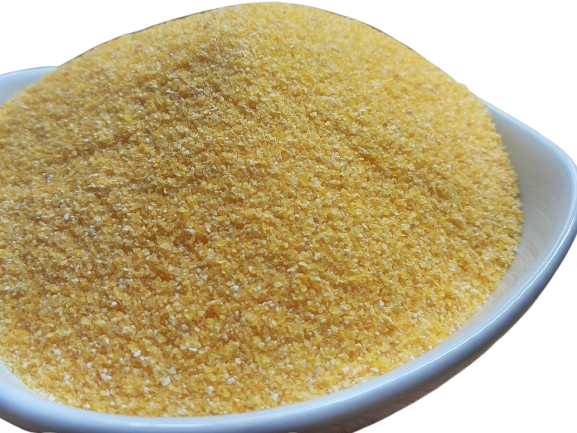
Get a Custom Report on Cornmeal Nutrition Data – Contact Us!
What are the Types of Cornmeal?
The types of cornmeal are distinguished by the type of corn used, the milling process, and any added ingredients. The table below outlines the features of these common types.
| Type | Description | Calories (per 100g) | Calorie Qualifications |
|---|---|---|---|
|
Whole-Grain Cornmeal
|
Ground from the entire corn kernel, including the bran, germ, and endosperm. Available in yellow or white. | 362 | The presence of the oil-rich germ makes this type more nutrient-dense but also gives the product a shorter shelf life. |
|
Degerminated Cornmeal
|
Ground from corn kernels with the bran and germ removed, leaving only the starchy endosperm. Available in yellow or white. | 364 | The removal of the fatty germ results in a slightly higher carbohydrate concentration and a longer shelf life. |
|
Self-Rising Cornmeal
|
Degerminated cornmeal with baking powder and salt already added. Available in yellow or white. | 343 | The addition of leavening agents and salt slightly lowers the caloric density per 100g compared to plain cornmeal. |
|
Blue Cornmeal
|
Whole-grain cornmeal ground from blue corn kernels. | 367 | Blue corn contains anthocyanins, which are antioxidants, and has a slightly higher protein and calorie content. |
What are Desserts With Cornmeal?
From rustic cakes to classic puddings, cornmeal is a key ingredient in many sweet dishes, providing a unique texture and wholesome flavor. The table that follows provides details on several desserts that feature cornmeal.
| Dish Name | Calories (Estimate per serving) | Type of Cornmeal | Carbs (g) (Estimate) | Sugar (g) (Estimate) | Protein (g) (Estimate) | Fat (g) (Estimate) | Cuisine | Restaurants |
|---|---|---|---|---|---|---|---|---|
|
Sweet Cornbread
|
350 | Yellow or White | 55 | 25 | 6 | 12 | Southern American | Cracker Barrel |
|
Cornmeal Pound Cake
|
480 | Yellow | 65 | 40 | 7 | 22 | Southern American | Husk (Charleston, SC) |
|
Indian Pudding
|
420 | Yellow | 70 | 45 | 8 | 12 | New England | Durgin-Park (Boston, MA - closed) |
|
Cornmeal Shortcake
|
450 | Yellow | 60 | 28 | 6 | 20 | American Bakery | Tartine Bakery (San Francisco, CA) |
|
Blueberry Cornmeal Muffins
|
380 | Yellow | 50 | 26 | 6 | 18 | American Bakery | Blue Sky Bakery (Chicago, IL) |
|
Cornmeal Cookies
|
210 | Yellow | 28 | 15 | 3 | 10 | American Bakery | Levain Bakery (New York, NY) |
|
Lemon Cornmeal Cake
|
460 | Yellow | 62 | 38 | 6 | 21 | Italian-American | Zuni Café (San Francisco, CA) |
|
Cornmeal Waffles
|
430 | Yellow or White | 60 | 15 | 10 | 16 | American | Waffle House |
|
Skillet Cornbread with Honey Butter
|
400 | Yellow | 58 | 22 | 7 | 16 | American BBQ | Dinosaur Bar-B-Que |
|
Cornmeal Pancakes
|
390 | Yellow or White | 55 | 18 | 9 | 14 | American | The Original Pancake House (restaurant chain) |
|
Cornmeal Scones
|
410 | Yellow | 52 | 20 | 7 | 20 | British-American | Alice's Tea Cup (New York, NY) |
|
Cornmeal-Apple Upside-Down Cake
|
510 | Yellow | 75 | 50 | 6 | 22 | New American | Gramercy Tavern (New York, NY) |
What are Main Dishes With Cornmeal?
Cornmeal's versatility is evident in numerous savory main courses from different cultures, where the product is used as a porridge, a dough, or a crispy coating. The subsequent table highlights a selection of main dishes prepared with cornmeal.
| Dish Name | Calories (Estimate per serving) | Type of Cornmeal | Carbs (g) (Estimate) | Sugar (g) (Estimate) | Protein (g) (Estimate) | Fat (g) (Estimate) | Cuisine | Restaurants |
|---|---|---|---|---|---|---|---|---|
|
Polenta
|
380 | Yellow | 55 | 2 | 8 | 14 | Italian | Babbo (New York, NY) |
|
Shrimp and Grits
|
650 | White | 60 | 5 | 30 | 35 | Southern American | Commander's Palace (New Orleans, LA) |
|
Tamales
|
305 | White (Masa) | 32 | 3 | 12 | 16 | Mexican | Guelaguetza (Los Angeles, CA) |
|
Hushpuppies
|
280 | Yellow or White | 35 | 8 | 5 | 13 | Southern American | Captain D's |
|
Fried Catfish with Cornmeal Crust
|
550 | Yellow | 30 | 1 | 40 | 32 | Southern American | Sylvia's Restaurant (New York, NY) |
|
Savory Cornbread
|
310 | Yellow or White | 45 | 5 | 7 | 11 | Southern American | Popeyes |
|
Corn Dog
|
330 | Yellow | 28 | 7 | 10 | 20 | American | Nathan's Famous |
|
Spoonbread
|
390 | White or Yellow | 40 | 12 | 10 | 20 | Southern American | The Olde Pink House (Savannah, GA) |
|
Arepas
|
290 | White (Masarepa) | 45 | 1 | 6 | 10 | Venezuelan/Colombian | The Arepa Stand (Brooklyn, NY) |
|
Fried Green Tomatoes
|
320 | Yellow or White | 38 | 6 | 5 | 17 | Southern American | Whistle Stop Cafe (Juliette, GA) |
|
Scrapple
|
250 | Yellow or White | 15 | 1 | 12 | 18 | Pennsylvania Dutch | Reading Terminal Market (Philadelphia, PA) |
|
Gnocchi alla Romana
|
450 | Semolina (related) | 50 | 3 | 15 | 22 | Italian | Osteria Morini (New York, NY) |
What Cuisines Prefer Cornmeal the Most?
From Southern American comfort food to traditional Italian fare, cornmeal is integral to many cuisines. The following table identifies several culinary traditions that make significant use of cornmeal.
| Cuisine | Dish | Types of Cornmeal Used | Calories (Estimate) | Restaurant(s) |
|---|---|---|---|---|
|
Southern American
|
Shrimp and Grits, Cornbread | White, Yellow | 300-700 | Hominy Grill (Charleston, SC - closed) |
|
Mexican
|
Tamales, Gorditas | White (Masa Harina) | 250-500 | Rick Bayless' Frontera Grill (Chicago, IL) |
|
Italian
|
Polenta | Yellow | 350-550 | Spiaggia (Chicago, IL - closed) |
|
Southwestern
|
Blue Corn Tortillas, Blue Corn Muffins | Blue | 200-400 | The Shed (Santa Fe, NM) |
|
American BBQ
|
Cornbread, Hushpuppies | Yellow, White | 280-400 | Franklin Barbecue (Austin, TX) |
|
Venezuelan
|
Arepas | White (Masarepa) | 290-600 | Caracas Arepa Bar (New York, NY) |
|
Caribbean
|
Funchi, Cou-cou | Yellow | 250-400 | Golden Krust |
|
Romanian
|
Mămăligă | Yellow | 300-450 | Romanian Garden (Sunnyside, NY) |
|
Pennsylvania Dutch
|
Scrapple, Cornmeal Mush | Yellow, White | 250-400 | Shady Maple Smorgasbord (East Earl, PA) |
|
New England
|
Johnnycakes, Indian Pudding | White, Yellow | 200-420 | The Commons Restaurant (Little Compton, RI) |
|
Soul Food
|
Fried Chicken/Fish Breading | Yellow, White | 400-600 | Willie Mae's Scotch House (New Orleans, LA) |
Which Countries Produce the Most Cornmeal?
The top producers of maize (corn), which is the main component of cornmeal, are the United States, China, and Brazil. Global production data for milled cornmeal is not tracked in the same way as the raw commodity. The table below shows the production quantity of maize in key countries.
| Country | 2003 | 2008 | 2013 | 2018 | 2019 | 2020 | 2021 | 2022 |
|---|---|---|---|---|---|---|---|---|
| United States | 256,904,740 | 307,761,970 | 353,699,020 | 364,288,710 | 345,959,720 | 358,409,000 | 383,943,000 | 382,539,000 |
| China | 115,827,000 | 166,036,000 | 217,730,000 | 257,173,900 | 260,776,100 | 260,670,000 | 272,551,800 | 277,203,000 |
| Brazil | 47,481,200 | 59,028,300 | 80,273,000 | 82,288,290 | 101,137,300 | 103,964,000 | 88,479,000 | 116,000,000 |
| Argentina | 15,000,000 | 22,000,000 | 32,119,300 | 51,000,000 | 56,894,540 | 60,500,000 | 58,397,000 | 49,500,000 |
| Ukraine | 6,867,400 | 11,446,900 | 30,949,600 | 35,801,050 | 35,885,000 | 30,289,000 | 42,130,000 | 27,000,000 |
| Mexico | 19,434,800 | 24,244,100 | 22,663,900 | 27,169,960 | 27,227,000 | 27,424,500 | 26,672,000 | 27,700,000 |
Which Countries Consume the Most Cornmeal?
The top consumers of maize (corn), the source of cornmeal, are China and the United States, which use the grain for food, animal feed, and industrial purposes. Per capita food consumption data provides insight into direct human use. The table below shows the food supply of maize for human consumption in select countries.
| Country | 2003 | 2008 | 2013 | 2018 | 2019 | 2020 |
|---|---|---|---|---|---|---|
| Mexico | 120.45 | 115.01 | 118.91 | 124.71 | 124.16 | 124.16 |
| South Africa | 77.83 | 74.91 | 79.11 | 78.50 | 78.10 | 78.10 |
| Malawi | 140.21 | 135.10 | 130.50 | 125.12 | 124.90 | 124.90 |
| Guatemala | 90.15 | 88.50 | 92.14 | 95.20 | 94.98 | 94.98 |
| Egypt | 38.45 | 40.12 | 42.50 | 45.18 | 45.10 | 45.10 |
| United States | 26.50 | 27.15 | 28.91 | 30.15 | 30.21 | 30.21 |
How Do Prices of Cornmeal-Including Dishes Change?
Restaurant menu costs for dishes with cornmeal have risen over the last decade, a trend reflecting the increased price of corn and greater expenses for labor and restaurant operations. Southern and Italian-American restaurants that feature staples like grits, cornbread, and polenta show these price adjustments on menus.
| Restaurant | Dish | Old Price (Year) | Current Price (2025) |
|---|---|---|---|
| Cracker Barrel | Fried Catfish (with cornmeal breading) | $10.99 (2017) | $11.99 - $20.61 |
| Waffle House | Bowl of Grits | $1.95 (2016) | $3.25 - $3.75 |
| Dinosaur Bar-B-Que | Cornbread (side) | $1.95 (2017) | $2.25 - $5.25 |
What is the Cornmeal Calorie for 100 Grams?
A 100 gram serving of whole-grain yellow cornmeal has 362 calories. A 100 gram serving of enriched degerminated yellow cornmeal contains 364 calories. A 100 gram serving of self-rising enriched yellow cornmeal provides 343 calories.
What is the Cornmeal Calorie for 1 KG?
One kilogram (1000g) of whole-grain yellow cornmeal contains 3620 calories. One kilogram of enriched degerminated yellow cornmeal has 3640 calories. One kilogram of self-rising enriched yellow cornmeal contains 3430 calories.
What is the Cornmeal Calorie for 1 Cup?
One cup (122g) of whole-grain yellow cornmeal has 442 calories. One cup (138g) of enriched degerminated yellow cornmeal contains 502 calories. One cup (155g) of self-rising enriched yellow cornmeal provides 532 calories.
What is the Calorie of 1 Cornmeal?
The calorie of one serving of cornmeal varies by brand. A quarter-cup serving (30g) of Quaker Yellow Corn Meal contains 110 calories. A quarter-cup serving (34g) of Bob's Red Mill Medium Grind Cornmeal has 120 calories. A quarter-cup serving (28g) of Arrowhead Mills Organic Yellow Cornmeal contains 100 calories.
What are the Health Benefits of Cornmeal?
Cornmeal consumption is associated with several health advantages, supported by research. The key health benefits are detailed below.
- Supports Digestive Health: Whole-grain cornmeal is a good source of dietary fiber, which is essential for maintaining a healthy digestive system. Fiber adds bulk to stool, promoting regular bowel movements and helping to prevent constipation. A study by Aune, D., et al. (2011), "Dietary fiber, whole grains, and risk of colorectal cancer: systematic review and dose-response meta-analysis of prospective studies," concluded that a high intake of dietary fiber and whole grains is associated with a lower risk of colorectal cancer.
- Aids in Energy Production: Enriched cornmeal is an important source of B vitamins, including thiamin, niacin, and riboflavin. These vitamins are crucial coenzymes in the metabolic process that converts carbohydrates from food into usable energy for the body's cells. A review by Depeint, F., Bruce, W. R., & Ames, B. N. (2006), " Mitochondrial function and toxicity: Role of the B vitamin family on mitochondrial energy metabolism," details the fundamental roles of these B vitamins in cellular energy metabolism and overall metabolic function.
- Promotes Eye Health: Yellow cornmeal contains the carotenoids lutein and zeaxanthin. These antioxidants accumulate in the retina of the eye and help protect against oxidative damage from high-energy light waves. Research by Ma, L., et al. (2012), "Lutein and zeaxanthin intake and the risk of age-related macular degeneration: a systematic review and meta-analysis," found that higher dietary intakes of lutein and zeaxanthin were associated with a reduced risk of late-stage age-related macular degeneration.
What are the Downsides of Cornmeal?
Cornmeal is safe for most people, but some considerations exist. These potential aspects are outlined below.
- High Glycemic Index: Degerminated cornmeal has a high glycemic index, meaning the product can cause a rapid spike in blood sugar levels after consumption. This effect can be a concern for individuals managing blood sugar, such as those with type 2 diabetes. A study by Brand-Miller, J. C., et al. (2002), "Glycemic index and obesity," discusses how high-glycemic index foods may influence food intake and body weight regulation. An alternative with a lower glycemic index is almond flour. A daily suggested amount for refined grains is limited.
- Contains Phytic Acid: Whole-grain cornmeal contains phytic acid, an antinutrient that can bind to minerals like iron and zinc in the digestive tract, reducing their absorption. This effect is a concern in diets that rely heavily on unprocessed grains as a staple food. Research by Gibson, R. S., Bailey, K. B., & Ferguson, E. L. (2010), "A review of phytate, iron, zinc, and calcium concentrations in plant-based complementary foods used in low-income countries and implications for bioavailability," examines how phytate levels impact mineral bioavailability. Degerminated cornmeal is a lower-phytate alternative.
Is Cornmeal Good for You?
Yes, cornmeal can be a nutritious food choice, especially the whole-grain variety, because the product offers benefits for digestive, metabolic, and eye health. Whole-grain cornmeal supports digestive health through a high content of insoluble fiber. A meta-analysis by Aune, D., et al. (2011), "Dietary fiber, whole grains, and risk of colorectal cancer," established a clear link between higher whole grain intake and a reduced risk of colorectal cancer. The B vitamins found in enriched cornmeal are essential for metabolic health. A publication by Kennedy, D. O. (2016), "B Vitamins and the Brain: Mechanisms, Dose and Efficacy—A Review," confirms the critical role of B vitamins in converting food into cellular energy. For eye health, yellow cornmeal provides lutein and zeaxanthin, antioxidants that protect the eyes from harmful light waves. A study by Jia, Y. P., et al. (2017), "The Pharmacological Effects of Lutein and Zeaxanthin on Visual Disorders and Cognition," details the protective mechanisms of these carotenoids against age-related eye diseases.
How Does Calorie Change According to Cornmeal Types?
The specific type of cornmeal determines its caloric value, with differences resulting from the milling method and any added ingredients. Blue cornmeal has the highest calorie count, with 367 calories per 100g, due to a slightly higher protein and fat content from the specific corn variety. Degerminated cornmeal follows with 364 calories per 100g, as removing the bran and germ concentrates the starchy, energy-dense endosperm. Whole-grain cornmeal contains 362 calories per 100g. Self-rising cornmeal has the lowest calorie count at 343 calories per 100g, because the addition of non-caloric leavening agents and salt slightly reduces the overall concentration of cornmeal by weight.
Does Cornmeal Have Gluten?
No, pure cornmeal does not contain gluten. Corn is a naturally gluten-free grain, making cornmeal a suitable option for individuals with celiac disease or non-celiac gluten sensitivity. A major concern is cross-contamination, which can occur if the corn is processed in facilities that also handle wheat, barley, or rye. To ensure safety, people requiring a strict gluten-free diet must choose products that are explicitly labeled and certified as gluten-free.
Is Cornmeal a Whole Grain?
Yes and No, as the answer depends entirely on the type of cornmeal. A grain is considered "whole" when all three original parts, the bran, germ, and endosperm, are present. "Whole-grain cornmeal" meets this definition because the entire corn kernel is ground to make the product. This type retains all the fiber and nutrients found in the original kernel. In contrast, "degerminated cornmeal" is a refined grain, not a whole grain. The milling process for degerminated cornmeal removes the bran and the germ, leaving only the starchy endosperm. This distinction is important because whole grains provide more fiber, vitamins, and minerals, which are linked to better health outcomes.
What is the Origin of Cornmeal?
The history of cornmeal begins with the domestication of maize thousands of years ago in what is now southern Mexico. The transformation of hard corn kernels into a usable meal was a critical innovation of ancient Mesoamerican peoples. These cultures pioneered nixtamalization, a process of soaking corn in an alkaline solution that softened the kernels for grinding and unlocked vital nutrients, most notably niacin. This treated corn, ground into masa, formed the basis of foundational dishes like tortillas and tamales. As maize cultivation traveled north, Native American tribes throughout North America developed their own methods for grinding dried corn into meal, creating staple foods like cornbread and grits. When European explorers arrived in the Americas, they were introduced to corn and its derived meal, which they subsequently transported back to Europe. In Northern Italy, cornmeal was widely adopted and used to make polenta, a thick porridge that became a crucial food source for the region's rural population, supplanting older grains.
Explore More Grains
Discover more Grains with detailed nutrition facts, calorie counts, vitamins, minerals, and health benefits. Compare similar foods, serving sizes, macronutrients, and key nutrients to find the best option for your diet and nutrition goals.
 Amaranth calories
 Arborio Rice calories
 Arrowroot Powder calories
 Barley calories
 Basmati Rice calories
 Black Rice calories
 Brown Rice calories
 Buckwheat calories
 Bulgur Wheat calories
 Coconut Flour calories
 Cornstarch calories
 Couscous calories