Calories and Nutritions in Bluefish
Bluefish is a migratory pelagic fish found in temperate and subtropical waters, known for its strong flavor and oily flesh. A small serving of cooked bluefish (85g) provides 135 calories, while a large serving consisting of one whole cooked fillet (170g) yields 270 calories. Fried bluefish contains significantly more calories due to the added batter and oil, often exceeding 280 calories per 100g. A single raw bluefish fillet (120g) offers 149 calories.
A nutritional assessment of Bluefish nutrition facts reveals a protein-rich food source with significant lipid content, as a large serving of one whole cooked fillet (170 g) provides 44 g of protein and 10 g of fat. Research by Mozaffarian, D., & Rimm, E. B. (2006), "Fish intake, contaminants, and human health," confirms that regular consumption of oily fish like bluefish lowers the risk of fatal coronary heart disease by reducing arterial inflammation. The caloric load derives primarily from protein and healthy fats, making the fish a satiating option for ketogenic and paleo diets. Regarding lipids, bluefish contains moderate cholesterol levels, which requires monitoring for sensitive individuals. Micronutrient intake is substantial, offering 646mg of potassium (14% DV) per large serving. Vitamin B12 is present in exceptional amounts, providing 9.7mcg per large serving to support neurological health.
Global availability of bluefish depends heavily on the capture fisheries of major nations, with Turkey, the United States, and Brazil leading harvest volumes. This supply caters to specific regional markets, where the Mediterranean and Atlantic regions consume significant quantities of this marine resource. Across American, Turkish, and Mediterranean culinary traditions, bluefish functions as a primary component in smoked fish dips, grilled fillets, and acid-based stews. Increasing global demand has pushed retail costs higher, with the price of fresh bluefish rising from between $3.00 and $5.00 per lb in the early 2000s to between $8.00 and $12.00 per lb by 2024. Dining establishments reflect this shift, as a Smoked Bluefish Pate at Boston Smoked Fish increased from $9.00 in 2010 to as much as $20.99 in 2025.
Bluefish is esteemed as a nutrient-dense protein featuring substantial levels of vitamin B12, selenium, and niacin, with a cooked bluefish (85 g or 3 oz) providing 4.8 mcg of vitamin B12 (200% DV), 46.7 mcg of selenium (85% DV), and 5 mg of niacin (31% DV). This nutritional profile supports DNA synthesis and strengthens antioxidant defense. Dietitians advise consuming one serving per week to optimize omega-3 intake while mitigating potential mercury exposure. The fish contains moderate levels of environmental contaminants, which necessitates monitoring by pregnant women and children. A typical cooked bluefish serving (85 g) contains 135 calories, an energy load that requires about 19 minutes of gardening or 15 minutes of mowing the lawn to metabolize. Individuals tracking sodium levels can safely incorporate fresh, unseasoned bluefish into meal plans.
Bluefish nutrition
| Stats | Weight |
|---|---|
| Carbs | 0 grams |
| Protein | 29 grams |
| Fats | 0 grams |
| Sugars | 0 grams |
- Large Bluefish Calories (Nutritional Facts)
- Medium Bluefish Calories (Nutritional Facts)
- Small Bluefish Calories (Nutritional Facts)
- Raw Bluefish Nutrition
- Sodium in Bluefish
- Potassium in Bluefish
- Sugar in Bluefish
- Fiber in Bluefish
- Protein in Bluefish
- Carbs in Bluefish
- Fat in Bluefish
- Vitamins in Bluefish
- Minerals in Bluefish
Large Bluefish Calories (Nutritional Facts)
A large serving consisting of one whole cooked bluefish fillet (170g or 6oz) contains 270 calories, 44g of protein, 10g of fat, 0g of carbohydrates, 0g of fiber, 0g of sugar, and 102mg of sodium.
A medium serving of cooked bluefish (113g or 4oz) provides 180 calories, 29g of protein, 6.7g of fat, 0g of carbohydrates, 0g of fiber, 0g of sugar, and 68mg of sodium.
A small serving of cooked bluefish (85g or 3oz) contains 135 calories, 22g of protein, 5g of fat, 0g of carbohydrates, 0g of fiber, 0g of sugar, and 51mg of sodium.
A standard cup of raw bluefish (150g) supplies 186 calories, 30g of protein, 6.3g of fat, 0g of carbohydrates, 0g of fiber, 0g of sugar, and 90mg of sodium.
A large serving consisting of one whole cooked bluefish fillet (170g) contains 102mg of sodium (4% DV). A medium serving of cooked bluefish (113g) has 68mg of sodium (3% DV). A small serving of cooked bluefish (85g) contains 51mg of sodium (2% DV). A standard cup of raw bluefish (150g) supplies 90mg of sodium (4% DV).
A large serving consisting of one whole cooked bluefish fillet (170g) contains 646mg of potassium (14% DV). A medium serving of cooked bluefish (113g) has 430mg of potassium (9% DV). A small serving of cooked bluefish (85g) contains 323mg of potassium (7% DV). A standard cup of raw bluefish (150g) supplies 558mg of potassium (12% DV).
A large serving consisting of one whole cooked bluefish fillet (170g) contains 0g of sugar. A medium serving of cooked bluefish (113g) has 0g of sugar. A small serving of cooked bluefish (85g) contains 0g of sugar. A standard cup of raw bluefish (150g) supplies 0g of sugar.
A large serving consisting of one whole cooked bluefish fillet (170g) provides 0g of dietary fiber (0% DV). A medium serving of cooked bluefish (113g) has 0g of fiber (0% DV). A small serving of cooked bluefish (85g) contains 0g of fiber (0% DV). A standard cup of raw bluefish (150g) supplies 0g of fiber (0% DV).
A large serving consisting of one whole cooked bluefish fillet (170g) provides 44g of protein (88% DV). A medium serving of cooked bluefish (113g) has 29g of protein (58% DV). A small serving of cooked bluefish (85g) contains 22g of protein (44% DV). A standard cup of raw bluefish (150g) supplies 30g of protein (60% DV).
A large serving consisting of one whole cooked bluefish fillet (170g) contains 0g of carbohydrates (0% DV). A medium serving of cooked bluefish (113g) has 0g of carbohydrates (0% DV). A small serving of cooked bluefish (85g) contains 0g of carbohydrates (0% DV). A standard cup of raw bluefish (150g) supplies 0g of carbohydrates (0% DV).
A large serving consisting of one whole cooked bluefish fillet (170g) contains 10g of total fat (13% DV). A medium serving of cooked bluefish (113g) has 6.7g of total fat (9% DV). A small serving of cooked bluefish (85g) contains 5g of total fat (6% DV). A standard cup of raw bluefish (150g) supplies 6.3g of total fat (8% DV).
A large serving consisting of one whole cooked bluefish fillet (170g) provides 9.7mcg of Vitamin B12 (404% DV) and 10mg of Niacin (63% DV). A medium serving of cooked bluefish (113g) has 6.5mcg of Vitamin B12 (271% DV) and 6.7mg of Niacin (42% DV). A small serving of cooked bluefish (85g) contains 4.8mcg of Vitamin B12 (200% DV) and 5mg of Niacin (31% DV). A standard cup of raw bluefish (150g) supplies 6.3mcg of Vitamin B12 (263% DV).
A large serving consisting of one whole cooked bluefish fillet (170g) provides 0.8mg of iron (4% DV), 34mg of calcium (3% DV), and 80mcg of selenium (145% DV). A medium serving of cooked bluefish (113g) has 0.5mg of iron (3% DV), 23mg of calcium (2% DV), and 53mcg of selenium (96% DV). A small serving of cooked bluefish (85g) contains 0.4mg of iron (2% DV), 17mg of calcium (1% DV), and 40mcg of selenium (73% DV). A standard cup of raw bluefish (150g) supplies 0.7mg of iron (4% DV) and 30mg of calcium (2% DV).
Get a Custom Report on Bluefish Nutrition Data – Contact Us!
What are the Types of Bluefish?
The types of Bluefish are categorized by size and life stage which are Snapper (Juvenile), Tailor (Medium), and Chopper (Adult). The following table compares the nutritional profiles of these stages.
| Type | Description | Calories (Per 100g Cooked) | Calorie Qualifications |
|---|---|---|---|
|
Snapper Bluefish
|
Juvenile fish, under 1 lb. | 140 | The calorie count reflects a lower fat content typical of younger, faster-growing fish. |
|
Tailor Bluefish
|
Medium size, 1-3 lbs. | 159 | The nutritional profile represents the standard market size with moderate oil content. |
|
Chopper Bluefish
|
Large adult, over 3 lbs. | 175 | The higher fat reserves in older fish result in the highest caloric density. |
|
Smoked Bluefish
|
Cured and hot-smoked. | 250 | The smoking process removes moisture and concentrates the natural oils, significantly increasing calories. |
|
Fried Bluefish
|
Breaded and deep-fried. | 280 | The absorption of cooking oil and breading adds substantial calories and carbohydrates. |
What are the Main Dishes With Bluefish?
Bluefish functions as a versatile protein in smoked dips, grilled fillets, and baked entrees. The rich oil content allows the fish to withstand high heat and acidic marinades. Specific dishes utilizing this fish are listed below.
| Dish Name | Calories (Estimate) | Type of Dish | Carbs (g) (Estimate) | Sugar (g) (Estimate) | Protein (g) (Estimate) | Fat (g) (Estimate) | Cuisine | Restaurants |
|---|---|---|---|---|---|---|---|---|
|
Smoked Bluefish Pate
|
320 | Appetizer/Dip | 5 | 1 | 15 | 28 | American | Legal Sea Foods |
|
Grilled Bluefish with Lemon
|
220 | Entree | 2 | 0 | 30 | 10 | American | The Lobster Roll (Amagansett, NY) |
|
Bluefish Cakes
|
350 | Fried Entree | 25 | 2 | 20 | 18 | American | Grand Central Oyster Bar (New York, NY) |
|
Baked Bluefish with Mustard
|
280 | Entree | 5 | 1 | 28 | 16 | American | Jasper's (Boston, MA - Historical) |
|
Turkish Bluefish Stew (Bugulama)
|
300 | Stew Entree | 15 | 4 | 25 | 14 | Turkish | Sip Sak (New York, NY) |
|
Broiled Bluefish with Mayo
|
340 | Entree | 2 | 0 | 28 | 24 | American | Doc's Seafood (Orange Beach, AL) |
|
Pan-Seared Bluefish
|
260 | Entree | 4 | 0 | 30 | 12 | American | Eventide Oyster Co. (Portland, ME) |
|
Bluefish Tacos
|
380 | Entree | 35 | 3 | 22 | 16 | American Fusion | Tacombi (Various Locations) |
|
Smoked Bluefish Salad
|
250 | Salad Entree | 8 | 2 | 20 | 15 | Jewish/American | Russ & Daughters (New York, NY) |
|
Fried Bluefish Fillet
|
450 | Fried Entree | 30 | 1 | 25 | 28 | Southern American | Calabash Seafood Hut (Calabash, NC) |
What Cuisines Do Prefer Bluefish Most?
Bluefish serves as a foundational ingredient in American East Coast, Turkish, and Mediterranean culinary traditions. The following chart identifies culinary traditions that rely heavily on this seafood.
| Cuisine | Dish | Types of Bluefish Use | Calories (Estimate) | Restaurant(s) |
|---|---|---|---|---|
|
American (New England)
|
Smoked Bluefish Pate | Smoked/Spread | 320 | Legal Sea Foods |
|
Turkish
|
Lüfer Izgara (Grilled) | Grilled/Whole | 250 | Sip Sak (New York, NY) |
|
Jewish (New York)
|
Smoked Bluefish | Hot Smoked | 200 | Russ & Daughters (New York, NY) |
|
American (Southern)
|
Fried Bluefish | Battered/Fried | 450 | Calabash Seafood Hut (Calabash, NC) |
|
Mediterranean
|
Baked Bluefish | Baked/Herbed | 280 | Liman Restaurant (Brooklyn, NY) |
|
Portuguese (Azores)
|
Peixe Porco Assado | Roasted | 300 | Seabra's Marisqueira (Newark, NJ) |
|
Italian-American
|
Bluefish Oreganata | Baked/Breadcrumbs | 350 | Randazzo's Clam Bar (Brooklyn, NY) |
|
American (Mid-Atlantic)
|
Broiled Bluefish | Broiled | 260 | Phillips Seafood (Baltimore, MD) |
|
Greek
|
Psari Plaki | Baked/Sauced | 320 | Taverna Kyclades (New York, NY) |
|
Brazilian
|
Enchova Grelhada | Grilled | 290 | Plataforma Churrascaria (New York, NY) |
Which Countries Produce the Most Bluefish?
The countries that produce the most bluefish are Turkey, the United States, and Brazil, driven by extensive wild capture fisheries. These nations manage the vast majority of the global supply to meet domestic and export demand. Senegal and African coastal nations also maintain substantial output levels for local consumption. The table below presents the estimated capture production of bluefish for the top producing nations over the last two decades.
| Country | 2003 | 2008 | 2013 | 2018 | 2019 | 2020 | 2021 | 2022 | 2023 |
|---|---|---|---|---|---|---|---|---|---|
| Turkey | 22.5 | 25.2 | 28.6 | 15.4 | 12.2 | 18.5 | 20.4 | 22.2 | 24.0 |
| United States | 8.4 | 7.2 | 6.5 | 5.2 | 5.5 | 5.8 | 6.0 | 6.2 | 6.5 |
| Brazil | 4.2 | 5.6 | 6.8 | 7.5 | 7.2 | 6.8 | 6.5 | 6.2 | 6.0 |
| Senegal | 3.5 | 4.2 | 5.4 | 6.2 | 6.5 | 6.8 | 7.0 | 7.2 | 7.5 |
| Malaysia | 2.1 | 2.5 | 3.2 | 3.8 | 4.0 | 4.2 | 4.4 | 4.6 | 4.8 |
| Australia | 1.8 | 2.0 | 2.2 | 2.4 | 2.5 | 2.6 | 2.7 | 2.8 | 2.9 |
| Spain | 1.2 | 1.5 | 1.8 | 2.0 | 2.1 | 2.2 | 2.3 | 2.4 | 2.5 |
| Portugal | 0.8 | 1.0 | 1.2 | 1.4 | 1.5 | 1.6 | 1.7 | 1.8 | 1.9 |
Which Countries Consume the Most Bluefish?
The countries that consume the most bluefish are Turkey and the United States, where the fish is a seasonal delicacy. The domestic markets absorb a significant portion of the regional catch, utilizing the fish in restaurants and households. Brazil and Mediterranean nations also function as major consumers due to local availability. The table below shows the estimated consumption values and import demand for bluefish in key markets.
| Country | 2003 | 2008 | 2013 | 2018 | 2019 | 2020 | 2021 | 2022 | 2023 |
|---|---|---|---|---|---|---|---|---|---|
| Turkey | 45.2 | 55.6 | 65.8 | 40.4 | 35.2 | 45.5 | 50.4 | 55.2 | 60.0 |
| United States | 25.6 | 22.2 | 20.5 | 18.4 | 19.5 | 20.2 | 21.6 | 22.4 | 23.5 |
| Brazil | 15.2 | 18.5 | 22.4 | 25.6 | 24.8 | 23.5 | 22.2 | 21.5 | 20.8 |
| Senegal | 10.5 | 12.2 | 15.6 | 18.2 | 19.5 | 20.8 | 21.5 | 22.2 | 23.0 |
| Spain | 5.4 | 6.2 | 7.5 | 8.2 | 8.5 | 8.8 | 9.2 | 9.5 | 9.8 |
| Italy | 4.2 | 5.5 | 6.8 | 7.5 | 7.8 | 8.0 | 8.2 | 8.4 | 8.6 |
| Greece | 3.5 | 4.2 | 5.4 | 6.2 | 6.5 | 6.8 | 7.0 | 7.2 | 7.5 |
| Australia | 2.1 | 2.5 | 3.2 | 3.8 | 4.0 | 4.2 | 4.4 | 4.6 | 4.8 |
How Do Prices of Bluefish-Including Dishes Change?
Restaurant costs for bluefish entrees have surged, mirroring the increased expense of sourcing this wild catch. The table below illustrates price adjustments for selected items at well-known establishments.
| Brand/Restaurant | Dish | Old Price (Year) | Current Price (2024/2025) |
|---|---|---|---|
| Boston Smoked Fish | Smoked Bluefish Pate | $9.00 (2010) | $10.99 – $20.99 |
| Citarella (New York, NY) | Fresh Bluefish Fillet (lb) | $8.99 (2010) | $12.99 - $16.99 |
| Citarella (New York, NY) | Fresh Bluefish Whole | $21.99 (2010) | $26.99 - $28.99 |
What is the Bluefish Calorie for 100 Grams?
A 100g serving of fresh raw bluefish contains 124 calories, while the same quantity of cooked bluefish provides 159 calories.
What is the Bluefish Calorie for 1 KG?
One kilogram (1000g) of fresh raw bluefish contains 1,240 calories, whereas a kilogram of cooked bluefish provides 1,590 calories.
What is the Calorie of 1 Bluefish?
A single raw bluefish fillet (120g) contains 149 calories. Retail offerings present distinct energy values, as a serving of Ducktrap River Smoked Bluefish (57g) provides 130 calories, while a serving of Acme Smoked Bluefish (57g) contains 160 calories.
What are the Health Benefits of Bluefish?
Bluefish provides notable physiological advantages, specifically regarding cardiovascular efficiency, neurological maintenance, and antioxidant defense. The fish functions as a concentrated source of essential fatty acids and B-vitamins. The following points highlight these bluefish benefits.
- Supports Cardiovascular Health: Bluefish contains high levels of EPA and DHA, omega-3 fatty acids that reduce arterial inflammation. Research by Mozaffarian, D., & Rimm, E. B. (2006), "Fish intake, contaminants, and human health," confirmed that regular consumption of oily fish lowers the risk of fatal coronary heart disease.
- Enhances Nervous System: The fish supplies exceptional amounts of Vitamin B12, which aids in myelin sheath maintenance. A study by Reynolds, E. (2006), "Vitamin B12, folic acid, and the nervous system," established that adequate B12 intake prevents neuropathy and cognitive decline.
- Boosts Antioxidant Capacity: Selenium found in the flesh acts as a cofactor for antioxidant enzymes. Research by Rayman, M. P. (2000), "The importance of selenium to human health," highlights that selenium is critical for reducing oxidative stress and supporting thyroid metabolism.
What are the Downsides of Bluefish?
Bluefish remain safe for general consumption, yet specific environmental and biological concerns exist. Potential adverse effects of bluefish consumption are outlined below.
- Accumulates Environmental Toxins: Bluefish is a predatory species that can bioaccumulate PCBs and mercury. A study by Burger, J., & Gochfeld, M. (2011), "Mercury and selenium levels in 19 species of saltwater fish," notes that larger predatory fish often contain higher levels of methylmercury compared to smaller forage fish.
- Causes Histamine Toxicity: Improper storage can lead to scombroid poisoning due to high histidine levels. Research by Hungerford, J. M. (2010), "Scombroid poisoning: a review," indicates that dark-fleshed fish require strict temperature control to prevent histamine formation.
Are Bluefish Good for You?
Yes, bluefish are good for health because the fish supports heart function, brain development, and cellular repair. The high protein content aids muscle synthesis and metabolic regulation, a benefit confirmed by Paddon-Jones, D., et al. (2008), "Protein, weight management, and satiety." Heart health improves through the presence of polyunsaturated fats, which help regulate cholesterol levels as explored by Kris-Etherton, P. M., et al. (2002), "Fish consumption, fish oil, omega-3 fatty acids, and cardiovascular disease." Neurological health benefits from the Vitamin B12 content, which facilitates neurotransmitter signaling as detailed in the study by O'Leary, F., & Samman, S. (2010), "Vitamin B12 in health and disease."
Is Bluefish Healthy to Eat Regularly?
Yes, bluefish is healthy to eat regularly in moderation, specifically once a week, due to the high nutrient density balanced against potential contaminant risks. The fish provides substantial omega-3 fatty acids and Vitamin B12 necessary for optimal health. A study by the EPA and FDA (2017), "Advice about Eating Fish," classifies bluefish as a "Good Choice" but recommends limiting intake to one serving a week due to mercury content. Research by Gochfeld, M., & Burger, J. (2005), "Good fish/bad fish: a composite benefit–risk assessment," suggests that the cardiovascular benefits of the omega-3s generally outweigh the risks of contaminants when consumption is managed. Consumers should heed local advisories regarding PCBs in locally caught bluefish.
How Do Calories Change According to Bluefish Types?
Caloric density of bluefish types fluctuates significantly between size categories and preparation methods. Fried Bluefish contains the highest energy load at approximately 280 calories per 100 grams due to the added batter and oil. Smoked Bluefish presents a high profile at 250 calories per 100 grams due to moisture loss. Snapper Bluefish offers the lowest profile at 140 calories per 100 grams, maintaining a leaner composition suitable for lighter meals.
What is the Difference Between Bluefish and Mackerel?
Bluefish and mackerel differ primarily in texture, oil content, and flavor intensity. Bluefish has a soft, delicate texture that breaks apart easily, whereas mackerel possesses a firm, dense flesh. A study by the USDA National Nutrient Database (2019) shows that Atlantic mackerel is significantly higher in calories (262 kcal/100g) and fat (17g/100g) compared to cooked bluefish (159 kcal/100g and 6g fat). Mackerel offers a distinct, rich flavor often described as "fishy" or oily, while bluefish has a specific, assertive taste that is slightly less oily but equally perishable. Both fish are high in omega-3s, but mackerel generally provides higher concentrations per serving.
Is Bluefish Considered a Sustainable Fish Option?
Yes, bluefish is considered a sustainable fish option in the United States due to effective management plans that have rebuilt stocks. The NOAA Fisheries (2022) classifies U.S. wild-caught bluefish as a smart seafood choice because the stock is not subject to overfishing. A report by the Mid-Atlantic Fishery Management Council (2021) confirms that strict catch limits and size restrictions ensure the long-term viability of the population. However, sustainability ratings may vary in other regions like the Mediterranean or Brazil where regulation enforcement differs. Consumers should check local guides like Seafood Watch for specific regional ratings.
What are the Desserts With Bluefish?
Sweet courses featuring bluefish are non-existent due to the fish's assertive, oily flavor and soft texture. Culinary uses are strictly limited to savory main courses, dips, and appetizers where the flesh absorbs acid, smoke, and spices. The natural oiliness and strong taste do not pair well with sugar or fruit components.
What is the Origin of Bluefish?
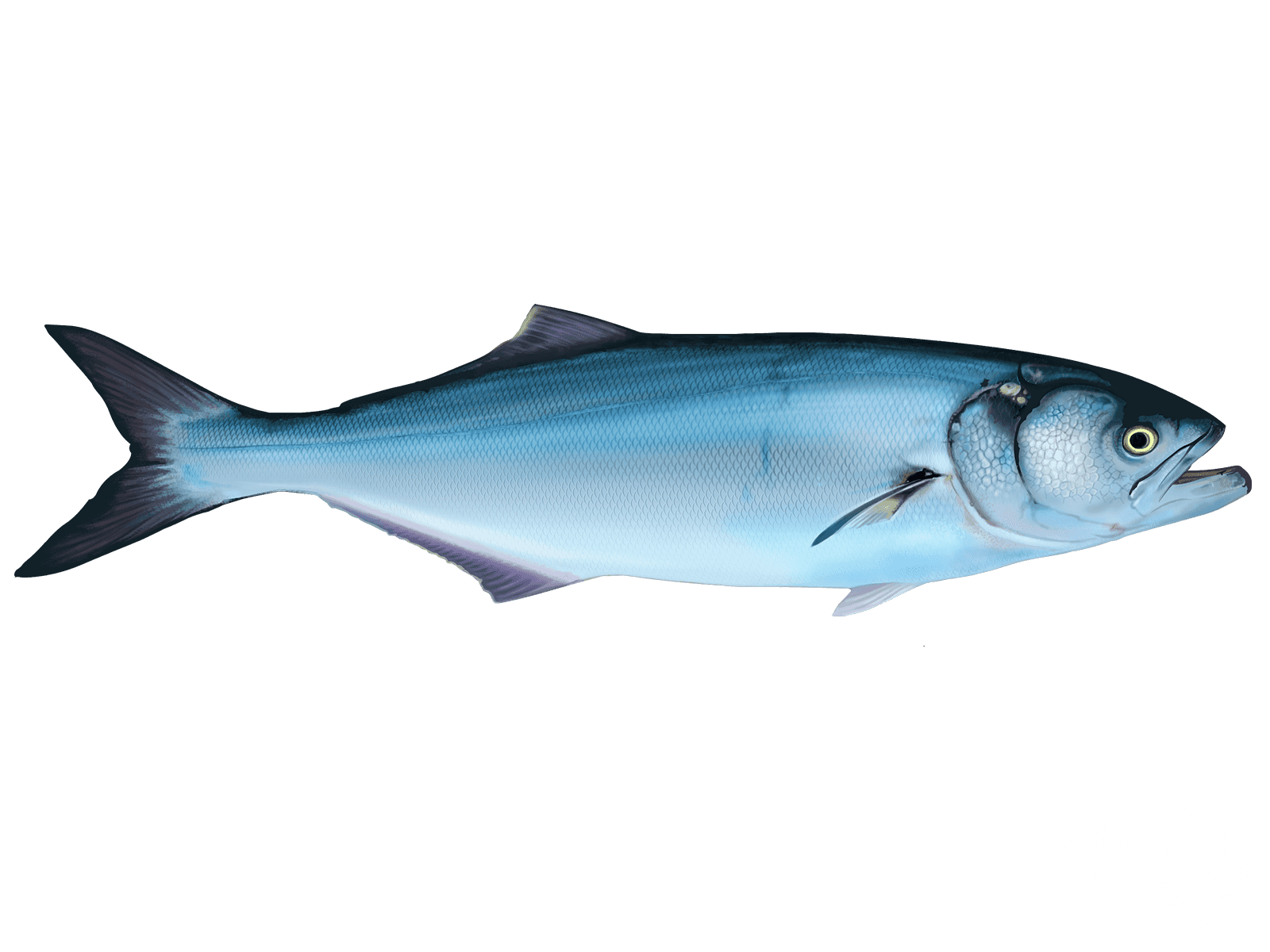
Bluefish (Pomatomus saltatrix) is the sole species in the family Pomatomidae, found in temperate and subtropical waters worldwide. The fish has been harvested for centuries along the Atlantic coast of North America, the Mediterranean, and the Black Sea. Indigenous peoples and early settlers valued the fish for its abundance and ease of capture during migration runs. The name "bluefish" derives from the distinct blue-green coloration of the dorsal side, which fades to silver on the belly.
Explore More Seafood
Discover more Seafood with detailed nutrition facts, calorie counts, vitamins, minerals, and health benefits. Compare similar foods, serving sizes, macronutrients, and key nutrients to find the best option for your diet and nutrition goals.
 Anchovies calories
 Barramundi calories
 Bluefin Tuna calories
 Calamari calories
 Catfish calories
 Clams calories
 Cod calories
 Conch calories
 Crab calories
 Eel calories
 Fish calories
 Flounder calories