Calories and Nutritions in Lentils
The calories in lentils depend on the type of preparation and serving size. One cup (198 grams) of cooked lentils contains 230 calories, while a cup of raw lentils (192 grams) provides 676 calories. A cup (around 240 grams or 8.5 ounces) of lentil soup ranges from 170 to 250 calories depending on added ingredients. A single cup (198 grams) of cooked lentils is packed with essential nutrients, offering 17.9 grams of protein (36% Daily Value, DV), 15.6 grams of dietary fiber (56% DV), 39.9 grams of carbohydrates (15% DV), and 0.8 grams of fat (1% DV). Lentils are rich in folate (Vitamin B9), providing 358 micrograms (90% DV) per cooked cup, and iron, with 7 milligrams (37% DV). A study by Jenkins DJA in 2012 demonstrated that including legumes like lentils in a low glycemic index diet improved glycemic control and reduced cardiovascular risk factors in individuals with type 2 diabetes.
Common types of lentils include Brown, Green, Red/Yellow, Black Beluga, and French Puy lentils. Global lentil production is dominated by Canada, which produced 2.3 million tonnes in 2022, and India, which produced 1.28 million tonnes the same year. India stands out as the world's largest consumer of lentils. Over the past two decades, US producer prices for lentils have fluctuated, sometimes falling below $0.20 per pound and exceeding $0.40 per pound during years with poor harvests or high demand.
Lentils form the base of many staple dishes worldwide, such as hearty lentil soup, creamy Indian Dal Makhani, and flavorful Middle Eastern Mujadara (lentils and rice). These dishes are available in restaurants like Panera Bread. The Dietary Guidelines for Americans recommend consuming 1.5 to 3 cups (150 grams to 300 grams cooked weight) of legumes, including lentils, per week. A standard half-cup (99 grams or 3.5 ounces) serving of cooked lentils contains about 115 calories. To expend these 115 calories, 15 to 20 minutes of brisk walking, 10 to 15 minutes of jogging, or 30 minutes of moderate gardening activity is required.
Lentils nutrition
| Stats | Weight |
|---|---|
| Carbs | 62.2 grams |
| Protein | 23.6 grams |
| Fats | 1.92 grams |
| Sugars | 0 grams |
- Large Bowl of Lentils Calories (Nutritional Facts)
- Medium Bowl of Lentils Calories (Nutritional Facts)
- Small Bowl of Lentils Calories (Nutritional Facts)
- Raw Lentils Calories
- Potassium in Lentils
- Sugar in Lentils
- Fiber in Lentils
- Protein in Lentils
- Carbs in Lentils
- Fat in Lentils
- Vitamins in Lentils
- Minerals in Lentils
Large Bowl of Lentils Calories (Nutritional Facts)
A large bowl of cooked lentils (396g or 14oz) provides 460 calories, 35.7g of protein, 1.5g of fat, and 79.7g of carbohydrates. A large bowl of lentil soup contains variable calories depending on the recipe, often ranging from 350 to 500 calories, with protein, fat, and carbohydrate content also varying based on ingredients like vegetables, broth, and added fats. A large bowl of raw lentils (387g) contains 1352 calories, 94.6g of protein, 4.1g of fat, and 243.3g of carbohydrates.
A medium bowl of cooked lentils (297g or 10.5oz) contains 345 calories, 26.8g of protein, 1.1g of fat, and 59.8g of carbohydrates. A medium bowl of raw lentils (288g or 10.2oz) provides 1014 calories, 71.0g of protein, 3.1g of fat, and 182.5g of carbohydrates.
A small bowl of cooked lentils (1 cup, 198g or 7oz) has 230 calories, 17.9g of protein, 0.8g of fat, and 39.9g of carbohydrates. One cup (around 240g or 8.5oz) of lentil soup in a small bowl provides between 170 and 250 calories. A small bowl (192g or 6.8oz) of dry, raw lentils contains 676 calories, 47.3g of protein, 2.0g of fat, and 121.6g of carbohydrates.
Raw lentils contain 352 calories per 100g (3.5oz) serving. This portion size also includes 24.6g of protein, 1.1g of fat, and 63.4g of carbohydrates.
Cooked lentils provide 369mg of potassium per 100g (3.5oz), contributing 8% towards the Daily Value (DV). Raw lentils contain 677mg of potassium per 100g, fulfilling 14% of the DV.
Cooked lentils contain 1.8g of sugar per 100g (3.5oz). Raw lentils have 2g of sugar per 100g serving.
A 100g (3.5oz) serving of cooked lentils offers 7.9g of dietary fiber, meeting 28% of the DV for supporting a healthy diet. Raw lentils provide 10.7g of fiber per 100g, which is 39% of the DV.
Cooked lentils supply 9.02g of protein per 100g (3.5oz), contributing 18% to the DV. Raw lentils contain 24.6g of protein per 100g, providing 49% of the DV.
A 100g (3.5oz) serving of cooked lentils has 20.13g of total carbohydrates, which is 7% of the DV. Raw lentils contain 63.35g of carbohydrates per 100g, fulfilling 23% of the DV.
Cooked lentils contain 0.38g of total fat per 100g (3.5oz), which is less than 1% of the DV. Raw lentils provide 1.06g of fat per 100g, contributing 1% to the DV.
A 100g (3.5oz) serving of cooked lentils is an excellent source of folate (Vitamin B9), providing 181µg or 45% of the DV, which is important for cell growth. It also supplies thiamin (Vitamin B1) at 0.169mg (14% DV), Vitamin B6 at 0.18mg (14% DV), pantothenic acid (Vitamin B5) at 0.64mg (13% DV), niacin (Vitamin B3) at 1.06mg (7% DV), and riboflavin (Vitamin B2) at 0.07mg (5% DV).
Cooked lentils per 100g (3.5oz) are rich in iron, providing 3.33mg (19% DV), essential for oxygen transport, and manganese at 0.49mg (21% DV). They also contain phosphorus at 180mg (14% DV), copper at 0.25mg (28% DV), zinc at 1.27mg (12% DV), magnesium at 36mg (9% DV) and selenium at 2.8µg (5% DV).
Get a Custom Report on Lentils Nutrition Data – Contact Us!
What are the Types of Lentils?
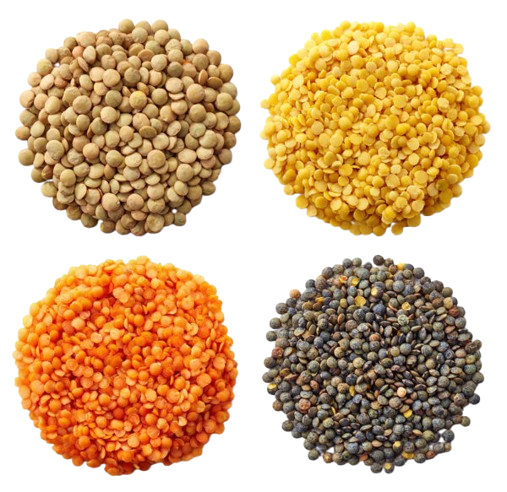
Lentils come in several varieties, differing in size, color, texture, and cooking properties. The main types include Brown, Green, Red/Yellow, Black (Beluga), and Puy lentils. The characteristics and general calorie content for cooked lentils are provided in the table below:
| Type | Description | Calories (per 100g cooked) | Calorie Differences & Qualifications |
|---|---|---|---|
|
Brown
|
Most common type, earthy flavor, hold shape moderately well during cooking. | 116 | Standard calorie content for cooked lentils. Versatile for soups, stews, salads. |
|
Green
|
Often larger than brown, slightly firmer texture, peppery taste, hold shape well. | 116 | Similar calorie content to brown lentils when cooked. Good for salads and side dishes where shape retention is desired. |
|
Red / Yellow
|
Split lentils (dehusked), cook quickly, break down into a soft, creamy texture. Sweet, nutty flavor. | 100-110 | Slightly lower calorie count per 100g cooked, potentially due to higher water absorption/processing. Best for soups, purees, dals, and thickening sauces. |
|
Black Beluga
|
Small, round, black, resemble caviar. Rich, earthy flavor, hold shape very well when cooked. | 116 | Similar calorie content to brown/green lentils. Excellent for salads, side dishes, adding visual appeal. |
|
Puy
|
Small, slate-green/blue with speckles, from Le Puy, France. Peppery flavor, hold shape exceptionally well. | 116 | Similar calorie content to brown/green lentils. Considered premium quality; ideal for salads and dishes requiring distinct lentils. Raw lentils have ~352 kcal/100g. |
What are the Main Dishes with Lentils?
The main dishes that feature lentils are listed below:
| Dish Name | Calories (Estimate) | Carbs (g) | Sugar (g) | Protein (g) | Fat (g) | Cuisine | Restaurants |
|---|---|---|---|---|---|---|---|
|
Lentil Soup
|
200-400 per bowl | 30-60 | 3-8 | 10-20 | 2-15 | Mediterranean, Middle Eastern, American | Panera Bread |
|
Dal Makhani
|
350-550 per serving | 30-45 | 2-5 | 10-18 | 18-35 | Indian (Punjabi) | Tamarind Tribeca |
|
Mujadara
|
400-600 per serving | 60-90 | 2-6 | 15-25 | 10-20 | Middle Eastern (Levantine) | Tanoreen (Brooklyn, NY), Mamoun's Falafel |
|
Ethiopian Misir Wot (Red Lentil Stew)
|
300-450 per serving | 40-60 | 3-7 | 15-22 | 8-15 | Ethiopian | Dukem Ethiopian Restaurant (DC), Awash Ethiopian Restaurant (NYC) |
|
Lentil Shepherd's Pie (Vegetarian/Vegan)
|
450-650 per serving | 50-75 | 8-15 | 15-25 | 15-25 | Modern Vegetarian/Vegan (British-inspired) | Veggie Grill |
|
Harira
|
250-400 per bowl | 35-55 | 5-10 | 10-18 | 5-12 | Moroccan | Kous Kous Moroccan Bistro - San Diego |
|
Lentil Salad
|
250-450 per serving | 30-50 | 4-8 | 12-20 | 8-18 | Mediterranean, International | Cava, Sweetgreen |
What are the Desserts with Lentils?
Lentil-based desserts are less common in mainstream US cuisine but appear in specific culinary traditions. Some examples are listed below:
| Dish Name | Calories (Estimate) | Carbs (g) | Sugar (g) | Protein (g) | Fat (g) | Cuisine | Restaurants |
|---|---|---|---|---|---|---|---|
|
Lentil Halwa (Moong Dal)
|
350-500 per serving | 40-60 | 25-40 | 6-10 | 15-25 | Indian | Common in many Indian restaurants during festivals or as specials |
|
Lentil Cookies/Energy Bites
|
100-200 per cookie/bite | 15-25 | 8-15 | 3-6 | 5-10 | Health-focused/Modern Fusion | health food cafes, vegan bakeries |
What Cuisines Prefer Lentils the Most?
Several cuisines around the world rely heavily on lentils. Some popular examples are listed below:
| Cuisine | Dish Name(s) | Calories (Estimate per serving) | Restaurants |
|---|---|---|---|
|
Indian
|
Dal (Makhani, Tarka, Fry), Sambar, Khichdi | 250-550 | Saravana Bhavan, local eateries like Thelewala NYC) |
|
Middle Eastern
|
Mujadara, Lentil Soup (Shorbat Adas), Lentil Kofta | 300-600 | Mamoun's Falafel, Tanoreen Brooklyn |
|
Mediterranean
|
Lentil Salads, Greek Lentil Soup (Fakes) | 250-450 | Cava, Souvla SF, local Greek tavernas |
|
Ethiopian
|
Misir Wot (Red Lentil Stew), Azifa | 300-450 (with Injera) | Queen of Sheba NYC, Dukem DC |
|
North African
|
Harira (Moroccan Lentil & Tomato Soup) | 250-400 | Shango Los Angeles |
|
Vegetarian/Vegan
|
Lentil Loaf, Lentil Burgers, Lentil Shepherd's Pie | 350-650 | Veggie Grill, Amy's Drive Thru, Blossom NYC |
Which Countries Produce the Most Lentils?
Based on data from the Food and Agriculture Organization of the United Nations (FAOSTAT), Canada and India are consistently the world's largest producers of lentils. Other significant producers include Turkey, Australia, the United States, and Nepal. The table below shows production volumes for these countries from 2004 to 2022:
| Country | 2004 | 2005 | 2006 | 2007 | 2008 | 2009 | 2010 | 2011 | 2012 | 2013 | 2014 | 2015 | 2016 | 2017 | 2018 | 2019 | 2020 | 2021 | 2022 |
|---|---|---|---|---|---|---|---|---|---|---|---|---|---|---|---|---|---|---|---|
| Canada | 1179900 | 1528800 | 1498900 | 1211000 | 1510300 | 1508800 | 1954200 | 1541800 | 1831900 | 2150100 | 1988000 | 2748000 | 3233800 | 2556400 | 2092900 | 2170500 | 2868000 | 1606400 | 2300671 |
| India | 1100000 | 920000 | 1000000 | 900000 | 880000 | 950000 | 1030000 | 940000 | 950000 | 1130000 | 1100000 | 1060000 | 1030000 | 1190000 | 1230000 | 1100000 | 1490000 | 1180000 | 1279440 |
| Turkey | 600000 | 580000 | 617950 | 278053 | 191782 | 337449 | 447400 | 409276 | 438000 | 417000 | 345000 | 380000 | 365000 | 430000 | 310000 | 320000 | 263000 | 225000 | 440000 |
| Australia | 134000 | 117000 | 141000 | 65000 | 130000 | 140000 | 163000 | 218000 | 344000 | 379000 | 265000 | 280000 | 1017000 | 540000 | 600000 | 530000 | 857000 | 992000 | 1150000 |
| United States | 209830 | 265010 | 231380 | 155950 | 214600 | 391180 | 372390 | 239500 | 214000 | 191000 | 240000 | 248000 | 372000 | 374000 | 173000 | 242000 | 308000 | 143000 | 227570 |
| Nepal | 174941 | 183470 | 189928 | 199910 | 206768 | 208000 | 207000 | 226000 | 208000 | 207000 | 228000 | 227000 | 245000 | 253000 | 252000 | 255000 | 252000 | 208631 | 208631 |
| Russia | N/A | N/A | N/A | N/A | N/A | N/A | N/A | N/A | N/A | N/A | 66000 | 104000 | 99000 | 115000 | 64000 | 121000 | 261000 | 164000 | 242415 |
| Ethiopia | 60800 | 71000 | 81300 | 91500 | 101800 | 112000 | 122000 | 132000 | 142000 | 152000 | 162000 | 172000 | 181000 | 191000 | 192000 | 192000 | 192000 | 192000 | 192000 |
| Bangladesh | 121000 | 118000 | 115000 | 130000 | 132000 | 128000 | 151000 | 154000 | 157000 | 160000 | 163000 | 187000 | 159000 | 160000 | 171000 | 177000 | 269000 | 258000 | 258000 |
| Syria | 169000 | 165000 | 160000 | 155000 | 150000 | 145000 | 140000 | 135000 | 130000 | 125000 | 120000 | 115000 | 110000 | 105000 | 100000 | 95000 | 90000 | 85000 | 85000 |
Which Countries Consume the Most Lentils?
Based on production, import data, and traditional dietary patterns, India is by far the largest consumer of lentils globally. Other major consuming regions and countries include the Middle East (Turkey, Syria, Lebanon), North Africa (Morocco, Egypt), South Asia (Nepal, Bangladesh, Pakistan), North America and Europe. The table below shows consumption volumes for these countries from 2004 to 2022:
| Country | 2004 | 2005 | 2006 | 2007 | 2008 | 2009 | 2010 | 2011 | 2012 | 2013 | 2014 | 2015 | 2016 | 2017 | 2018 | 2019 | 2020 | 2021 |
|---|---|---|---|---|---|---|---|---|---|---|---|---|---|---|---|---|---|---|
| Rwanda | 31.1 | 33.5 | 35.8 | 38.2 | 39.6 | 40.1 | 40.5 | 41.0 | 41.5 | 42.0 | 42.5 | 43.0 | 43.5 | 44.0 | 44.5 | 45.0 | 45.5 | 46.0 |
| Niger | 25.4 | 26.1 | 26.8 | 27.5 | 28.1 | 28.8 | 29.5 | 30.1 | 30.8 | 31.5 | 32.1 | 32.8 | 33.5 | 34.1 | 34.8 | 35.5 | 36.1 | 36.8 |
| Burundi | 22.3 | 23.0 | 23.7 | 24.4 | 25.0 | 25.7 | 26.4 | 27.0 | 27.7 | 28.4 | 29.0 | 29.7 | 30.4 | 31.0 | 31.7 | 32.4 | 33.0 | 33.7 |
| India | 11.8 | 10.9 | 12.1 | 11.5 | 11.8 | 13.0 | 14.6 | 14.0 | 13.5 | 14.2 | 14.9 | 15.5 | 16.2 | 18.8 | 17.5 | 17.0 | 19.5 | 19.0 |
| Ethiopia | 10.5 | 10.8 | 11.1 | 11.4 | 11.7 | 12.0 | 12.3 | 12.6 | 12.9 | 13.2 | 13.5 | 13.8 | 14.1 | 14.4 | 14.7 | 15.0 | 15.3 | 15.6 |
| Tanzania | 10.1 | 10.4 | 10.7 | 11.0 | 11.3 | 11.6 | 11.9 | 12.2 | 12.5 | 12.8 | 13.1 | 13.4 | 13.7 | 14.0 | 14.3 | 14.6 | 14.9 | 15.2 |
| Haiti | 9.8 | 9.9 | 10.0 | 10.1 | 10.2 | 10.3 | 10.4 | 10.5 | 10.6 | 10.7 | 10.8 | 10.9 | 11.0 | 11.1 | 11.2 | 11.3 | 11.4 | 11.5 |
| Uganda | 9.5 | 9.7 | 9.9 | 10.1 | 10.3 | 10.5 | 10.7 | 10.9 | 11.1 | 11.3 | 11.5 | 11.7 | 11.9 | 12.1 | 12.3 | 12.5 | 12.7 | 12.9 |
| Myanmar | 8.9 | 9.1 | 9.3 | 9.5 | 9.7 | 9.9 | 10.1 | 10.3 | 10.5 | 10.7 | 10.9 | 11.1 | 11.3 | 11.5 | 11.7 | 11.9 | 12.1 | 12.3 |
| Sudan | 8.5 | 8.7 | 8.9 | 9.1 | 9.3 | 9.5 | 9.7 | 9.9 | 10.1 | 10.3 | 10.5 | 10.7 | 10.9 | 11.1 | 11.3 | 11.5 | 11.7 | 11.9 |
| Turkey | 7.5 | 7.8 | 8.1 | 8.4 | 8.7 | 9.0 | 9.3 | 9.6 | 9.9 | 10.2 | 10.5 | 10.8 | 11.1 | 11.4 | 11.7 | 12.0 | 12.3 | 12.6 |
| Pakistan | 6.8 | 6.9 | 7.0 | 7.1 | 7.2 | 7.3 | 7.4 | 7.5 | 7.6 | 7.7 | 7.8 | 7.9 | 8.0 | 8.1 | 8.2 | 8.3 | 8.4 | 8.5 |
How Do Prices of Lentil-including Dishes Change?
The price of dishes featuring lentils in restaurants has increased over the past two decades. While lentils themselves remain relatively affordable compared to meat proteins, the overall cost to prepare and serve dishes like lentil soup or dal has gone up. Pricing comparison examples for lentil-based dishes are shown below:
| Restaurant | Dish | Old Price (2008 to 2010) | Current Price (2025) |
|---|---|---|---|
| Panera Bread | Vegetarian Lentil Soup | $4.50 - $5.50 (Bowl, 2010) | $6.79 - $8.50 (Bowl) |
| Local Indian Rest. | Dal Makhani | $9.00 - $12.00 (Entree, 2005) | $15.00 - $20.00 (Entree) |
| Local Middle East. | Mujadara | $8.00 - $11.00 (Entree, 2008) | $14.00 - $18.00 (Entree) |
| Cava | Lentil Tabbouleh (Side) | $2.50 - $3.50 (Side, 2015) | $4.00 - $5.00 (Side) |
| Amy's Drive Thru | Lentil Veggie Burger | $5.00 - $6.00 (Burger, 2015) | $8.00 - $9.50 (Burger) |
How Does the Price of Lentils Change for the Last 20 Years?
Lentil prices have fluctuated over the last 20 years. Looking at US data for dry peas and lentils (often grouped), prices saw lows in the early 2000s and highs during periods of drought or increased demand, such as spikes around 2008, 2015-2016, and again in the early 2020s. For example, average US producer prices for lentils were often below $0.20 per pound in the early 2000s, but exceeded $0.40 per pound during peak years. The lowest prices often correspond with years of high production in Canada, while the highest prices align with poor harvests or surges in global demand, sometimes outpacing the general growth trend seen in overall pulse consumption.
| Year | Price |
|---|---|
| 2005 | $0.18 |
| 2006 | $0.19 |
| 2007 | $0.2 |
| 2008 | $0.42 |
| 2009 | $0.32 |
| 2010 | $0.3 |
| 2011 | $0.28 |
| 2012 | $0.26 |
| 2013 | $0.27 |
| 2014 | $0.29 |
| 2015 | $0.41 |
| 2016 | $0.44 |
| 2017 | $0.38 |
| 2018 | $0.35 |
| 2019 | $0.34 |
| 2020 | $0.39 |
| 2021 | $0.43 |
| 2022 | $0.41 |
| 2023 | $0.38 |
| 2024 | $0.36 |
What is the Lentils Calorie for 100 GR?
One hundred grams (3.5oz) of cooked lentils contain 116 calories. Raw lentils contain 352 calories per 100g (3.5oz).
What is the Lentils Calorie for 1 KG?
One kilogram (2.2 lbs) of cooked lentils provides 1160 calories. One kilogram (2.2 lbs) of raw lentils contains 3520 calories.
What is the Calorie of 1 Cup of Lentils?
One cup (198g or 7oz) of cooked lentils contains 230 calories. One cup (192g or 6.8oz) of raw lentils contains 676 calories.
What are the Health Benefits of Lentils?
Lentils offer numerous health benefits supported by their rich nutrient profile, as listed below:
- Support Heart Health: Lentils are rich in fiber, folate, and potassium, nutrients known to support cardiovascular health. Soluble fiber helps lower LDL (bad) cholesterol levels. A meta-analysis by Anderson JW et al. (2009), titled "Dietary fiber: the effect on coronary heart disease risk factors," highlighted the role of dietary fiber in reducing heart disease risk factors. Folate helps lower homocysteine levels, an amino acid linked to increased heart disease risk when elevated. Potassium helps regulate blood pressure.
- Aid Digestive Health: The high dietary fiber content in lentils promotes regular bowel movements and helps prevent constipation. Fiber acts as a prebiotic, feeding beneficial gut bacteria, which contributes to a healthy gut microbiome. Research reviewed by Stephen J. D. O'Keefe (2016) in "Diet, microorganisms and kidney disease" emphasizes the link between dietary fiber, gut microbiota, and overall health, including kidney function which is related to digestive system processing.
- Help Manage Blood Sugar Levels: Lentils have a low glycemic index (GI) due to their complex carbohydrates and fiber. This means they cause a slower, more gradual rise in blood sugar levels compared to high-GI foods, which is beneficial for managing blood sugar control, particularly for individuals with diabetes. A study by Jenkins DJA et al. (2012), "Effect of legumes as part of a low glycemic index diet on glycemic control and cardiovascular risk factors in type 2 diabetes mellitus: a randomized controlled trial," demonstrated the benefits of legumes like lentils in improving glycemic control.
- Source of Plant-Based Protein: Lentils provide a significant amount of protein, essential for building and repairing tissues, muscle maintenance, and enzyme production. This makes them a valuable protein source, especially for vegetarian and vegan diets.
- Rich in Iron: Lentils are a good source of non-heme iron. Iron is crucial for preventing iron-deficiency anemia and for transporting oxygen throughout the body. Consuming lentils with vitamin C-rich foods (like tomatoes or bell peppers) can enhance iron absorption.
- High in Folate: Lentils are exceptionally rich in folate (Vitamin B9), providing 45% of the DV per 100g cooked serving. Folate is vital for cell growth, DNA formation, and is particularly important during pregnancy to prevent neural tube defects.
What are the Downsides of Lentils?
While highly nutritious, lentils have a few potential downsides for some individuals, including:
- Cause Digestive Discomfort: The high fiber content, particularly types like raffinose, can cause gas, bloating, and abdominal discomfort, especially for those not accustomed to high-fiber diets. Gradually increasing intake and ensuring adequate hydration can help mitigate these effects. Soaking lentils before cooking can also reduce gas-producing compounds. For those highly sensitive, smaller portions or alternative legumes like well-cooked chickpeas might be better tolerated initially.
- Contain Anti Nutrients: Lentils contain compounds like phytates (phytic acid) and lectins, which can interfere with the absorption of minerals like iron, zinc, and calcium. Lectins can also cause digestive upset in sensitive individuals if consumed raw or undercooked. Proper cooking methods, such as soaking, sprouting, or boiling, significantly reduce the levels of these antinutrients, minimizing their impact. Individuals needing maximum mineral absorption might consider pairing lentils with absorption enhancers (like vitamin C for iron) or choosing lower-phytate grains like quinoa as an alternative staple sometimes. There isn't a specific daily limit related solely to antinutrients, but varying protein sources is generally advisable.
- Allergic Reactions: Though rare, allergies to lentils exist. Symptoms can range from mild digestive upset to severe reactions. Anyone suspecting an allergy should consult a healthcare professional.
Are Lentils Good for You?
Yes, lentils are good for you and are considered a nutrient-dense food. They contribute positively to overall health by supporting heart health through their fiber, potassium, and folate content, which help manage cholesterol and blood pressure. Their high fiber content promotes digestive health by aiding regularity and nourishing beneficial gut bacteria. Lentils' low glycemic index assists in blood sugar management, making them beneficial for metabolic health. As a rich source of plant-based protein and iron, they support muscle maintenance, energy levels, and oxygen transport. While they can cause initial digestive adjustments due to fiber and contain antinutrients reduced by proper cooking, their substantial contribution of essential vitamins, minerals, and macronutrients makes them a valuable component of a healthy and balanced diet.
How Much Lentils Should I Eat a Day?
There isn't a specific daily requirement for lentils set by organizations like the FDA or AHA. However, the Dietary Guidelines for Americans recommend that adults consume 1.5 to 3 cups of legumes (which include lentils, beans, and peas) per week as part of a healthy eating pattern. A typical serving size of cooked lentils is ½ cup (99g or 3.5oz). Incorporating a ½ cup serving of cooked lentils into meals several times a week can help meet these recommendations and contribute significantly to fiber, protein, folate, and iron intake.
How Much Lentils Can I Eat a Day at Most?
Consuming more than 1 to 1.5 cups (198g-297g or 7oz-10.5oz) of cooked lentils daily might be excessive for some individuals and could displace other important foods. There is no strict upper limit defined for daily lentil consumption for healthy adults, but eating excessive amounts could lead to issues primarily related to their high fiber content. Consuming very large quantities, especially without gradually increasing intake, might cause significant digestive discomfort, including gas, bloating, and potentially diarrhea or constipation.
How Does Calorie Change According to Lentils Types?
The calorie content of lentils changes significantly based on their state (raw vs. cooked) rather than varying substantially between different types like brown, green, black, or Puy lentils. Raw lentils possess the highest calorie density, providing around 352 calories per 100g (3.5oz) regardless of the specific type. When cooked, lentils absorb a considerable amount of water, which increases their volume and weight while lowering their calorie density. Most types of cooked lentils provide roughly 116 calories per 100g (3.5oz). Red and yellow lentils, being split and often cooking down more, might sometimes register slightly lower calories per 100g cooked (around 100-110 calories) potentially due to higher water content in the final dish, but the difference is generally minimal compared to the drastic change from raw to cooked.
Do Lentil Macros Change When Cooked?
Yes, the concentration of lentil macros changes significantly when cooked. Raw lentils are very dense in macronutrients per unit of weight. During cooking, lentils absorb a large amount of water, typically increasing their weight by 2.5 to 3 times. This process dilutes the concentration of protein, carbohydrates, and fat per 100g of the final cooked product compared to 100g of raw lentils. While the total amount of each macronutrient in the initial batch remains the same (minus minimal losses), the amount present in any given weight or volume of cooked lentils is lower than in the same weight or volume of raw lentils due to the added water weight.
What is the Origin of the Lentils?
Lentils (Lens culinaris) are one of the oldest known cultivated legumes, with origins tracing back to the Near East (Fertile Crescent region of Western Asia) around 8,000 to 7,000 BCE. Archaeological evidence suggests they were domesticated alongside staple grains like wheat and barley, quickly becoming a vital food source due to their nutritional value and ability to grow in relatively poor soil conditions. From the Near East, their cultivation spread across the Mediterranean basin, into Asia, and throughout Europe. Their long storage life made them crucial for sustenance, especially during lean times.
One of the most globally recognized and historically significant lentil dishes is Dal (also spelled Dahl or Daal). Originating from the Indian subcontinent, the term 'Dal' refers both to the dried, split pulse itself and the thick stew prepared from it. Recipes for dal are ancient, mentioned in early Hindu scriptures, and have evolved over millennia into countless regional variations across India, Nepal, Pakistan, Sri Lanka, and Bangladesh.
Explore More Legumes
Discover more Legumes with detailed nutrition facts, calorie counts, vitamins, minerals, and health benefits. Compare similar foods, serving sizes, macronutrients, and key nutrients to find the best option for your diet and nutrition goals.
 Arhar Dal calories
 Black beans calories
 Black-Eyed Peas calories
 Cannellini Beans calories
 Chickpea Flour calories
 Cream Bean calories
 Edamame calories
 Fava Beans calories
 Hummus calories
 Lupini Beans calories
 Mung Beans calories
 Pigeon Peas calories