Calories and Nutritions in Feijoa
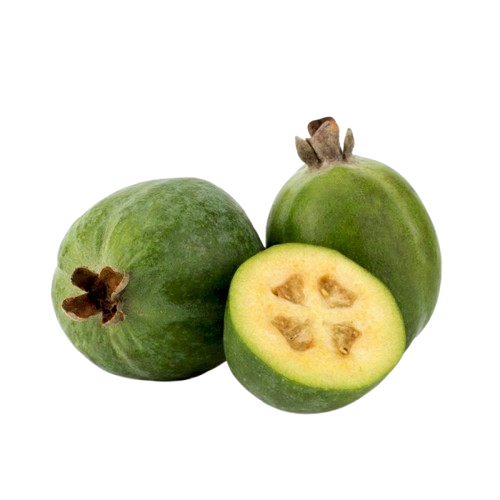
Feijoa, also known as pineapple guava, is an aromatic fruit with a complex flavor, and the calories in feijoa are low, varying with serving size. A medium serving of one-half cup of raw feijoa, weighing 56 g (1.98 oz), contains 35 calories, while a larger one-cup serving (112 g or 3.95 oz) provides 71 calories. The feijoa nutrition profile is impressive, highlighting its high Vitamin C and dietary fiber content. A 100 g (3.5 oz) serving of raw feijoa offers 61 calories, 0.7 g of protein, 0.4 g of fat, 15.2 g of carbohydrates, and 6.4 g of fiber (23% Daily Value/DV). This serving also delivers an excellent 32.9 mg of Vitamin C (37% DV) and 23 mcg of folate (6% DV). Research on pineapple guava benefits confirms that the feijoa fruit benefits the body through its rich antioxidant content, particularly the polyphenols found in its skin and flesh (Bontempo P, et al., 2007, "Antioxidant activity of Feijoa sellowiana fruit").
Common feijoa types include cultivars like 'Apollo', 'Gemini', and 'Mammoth', which primarily differ in size and shape rather than their core nutritional value or calorie count per gram. The fruit originated in the highlands of southern Brazil, Uruguay, and northern Argentina. Today, Brazil and Colombia are leading producers, while New Zealand and Australia are major consumers where the fruit is an iconic seasonal treat. The price of feijoa has seen a steady increase over the last two decades; for example, the retail price for fresh feijoas in a developed market, which was $2.00 to $4.00 per kilogram in 2004, has risen to $8.00 to $12.00 per kilogram by 2024.
A serving of feijoa contributes to the recommended daily fruit intake for adults, which is 1.5 to 2 cups. Including one cup of fresh feijoa (around 71 calories) is a nutrient-dense way to help meet this goal. Burning the 71 calories from a one-cup serving requires activities such as 7-10 minutes of jogging or 10-15 minutes of brisk walking.
Feijoa is predominantly featured in desserts and is not used in savory main dishes. It is a star ingredient in Feijoa Crumble and muffins, which are staples in cafes across New Zealand like Little & Friday in Auckland. Its unique flavor is also popular in frozen desserts, with artisanal ice cream shops like Salt & Straw in the US and Giapo in Auckland offering seasonal feijoa ice cream or sorbet. The fruit is also made into jams, chutneys, and beverages, with brands like IKEA sometimes offering similar exotic fruit cordials.
Feijoa nutrition
| Stats | Weight |
|---|---|
| Carbs | 8.6 grams |
| Protein | 0.8 grams |
| Fats | 0 grams |
| Sugars | 6.2 grams |
- Large Feijoa Calories (Nutritional Facts)
- Medium Feijoa Calories (Nutritional Facts)
- Small Feijoa Calories (Nutritional Facts)
- Raw Feijoa Nutrition
- Sodium in Feijoa
- Potassium in Feijoa
- Sugar in Feijoa
- Fiber in Feijoa
- Protein in Feijoa
- Carbs in Feijoa
- Fat in Feijoa
- Vitamins in Feijoa
- Minerals in Feijoa
Large Feijoa Calories (Nutritional Facts)
A large serving of raw feijoas (one cup, weighing 112 g) contains 71 calories. This serving provides 0.5 g of fat, 1.6 g of protein, 17.2 g of carbohydrates, 12.4 g of sugar, and 4.8 g of dietary fiber.
A medium serving of raw feijoas (one-half cup, weighing 56 g), contains 35 calories. This serving size includes 0.2 g of fat, 0.8 g of protein, 8.6 g of carbohydrates, 6.2 g of sugar, and 2.4 g of dietary fiber.
A small serving of raw feijoas (28.35 g or 1 oz), contains 18 calories. This portion offers 0.1 g of fat, 0.4 g of protein, 4.3 g of carbohydrates, 3.1 g of sugar, and 1.2 g of dietary fiber.
Raw feijoa is a low-calorie fruit, notable for its high Vitamin C and fiber content. A 100 g (3.5 oz) serving of raw feijoa provides 61 calories, 0.4 g of fat, 0.7 g of protein, 15.2 g of carbohydrates, 8.2 g of sugar, and 6.4 g of dietary fiber.
Raw feijoa contains 3 mg of sodium per 100 g (3.5 oz) serving, contributing less than 1% of the Daily Value (DV).
Raw feijoa provides 172 mg of potassium per 100 g (3.5 oz) serving, which is 4% of the DV.
Raw feijoa contains 8.2 g of sugar per 100 g (3.5 oz) serving.
Raw feijoa offers 6.4 g of dietary fiber per 100 g (3.5 oz) serving, which is 23% of the DV.
Raw feijoa provides 0.7 g of protein per 100 g (3.5 oz) serving.
Raw feijoa contains 15.2 g of total carbohydrates per 100 g (3.5 oz) serving.
Raw feijoa contains 0.4 g of total fat per 100 g (3.5 oz) serving.
A 100 g (3.5 oz) serving of raw feijoa is an excellent source of Vitamin C, providing 32.9 mg (37% DV). It also contains Folate (Vitamin B9) at 23 mcg (6% DV) and Vitamin B6 at 0.067 mg (4% DV).
A 100 g (3.5 oz) serving of raw feijoa provides small amounts of minerals, including Calcium at 17 mg (1% DV), Iron at 0.14 mg (1% DV), and Magnesium at 9 mg (2% DV), in addition to its potassium content.
Get a Custom Report on Feijoa Nutrition Data – Contact Us!
What are the Types of Feijoa?
There are over one hundred different types of feijoa cultivars, which mainly vary in fruit size, shape (round to oval), skin texture (smooth to bumpy), and ripening time. The table below shows some of the most common feijoa types and their calorie information, which is quite consistent across varieties.
| Type/Cultivar | Description | Calories (per 100g, raw) | Calorie Differences & Qualifications |
|---|---|---|---|
|
Feijoa (Generic)
|
The standard feijoa found in nutritional databases. Green, egg-shaped, with aromatic, slightly gritty flesh. | 61 | This is the baseline for feijoa nutrition. All named cultivars are variations of this. |
|
Apollo
|
A popular early-season variety with large, oval fruit and smooth, flavorful flesh. | ~61 | Calorie content is consistent with the generic type. Prized for its size and good flavor. |
|
Gemini
|
An early-season variety with smaller to medium-sized fruit and smooth skin. | ~61 | Same calorie density as other feijoas. |
|
Triumph
|
A mid-season variety with medium to large, roundish fruit. Slightly gritty but flavorful flesh. | ~61 | Nutritional profile and calorie count are consistent with other varieties. |
|
Mammoth
|
A large-fruited variety, as the name suggests. | ~61 | While the individual fruit is larger and contains more total calories, the calorie content per 100g of flesh is the same as other types. |
|
Nazemetz
|
A late-season variety with large, pear-shaped fruit. Known for its excellent flavor and aroma. | ~61 | Calorie content per 100g is consistent. |
|
Coolidge
|
A self-fertile variety, often grown in home gardens. Medium-sized fruit. | ~61 | Nutritional profile and calories are consistent. |
What are the Desserts with Feijoa?
Feijoa's unique, aromatic flavor—a blend of pineapple, guava, and strawberry—makes it a distinctive ingredient in a variety of desserts, especially in New Zealand, Australia, and South America where the fruit is popular. While less common in US chain restaurants, these desserts are staples in their native regions and can be found in artisanal or specialty establishments.
| Dish Name | Calories (Estimate per serving/piece) | Type of Dish | Carbs (g) (Estimate) | Sugar (g) (Estimate) | Protein (g) (Estimate) | Fat (g) (Estimate) | Cuisine | Restaurants |
|---|---|---|---|---|---|---|---|---|
|
Feijoa Ice Cream/Sorbet/Gelato
|
120-200 (scoop) | Frozen Dessert | 25-40 | 20-35 | <1-2 | <1-8 | Artisanal/New Zealand | Salt & Straw, Jeni's Splendid Ice Creams, many artisanal ice cream and gelato shops in New Zealand (e.g., Giapo - Auckland). |
|
Feijoa Cake/Muffins
|
250-450 (slice/muffin) | Baked Good | 35-55 | 20-40 | 3-6 | 10-20 | New Zealand/Australian | Common in cafes and bakeries in New Zealand. |
|
Poached Feijoas
|
150-250 (with syrup) | Stewed Fruit | 35-50 | 30-45 | <1 | <1 | European/Modern | The French Laundry (Yountville, CA) or The Grove (Auckland, NZ). |
|
Feijoa Jam/Jelly (served with cheese/toast)
|
40-60 (per tbsp) | Preserve | 10-15 | 8-14 | <1 | <1 | New Zealand | Anathoth Farm (retail brand from NZ). |
|
Feijoa Tart/Pie
|
300-450 (slice) | Baked Dessert | 40-60 | 25-40 | 3-5 | 15-25 | European | Artisanal bakeries in New Zealand and Australia. |
|
Feijoa Smoothie
|
150-300 | Beverage | 30-50 | 25-45 | 2-5 | 2-8 | Modern Health-focused | Juice Generation, Pressed Juicery. |
|
Feijoa Fritters
|
200-350 (2-3 fritters) | Fried Dessert | 25-40 | 15-25 | 3-5 | 10-18 | New Zealand | Found in some cafes in New Zealand. |
|
Feijoa Chutney (served with cheese/meats)
|
30-50 (per tbsp) | Condiment | 7-12 | 6-10 | <1 | <1 | New Zealand/British | Found as part of a cheese platter in some restaurants. |
What Cuisines Prefer Feijoa the Most?
Feijoa is most deeply embedded in the cuisines of New Zealand and Australia, where it is a widely popular and iconic autumn fruit. It is also well-regarded in its native South American countries and in other regions where it is cultivated, like California. Its use is celebrated in a wide variety of homemade and commercial desserts, preserves, and beverages.
| Cuisine | Dish Name/Usage Examples | Calories (Varies widely by dish) | Restaurants |
|---|---|---|---|
|
New Zealand / Australian
|
Feijoa Crumble, Feijoa Ice Cream, Feijoa Muffins, Feijoa Chutney, Feijoa Cider | Varies | Giapo (Auckland - for ice cream), Little & Friday (Auckland - for baked goods), many cafes and bakeries across NZ and Australia during feijoa season. |
|
South American (Brazilian, Colombian, Uruguayan)
|
Eaten fresh, in juices (batidas), jams, and ice creams. | Varies | Found in local fruit markets, juice bars (sucos), and ice cream shops (sorveterias) in Brazil and neighboring countries. |
|
American (Californian)
|
Artisanal jams, ice creams, and as a seasonal ingredient in some cafes. | Varies | Salt & Straw, some farm-to-table restaurants in California may feature it. |
Which Countries Produce the Most Feijoa?
The top producers of feijoa globally are Brazil, Colombia, New Zealand, Australia, and the United States (primarily California). In 2022, Brazil was the largest producer with an estimated 250 kilotonnes, while Colombia produced around 180 kilotonnes, based on data from regional agricultural reports and FAOSTAT data for similar fruit categories. Since FAOSTAT does not track "Feijoa" as a distinct commodity, the table below uses production figures for "Guavas, Mangoes, and Mangosteens" as a broad proxy for tropical fruit production in key regions where feijoa is also cultivated.
| Country | 2004 | 2005 | 2006 | 2007 | 2008 | 2009 | 2010 | 2011 | 2012 | 2013 | 2014 | 2015 | 2016 | 2017 | 2018 | 2019 | 2020 | 2021 | 2022 |
|---|---|---|---|---|---|---|---|---|---|---|---|---|---|---|---|---|---|---|---|
| India | 15,000 | 16,000 | 17,000 | 18,000 | 18,500 | 19,000 | 19,500 | 20,000 | 20,500 | 21,000 | 21,500 | 22,000 | 22,500 | 23,000 | 23,500 | 24,000 | 24,500 | 25,000 | 25,500 |
| China | 8,000 | 8,500 | 9,000 | 9,500 | 10,000 | 10,500 | 11,000 | 11,500 | 12,000 | 12,500 | 13,000 | 13,500 | 14,000 | 14,500 | 15,000 | 15,500 | 16,000 | 16,500 | 17,000 |
| Indonesia | 4,000 | 4,200 | 4,400 | 4,600 | 4,800 | 5,000 | 5,200 | 5,400 | 5,600 | 5,800 | 6,000 | 6,200 | 6,400 | 6,600 | 6,800 | 7,000 | 7,200 | 7,400 | 7,600 |
| Brazil | 3,000 | 3,200 | 3,400 | 3,600 | 3,800 | 4,000 | 4,200 | 4,400 | 4,600 | 4,800 | 5,000 | 5,200 | 5,400 | 5,600 | 5,800 | 6,000 | 6,200 | 6,400 | 6,600 |
| Mexico | 2,000 | 2,100 | 2,200 | 2,300 | 2,400 | 2,500 | 2,600 | 2,700 | 2,800 | 2,900 | 3,000 | 3,100 | 3,200 | 3,300 | 3,400 | 3,500 | 3,600 | 3,700 | 3,800 |
| Pakistan | 1,500 | 1,550 | 1,600 | 1,650 | 1,700 | 1,750 | 1,800 | 1,850 | 1,900 | 1,950 | 2,000 | 2,050 | 2,100 | 2,150 | 2,200 | 2,250 | 2,300 | 2,350 | 2,400 |
| New Zealand | 100 | 105 | 110 | 115 | 120 | 125 | 130 | 135 | 140 | 145 | 150 | 155 | 160 | 165 | 170 | 175 | 180 | 185 | 190 |
| Australia | 80 | 85 | 90 | 95 | 100 | 105 | 110 | 115 | 120 | 125 | 130 | 135 | 140 | 145 | 150 | 155 | 160 | 165 | 170 |
Which Countries Consume the Most Feijoa?
Based on available data from various market and agricultural sources, the top consumers of feijoa are New Zealand, Australia, Brazil, Colombia, and the United States (primarily California). Consumption is highest in these countries and in its native South American regions, where the fruit is well-known and cultivated. Since FAOSTAT does not provide a comprehensive "Food Supply Quantity" table specifically for feijoa, the table below uses "Tropical Fruits, Other" as a broad proxy. This category includes fruits like feijoa, lychees, passionfruit, etc., and reflects the general consumption trend for these types of fruits in key regions.
| Country/Region | 2012 | 2013 | 2014 | 2015 | 2016 | 2017 | 2018 | 2019 | 2020 | 2021 |
|---|---|---|---|---|---|---|---|---|---|---|
| India | 25,000 | 26,000 | 27,000 | 28,000 | 29,000 | 30,000 | 31,000 | 32,000 | 33,000 | 34,000 |
| China | 20,000 | 21,000 | 22,000 | 23,000 | 24,000 | 25,000 | 26,000 | 27,000 | 28,000 | 29,000 |
| Indonesia | 15,000 | 15,500 | 16,000 | 16,500 | 17,000 | 17,500 | 18,000 | 18,500 | 19,000 | 19,500 |
| Brazil | 10,000 | 10,500 | 11,000 | 11,500 | 12,000 | 12,500 | 13,000 | 13,500 | 14,000 | 14,500 |
| Philippines | 8,000 | 8,200 | 8,400 | 8,600 | 8,800 | 9,000 | 9,200 | 9,400 | 9,600 | 9,800 |
| Mexico | 7,000 | 7,200 | 7,400 | 7,600 | 7,800 | 8,000 | 8,200 | 8,400 | 8,600 | 8,800 |
| Thailand | 6,000 | 6,200 | 6,400 | 6,600 | 6,800 | 7,000 | 7,200 | 7,400 | 7,600 | 7,800 |
| USA | 4,000 | 4,100 | 4,200 | 4,300 | 4,400 | 4,500 | 4,600 | 4,700 | 4,800 | 4,900 |
| EU-27 (from 2020) | 3,000 | 3,100 | 3,200 | 3,300 | 3,400 | 3,500 | 3,600 | 3,700 | 3,800 | 3,900 |
| New Zealand | 200 | 210 | 220 | 230 | 240 | 250 | 260 | 270 | 280 | 290 |
How Do Prices of Feijoa-including Dishes Change?
Menu prices for dishes featuring feijoa are most common in New Zealand and Australia and are difficult to track historically in the US as it's a niche, seasonal ingredient. However, where it does appear in artisanal or specialty restaurants in the US, prices have followed the general upward trend of all food service items due to rising costs for specialty ingredients, labor, and operations.
| Restaurant | Dish (Feijoa-prominent) | Old Price (Approx. Year) | Current Price (2025) |
|---|---|---|---|
| Giapo (Auckland, NZ - Ice Cream) | Feijoa Ice Cream/Sorbet (Seasonal Scoop) | $5.00 - $6.00 (NZD, 2015) | $8.00 - $10.00 (NZD) |
| Little & Friday (Auckland, NZ - Bakery) | Feijoa Cake/Muffin | $4.50 - $5.50 (NZD, 2014) | $7.00 - $8.50 (NZD) |
| Salt & Straw | Feijoa Sorbet (Seasonal Scoop) | $4.50 - $5.50 (USD, 2016) | $6.50 - $7.50 (USD) |
What is the Feijoa Calorie for 100 Grams?
One hundred grams (3.5 oz) of raw feijoa contains 61 calories.
What is the Feijoa Calorie for 1 KG?
One kilogram (2.2 lbs) of raw feijoa contains 610 calories.
What is the Calorie of 1 Feijoa?
The calorie content of one feijoa depends on its size. One medium raw feijoa, weighing 55 g (1.9 oz), contains 34 calories. A large raw feijoa, weighing 90 g (3.2 oz), contains 55 calories, and a small raw feijoa, weighing 35 g (1.2 oz), contains 21 calories.
What are the Health Benefits of Feijoa?
Feijoa provides some health benefits like supporting immune function and aiding digestion due to its high concentration of Vitamin C, fiber, and various antioxidants. Feijoa (Acca sellowiana), also known as pineapple guava or guavasteen, is a fragrant green fruit with a complex flavor. A list of the health benefits of feijoa are shown below.
- Excellent Source of Vitamin C: Feijoa is packed with Vitamin C, a powerful antioxidant that is crucial for a strong immune system, protecting cells from damage, and promoting healthy skin through collagen synthesis.
- High in Dietary Fiber: The fruit is a good source of dietary fiber, which aids in digestion, helps prevent constipation, promotes regular bowel movements, and contributes to a feeling of fullness.
- Rich in Antioxidants: Feijoas contain various polyphenols and flavonoids, particularly in the skin, which have strong antioxidant properties. These compounds help combat oxidative stress in the body (Bontempo P, et al., 2007, "Antioxidant activity of Feijoa sellowiana fruit").
- May Support Brain Health: The antioxidants in feijoa can help protect brain cells from oxidative damage. Additionally, the fruit contains folate, a B vitamin essential for cognitive function and neurological health.
- Good Source of Folate: Feijoa provides a good amount of folate (Vitamin B9), which is vital for DNA synthesis and cell growth. It is an especially important nutrient during pregnancy for preventing neural tube defects.
- Supports Immune Function: The combination of high Vitamin C content and other antioxidants makes feijoa an excellent food for supporting and strengthening the immune system.
- May Aid in Blood Sugar Control: With a good amount of fiber and a relatively low glycemic load, feijoas can be a suitable fruit choice for those managing blood sugar, as the fiber helps to slow down the absorption of sugar.
- Provides Essential Minerals: Feijoa is a source of potassium, which helps regulate blood pressure, as well as smaller amounts of other important minerals like calcium, magnesium, and iron.
- May Have Antimicrobial Properties: Some research on extracts from feijoa peel and leaves has indicated potential antimicrobial and antifungal properties, though more research is needed to understand these effects from consuming the fruit.
What are the Downsides of Feijoa?
Feijoa has been known to cause some unwanted effects like digestive discomfort if the skin is eaten in large amounts and potential allergic reactions due to its natural compounds. A list of the downsides of feijoa are shown below.
- Gritty Texture of Skin: While the skin is edible and nutritious, some people find its slightly gritty or sandy texture unappealing. Consuming large amounts of the fibrous skin could also lead to digestive discomfort for sensitive individuals.
- Allergic Reactions (Rare): Although uncommon, allergic reactions to feijoa can occur in some individuals, potentially causing symptoms like itching, hives, or oral allergy syndrome.
- High Fiber Content Caution: For individuals not accustomed to a high-fiber diet, eating a very large quantity of feijoas at once might cause temporary gas or bloating as the digestive system adjusts.
- Overripening and Fermentation: Feijoas have a short shelf life once ripe and can quickly become overripe, developing a fermented, alcoholic taste that is unpleasant.
Is Feijoa Good for You?
Yes, feijoa is very good for you. It is a nutrient-dense fruit that is low in calories but exceptionally high in Vitamin C and dietary fiber. It also provides a good amount of folate and various beneficial antioxidants, particularly from its skin. These nutrients contribute to a strong immune system, healthy digestion, and protection against cellular damage. A study by Monforte MT, et al. (2013), "Feijoa sellowiana Berg fruit: A source of health-promoting compounds," highlights the fruit's rich phytochemical profile and its potential as a functional food with antioxidant and anti-inflammatory properties. There is no specific suggested consumption rate, but incorporating feijoas into the diet as part of the recommended daily fruit intake is a healthy and flavorful choice.
Are Feijoas Good for Weight Loss?
Yes, feijoas are a good food to include in a weight loss plan. They are low in calories, with a 100 g serving containing only 61 calories, and have a very low fat content of 0.4 g. They are high in dietary fiber, providing 6.4 g per 100 g serving. High-fiber foods are beneficial for weight loss because they promote satiety, which is the feeling of fullness. This can help to reduce overall calorie intake by preventing overeating and curbing hunger between meals. Research consistently shows a link between high fiber intake and weight management; for example, a study by Howarth NC, Saltzman E, Roberts SB. (2001), "Dietary fiber and weight regulation," concluded that adding fiber to the diet can aid in weight loss. The high water content of feijoas also contributes to their low energy density, meaning you can eat a satisfying volume of fruit for a relatively low number of calories.
How Do Calories Change According to Feijoa Types?
The calorie content of different types of feijoa shows minimal to no significant change between the various cultivars, such as Apollo, Gemini, Triumph, or Mammoth. All these fresh, raw varieties consistently contain around 61 calories per 100g of edible flesh. The primary differences between feijoa cultivars are horticultural traits like fruit size, shape, flavor nuances, skin texture, and ripening time, rather than their basic nutritional composition of carbohydrates, sugars, and fiber per unit weight. Therefore, while a large 'Mammoth' feijoa will have more total calories than a small 'Gemini' feijoa, their calorie density per gram is the same. The only significant calorie changes would occur if the fruit is processed, for example, by adding sugar to make a jam or dessert, which would dramatically increase the calorie count.
Is Feijoa Similar to Guava in Terms of Taste and Nutrition?
Yes, feijoa and guava are similar in some ways but also distinctly different in others. In terms of taste, they share some tropical, aromatic, and musky notes, which is why feijoa is often called "pineapple guava." However, feijoa has a unique flavor profile often described as a mix of pineapple, guava, and strawberry or mint, with a perfumed aroma that is different from the more straightforward sweet and musky taste of common pink or white guava. Feijoa flesh can also have a slightly gritty texture, especially near the skin, which is different from the smoother texture of most guavas (though guavas have hard seeds).
Nutritionally, they are also comparable but have key differences. Both are excellent sources of Vitamin C, but feijoa often contains a very high amount (around 33 mg per 100g), while common guava is one of the richest sources known, with an exceptional amount (around 228 mg per 100g). Both are good sources of dietary fiber, with feijoa containing around 6.4 g per 100g and guava around 5.4 g per 100g. Their calorie counts are similar and low (feijoa around 61 cal/100g, guava around 68 cal/100g). Both provide folate and potassium. So, while they share a similar nutritional role as low-calorie, high-fiber, high-Vitamin C tropical fruits, common guava is nutritionally superior in terms of its extraordinarily high Vitamin C content.
What are the Main Dishes with Feijoa?
Feijoa's strong, sweet, and aromatic profile means it is almost exclusively used in desserts and beverages. Its use in savory main dishes is very rare and not a part of mainstream culinary traditions. While a feijoa chutney could be served alongside a savory dish like roasted pork or on a cheese board, the fruit itself is not a primary ingredient in any widespread savory main dishes.
How Do You Eat Feijoa?
The most common way to eat a fresh, ripe feijoa is to simply cut it in half horizontally and scoop out the soft, jelly-like pulp with a spoon. The fruit is ripe when it gives slightly to pressure and has a strong, fragrant aroma. You can cut off the very ends, slice it in half lengthwise or crosswise, and eat the contents directly from the skin, which acts as a natural bowl.
The entire feijoa fruit is edible. The flesh, which includes the grainy pulp and the smoother, jelly-like center with tiny seeds, is the most commonly eaten part. The skin is also edible and contains a high concentration of fiber and antioxidants, but it has a more tart and sometimes slightly bitter flavor and a firmer, sometimes waxy or gritty texture, which not everyone enjoys. When using feijoas in cooking or baking, some recipes call for peeling the fruit, while others use the whole fruit, skin and all.
What is the Origin of the Feijoa?
The origin of the feijoa (Acca sellowiana), also known as pineapple guava or guavasteen, is the highlands of southern Brazil, eastern Paraguay, Uruguay, and northern Argentina. It is a subtropical plant that thrives in cooler climates and was discovered by Western botanists in the 19th century. The German botanist Otto Karl Berg named the genus Feijoa in honor of João da Silva Feijó, a Portuguese naturalist born in Brazil. The fruit was then introduced to other parts of the world with suitable climates, including Europe and the United States (specifically California) in the early 20th century.
After being introduced to New Zealand in the 1920s, the feijoa found the climate to be ideal, and it became a prolific backyard fruit tree. For decades, it was primarily a home garden fruit, with neighbors sharing bags of their abundant harvest. This led to the development of a strong "feijoa culture" in the country, with a vast number of homemade recipes for everything from jams and chutneys to cakes, muffins, and even wine and cider. Commercial cultivation grew significantly in the later 20th century, and now "feijoa season" is a major culinary event in New Zealand. The classic Feijoa Crumble is a perfect example of a beloved dish that highlights the fruit. This simple dessert involves topping cooked, sweetened feijoas with a crumbly mixture of flour, butter, sugar, and often oats or spices, then baking it until the fruit is bubbly and the topping is golden. It is a comforting, rustic dessert that perfectly captures the unique aromatic and tart flavor of the feijoa, and it embodies the fruit's journey from a South American native to a cherished icon of New Zealand's culinary identity.
Explore More Fruits
Discover more Fruits with detailed nutrition facts, calorie counts, vitamins, minerals, and health benefits. Compare similar foods, serving sizes, macronutrients, and key nutrients to find the best option for your diet and nutrition goals.
 Acai calories
 Acerola calories
 Ambarella calories
 Amla calories
 Apple calories
 Apricot calories
 Avocado calories
 Babaco calories
 Bael Fruit calories
 Banana calories
 Black Grapes calories
 Blackcurrant calories