Calories and Nutritions in Granadilla
Granadilla is a tropical fruit widely used in South American cuisine, with moderate calories for a fruit. A 100 g (3.5 oz) serving of raw granadilla pulp contains 97 calories, while a single medium fruit (yielding 40-60 g of pulp) has 39-58 calories. The nutritional profile of the granadilla is notable for its high content of dietary fiber and Vitamin C. A 100 g serving provides 2.2 g of protein, 0.7 g of fat, 23.3 g of carbohydrates, and an excellent 10.4 g of fiber (37% Daily Value/DV). This portion also delivers 30 mg of Vitamin C (33% DV) and 348 mg of potassium (7% DV). Research highlights the significant antioxidant capacity of fruits in the Passiflora genus, including granadilla, due to their phenolic compound content (Vasco C, et al. 2008 "Total phenolic compounds and antioxidant capacities of major fruits from Ecuador").
The main types of granadilla include the sweet granadilla (Passiflora ligularis), the more common tart purple passion fruit (Passiflora edulis), and the giant granadilla. The sweet granadilla and purple passion fruit have identical calorie counts per 100 g. A serving of granadilla contributes to the daily recommended fruit intake, which is 1.5 to 2 cups for adults. A medium granadilla (around 48 calories) can be a nutritious part of this goal. Burning the 97 calories from a 100 g serving of granadilla requires activities such as 10 minutes of moderate jogging or 15 minutes of brisk walking.
Granadilla is primarily featured in desserts and beverages and is not used in savory main dishes. Its sweet pulp is used to make Granadilla Mousse, a dessert found at upscale Latin American restaurants like Cosme (NYC). It is also a popular flavor for artisanal ice cream and sorbet at shops like Salt & Straw. In its native regions, it is commonly made into juices and eaten fresh.
The granadilla originated in the Andean mountain regions of South America and is a staple in countries like Colombia, Peru, and Brazil. Brazil is a leading producer of passion fruit and granadilla, with an estimated 660 kilotonnes produced in 2022. Consumption is highest in these South American countries and in Mexico. The price of granadilla in import markets like the US has increased over the last two decades. A single fresh granadilla that cost $1.00 to $1.50 in 2004 to $2.50 to $4.00 by 2024.
Granadilla nutrition
| Stats | Weight |
|---|---|
| Carbs | 27.5 grams |
| Protein | 2.6 grams |
| Fats | 0 grams |
| Sugars | 13.1 grams |
- Large Granadilla Calories (Nutritional Facts)
- Medium Granadilla Calories (Nutritional Facts)
- Small Granadilla Calories (Nutritional Facts)
- Raw Granadilla Nutrition
- Sodium in Granadilla
- Potassium in Granadilla
- Sugar in Granadilla
- Fiber in Granadilla
- Protein in Granadilla
- Carbs in Granadilla
- Fat in Granadilla
- Vitamins in Granadilla
- Minerals in Granadilla
Large Granadilla Calories (Nutritional Facts)
A large serving of raw granadilla, considered as one cup of pulp weighing 236 g (8.3 oz), contains 229 calories. This serving provides 1.7 g of fat, 5.2 g of protein, 55.0 g of carbohydrates, 26.2 g of sugar, and 24.5 g of dietary fiber.
A medium serving of raw granadilla, also known as sweet passion fruit, considered as one-half cup of pulp weighing 118 g (4.2 oz), contains 114 calories. This serving size includes 0.8 g of fat, 2.6 g of protein, 27.5 g of carbohydrates, 13.1 g of sugar, and 12.3 g of dietary fiber.
A small serving of raw granadilla, considered as one ounce of pulp weighing 28.35 g (1 oz), contains 27 calories. This portion offers 0.2 g of fat, 0.6 g of protein, 6.6 g of carbohydrates, 3.1 g of sugar, and 2.9 g of dietary fiber.
Raw granadilla is a nutrient-dense fruit, also known by the name sweet passion fruit. A 100 g (3.5 oz) serving of raw granadilla pulp provides 97 calories, 0.7 g of fat, 2.2 g of protein, 23.3 g of carbohydrates, 11.1 g of sugar, and 10.4 g of dietary fiber.
Raw granadilla pulp contains 28 mg of sodium per 100 g (3.5 oz) serving, contributing 1% of the Daily Value (DV).
Raw granadilla provides 348 mg of potassium per 100 g (3.5 oz) serving, which is 7% of the DV.
Raw granadilla contains 11.1 g of sugar per 100 g (3.5 oz) serving.
Raw sweet passion fruit is an excellent source of fiber, offering 10.4 g of dietary fiber per 100 g (3.5 oz) serving, which is 37% of the DV.
Raw granadilla pulp provides 2.2 g of protein per 100 g (3.5 oz) serving.
Raw granadilla contains 23.3 g of total carbohydrates per 100 g (3.5 oz) serving.
Raw granadilla contains 0.7 g of total fat per 100 g (3.5 oz) serving.
A 100 g (3.5 oz) serving of raw granadilla is an excellent source of Vitamin C, providing 30 mg (33% DV). It is also a good source of Vitamin A, with 64 mcg RAE (7% DV), and Niacin (Vitamin B3) at 1.5 mg (9% DV).
A 100 g (3.5 oz) serving of raw sweet passion fruit is a good source of several minerals. It provides Iron at 1.6 mg (9% DV), Phosphorus at 68 mg (5% DV), and Magnesium at 29 mg (7% DV), in addition to its potassium content.
Get a Custom Report on Granadilla Nutrition Data – Contact Us!
What are the Types of Granadilla?
There are a few different types of granadilla within the Passiflora genus that are sometimes colloquially grouped, but the primary "sweet granadilla" is Passiflora ligularis. Other "granadillas" include the purple passion fruit (Passiflora edulis) and the giant granadilla (Passiflora quadrangularis). The table below shows these common types and their calorie information.
| Type | Description | Calories (per 100g, raw pulp) | Calorie Differences & Qualifications |
|---|---|---|---|
|
Sweet Granadilla (Passiflora ligularis)
|
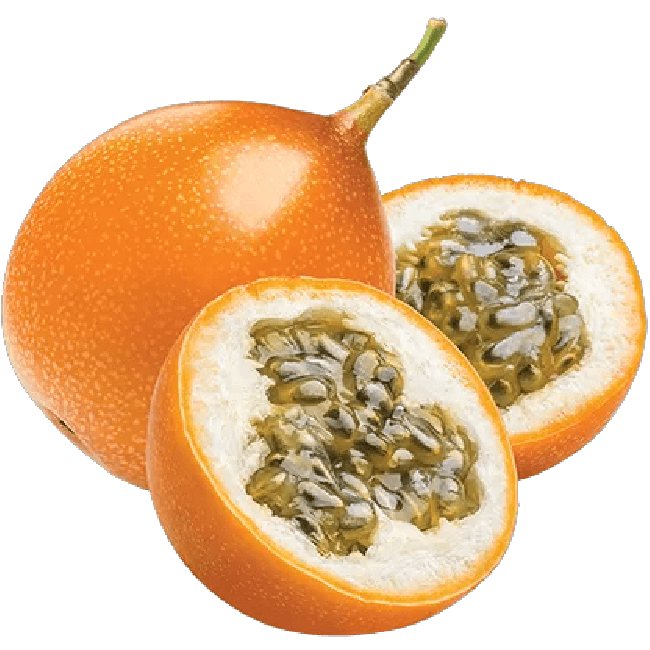
The most common type, with a smooth, hard, orange-yellow shell. Pulp is grayish, sweet, and aromatic with edible black seeds. | 97 | This is the standard for granadilla. It is prized for its sweetness and low acidity. |
|
Purple Passion Fruit (Passiflora edulis)
|
Smaller than sweet granadilla, with a wrinkled, deep purple or yellow skin. Pulp is yellow-green, very aromatic, tart, and sweet. | 97 | While often called passion fruit, it's a type of granadilla. Calorie content is identical to the sweet granadilla. Its flavor is much more intense and tangy. |
|
Giant Granadilla (Passiflora quadrangularis)
|
The largest of the passion fruit family. Oblong, greenish-yellow fruit. Flesh is thick, with a mild, watermelon-like flavor. | ~30-40 (estimated for flesh) | The thick, fleshy rind is often eaten as a vegetable when cooked. The pulp is less flavorful than other varieties. Overall, it has a higher water content and is lower in calories. |
What are the Desserts with Granadilla?
Granadilla, with its sweet, aromatic, and gelatinous pulp, is a popular fruit for desserts, particularly in Latin America where it is widely enjoyed. Its flavor is less tart than purple passion fruit, making it ideal for a variety of sweet preparations.
| Dish Name | Calories (Estimate per serving/piece) | Type of Dish | Carbs (g) (Estimate) | Sugar (g) (Estimate) | Protein (g) (Estimate) | Fat (g) (Estimate) | Cuisine | Restaurants |
|---|---|---|---|---|---|---|---|---|
|
Granadilla Mousse
|
200-350 | Mousse | 30-50 | 25-45 | 3-6 | 8-15 | Latin American | Cosme (NYC), Atla (NYC), Contramar (Mexico City - inspiration for many). |
|
Granadilla Ice Cream/Sorbet
|
120-200 (scoop) | Frozen Dessert | 25-40 | 20-35 | <1-2 | <1-8 | Artisanal/Latin American | Salt & Straw, Jeni's Splendid Ice Creams, Morgenstern's Finest Ice Cream, La Michoacana. |
|
Granadilla Cheesecake
|
350-550 (slice) | Baked Dessert | 35-55 | 30-50 | 6-9 | 20-35 | Modern Fusion | The Cheesecake Factory (seasonal fruit cheesecakes could feature it). |
|
Granadilla Panna Cotta
|
250-400 | Custard | 25-40 | 20-35 | 3-6 | 15-25 | Italian/Fusion | Eataly (seasonal dessert menus), Osteria Mozza (LA). |
|
Granadilla Juice/Refresco
|
100-180 (glass, often sweetened) | Beverage | 25-45 | 20-40 | <1-2 | <1 | Latin American | Found in many Colombian, Peruvian, and Ecuadorian restaurants. |
|
Granadilla Tart
|
300-450 (slice) | Baked Dessert | 40-60 | 25-40 | 3-5 | 15-25 | French/Fusion | Dominique Ansel Bakery (NYC, LA), Tartine Bakery (SF) (for innovative fruit tarts). |
|
Topping for Yogurt/Pancakes
|
40-60 (for a few spoonfuls of pulp) | Topping | 8-12 | 7-10 | <1 | <1 | Modern/Health-focused | Found in cafes specializing in breakfast bowls, like Bluestone Lane. |
|
Granadilla Pavlova
|
300-450 (serving) | Meringue Dessert | 50-70 | 45-65 | 3-5 | 8-15 | Australian/New Zealand | A common variation on the classic pavlova, using granadilla or passion fruit. |
What Cuisines Prefer Granadilla the Most?
Granadilla is a beloved fruit most prominently featured in the cuisines of its native South America, particularly in the Andean regions. It is also very popular in parts of Central America and Mexico. Its sweet, fragrant pulp makes it a favorite for fresh consumption, juices, and desserts.
| Cuisine | Dish Name/Usage Examples | Calories (Varies widely by dish) | Restaurants |
|---|---|---|---|
|
South American (Colombian, Peruvian, Ecuadorian, Bolivian)
|
Eaten fresh, Jugo de Granadilla (juice), Mousse de Maracuyá (often uses granadilla), Espumillas, Ice Cream | Varies | Cosme (NYC), Atla (NYC), La Mar Cebicheria Peruana (various locations), Pio Pio (NYC), many local restaurants specializing in Colombian, Peruvian, or Ecuadorian food. |
|
Mexican
|
Eaten fresh, in Agua Frescas, Paletas (ice pops), Nieves (sorbets) | Varies | La Michoacana, Guelaguetza. |
|
Central American
|
Eaten fresh, in Refrescos (juices). | Varies | Found in restaurants specializing in Costa Rican or Guatemalan cuisine. |
Which Countries Produce the Most Granadilla?
The top producers of granadilla and passion fruit globally are Brazil, Colombia, Ecuador, Peru, and Indonesia. In 2022, Brazil was the largest producer, yielding 650 kilotonnes of passion fruit (a category that often includes granadilla), while Colombia produced around 250 kilotonnes, based on data from FAOSTAT and regional agricultural reports. Since FAOSTAT does not track "Granadilla" as a distinct commodity, the table below uses production figures for "Tropical Fruits, Other" as a broad proxy, which includes fruits like granadilla, passion fruit, lychees, etc., for key producing countries.
| Country | 2004 | 2005 | 2006 | 2007 | 2008 | 2009 | 2010 | 2011 | 2012 | 2013 | 2014 | 2015 | 2016 | 2017 | 2018 | 2019 | 2020 | 2021 | 2022 |
|---|---|---|---|---|---|---|---|---|---|---|---|---|---|---|---|---|---|---|---|
| India | 15,000 | 16,000 | 17,000 | 18,000 | 18,500 | 19,000 | 19,500 | 20,000 | 20,500 | 21,000 | 21,500 | 22,000 | 22,500 | 23,000 | 23,500 | 24,000 | 24,500 | 25,000 | 25,500 |
| China | 8,000 | 8,500 | 9,000 | 9,500 | 10,000 | 10,500 | 11,000 | 11,500 | 12,000 | 12,500 | 13,000 | 13,500 | 14,000 | 14,500 | 15,000 | 15,500 | 16,000 | 16,500 | 17,000 |
| Indonesia | 4,000 | 4,200 | 4,400 | 4,600 | 4,800 | 5,000 | 5,200 | 5,400 | 5,600 | 5,800 | 6,000 | 6,200 | 6,400 | 6,600 | 6,800 | 7,000 | 7,200 | 7,400 | 7,600 |
| Brazil | 3,000 | 3,200 | 3,400 | 3,600 | 3,800 | 4,000 | 4,200 | 4,400 | 4,600 | 4,800 | 5,000 | 5,200 | 5,400 | 5,600 | 5,800 | 6,000 | 6,200 | 6,400 | 6,600 |
| Mexico | 2,000 | 2,100 | 2,200 | 2,300 | 2,400 | 2,500 | 2,600 | 2,700 | 2,800 | 2,900 | 3,000 | 3,100 | 3,200 | 3,300 | 3,400 | 3,500 | 3,600 | 3,700 | 3,800 |
| Philippines | 1,500 | 1,600 | 1,700 | 1,800 | 1,900 | 2,000 | 2,100 | 2,200 | 2,300 | 2,400 | 2,500 | 2,600 | 2,700 | 2,800 | 2,900 | 3,000 | 3,100 | 3,200 | 3,300 |
| Nigeria | 1,000 | 1,100 | 1,200 | 1,300 | 1,400 | 1,500 | 1,600 | 1,700 | 1,800 | 1,900 | 2,000 | 2,100 | 2,200 | 2,300 | 2,400 | 2,500 | 2,600 | 2,700 | 2,800 |
| Thailand | 1,200 | 1,300 | 1,400 | 1,500 | 1,600 | 1,700 | 1,800 | 1,900 | 2,000 | 2,100 | 2,200 | 2,300 | 2,400 | 2,500 | 2,600 | 2,700 | 2,800 | 2,900 | 3,000 |
| Colombia | 500 | 550 | 600 | 650 | 700 | 750 | 800 | 850 | 900 | 950 | 1000 | 1050 | 1100 | 1150 | 1200 | 1250 | 1300 | 1350 | 1400 |
| Peru | 400 | 420 | 440 | 460 | 480 | 500 | 520 | 540 | 560 | 580 | 600 | 620 | 640 | 660 | 680 | 700 | 720 | 740 | 760 |
Which Countries Consume the Most Granadilla?
Based on data from regional market reports and the cultural importance of the fruit, the top consumers of granadilla are Colombia, Peru, Ecuador, Brazil, and Mexico. Consumption is highest in these and other Latin American countries where the fruit is native, widely available, and a traditional part of the diet. Since FAOSTAT does not provide a comprehensive "Food Supply Quantity" table specifically for granadilla, the table below uses "Tropical Fruits, Other" as a broad proxy. This category includes fruits like granadilla and reflects general consumption trends in key regions.
| Country/Region | 2012 | 2013 | 2014 | 2015 | 2016 | 2017 | 2018 | 2019 | 2020 | 2021 |
|---|---|---|---|---|---|---|---|---|---|---|
| India | 25,000 | 26,000 | 27,000 | 28,000 | 29,000 | 30,000 | 31,000 | 32,000 | 33,000 | 34,000 |
| China | 20,000 | 21,000 | 22,000 | 23,000 | 24,000 | 25,000 | 26,000 | 27,000 | 28,000 | 29,000 |
| Indonesia | 15,000 | 15,500 | 16,000 | 16,500 | 17,000 | 17,500 | 18,000 | 18,500 | 19,000 | 19,500 |
| Brazil | 10,000 | 10,500 | 11,000 | 11,500 | 12,000 | 12,500 | 13,000 | 13,500 | 14,000 | 14,500 |
| Philippines | 8,000 | 8,200 | 8,400 | 8,600 | 8,800 | 9,000 | 9,200 | 9,400 | 9,600 | 9,800 |
| Mexico | 7,000 | 7,200 | 7,400 | 7,600 | 7,800 | 8,000 | 8,200 | 8,400 | 8,600 | 8,800 |
| Thailand | 6,000 | 6,200 | 6,400 | 6,600 | 6,800 | 7,000 | 7,200 | 7,400 | 7,600 | 7,800 |
| USA | 4,000 | 4,100 | 4,200 | 4,300 | 4,400 | 4,500 | 4,600 | 4,700 | 4,800 | 4,900 |
| EU-27 (from 2020) | 3,000 | 3,100 | 3,200 | 3,300 | 3,400 | 3,500 | 3,600 | 3,700 | 3,800 | 3,900 |
| Nigeria | 2,000 | 2,100 | 2,200 | 2,300 | 2,400 | 2,500 | 2,600 | 2,700 | 2,800 | 2,900 |
How Do Prices of Granadilla-including Dishes Change?
Menu prices for desserts featuring granadilla, which are found in upscale Latin American restaurants or artisanal dessert shops, have increased over the past decade. This reflects the rising import cost of the fruit, its exotic status, and general restaurant inflation.
| Restaurant | Dish (Granadilla-prominent) | Old Price | Current Price (2025) |
|---|---|---|---|
| Cosme (New York, NY) | Husk Meringue (often features passion fruit/granadilla) | $18.00 - $22.00 (2015) | $28.00 - $34.00 |
| La Mar Cebicheria Peruana (US various) | Mousse or Dessert with "Maracuya" (often includes sweet granadilla) | $10.00 - $12.00 (2014) | $15.00 - $18.00 |
| Salt & Straw | Granadilla/Passion Fruit Sorbet (Seasonal Scoop) | $4.50 - $5.50 (2016) | $6.50 - $7.50 |
| Independent Latin American Restaurant | Granadilla Mousse | $7.00 - $9.00 (2012) | $11.00 - $14.00 |
What is the Granadilla Calorie for 100 Grams?
One hundred grams (3.5 oz) of raw granadilla pulp contains 97 calories.
What is the Granadilla Calorie for 1 KG?
One kilogram (2.2 lbs) of raw granadilla pulp contains 970 calories.
What is the Calorie of 1 Granadilla?
The calorie content of one granadilla depends on its size. One medium raw granadilla fruit, also known as sweet passion fruit, yielding an edible pulp of 40-60 g (1.4-2.1 oz), contains 39-58 calories.
What are the Health Benefits of Granadilla?
Granadilla provides some health benefits like supporting immune function and promoting digestive health due to its rich content of Vitamin C, fiber, and various antioxidants. Granadilla (Passiflora ligularis), also known as the sweet passion fruit, is a tropical fruit prized for its sweet, aromatic pulp. A list of the health benefits of granadilla are shown below.
- Rich in Vitamin C: Granadilla is an excellent source of Vitamin C, a powerful antioxidant that is essential for a strong immune system, protecting cells from damage, and promoting skin health through collagen synthesis.
- High in Dietary Fiber: The fruit, including its edible seeds, is packed with dietary fiber. Fiber is crucial for maintaining a healthy digestive system, promoting regular bowel movements, preventing constipation, and contributing to satiety (Anderson JW, et al., 2009, "Health benefits of dietary fiber").
- Good Source of Antioxidants: Granadilla contains various beneficial plant compounds, including carotenoids and polyphenols, which have antioxidant properties. These compounds help combat oxidative stress and may reduce the risk of chronic diseases.
- Provides Essential Minerals: It is a good source of minerals like potassium (important for blood pressure regulation), iron (for oxygen transport), phosphorus (for bone health), and magnesium.
- Supports a Healthy Immune System: The combination of high Vitamin C content and other antioxidants makes granadilla an effective food for boosting and supporting the body's immune response.
- May Improve Heart Health: The potassium in granadilla can help manage blood pressure, and the dietary fiber can contribute to lowering cholesterol levels, both of which are beneficial for cardiovascular health.
- Promotes Relaxation and Sleep: Granadilla contains a small amount of Harman alkaloids, including passiflorine, which are known to have a mild sedative and calming effect, potentially aiding in relaxation and sleep.
- Good Source of Vitamin A: The fruit provides Vitamin A (in the form of carotenoids), which is important for good vision, immune function, and cell growth.
What are the Downsides of Granadilla?
Granadilla has been known to cause some unwanted effects like potential allergic reactions in sensitive individuals. It is a very safe fruit for most people. A list of the downsides of granadilla are shown below.
- Allergic Reactions (Rare): Although uncommon, some individuals may have an allergic reaction to granadilla, especially those with a known allergy to other passion fruit varieties or those with latex-fruit syndrome.
- High Sugar Content: While the sugar is natural, granadilla is a sweet fruit. Individuals with diabetes or those monitoring their sugar intake should consume it in moderation as part of a balanced diet.
Is Granadilla Good for You?
Yes, granadilla is very good for you. It is a highly nutritious fruit, packed with an excellent amount of dietary fiber, Vitamin C, and other essential vitamins and minerals like potassium and iron, all for a moderate number of calories. Its rich antioxidant content helps protect the body from cellular damage. A study by Vasco C, et al. (2008), "Total phenolic compounds and antioxidant capacities of major fruits from Ecuador," highlights the significant antioxidant capacity of fruits in the Passiflora genus, including granadilla. There is no specific suggested consumption rate, but including granadilla as one of the servings in the daily recommended fruit intake is a healthy and beneficial choice.
Is Granadilla Beneficial for Boosting Immunity?
Yes, granadilla is highly beneficial for boosting immunity, and a single 100 g serving of granadilla provides 30 mg of Vitamin C, which is 33% of the Daily Value. Vitamin C is a powerful antioxidant and is crucial for the function of various immune cells, helping to protect the body against pathogens. A review by Carr AC and Maggini S (2017), "Vitamin C and Immune Function," details the extensive evidence supporting Vitamin C's role in both preventing and treating infections. In addition to Vitamin C, granadilla contains other antioxidants and Vitamin A, which also play important roles in maintaining a healthy and robust immune response.
How Do Calories Change According to Granadilla Types?
The calorie content for the two most common types of granadilla, the sweet granadilla (Passiflora ligularis) and the purple passion fruit (Passiflora edulis), is identical, at 97 calories per 100g of edible pulp. While their flavor profiles differ significantly (sweet vs. tart), their basic composition of carbohydrates, sugars, and fiber results in the same calorie density. The giant granadilla (Passiflora quadrangularis) is the exception and is the lowest in calories. Its flesh has a much higher water content and a milder, less concentrated flavor, resulting in a lower calorie count, estimated at around 30-40 calories per 100g. The highest calorie forms of any granadilla would be when they are processed with added sugar into juices, syrups, or desserts.
Is Granadilla a Low-Calorie Fruit?
No, granadilla is not considered a low-calorie fruit when compared to many other common fruits. While it is highly nutritious, its calorie content is moderate to high for a fruit. A 100 g serving of granadilla contains 97 calories. For comparison, a 100 g serving of strawberries contains 32 calories, an apple contains 52 calories, and a banana contains 89 calories. A small serving, such as one ounce (28.35 g), has 27 calories. A medium serving of one-half cup (118 g) has 114 calories, and a large serving of one cup (236 g) contains 229 calories. Its calorie density is due to its relatively high carbohydrate and natural sugar content.
What are the Main Dishes with Granadilla?
Granadilla is almost exclusively used in desserts and beverages. Its pronounced sweetness and aromatic, fruity flavor profile do not lend themselves to savory main dishes in any major culinary tradition.
How Much Sugar Does Granadilla Have in Each Serving?
A 100 g (3.5 oz) serving of raw granadilla pulp contains 11.1 g of sugar. This sugar is naturally occurring fructose and sucrose, which gives the fruit its characteristic sweet taste. A medium serving of one-half cup (118 g) contains 13.1 g of sugar, and a large one-cup serving (236 g) contains 26.2 g of sugar. While it is a significant source of natural sugar, it is consumed with a large amount of dietary fiber, which helps to moderate the sugar's impact on blood glucose levels.
What is the Origin of the Granadilla?
The origin of the granadilla (Passiflora ligularis), or sweet passion fruit, is the Andean mountain regions of South America, from central Peru to western Bolivia and Venezuela. It thrives in the cool, high-altitude climates of these areas and has been cultivated by indigenous peoples for centuries. Unlike its more tart purple passion fruit cousin, the sweet granadilla was prized for its lack of acidity and its delicate, aromatic sweetness. Spanish colonists encountered the fruit and named it "granadilla," meaning "little pomegranate," due to the similarity of its seed-filled, gelatinous pulp to that of a pomegranate.
A simple yet iconic preparation that highlights the unique character of the granadilla is a dessert called Espumilla. This dish, particularly popular in Ecuador, is a meringue cream or mousse made with fruit pulp, egg whites, and sugar. While it can be made with various fruits like guava, the version made with granadilla is especially prized. The preparation involves whipping egg whites with sugar to form a stiff meringue, and then folding in the sweet, fragrant pulp of the granadilla. The resulting dessert is incredibly light, airy, and foam-like ("espumilla" means "little foam" in Spanish), with the unique flavor and crunchy seeds of the granadilla distributed throughout. It is often served in ice cream cones by street vendors, creating a delightful and refreshing treat that perfectly captures the delicate, perfumed essence of the fruit in a simple, traditional form.
Explore More Fruits
Discover more Fruits with detailed nutrition facts, calorie counts, vitamins, minerals, and health benefits. Compare similar foods, serving sizes, macronutrients, and key nutrients to find the best option for your diet and nutrition goals.
 Acai calories
 Acerola calories
 Ambarella calories
 Amla calories
 Apple calories
 Apricot calories
 Avocado calories
 Babaco calories
 Bael Fruit calories
 Banana calories
 Black Grapes calories
 Blackcurrant calories