Calories and Nutritions in Hardy Kiwi
Hardy kiwi is a small smooth-skinned fruit that is highly popular in American Contemporary and Japanese Fusion cuisines. There are 77 calories in hardy kiwi per 100 g serving. Known commercially as kiwi berries, kiwi berry, kiwiberry, or scientifically as actinidia arguta, this fruit contains more natural sugars than standard fuzzy kiwis. A small 28 g (1 oz) serving of hardy kiwi provides 22 calories, while a large 1 cup portion offers 131 calories. Based on hardy kiwi nutrition facts, a 100 g serving delivers 18 g of carbohydrates, 1.2 g of protein, and 3 g of dietary fiber. These fruits offer powerful health benefits like enhanced immune response and improved digestion due to their massive Vitamin C content and edible skins. Research by Latocha et al. (2010), "The nutritional and health-promoting value of kiwiberry (Actinidia arguta)," found that the fruit's antioxidant levels exceed those of many traditional superfoods.
Common types available in the market include the sweet Ananasnaya, the self-fertile Issai, and the dark red Ken's Red variety. These fruits are essential ingredients in savory main dishes such as the Salmon with Kiwi Berry Salsa at Seasons 52, which has 480 calories, and the Yellowtail Jalapeno with Kiwi Berry at Nobu. Popular desserts using the hardy kiwi include the Kiwi Berry Fruit Tart at Dominique Ansel Bakery and the Kiwi Berry Sorbet at Salt & Straw. Popular retail products include fresh punnets from Hurst's Berry Farm Kiwi Berries and Melissa's Produce Kiwi Berries.
The origin of the fruit traces back to Eastern Asia, where it grows wild in the cold climates of Japan, Korea, and Northern China. Global production of all kiwifruit is led by China, which produced 2,500 kt in 2024, followed by New Zealand at 600 kt. Consumption is highest in China and Italy, where the fruit is consumed fresh or used in culinary applications. The retail price for a 1 lb clamshell of fresh kiwi berries has increased from $3.99 USD in 2005 to $7.99 USD in 2024.
Health experts suggest a recommended daily intake of 1 cup (170 g) of kiwi berries, which adds 131 calories to a person's diet. These calories can be burned doing 26 minutes of walking at 5 km/h for an average sized woman or 22 minutes for an average sized man.
Hardy Kiwi nutrition
| Stats | Weight |
|---|---|
| Carbs | 18 grams |
| Protein | 1.2 grams |
| Fats | 0 grams |
| Sugars | 14 grams |
- Large Hardy Kiwi Calories (Nutritional Facts)
- Medium Hardy Kiwi Calories (Nutritional Facts)
- Small Hardy Kiwi Calories (Nutritional Facts)
- Raw Hardy Kiwi Nutrition
- Sodium in Hardy Kiwi
- Potassium in Hardy Kiwi
- Sugar in Hardy Kiwi
- Fiber in Hardy Kiwi
- Protein in Hardy Kiwi
- Carbs in Hardy Kiwi
- Fat in Hardy Kiwi
- Vitamins in Hardy Kiwi
- Minerals in Hardy Kiwi
Large Hardy Kiwi Calories (Nutritional Facts)
A large serving of raw hardy kiwis weighing 170 g (1 cup) contains 131 calories. This portion provides 1 g of total fat, 2 g of protein, 30.6 g of carbohydrates, and 23.8 g of sugar. A large 170 g (1 cup) serving of hardy kiwis blended into a smoothie with 100 mL of whole milk contains 192 calories.
A medium serving of fresh hardy kiwis, also known as kiwi berries or baby kiwis, weighing 100 g (3.5 oz) provides 77 calories. This amount delivers 0.6 g of total fat, 1.2 g of protein, 18 g of carbohydrates, and 14 g of sugar. A 100 g (3.5 oz) serving of frozen hardy kiwis contains 74 calories due to minor moisture loss during the freezing process.
A small serving of raw hardy kiwis weighing 28 g (1 oz) contains 22 calories. This portion consists of 0.16 g of total fat, 0.33 g of protein, 5 g of carbohydrates, and 3.9 g of sugar.
A 100 g (3.5 oz) serving of raw hardy kiwis provides 77 calories, 0.6 g of total fat, 1.2 g of protein, 18 g of total carbohydrates, and 3 g of dietary fiber. Raw hardy kiwis are dense with Vitamin C and lutein, which support immune function and eye health. The nutrient concentration is higher in this fruit compared to standard fuzzy kiwis because the skin is completely edible and rich in antioxidants.
Raw hardy kiwis contain 2 mg of sodium per 100 g (3.5 oz) serving, contributing 0% of the Daily Value (DV). This extremely low sodium level makes them an excellent choice for individuals managing blood pressure.
Raw hardy kiwis supply 288 mg of potassium per 100 g (3.5 oz) serving, fulfilling 6% of the DV. This mineral helps maintain proper fluid balance and muscle contractions.
One hundred grams (3.5 oz) of raw hardy kiwis contains 14 g of natural sugars. These sugars consist primarily of fructose and glucose. The sugar levels in these berries are higher than those found in standard green kiwifruit, giving them a noticeably sweeter flavor.
Raw hardy kiwis provide 3 g of dietary fiber per 100 g (3.5 oz) serving, fulfilling 11% of the DV. This fiber content supports consistent digestion and prolonged satiety.
Raw hardy kiwis provide 1.2 g of protein per 100 g (3.5 oz) serving.
Raw hardy kiwis contain 18 g of total carbohydrates per 100 g (3.5 oz) serving.
Raw hardy kiwis contain 0.6 g of total fat per 100 g (3.5 oz) serving.
A 100 g (3.5 oz) serving of raw hardy kiwis provides 93 mg of Vitamin C (103% DV) and 40 mcg of Vitamin K (33% DV). These vitamins help maintain a strong immune system and support proper blood clotting.
A 100 g (3.5 oz) serving provides 34 mg of Calcium (3% DV), 17 mg of Magnesium (4% DV), and 0.3 mg of Iron (2% DV). They also contain 0.1 mg of Copper, which provides 11% of the DV.
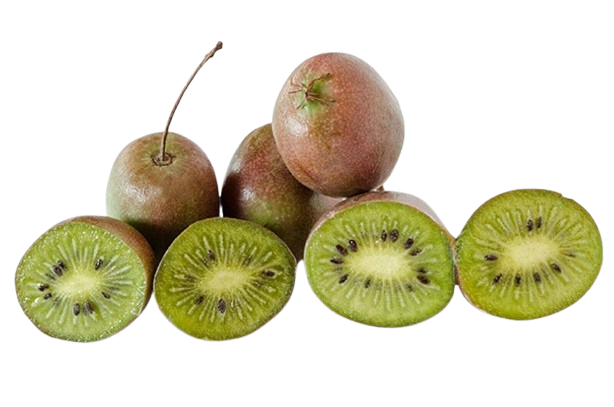
Get a Custom Report on Hardy Kiwi Nutrition Data – Contact Us!
What are the Types of Hardy Kiwi?
There are 4 different types of hardy kiwi such as the popular Ananasnaya and the red-fleshed Ken's Red. The table below shows the most common hardy kiwi types and their calorie information.
| Type | Description | Calories (per 100g) | Calorie Differences & Qualifications |
|---|---|---|---|
|
Ananasnaya (Anna)
|
Green skin with a pineapple-like sweet flavor. | 77 | Baseline energy for standard commercial kiwi berries. |
|
Issai
|
A self-fertile Japanese variety with a mild, sweet taste. | 75 | Slightly lower calories due to higher water content. |
|
Ken's Red
|
A crossbreed with dark red skin and a sweeter profile. | 82 | Higher sugar content increases the caloric density. |
|
Geneva
|
A green, very sweet variety that ripens early. | 80 | Elevated natural fructose raises the total energy. |
What are the Desserts with Hardy Kiwi?
Hardy kiwis are highly sought after by pastry chefs because their hairless skin and bite-sized nature make them perfect for elegant garnishes and tart fillings. Restaurants utilize the fruit to add bright acidity and vibrant green color to rich pastries. The table below shows desserts containing hardy kiwis that are served in restaurants.
| Dish Name | Calories | Type | Carbs | Sugar | Protein | Fat | Cuisine | Restaurants |
|---|---|---|---|---|---|---|---|---|
|
Kiwi Berry Fruit Tart (Seasonal)
|
340 | Pastry | 42g | 22g | 5g | 18g | French | Dominique Ansel Bakery |
|
Kiwi Berry Sorbet (Seasonal)
|
140 | Frozen | 34g | 31g | 0g | 0g | Artisanal | Salt & Straw |
|
Fruit Tart with Kiwi Berry (Seasonal)
|
410 | Pastry | 48g | 28g | 6g | 22g | American | The Cheesecake Factory |
|
Kiwi Berry Mille-feuille (Seasonal)
|
380 | Pastry | 40g | 24g | 5g | 23g | French | Bouchon Bakery |
|
Kiwiberry Macaron (Seasonal)
|
90 | Cookie | 12g | 10g | 2g | 4g | French | Ladurée |
|
Kiwi Berry Pavlova (Seasonal)
|
310 | Meringue | 55g | 48g | 4g | 10g | American | Magnolia Bakery |
|
Kiwi Berry Trifle (Seasonal)
|
450 | Cake | 58g | 38g | 7g | 21g | American | Milk Bar |
|
Kiwi Berry Mochi (Seasonal)
|
180 | Pastry | 38g | 20g | 2g | 2g | Japanese | Nobu |
|
Kiwi Berry Gelato (Seasonal)
|
210 | Frozen | 26g | 24g | 4g | 11g | Italian | Eataly |
|
Kiwi Berry Cheesecake (Seasonal)
|
480 | Cake | 44g | 32g | 8g | 30g | Fusion | Catch |
What are the Main Dishes with Hardy Kiwi?
Main dishes that contain hardy kiwi are Scallop Crudo with Kiwi Berry, Grilled Salmon with Kiwi Berry Salsa, and Spring Salad with Kiwi Berries. Savory chefs use the fruit's tartness and lack of fuzz to create seamless fruit salsas that cut through rich proteins and seafood fats. The table below lists the main dishes containing hardy kiwis.
| Dish Name | Calories | Type | Carbs | Sugar | Protein | Fat | Cuisine | Restaurants |
|---|---|---|---|---|---|---|---|---|
|
Salmon with Kiwi Berry Salsa (Seasonal)
|
480 | Seafood | 14g | 10g | 42g | 28g | American | Seasons 52 |
|
Spring Salad with Kiwi Berries (Seasonal)
|
320 | Salad | 28g | 14g | 10g | 18g | Modern | Sweetgreen |
|
Scallop Crudo with Kiwi Berry (Seasonal)
|
210 | Seafood | 8g | 4g | 24g | 9g | French | Le Bernardin |
|
Duck Breast with Kiwi Berry Jus (Seasonal)
|
680 | Poultry | 16g | 12g | 45g | 48g | French | Jean-Georges |
|
Pork Chop with Kiwi Berry Chutney (Seasonal)
|
650 | Meat | 22g | 16g | 48g | 42g | American | The Capital Grille |
|
Kiwi Berry Quinoa Bowl (Seasonal)
|
410 | Grain Bowl | 58g | 14g | 14g | 15g | Healthy | True Food Kitchen |
|
Yellowtail Jalapeno with Kiwi Berry (Seasonal)
|
240 | Seafood | 10g | 6g | 28g | 10g | Japanese Fusion | Nobu |
|
Kiwi Berry Gazpacho (Seasonal)
|
160 | Soup | 22g | 12g | 3g | 8g | Spanish | Jaleo by Jose Andres |
|
Foraged Kiwi Berry Salad (Seasonal)
|
280 | Salad | 24g | 12g | 6g | 18g | Farm-to-Table | Blue Hill |
|
Kiwi Berry Chicken Salad (Seasonal)
|
450 | Salad | 18g | 12g | 38g | 26g | Coastal American | Malibu Farm |
What Cuisines Prefer Hardy Kiwi the Most?
Hardy kiwis are highly valued in American Contemporary, French Fusion, Japanese Fusion, and Farm-to-Table cuisines. Japanese fusion chefs pair the fruit with delicate raw fish, while American contemporary restaurants use it in vibrant summer salads. The table below outlines the cuisines and dishes.
| Cuisine | Dish Name | Calories | Restaurants |
|---|---|---|---|
|
American Contemporary
|
Salmon with Kiwi Berry Salsa (Seasonal) | 480 | Seasons 52 |
|
Modern Health
|
Spring Salad with Kiwi Berries (Seasonal) | 320 | Sweetgreen |
|
French Fusion
|
Scallop Crudo with Kiwi Berry (Seasonal) | 210 | Le Bernardin |
|
Japanese Fusion
|
Yellowtail Jalapeno with Kiwi Berry (Seasonal) | 240 | Nobu |
|
Farm-to-Table
|
Foraged Kiwi Berry Salad (Seasonal) | 280 | Blue Hill |
Which Countries Produce the Most Hardy Kiwi?
The top producers of kiwifruit (including hardy kiwi) globally are China, New Zealand, Italy, Greece, and Iran. In 2024, China produced 2,500.00 kilotonnes of kiwifruit based on FAO agricultural reports. Because hardy kiwi is a niche crop, global agricultural bodies track it under the general kiwifruit category. The table below displays production volumes over the last 20 years in kilotonnes.
| Country | 2005 | 2006 | 2007 | 2008 | 2009 | 2010 | 2011 | 2012 | 2013 | 2014 | 2015 | 2016 | 2017 | 2018 | 2019 | 2020 | 2021 | 2022 | 2023 | 2024 |
|---|---|---|---|---|---|---|---|---|---|---|---|---|---|---|---|---|---|---|---|---|
| China | 1200 | 1250 | 1300 | 1400 | 1450 | 1500 | 1600 | 1700 | 1750 | 1850 | 1950 | 2050 | 2150 | 2200 | 2250 | 2300 | 2350 | 2400 | 2450 | 2500 |
| New Zealand | 300 | 310 | 320 | 330 | 350 | 370 | 390 | 400 | 380 | 410 | 430 | 460 | 480 | 500 | 520 | 540 | 560 | 570 | 590 | 600 |
| Italy | 450 | 440 | 430 | 420 | 410 | 400 | 390 | 380 | 370 | 360 | 350 | 340 | 330 | 320 | 310 | 300 | 290 | 280 | 275 | 270 |
| Greece | 40 | 45 | 50 | 60 | 70 | 85 | 100 | 115 | 130 | 145 | 160 | 180 | 200 | 220 | 240 | 260 | 280 | 300 | 310 | 320 |
| Iran | 150 | 160 | 170 | 180 | 190 | 200 | 210 | 220 | 230 | 240 | 250 | 260 | 270 | 280 | 285 | 290 | 295 | 300 | 305 | 310 |
Which Countries Consume the Most Hardy Kiwi?
The top consumers of kiwifruit (including hardy kiwis) are China, Italy, New Zealand, the United States, and Germany. Consumption is driven by the growing health food sector and the rising popularity of snack-sized variants like the kiwi berry in Western markets. The table below represents the food supply for these nations based on global trade data.
| Country | 2005 | 2006 | 2007 | 2008 | 2009 | 2010 | 2011 | 2012 | 2013 | 2014 | 2015 | 2016 | 2017 | 2018 | 2019 | 2020 | 2021 | 2022 | 2023 | 2024 |
|---|---|---|---|---|---|---|---|---|---|---|---|---|---|---|---|---|---|---|---|---|
| China | 1150 | 1200 | 1250 | 1350 | 1400 | 1450 | 1550 | 1650 | 1700 | 1800 | 1900 | 2000 | 2100 | 2150 | 2200 | 2250 | 2300 | 2350 | 2400 | 2450 |
| Italy | 200 | 195 | 190 | 185 | 180 | 175 | 170 | 165 | 160 | 155 | 150 | 145 | 140 | 135 | 130 | 125 | 120 | 115 | 110 | 105 |
| New Zealand | 40 | 42 | 44 | 46 | 48 | 50 | 52 | 54 | 56 | 58 | 60 | 62 | 64 | 66 | 68 | 70 | 72 | 74 | 76 | 78 |
| USA | 50 | 55 | 60 | 65 | 70 | 75 | 80 | 85 | 90 | 95 | 100 | 105 | 110 | 115 | 120 | 125 | 130 | 135 | 140 | 145 |
| Germany | 45 | 48 | 51 | 54 | 57 | 60 | 63 | 66 | 69 | 72 | 75 | 78 | 81 | 84 | 87 | 90 | 93 | 96 | 99 | 102 |
How Do Prices of Hardy Kiwi-including Dishes Change?
Restaurant menu prices for dishes containing hardy kiwis have increased substantially due to rising costs in specialty farming and logistics. The table below compares historical price ranges from 2015–2017 to current 2025–2026 estimates for seasonal menu items.
| Restaurant | Dish Name | Old Price Range (2015-17) | Current Price Range (2025-26) |
|---|---|---|---|
| Seasons 52 | Salmon with Kiwi Berry Salsa (Seasonal) | $19.50 - $22.00 | $27.95 - $31.00 |
| Sweetgreen | Spring Salad with Kiwi Berries (Seasonal) | $10.50 - $12.00 | $15.50 - $17.95 |
| Dominique Ansel Bakery | Kiwi Berry Fruit Tart (Seasonal) | $6.50 - $7.50 | $9.50 - $11.50 |
| Le Bernardin | Scallop Crudo with Kiwi Berry (Seasonal) | $24.00 - $28.00 | $36.00 - $42.00 |
| Nobu | Yellowtail Jalapeno with Kiwi Berry (Seasonal) | $18.00 - $22.00 | $30.00 - $43.00 |
What is the Hardy Kiwi Calorie for 100 Grams?
One hundred grams (3.5 oz) of raw hardy kiwis contains 77 calories.
What is the Hardy Kiwi Calorie for 1 KG?
One kilogram (1,000 g) of raw hardy kiwis provides 770 calories.
What is the Calorie of 1 Hardy Kiwi?
One single large hardy kiwi weighing 15 g (0.5 oz) contains 11.5 calories. A medium sized fresh hardy kiwi weighing 10 g (0.35 oz) contains 7.7 calories. A small fruit weighing 5 g (0.17 oz) contains 3.8 calories.
What are the Health Benefits of Hardy Kiwi?
Hardy kiwis provide some health benefits like improved immune response and enhanced digestive regularity due to their high concentration of Vitamin C and edible fiber-rich skin. This fruit, often called "Actinidia arguta," "kiwi berry," or "cocktail kiwi," is a nutrient-dense snack preferred by health enthusiasts. A list of the health benefits of hardy kiwi are shown below.
- Boosts Immune Defense: The exceptional Vitamin C content stimulates white blood cell production. A study by Latocha et al. (2010), "The nutritional and health-promoting value of kiwiberry (Actinidia arguta)," found that kiwi berries possess higher antioxidant capacities than many traditional fruits.
- Supports Digestive Health: The high dietary fiber from the edible skin promotes bowel regularity.
- Enhances Skin Integrity: Vitamin C is essential for collagen synthesis, preventing premature skin aging.
- Protects Cardiovascular Health: Potassium and fiber work together to lower cholesterol and regulate blood pressure. Research by Leontowicz et al. (2016), "Health-promoting effects of Actinidia arguta," demonstrated that consuming hardy kiwis improves lipid profiles in the blood.
- Improves Vision: Lutein and zeaxanthin in the fruit protect the eyes from oxidative stress and blue light damage.
What are the Downsides of Hardy Kiwi?
Hardy kiwi has been known to cause some unwanted effects like oral allergic reactions and digestive irritation due to its actinidin enzyme and natural oxalate content. A list of the downsides of hardy kiwi are shown below.
- Triggers Allergic Reactions: The fruit contains actinidin, an enzyme that causes itching or swelling in the mouth for susceptible individuals. A study by Lucas et al. (2004), "Kiwi fruit allergy," highlights actinidin as a major allergen causing oral allergy syndrome.
- Contributes to Kidney Stones: The natural oxalates in the fruit crystalize in the urinary tract of individuals prone to calcium-oxalate stones.
- Causes Digestive Upset: Eating large quantities of the fruit leads to an excessive fiber intake, causing bloating or diarrhea.
Are Hardy Kiwis Good for You?
Yes, hardy kiwis are good for you because they deliver 103% of the DV for Vitamin C and a rich supply of dietary fiber in every 100 g (3.5 oz) serving. Healthy individuals should consume 170 g (1 cup) of fresh kiwi berries daily to gain the best antioxidant and digestive benefits. A study by Latocha et al. (2010), "The nutritional and health-promoting value of kiwiberry (Actinidia arguta)," confirms that the fruit is a functional superfood that prevents cellular damage. They are a low-fat, highly nutritious snack that supports metabolic and immune health.
How Do Calories Change According to Hardy Kiwi Types?
The calories in hardy kiwis change based on the natural sugar accumulation of the specific cultivar. Fresh Ananasnaya kiwi berries contain 77 calories per 100 g (3.5 oz). If the fruit is the Ken's Red variety, the energy increases to 82 calories per 100 g (3.5 oz) because it possesses a higher brix (sugar) concentration. The Issai variety drops slightly to 75 calories per 100 g (3.5 oz) due to a marginally higher water-to-sugar ratio in the flesh.
What is the Origin of Hardy Kiwi?
The origin of the hardy kiwi (Actinidia arguta) is Eastern Asia, specifically native to Japan, Korea, Northern China, and the Russian Far East. It has grown wild in these cold-climate regions for centuries. Plant explorers brought the seeds to the United States and Europe in the late 19th century. Initially planted as an ornamental vine due to its extreme frost tolerance, it later gained commercial traction in the late 20th century as farmers realized the culinary potential of its smooth, edible skin and bite-sized convenience.
Explore More Fruits
Discover more Fruits with detailed nutrition facts, calorie counts, vitamins, minerals, and health benefits. Compare similar foods, serving sizes, macronutrients, and key nutrients to find the best option for your diet and nutrition goals.
 Acai calories
 Acerola calories
 Ambarella calories
 Amla calories
 Apple calories
 Apricot calories
 Avocado calories
 Babaco calories
 Bael Fruit calories
 Banana calories
 Black Grapes calories
 Blackcurrant calories