Calories and Nutritions in Honeydew Melon
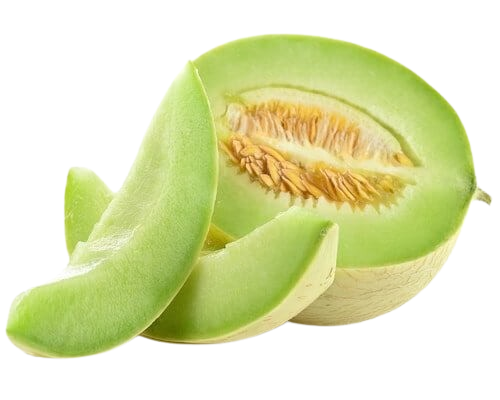
Honeydew melon is a sweet pale-green fruit belonging to the muskmelon family. Honeydew calories vary by size, with a whole medium melon (1kg or 35oz) containing 360 calories. Honeydew melon nutrition data indicates that energy content fluctuates with weight, as a small raw melon (800g or 28.2oz) has 288 calories and a large raw melon (1280g or 45.1oz) provides 461 calories. A wedge of sweet melon (125g or 4.4oz) contains 45 calories while a cup of diced fruit (170g or 6oz) has 61.2 calories. A serving of Del Monte Fresh Cut Honeydew Melon (140g or 1 cup) contains 50 calories, while a serving of Dole Honeydew Chunks (113g or 4oz) provides 40 calories and a container of Whole Foods Market Honeydew Chunks (227g or 8oz) has 80 calories. A standard 100g portion of raw honeydew contains 36 calories.
An examination of the nutritional profile reveals a hydrating food rich in simple sugars and electrolytes, with a large raw melon (1280g or 45.1oz) providing 6.91g of protein (14% DV), 1.79g of fat (2% DV), and 116g of carbohydrates (42% DV), including 104g of sugar. The fruit delivers significant potassium, providing 2920mg per large melon, which supports cardiovascular stability. Honeydew melon helps lower blood pressure due to this high potassium concentration counteracting sodium, and a meta-analysis by Aburto, N. J., et al. (2013) confirmed that increased potassium intake significantly reduces systolic and diastolic blood pressure. The high water content aids hydration, and a study by Popkin, B. M., et al. (2010) highlights that water from fruits contributes significantly to total body fluid balance.
Global supply of honeydew melon depends on cucurbit agriculture, with top producers like China yielding over 14.5 million tonnes of melons in 2022. This harvest feeds high demand in temperate regions, where the United States imported over $750 million in fresh melons in 2022. This fruit serves as a refreshing component in at least 10 distinct dessert preparations, such as Melon Bingsu, Melon Sago, and Honeydew Milk Tea, and functions as a savory counterpoint in 10 different culinary traditions, including Italian Prosciutto e Melone. Economic factors have driven costs upward, as the retail price for a single melon rose from under $2.50 in the early 2000s to over $4.99 after 2020. Menu prices reflect this trend, as a Fresh Fruit Cup at Panera Bread moved from $2.99 to as high as $5.29, while a Fruit Cup side at Jamba climbed from $3.00 to between $4.50 and $5.50.
Honeydew melon’s moderate glycemic index of 62 means it is safe for diabetics when consumed in moderation, as the low glycemic load of 9 per serving prevents drastic blood sugar spikes. Health authorities advise washing the rind thoroughly before cutting to prevent bacterial contamination from pathogens like Salmonella. A suggested consumption rate is one cup (170g) per sitting to manage the fructose load. Burning off the 61.2 calories found in a single cup of honeydew melon requires an energy expenditure equivalent to 6 minutes of running or 8 minutes of swimming.
Honeydew Melon nutrition
| Stats | Weight |
|---|---|
| Carbs | 8.15 grams |
| Protein | 0.531 grams |
| Fats | 0.216 grams |
| Sugars | 0 grams |
- Large Honeydew Melon Calories (Nutritional Facts)
- Medium Honeydew Melon Calories (Nutritional Facts)
- Small Honeydew Melon Calories (Nutritional Facts)
- Sweet Honeydew Melon Calories (Nutritional Facts)
- Raw Honeydew Melon Nutrition
- Sodium in Honeydew Melon
- Potassium in Honeydew Melon
- Sugar in Honeydew Melon
- Fiber in Honeydew Melon
- Protein in Honeydew Melon
- Carbs in Honeydew Melon
- Fat in Honeydew Melon
- Vitamins in Honeydew Melon
- Minerals in Honeydew Melon
Large Honeydew Melon Calories (Nutritional Facts)
A large raw honeydew melon (1280g or 45.1oz) contains 461 calories, 6.91g of protein, 1.79g of fat, 116g of carbohydrates, 10.2g of fiber, 104g of sugar, and 230mg of sodium.
A medium raw honeydew melon (1000g or 35.3oz) provides 360 calories, 5.4g of protein, 1.4g of fat, 90.9g of carbohydrates, 8g of fiber, 81.2g of sugar, and 180mg of sodium.
A small raw honeydew melon (800g or 28.2oz) contains 288 calories, 4.3g of protein, 1.1g of fat, 72.7g of carbohydrates, 6.4g of fiber, 65g of sugar, and 144mg of sodium.
A wedge of sweet honeydew melon (125g or 4.4oz) contains 45 calories, 0.68g of protein, 0.18g of fat, 11.4g of carbohydrates, 1g of fiber, 10.2g of sugar, and 22.5mg of sodium.
A cup of diced raw honeydew melon (170g or 6oz) contains 61.2 calories, 0.92g of protein, 0.24g of fat, 15.5g of carbohydrates, 1.36g of fiber, 13.8g of sugar, and 30.6mg of sodium.
A large honeydew melon (1280g) contains 230mg of sodium (10% DV). A medium honeydew melon (1000g) has 180mg of sodium (8% DV). A small honeydew melon (800g) contains 144mg of sodium (6% DV). A cup of diced honeydew (170g) contains 30.6mg of sodium (1% DV), while a wedge (125g) has 22.5mg of sodium (1% DV). A serving of 10 honeydew balls (138g) contains 24.8mg of sodium (1% DV), and an NLEA serving (134g) provides 24.1mg of sodium (1% DV).
A large honeydew melon (1280g) contains 2920mg of potassium (62% DV). A medium honeydew melon (1000g) has 2280mg of potassium (49% DV). A small honeydew melon (800g) contains 1824mg of potassium (39% DV). A cup of diced honeydew (170g) contains 388mg of potassium (8% DV), while a wedge (125g) has 285mg of potassium (6% DV). A serving of 10 honeydew balls (138g) contains 315mg of potassium (7% DV), and an NLEA serving (134g) provides 306mg of potassium (7% DV).
A large honeydew melon (1280g) contains 104g of sugar. A medium honeydew melon (1000g) has 81.2g of sugar. A small honeydew melon (800g) contains 65g of sugar. A cup of diced honeydew (170g) contains 13.8g of sugar, while a wedge (125g) has 10.2g of sugar. A serving of 10 honeydew balls (138g) contains 11.2g of sugar, and an NLEA serving (134g) provides 10.9g of sugar.
A large honeydew melon (1280g) provides 10.2g of dietary fiber (36% DV). A medium honeydew melon (1000g) has 8g of fiber (29% DV). A small honeydew melon (800g) contains 6.4g of fiber (23% DV). A cup of diced honeydew (170g) provides 1.36g of fiber (5% DV), while a wedge (125g) has 1g of fiber (4% DV). A serving of 10 honeydew balls (138g) provides 1.1g of fiber (4% DV), and an NLEA serving (134g) provides 1.07g of fiber (4% DV).
A large honeydew melon (1280g) provides 6.91g of protein (14% DV). A medium honeydew melon (1000g) has 5.4g of protein (11% DV). A small honeydew melon (800g) contains 4.3g of protein (9% DV). A cup of diced honeydew (170g) provides 0.92g of protein (2% DV), while a wedge (125g) has 0.68g of protein (1% DV). A serving of 10 honeydew balls (138g) provides 0.75g of protein (2% DV), and an NLEA serving (134g) provides 0.72g of protein (1% DV).
A large honeydew melon (1280g) contains 116g of carbohydrates (42% DV). A medium honeydew melon (1000g) has 90.9g of carbohydrates (33% DV). A small honeydew melon (800g) contains 72.7g of carbohydrates (26% DV). A cup of diced honeydew (170g) contains 15.5g of carbohydrates (6% DV), while a wedge (125g) has 11.4g of carbohydrates (4% DV). A serving of 10 honeydew balls (138g) contains 12.5g of carbohydrates (5% DV), and an NLEA serving (134g) provides 12.2g of carbohydrates (4% DV).
A large honeydew melon (1280g) contains 1.79g of total fat (2% DV). A medium honeydew melon (1000g) has 1.4g of total fat (2% DV). A small honeydew melon (800g) contains 1.1g of total fat (1% DV). A cup of diced honeydew (170g) contains 0.24g of total fat (0% DV), while a wedge (125g) has 0.18g of total fat (0% DV). A serving of 10 honeydew balls (138g) contains 0.19g of total fat (0% DV), and an NLEA serving (134g) provides 0.19g of total fat (0% DV).
A large honeydew melon (1280g) provides 230mg of Vitamin C (256% DV). A medium honeydew melon (1000g) provides 180mg of Vitamin C (200% DV). A small honeydew melon (800g) provides 144mg of Vitamin C (160% DV). A cup of diced honeydew (170g) provides 30.6mg of Vitamin C (34% DV), while a wedge (125g) has 22.5mg of Vitamin C (25% DV). A serving of 10 honeydew balls (138g) provides 24.8mg of Vitamin C (28% DV), and an NLEA serving (134g) provides 24.1mg of Vitamin C (27% DV).
A large honeydew melon (1280g) provides 2.18mg of iron (12% DV) and 128mg of magnesium (30% DV). A medium honeydew melon (1000g) provides 1.7mg of iron (9% DV) and 100mg of magnesium (24% DV). A small honeydew melon (800g) provides 1.4mg of iron (8% DV) and 80mg of magnesium (19% DV). A cup of diced honeydew (170g) provides 0.29mg of iron (2% DV) and 17mg of magnesium (4% DV), while a wedge (125g) has 0.21mg of iron (1% DV) and 12.5mg of magnesium (3% DV). A serving of 10 honeydew balls (138g) provides 0.24mg of iron (1% DV) and 13.8mg of magnesium (3% DV), and an NLEA serving (134g) provides 0.23mg of iron (1% DV) and 13.4mg of magnesium (3% DV).
Get a Custom Report on Honeydew Melon Nutrition Data – Contact Us!
What are the Types of Honeydew Melons?
The types of honeydew melons are Green-Fleshed, Orange-Fleshed, and Golden Honeydew. These variations are distinguished by the color of the rind and flesh, as well as subtle differences in flavor and nutrient composition. The following table outlines the nutritional distinctions among these types.
| Type | Description | Calories (per 100g) | Calorie Qualifications |
|---|---|---|---|
|
Green-Fleshed Honeydew
|
Smooth, pale rind with light green flesh; the standard commercial variety. | 36 | The high water content keeps the calorie density low. |
|
Orange-Fleshed Honeydew
|
Smooth rind with salmon-colored flesh; a hybrid of honeydew and cantaloupe. | 38 | The slightly higher sugar content results in a negligible calorie increase. |
|
Golden Honeydew
|
Bright yellow rind with green or white flesh; often sweeter than the green variety. | 40 | The increased fructose levels contribute to a slightly higher caloric value. |
What are Desserts With Honeydew Melon?
Honeydew melon serves as a refreshing component in cold desserts, adding natural sweetness and a crisp texture. The list below details sweet courses that utilize honeydew melon.
| Dish Name | Calories (Estimate per serving) | Type of Dessert | Carbs (g) (Estimate) | Sugar (g) (Estimate) | Protein (g) (Estimate) | Fat (g) (Estimate) | Cuisine | Restaurants |
|---|---|---|---|---|---|---|---|---|
|
Melon Bingsu
|
450 | Shaved Ice | 85 | 60 | 8 | 12 | Korean | Sul & Beans |
|
Honeydew Sorbet
|
150 | Frozen Dessert | 38 | 35 | 0 | 0 | French | Amorino |
|
Melon Sago (Sai Mai Lo)
|
250 | Dessert Soup | 45 | 25 | 3 | 6 | Cantonese | Hui Lau Shan |
|
Honeydew Milk Tea
|
300 | Beverage | 50 | 40 | 2 | 10 | Taiwanese | Chatime |
|
Fruit Tart with Melon
|
350 | Pastry | 45 | 20 | 4 | 16 | French | 85°C Bakery Cafe |
|
Melon Cream Soda
|
200 | Beverage | 50 | 48 | 0 | 0 | Japanese | Mos Burger |
|
Honeydew Ice Cream
|
220 | Frozen Dessert | 25 | 20 | 4 | 12 | American | Baskin-Robbins |
|
Melon Pan (Flavor)
|
300 | Bread/Pastry | 55 | 20 | 6 | 8 | Japanese | Tous Les Jours |
|
Fruit Salad with Honey
|
120 | Salad | 30 | 25 | 1 | 0 | American | Panera Bread |
|
Honeydew Popsicle
|
80 | Frozen Treat | 20 | 18 | 0 | 0 | Mexican | La Michoacana |
What are Main Dishes With Honeydew Melon?
Honeydew melon functions as a sweet counterpoint in savory salads, cold soups, and appetizers, particularly in European cuisines. The chart below displays savory meal pairings involving honeydew melon.
| Dish Name | Calories (Estimate per serving) | Type of Dish | Carbs (g) (Estimate) | Sugar (g) (Estimate) | Protein (g) (Estimate) | Fat (g) (Estimate) | Cuisine | Restaurants |
|---|---|---|---|---|---|---|---|---|
|
Prosciutto e Melone
|
250 | Appetizer | 15 | 12 | 15 | 18 | Italian | Maggiano's Little Italy |
|
Chilled Melon Soup
|
150 | Soup | 25 | 20 | 2 | 5 | American | Panera Bread |
|
Melon & Feta Salad
|
300 | Salad | 20 | 15 | 10 | 22 | Mediterranean | Cava |
|
Shrimp & Melon Salad
|
350 | Salad | 25 | 18 | 25 | 15 | Fusion | The Cheesecake Factory |
|
Chicken Salad with Melon
|
450 | Salad | 30 | 20 | 35 | 20 | American | Jason's Deli |
|
Melon Salsa (on Fish)
|
400 | Entree | 35 | 25 | 30 | 15 | Tropical | Bahama Breeze |
|
Gazpacho (Green Melon)
|
180 | Soup | 30 | 20 | 3 | 6 | Spanish | Jaleo |
|
Grilled Melon Skewers
|
100 | Side Dish | 20 | 18 | 1 | 2 | Modern American | Seasons 52 |
|
Melon Caprese
|
350 | Salad | 15 | 12 | 12 | 28 | Italian | North Italia |
|
Crab & Melon Cocktail
|
200 | Appetizer | 10 | 8 | 15 | 10 | French | Le Bernardin |
What Cuisines Prefer Honeydew Melon the Most?
Honeydew melon functions as a prized fruit in East Asian and Mediterranean culinary traditions. The chart below identifies culinary traditions that regularly use this item.
| Cuisine | Dish | Types of Honeydew | Calories (Estimate) | Restaurant(s) |
|---|---|---|---|---|
|
Italian
|
Prosciutto e Melone | Green-Fleshed | 200-300 | Maggiano's Little Italy |
|
Japanese
|
Gift Fruit/Dessert | Premium Musk Melon | 50-100 | Minamoto Kitchoan |
|
Korean
|
Bingsu (Shaved Ice) | Green-Fleshed | 400-600 | Sul & Beans |
|
Cantonese
|
Tong Sui (Sago) | Green-Fleshed | 200-300 | Tim Ho Wan |
|
American
|
Fruit Salad | Green-Fleshed | 80-150 | Panera Bread |
|
French
|
Charentais Melon Starter | Orange/Green | 100-200 | Bouchon Bistro |
|
Taiwanese
|
Bubble Tea | Green (Syrup/Fresh) | 300-500 | Gong Cha |
|
Spanish
|
Gazpacho/Salad | Green-Fleshed | 150-250 | Boqueria |
|
Thai
|
Fruit Carving/Salad | Green-Fleshed | 80-120 | Thai Express |
|
Iranian
|
Fruit Platter | Green/Yellow | 60-100 | Local Persian Restaurants |
Which Countries Produce the Most Honeydew Melons?
The top producers of melons, including honeydew, are China, Turkey, and Iran. China dominates the global market, accounting for nearly half of the world's total melon production. Specific global production data for honeydew is often aggregated under "other melons" (excluding watermelons). The table below shows the production quantity of melons in key countries.
| Country | 2003 | 2008 | 2013 | 2018 | 2019 | 2020 | 2021 | 2022 |
|---|---|---|---|---|---|---|---|---|
| China | 9,000,000 | 10,500,000 | 12,000,000 | 13,500,000 | 13,800,000 | 14,000,000 | 14,200,000 | 14,500,000 |
| Turkey | 1,500,000 | 1,600,000 | 1,700,000 | 1,750,000 | 1,780,000 | 1,800,000 | 1,600,000 | 1,550,000 |
| Iran | 1,200,000 | 1,300,000 | 1,400,000 | 1,600,000 | 1,650,000 | 1,700,000 | 1,750,000 | 1,800,000 |
| India | 600,000 | 800,000 | 900,000 | 1,100,000 | 1,200,000 | 1,300,000 | 1,350,000 | 1,400,000 |
| United States | 1,000,000 | 950,000 | 900,000 | 800,000 | 750,000 | 700,000 | 680,000 | 650,000 |
Which Countries Consume the Most Honeydew Melons?
The top consumers of melons are China, Turkey, and the United States. Consumption is highest in regions with strong domestic production and cultural traditions involving fresh fruit desserts. The table below shows import values for the broader category of fresh melons in key markets, reflecting the demand for honeydew.
| Country | 2003 | 2008 | 2013 | 2018 | 2019 | 2020 | 2021 | 2022 |
|---|---|---|---|---|---|---|---|---|
| United States | 300,000 | 400,000 | 500,000 | 600,000 | 620,000 | 650,000 | 700,000 | 750,000 |
| Netherlands | 150,000 | 200,000 | 250,000 | 300,000 | 310,000 | 320,000 | 340,000 | 360,000 |
| United Kingdom | 120,000 | 180,000 | 220,000 | 250,000 | 260,000 | 270,000 | 280,000 | 290,000 |
| Canada | 80,000 | 120,000 | 150,000 | 180,000 | 190,000 | 200,000 | 220,000 | 240,000 |
| Germany | 100,000 | 150,000 | 180,000 | 200,000 | 210,000 | 220,000 | 230,000 | 250,000 |
How Do Prices of Honeydew Melon-Including Dishes Change?
Menu prices for honeydew melon items at restaurants and cafes have increased over the past decade, reflecting higher wholesale fruit costs and rising labor expenses. This upward pricing trend is evident across established dining chains and cafes.
| Restaurant | Dish | Old Price (Year) | Current Price (2024/2025 Estimate) |
|---|---|---|---|
| Panera Bread | Fresh Fruit Cup (Seasonal) | $2.99 (2013) | $4.29 - $5.29 |
| First Watch | Fresh Fruit Bowl | $4.50 (2015) | $4.69 - $7.50 |
| Corner Bakery Cafe | Seasonal Fruit Medley | $3.29 (2013) | $4.99 - $5.61 |
| Walmart | Whole Honeydew Melon | $2.98 (2015) | $4.46 - $4.98 |
What is the Honeydew Melon Calorie for 100 Grams?
A 100g serving of raw honeydew melon contains 36 calories.
What is the Honeydew Melon Calorie for 1 KG?
One kilogram (1000g) of raw honeydew melon contains 360 calories.
What is the Calorie of 1 Honeydew Melon?
A whole medium honeydew melon (1000g) contains 360 calories. Commercial packaged options vary, as a serving of Del Monte Fresh Cut Honeydew Melon (140g or 1 cup) contains 50 calories, while a serving of Dole Honeydew Chunks (113g or 4oz) provides 40 calories. A container of Whole Foods Market Honeydew Chunks (227g or 8oz) has 80 calories.
What is the Calorie of 1 Cup of Honeydew?
A cup of diced honeydew melon (170g) contains 61.2 calories.
What are the Health Benefits of Honeydew Melon?
Honeydew melon possesses a nutritional profile rich in water and electrolytes, offering specific physiological advantages. An overview of these health assets is provided here.
- Supports Hydration: The fruit consists of approximately 90% water, which aids in maintaining fluid balance and body temperature regulation. A study by Popkin, B. M., et al. (2010), "Water, hydration, and health," confirms that water intake from fruits and vegetables contributes significantly to total body hydration status.
- Promotes Skin Health: Honeydew provides Vitamin C, a cofactor required for collagen synthesis and skin elasticity. A review by Pullar, J. M., et al. (2017), "The Roles of Vitamin C in Skin Health," highlights that adequate Vitamin C intake protects the skin from oxidative stress and supports structural integrity.
- Maintains Vision: The fruit contains lutein and zeaxanthin, phytonutrients that accumulate in the retina. A study by Ma, L., et al. (2012), "Lutein and zeaxanthin intake and the risk of age-related macular degeneration: a systematic review and meta-analysis," indicates that these carotenoids reduce the risk of age-related macular degeneration.
What are the Downsides of Honeydew Melon?
Specific health risks associated with sugar content and potential contamination exist regarding honeydew melon consumption. An examination of these dietary drawbacks is detailed below.
- High Fructose Content: Honeydew contains fructose, a fermentable sugar that can trigger digestive distress in individuals with malabsorption issues. A study by Gibson, P. R., et al. (2007), "Fructose malabsorption and the bigger picture," identifies fruit fructose as a common trigger for bloating and abdominal pain in sensitive populations. A healthier alternative for those with sensitivity is berries. A suggested amount is to limit consumption to one cup (170g) per sitting.
- Risk of Bacterial Contamination: The rough, netted rind of some melon varieties can harbor bacteria like Listeria or Salmonella, which may transfer to the flesh during cutting. A report by Bowen, A., et al. (2006), "Infections associated with cantaloupe consumption: a public health concern," notes that melons are susceptible to surface contamination that requires careful washing before preparation.
Is Honeydew Melon Safe for Diabetics?
Yes, honeydew melon is safe for diabetics when consumed in moderation because the glycemic load per serving remains low despite a moderate glycemic index. The fiber content helps slow the absorption of sugar into the bloodstream. A study by Atkinson, F. S., et al. (2008), "International tables of glycemic index and glycemic load values: 2008," assigns honeydew melon a glycemic index of 62, which is moderate, but a low glycemic load of 9 per 120g serving. Portion control is critical for maintaining stable blood glucose. A review by Bantle, J. P., et al. (2008), "Nutrition recommendations and interventions for diabetes," advises that monitoring total carbohydrate intake is the primary strategy for glycemic control, allowing for fruits like melon within a balanced meal plan.
Does Honeydew Melon Help Lower Blood Pressure?
Yes, honeydew melon helps lower blood pressure due to the high concentration of potassium and low sodium content. The fruit delivers 388mg of potassium per cup, an electrolyte that counteracts the hypertensive effects of sodium. A meta-analysis by Aburto, N. J., et al. (2013), "Effect of increased potassium intake on cardiovascular risk factors and disease," found that increased potassium intake significantly reduces systolic and diastolic blood pressure in adults. The hydration factor also supports vascular function. A study by Binia, A., et al. (2015), "Daily potassium intake and sodium-to-potassium ratio in the reduction of blood pressure," confirms that a diet with a favorable sodium-to-potassium ratio, supported by fruits like melon, lowers the risk of hypertension.
Are Honeydew Melons Good for You?
Yes, honeydew melons are good for health because the fruit provides a hydrating source of Vitamin C, potassium, and B vitamins with a low caloric density. The fruit's impact on cardiovascular health is positive due to the electrolyte balance which supports blood pressure regulation. A study by Adrogué, H. J., & Madias, N. E. (2007), "Sodium and potassium in the pathogenesis of hypertension," emphasizes the protective role of potassium-rich foods against cardiovascular disease. Regarding immune health, the Vitamin C content strengthens defense mechanisms. A review by Carr, A. C., & Maggini, S. (2017), "Vitamin C and Immune Function," notes that the vitamin accumulates in phagocytic cells to enhance microbial killing. For weight management, the high water volume promotes satiety. A study by Rolls, B. J., et al. (2014), "What is the role of portion control in weight management?," demonstrates that low-energy-dense foods like melons allow for satisfying portion sizes without excessive calorie intake.
How Does Calorie Change According to Honeydew Melon Types?
The sugar concentration determines the calorie count of a honeydew melon variety. Golden honeydew melons have the highest calorie value at 40 calories per 100 grams, a consequence of the higher brix (sugar) levels bred into this specific cultivar. Orange-fleshed honeydew contains a calorie value of 38 calories per 100 grams, representing a hybrid profile that incorporates the density of cantaloupe. Standard green-fleshed honeydew contains the lowest calorie value at 36 calories per 100 grams, representing the baseline for the fruit with the highest water content.
What Makes Honeydew Melon Different From Cantaloupe?
Honeydew differs from cantaloupe primarily in skin texture, flesh color, and beta-carotene content. A visual inspection reveals that honeydew possesses a smooth, pale rind and green flesh, whereas cantaloupe features a netted, rough rind and orange flesh. Nutritional analysis shows that cantaloupe contains significantly more Vitamin A (beta-carotene) than honeydew due to the orange pigment. Flavor profiles also diverge, with honeydew offering a sweeter, more subtle taste compared to the musky, aromatic flavor of cantaloupe.
What is the Origin of Honeydew Melon?
The lineage of honeydew melon traces back to the Middle East and Western Asia, although exact origins remain debated between West Africa and ancient Persia. The fruit was cultivated by the Egyptians as early as 2400 B.C., appearing in tomb hieroglyphics. The specific "Honeydew" cultivar gained prominence in France as the "White Antibes" melon before being introduced to the United States in the early 1900s. The name "Honeydew" was coined by American seedsmen to market the sweet, pale fruit to a broader audience.
Explore More Fruits
Discover more Fruits with detailed nutrition facts, calorie counts, vitamins, minerals, and health benefits. Compare similar foods, serving sizes, macronutrients, and key nutrients to find the best option for your diet and nutrition goals.
 Acai calories
 Acerola calories
 Ambarella calories
 Amla calories
 Apple calories
 Apricot calories
 Avocado calories
 Babaco calories
 Bael Fruit calories
 Banana calories
 Black Grapes calories
 Blackcurrant calories