Calories and Nutritions in Olallieberry
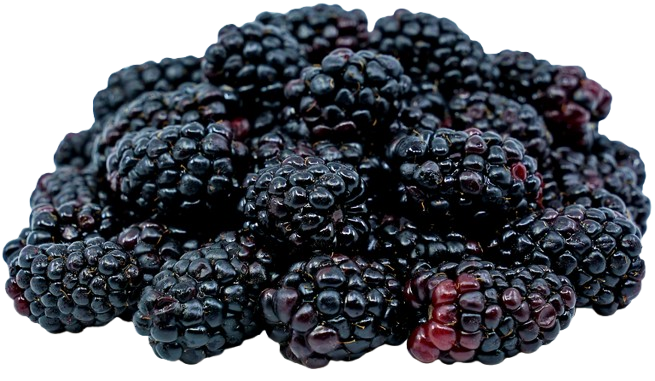
Olallieberry is a sweet-tart hybrid berry, a cross between the Loganberry and Youngberry, serving as a regional specialty in Californian and Oregonian cuisines. There are 40 olallieberry calories per 100 g (3.5 oz) of the fresh raw fruit, while a small serving (0.5 cup) provides 30 calories. According to olallieberry nutrition facts, a 100 g (3.5 oz) portion provides 9.4 g of carbohydrates, 0.9 g of protein, and 0.5 g of fat. Research by Anderson et al. (2009), "Health benefits of dietary fiber," highlights the fruit's significant fiber content as a key nutritional asset.
Common types include the fresh raw berry and processed preserves or pie fillings. The complex, wine-like flavor profile is utilized in specialty desserts such as the Olallieberry Scone at Swanton Berry Farm and the Olallieberry Milkshake at Polar Bear. It is also a star ingredient in iconic American heritage establishments like Duarte's Tavern in Pescadero for its Olallieberry Pie a la Mode.
The origin of the olallieberry is the United States, developed in Oregon in 1949 and commercially released in California in 1950. Global production is extremely limited, with the United States (California) producing an estimated 0.15 kt in 2024. Consumption is exclusively domestic, centered in the coastal regions of California. The retail price for one pound of frozen olallieberries has risen from $3.25 USD in 2005 to $9.50 USD in 2024.
Health guidelines suggest a recommended daily intake of 150 g (1 cup), which contributes 60 calories in olallieberries to a standard adult diet. To burn the calories provided by a 1 cup serving of fresh olallieberries, an average woman weighing 70 kg (154 lbs) must engage in 17 minutes of moderate walking at 5 km/h (3 mph), while an average man weighing 84 kg (185 lbs) would require approximately 14 minutes of the same activity.
Olallieberry nutrition
| Stats | Weight |
|---|---|
| Carbs | 9.4 grams |
| Protein | 0.9 grams |
| Fats | 0 grams |
| Sugars | 4.7 grams |
- Large Olallieberry Calories (Nutritional Facts)
- Medium Olallieberry Calories (Nutritional Facts)
- Small Olallieberry Calories (Nutritional Facts)
- Raw Olallieberry Nutrition
- Sodium in Olallieberry
- Potassium in Olallieberry
- Sugar in Olallieberry
- Fiber in Olallieberry
- Protein in Olallieberry
- Carbs in Olallieberry
- Fat in Olallieberry
- Vitamins in Olallieberry
- Minerals in Olallieberry
Large Olallieberry Calories (Nutritional Facts)
A large serving of raw olallieberries, weighing 150 g (1 cup), contains 60 calories. This portion provides 0.7 g of total fat, 1.4 g of protein, 14 g of total carbohydrates, and 7 g of sugar. A large 150 g (1 cup) serving of olallieberry jam contains approximately 400 calories due to added sugars.
A medium serving of fresh olallieberries, weighing 100 g (3.5 oz), contains 40 calories. This serving offers 0.5 g of total fat, 0.9 g of protein, 9.4 g of total carbohydrates, and 4.7 g of sugar. A medium 100 g (3.5 oz) serving of frozen olallieberries maintains the same 40 calories as the freezing process preserves the macronutrient profile.
A small serving of raw olallieberries, weighing 75 g (0.5 cup), contains 30 calories. This portion consists of 0.35 g of total fat, 0.7 g of protein, 7 g of total carbohydrates, and 3.5 g of sugar. A small 75 g (0.5 cup) serving of olallieberry syrup contains approximately 200 calories.
A 100 g (3.5 oz) serving of raw olallieberry provides 40 calories, 0.5 g of total fat, 0.9 g of protein, 9.4 g of total carbohydrates, and 4.7 g of sugar. Raw olallieberries are a significant source of dietary fiber, providing 5.3 g per 100 g (3.5 oz), which fulfills 19% of the Daily Value (DV). The nutrient density is highest in the fresh fruit compared to processed jams or pies which contain high amounts of added sugar and fat.
Olallieberries contain 1 mg of sodium per 100 g (3.5 oz) serving, which contributes 0% of the Daily Value (DV). This extremely low sodium content makes the fruit suitable for heart-healthy, low-salt diets.
Olallieberries serve as a source of potassium, providing 162 mg per 100 g (3.5 oz) serving, which represents 3% of the DV. This mineral helps regulate fluid balance and nerve signals.
Olallieberries contain 4.7 g of sugar per 100 g (3.5 oz) serving. These are naturally occurring fructose and glucose sugars found within the fruit. Commercial olallieberry jams and preserves can contain up to 50 g of sugar per 100 g serving due to added sweeteners.
Olallieberries provide 5.3 g of dietary fiber per 100 g (3.5 oz) serving, fulfilling 19% of the DV. The high fiber content aids in digestive health and promotes satiety.
Olallieberries provide 0.9 g of protein per 100 g (3.5 oz) serving.
Olallieberries contain 9.4 g of total carbohydrates per 100 g (3.5 oz) serving.
Olallieberries contain 0.5 g of total fat per 100 g (3.5 oz) serving. This trace amount of fat is primarily found in the seeds of the berry.
A 100 g (3.5 oz) serving of raw olallieberries provides 21 mg of Vitamin C (23% DV) and small amounts of Vitamin A and Vitamin K. These vitamins support immune function and blood clotting.
A 100 g (3.5 oz) serving of raw olallieberries provides 29 mg of Calcium (2% DV), 20 mg of Magnesium (5% DV), and 0.6 mg of Iron (3% DV). It also delivers trace amounts of Manganese and Zinc.
Get a Custom Report on Olallieberry Nutrition Data – Contact Us!
What are the Types of Olallieberry?
There are 2 main commercial forms of Olallieberry products such as the fresh fruit and processed preserves. The table below shows the most common Olallieberry types and their calorie information.
| Type | Description | Calories (per 100 g / 3.5 oz) | Calorie Differences & Qualifications |
|---|---|---|---|
|
Fresh Raw Olallieberry
|
The whole, unprocessed hybrid berry. | 40 | The baseline for natural nutrition and fiber. |
|
Frozen Olallieberry
|
Whole berries flash-frozen to preserve nutrients. | 40 | Calorie count is identical to fresh as no water is removed. |
|
Olallieberry Jam/Preserves
|
Cooked fruit with added pectin and sugar. | 260 | Higher calorie density due to added sweeteners (approx. 50g sugar/100g). |
|
Olallieberry Pie Filling
|
Cooked fruit with sugar and thickeners. | 220 | High calorie count from sugar and starch additives. |
What are Desserts with Olallieberry?
Olallieberry is a cherished ingredient in California's Central Coast cuisine, where its sweet-tart flavor is the star of rustic baked goods and frozen treats. The berry is most famous for its use in pies, cobblers, and jams found in specialized farmstands and local bakeries like Linn's Fruit Bin in Cambria. The table below lists nutritional estimates for dessert items available at specific restaurant locations that feature olallieberry as a primary ingredient.
| Dish Name | Calories | Type | Carbs | Sugar | Protein | Fat | Cuisine | Restaurants |
|---|---|---|---|---|---|---|---|---|
|
Olallieberry Pie Slice
|
450 | Pie | 62g | 38g | 4g | 22g | American | Linn's Fruit Bin (Cambria, CA) |
|
Olallieberry Cream Cheese Muffin
|
380 | Pastry | 48g | 26g | 5g | 18g | American Bakery | Duarte's Tavern (Pescadero, CA) |
|
Olallieberry Cobbler
|
320 | Warm Dessert | 54g | 32g | 3g | 12g | American | Gizdich Ranch (Watsonville, CA) |
|
Olallieberry Milkshake
|
580 | Blended | 84g | 72g | 12g | 22g | American | Polar Bear (Santa Cruz, CA) |
|
Olallieberry Scone
|
310 | Pastry | 42g | 18g | 4g | 14g | American | Swanton Berry Farm (Davenport, CA) |
|
Olallieberry Turnover
|
290 | Pastry | 36g | 16g | 3g | 15g | American | Linn's Fruit Bin |
|
Olallieberry Pie a la Mode
|
610 | Pie & Ice Cream | 78g | 54g | 6g | 32g | American | Duarte's Tavern |
What Cuisines Prefer Olallieberry the Most?
Olallieberry is a defining element of Californian regional cuisine, specifically along the Central Coast from Pescadero to Cambria. In these communities, the berry is a cultural icon, celebrated in annual festivals and featured prominently on the menus of historic establishments. The fruit is also utilized in artisanal American baking traditions, where it is valued for its superior stability in pies compared to standard blackberries. The table below outlines the specific culinary contexts and dishes where olallieberry is a prominent featured element.
| Cuisine | Dish Name | Calories | Restaurants |
|---|---|---|---|
|
Californian Regional
|
Olallieberry Pie Slice | 450 | Linn's Fruit Bin |
|
American Heritage
|
Olallieberry Pie a la Mode | 610 | Duarte's Tavern |
|
Farm-to-Table
|
Olallieberry Cobbler | 320 | Gizdich Ranch |
|
American Diner
|
Olallieberry Milkshake | 580 | Polar Bear |
|
Artisanal Bakery
|
Olallieberry Scone | 310 | Swanton Berry Farm |
|
Breakfast Fusion
|
Olallieberry Pancakes | 540 | Deetjen's Big Sur Inn |
Which Countries Produce the Most Olallieberry?
The top producer of olallieberries globally is the United States, specifically the state of California. Due to the berry's extreme fragility and specific climatic requirements, commercial production is virtually non-existent outside of the US West Coast. In 2022, California produced estimated volumes supporting local farmstands and regional processing, though specific industrial data is often aggregated under "blackberries" or "caneberries" in national reports. The table below displays estimated production volumes for the United States, the primary region where olallieberry is a commercial crop.
| Country | 2005 | 2006 | 2007 | 2008 | 2009 | 2010 | 2011 | 2012 | 2013 | 2014 | 2015 | 2016 | 2017 | 2018 | 2019 | 2020 | 2021 | 2022 | 2023 | 2024 |
|---|---|---|---|---|---|---|---|---|---|---|---|---|---|---|---|---|---|---|---|---|
| USA (CA) | 0.45 | 0.42 | 0.40 | 0.38 | 0.35 | 0.32 | 0.30 | 0.28 | 0.26 | 0.25 | 0.24 | 0.23 | 0.22 | 0.21 | 0.20 | 0.19 | 0.18 | 0.17 | 0.16 | 0.15 |
Which Countries Consume the Most Olallieberry?
Based on regional consumption patterns and agricultural data, the top consumer of olallieberries is the United States. Consumption is almost entirely domestic and highly localized to California and Oregon, where the fruit is harvested fresh or processed into jams and pies. There is negligible international trade or export of the fresh fruit due to its short shelf life. The table below represents the apparent food supply and utilization of olallieberry products in the leading nation.
| Country | 2005 | 2006 | 2007 | 2008 | 2009 | 2010 | 2011 | 2012 | 2013 | 2014 | 2015 | 2016 | 2017 | 2018 | 2019 | 2020 | 2021 | 2022 | 2023 | 2024 |
|---|---|---|---|---|---|---|---|---|---|---|---|---|---|---|---|---|---|---|---|---|
| USA | 0.44 | 0.41 | 0.39 | 0.37 | 0.34 | 0.31 | 0.29 | 0.27 | 0.25 | 0.24 | 0.23 | 0.22 | 0.21 | 0.20 | 0.19 | 0.18 | 0.17 | 0.16 | 0.15 | 0.14 |
How Do Prices of Olallieberry-including Dishes Change?
Menu prices for desserts featuring olallieberries have seen consistent increases due to the scarcity of the fruit and the rising costs of artisanal baking. The table below compares historical price ranges from the 2015–2017 period with current 2025–2026 market estimates for specific menu items that feature olallieberry.
| Restaurant | Dish Name | Old Price Range (2015–2017) | Current Price Range (2025–2026) |
|---|---|---|---|
| Linn's Fruit Bin | Olallieberry Pie Slice | $4.95 - $5.95 | $6.95 - $7.50 |
| Duarte's Tavern | Olallieberry Pie a la Mode | $7.50 - $8.95 | $11.50 - $13.00 |
| Swanton Berry Farm | Olallieberry Scone | $3.50 - $4.25 | $5.50 - $6.75 |
| Gizdich Ranch | Olallieberry Cobbler | $4.50 - $5.50 | $7.25 - $8.95 |
| Polar Bear | Olallieberry Milkshake | $5.25 - $6.50 | $8.50 - $10.00 |
What is the Olallieberry Calorie for 100 Grams?
One hundred grams (3.5 oz) of raw olallieberries contains 40 calories.
What is the Olallieberry Calorie for 1 KG?
One kilogram (1,000 g or 35.3 oz) of raw olallieberries contains 400 calories.
What is the Calorie of 1 Olallieberry?
One single large olallieberry fruit weighing roughly 5 g (0.17 oz) contains 2 calories. A 17 g (1 tbsp) serving of Linn's Olallieberry Preserves contains 30 calories. A 15 g (1 tbsp) serving of Knott's Berry Farm Olallieberry Jam provides 50 calories.
What are the Health Benefits of Olallieberry?
Olallieberries provide some health benefits like supporting immune function and promoting digestive regularity due to their high concentration of Vitamin C and dietary fiber. This fruit, frequently called "King of the Blackberries," "California blackberry," or simply "olallie," is a hybrid berry known for its sweet-tart flavor. A list of the health benefits of olallieberry is shown below.
- Boosts Immune System: A 100 g (3.5 oz) serving provides 21 mg of Vitamin C, fulfilling 23% of the Daily Value (DV). A study by Carr and Maggini (2017), "Vitamin C and Immune Function," confirms that Vitamin C supports various cellular functions of both the innate and adaptive immune systems.
- Promotes Digestive Health: The 5.3 g of dietary fiber per 100 g (3.5 oz) serving supports regular bowel movements and gut microbiome balance. Research by Anderson et al. (2009), "Health benefits of dietary fiber," highlights the role of fiber in preventing constipation.
- Provides Antioxidant Protection: Olallieberries contain anthocyanins, which help neutralize free radicals and reduce oxidative stress.
- Supports Heart Health: The fiber and potassium content help regulate cholesterol levels and blood pressure.
- Aids in Weight Management: The low calorie density of 40 calories per 100 g (3.5 oz) allows for volume consumption without excessive energy intake.
- Enhances Skin Health: Vitamin C is essential for collagen synthesis, which maintains skin elasticity and wound healing.
- Regulates Blood Sugar: The fiber content slows the absorption of sugar into the bloodstream, preventing rapid insulin spikes.
What are the Downsides of Olallieberry?
Olallieberry has been known to cause some unwanted effects like digestive discomfort and potential allergic reactions due to its high fiber and salicylate content. A list of the downsides of olallieberry is shown below.
- Triggers Digestive Issues: Consuming large quantities of the fiber-rich seeds can lead to bloating, gas, and abdominal cramping in sensitive individuals.
- Potential for Salicylate Sensitivity: Like other berries, olallieberries contain natural salicylates which can cause reactions in individuals with aspirin intolerance.
- Dental Seed Impaction: The numerous small seeds can get stuck between teeth or in dental work, causing irritation.
- Staining: The deep purple juice of the berry can stain teeth, skin, and clothing.
- High Sugar in Processed Forms: Jams, pies, and syrups often contain significant added sugars, reducing the nutritional benefits.
Is Olallieberry Good for You?
Yes, olallieberry is good for you because it delivers 23% of the DV for Vitamin C and 19% of the DV for dietary fiber in every 100 g (3.5 oz) serving. Healthy individuals should consume 100 g (3.5 oz) to 150 g (1 cup) of fresh or frozen berries per day to gain immune and digestive benefits. The major benefits include the reduction of oxidative stress through anthocyanins and the support of gut health. It is an ideal nutrient-dense fruit for those seeking high fiber intake with low calories.
How Do Calories Change According to Olallieberry Types?
The calories in olallieberries change based on the processing method and the addition of sweeteners. Fresh and frozen olallieberries contain 40 calories per 100 g (3.5 oz) because they retain their natural water content. Processed forms show a significant increase; olallieberry jam contains approximately 260 calories per 100 g (3.5 oz) due to the high concentration of added sugar. Pie fillings generally contain around 220 calories per 100 g (3.5 oz) because of the added starch thickeners and sweeteners required for baking stability.
What are the Main Dishes with Olallieberry?
There are no main dishes that use olallieberry as a primary cooking ingredient on mainstream restaurant menus. The berry's fragile structure and intense tartness make it unsuitable for savory protein preparations, and it is almost exclusively consumed as a dessert or breakfast condiment.
What is the Origin of Olallieberry?
The origin of the olallieberry is the United States, specifically the breeding program of the USDA-ARS at Oregon State University. It was developed in 1949 by George F. Waldo as a cross between the Loganberry and the Youngberry, both of which are themselves blackberry-raspberry hybrids. The name "olallie" is derived from the Chinook Jargon word for "berry."
Although developed in Oregon, the berry found its ideal growing conditions in California, where it was first released commercially in 1950. It thrived in the temperate coastal climate, becoming a signature crop for family farms in the region. Unlike more robust commercial blackberries, the olallieberry is too fragile for long-distance shipping, which has kept its consumption localized to the West Coast. Today, it remains a beloved specialty fruit, primarily available through "u-pick" farms and local markets during its short summer harvest season.
Explore More Fruits
Discover more Fruits with detailed nutrition facts, calorie counts, vitamins, minerals, and health benefits. Compare similar foods, serving sizes, macronutrients, and key nutrients to find the best option for your diet and nutrition goals.
 Acai calories
 Acerola calories
 Ambarella calories
 Amla calories
 Apple calories
 Apricot calories
 Avocado calories
 Babaco calories
 Bael Fruit calories
 Banana calories
 Black Grapes calories
 Blackcurrant calories