Calories and Nutritions in Peach
Peach calories vary depending on the size and type of peach. A medium peach (2-1/2" diameter) contains about 38 calories, while a large peach contains an average of 61 calories. Smaller peaches provide around 31 calories. The average protein content in peaches varies by size, with small peaches containing about 0.72g of protein, medium peaches around 0.89g, and large peaches offering about 1.43g. Carbohydrates average 8g for small peaches, 9g for medium, and 15g for large peaches. The fat content is minimal across all sizes, ranging from 0.2g to 0.39g per fruit. Popular varieties of peach are Donut Peach, Babcock Peach, Belle of Georgia, Nectarine, Early Amber, Elberta, and Arctic Supreme.
Peach production reached approximately 16 million tons globally in 2021, with China leading the production numbers. Other key peach producers include Spain, Italy, Turkey, and the United States, where peaches are commonly used in desserts, beverages, and savory dishes. Peach prices have fluctuated over time and in 2025, wholesale prices range from $1.52 to $6.59 per pound, while retail prices range from $2.18 to $9.41 per pound. Walmart’s fresh yellow nectarine and fresh white nectarine peaches are priced at $0.76 per piece, while Kroger’s Fresh California Yellow Peaches are available for $1.85 each, and White Nectarines are priced at $2.99 per pound.
Peaches are often used in classic desserts like peach cobbler, peach crisp, peach pie, and peach tart, served at fast food and fast casual restaurants such as Popeyes, The Cheesecake Factory, Red Lobster, Jollibee, and Cracker Barrel. Peach-based desserts and entrees also feature prominently in fine dining restaurants like The Capital Grille and Wolfgang’s Steakhouse.
Consuming peaches regularly promotes heart health, supports digestion, boosts immunity, lowers risk of breast cancer, and provides many skin benefits. Consuming 1–2 peaches daily is ideal to reap these peach benefits, and the calories can be burned with light exercise such as a 14-minute walk (3 mph), a 5-minute run (6 mph), or a 7-minute bicycle ride (10 mph).
Peach nutrition
| Stats | Weight |
|---|---|
| Carbs | 10.1 grams |
| Protein | 0.91 grams |
| Fats | 0.27 grams |
| Sugars | 0 grams |
- Large Peach Calories (Nutritional Facts)
- Medium Peach Calories (Nutritional Facts)
- Small Peach Calories (Nutritional Facts)
- Raw Peach Calories
- Calories in Peach with Skin
- Sugar in Peach
- Fiber in Peach
- Protein in Peach
- Carbs in Peach
- Fat in Peach
- Vitamins in Peach
- Minerals in Peach
Large Peach Calories (Nutritional Facts)
A large white peach (2-3/4" diameter, about 2-1/2 peaches per lb) contains approximately 61 calories, 14.98g of carbohydrates, 2.4g of fiber, 13.17g of sugar, 0.39g of fat, and 1.43g of protein, while providing 12% of the daily recommended intake of vitamin C.
Calories in a medium peach (2-1/2" diameter, about 4 per lb) is approximately 38 calories, with 9.35g of carbohydrates, 1.5g of fiber, 8.22g of sugar, 0.24g of fat, and 0.89g of protein, while providing 7% of the daily recommended intake of vitamin C.
A small peach (2" diameter, about 5 per lb) contains approximately 31 calories, 7.54g of carbohydrates, 1.2g of fiber, 6.63g of sugar, 0.2g of fat, and 0.72g of protein, while providing 6% of the daily recommended intake of vitamin C.
Raw peach calories range from 11 to 66, depending on the size and weight of the peach.
According to Nutrition Value, there are 65 calories in a peach with skin, with a portion size of 155g.
The sugar content in peaches depends on the size of the fruit or serving, as listed below:
- Sugar in one small peach is 6.63 grams.
- Sugar in one medium peach is 8.22 grams.
- Sugar in one large peach is 13.17 grams.
- Sugar in one-half cup of peach slices is 7.13 grams.
- Sugar in one cup of peach slices is 14.26 grams.
- Sugar in one ounce of peach slices is 2.38 grams.
The fiber content in peaches depends on the size of the fruit or serving as listed below:
- Fiber in one small peach is 1.2g (4% of the daily value).
- Fiber in one medium peach is 1.5g (5% of the daily value).
- Fiber in one large peach is 2.4g (8% of the daily value).
- Fiber in one-half cup of peach slices is 1.3g (5% of the daily value).
- Fiber in one cup of peach slices is 2.6g (9% of the daily value).
- Fiber in one ounce of peach slices is 0.4g (2% of the daily value).
The amount of protein in peaches depends on the size of the fruit or serving, as listed below:
- Protein in one small peach is 0.72g.
- Protein in one medium peach is 0.89g.
- Protein in one large peach is 1.43g.
- Protein in one-half cup of peach slices is 0.77g.
- Protein in one cup of peach slices is 1.55g.
- Protein in one ounce of peach slices is 0.26g.
The carbs in peaches depends on the size of the fruit or serving size, as listed below:
- Carbohydrates in one small peach are 7.54g (3% of the daily value).
- Carbohydrates in one medium peach are 9.35g (3% of the daily value).
- Carbohydrates in one large peach are 14.98g (5% of the daily value).
- Carbohydrates in one-half cup of peach slices are 8.11g (3% of the daily value).
- Carbohydrates in one cup of peach slices are 16.22g (6% of the daily value).
- Carbohydrates in one ounce of peach slices are 2.7g (1% of the daily value).
The amount of fat in a peach depends on the size of the fruit or the serving size, as listed below:
- A small peach has 0.2g total fat, including 0.015g saturated fat, 0.068g polyunsaturated fat, and 0.053g monounsaturated fat.
- A medium peach has 0.24g total fat, including 0.019g saturated fat, 0.084g polyunsaturated fat, and 0.066g monounsaturated fat.
- A large peach has 0.39g total fat, including 0.03g saturated fat, 0.135g polyunsaturated fat, and 0.105g monounsaturated fat.
- One-half cup of peach slices has 0.21g total fat, including 0.016g saturated fat, 0.073g polyunsaturated fat, and 0.057g monounsaturated fat.
- One cup of peach slices has 0.42g total fat, including 0.032g saturated fat, 0.146g polyunsaturated fat, and 0.114g monounsaturated fat.
- One ounce of peach slices has 0.07g total fat, including 0.005g saturated fat, 0.024g polyunsaturated fat, and 0.019g monounsaturated fat.
The peaches vitamins depends on the size of the serving as listed below:
- A small peach has 13mcg of vitamin A (1% DV) and 5.2mg of vitamin C (6% DV).
- A medium peach has 16mcg of vitamin A (2% DV) and 6.5mg of vitamin C (7% DV).
- A large peach has 25mcg of vitamin A (3% DV) and 10.4mg of vitamin C (12% DV).
- One-half cup of peach slices has 14mcg of vitamin A (2% DV) and 5.6mg of vitamin C (6% DV).
- One cup of peach slices has 27mcg of vitamin A (3% DV) and 11.2mg of vitamin C (12% DV).
- One ounce of peach slices has 5mcg of vitamin A (1% DV) and 1.9mg of vitamin C (2% DV).
The mineral content in peaches depends on the size of the fruit/serving as listed below:
- A small peach has 5mg of calcium, 0.2mg of iron, and 150mg of potassium.
- A medium peach has 6mg of calcium, 0.24mg of iron, and 186mg of potassium.
- A large peach has 9mg of calcium, 0.39mg of iron, and 298mg of potassium.
- One-half cup of peach slices has 5mg of calcium, 0.21mg of iron, and 162mg of potassium.
- One cup of peach slices has 10mg of calcium, 0.42mg of iron, and 323mg of potassium.
- One ounce of peach slices has 2mg of calcium, 0.07mg of iron, and 54mg of potassium.
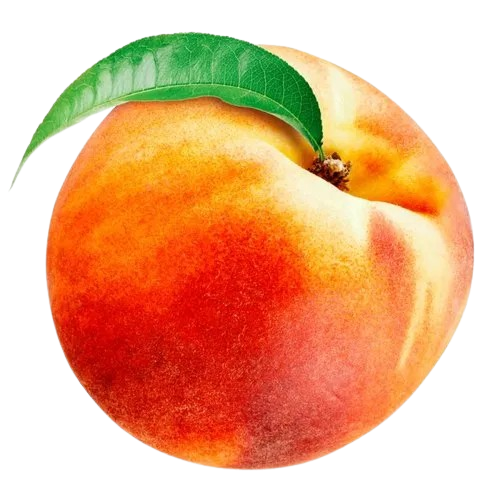
Get a Custom Report on Peach Nutrition Data – Contact Us!
What are the Types of Peaches?
The most common types of peaches are Donut Peach, Babcock Peach, Belle of Georgia, Nectarine, Early Amber, Elberta, and Arctic Supreme Peach.
| Peach Type | Calories (per 100g, raw) | Characteristics | Freestone/Clingstone/Semi | Flesh Color |
|---|---|---|---|---|
|
Donut Peach
|
37 | Flat, saucer-shaped. Sweet, low-acid flavor. Also known as "Saturn Peach" or "Flat Peach". | Freestone | White (usually) |
|
Babcock Peach
|
38 | Small to medium size. White-fleshed. Tart flavor. Developed in California. | Semi-freestone | White |
|
Belle of Georgia
|
39 | Large size. White-fleshed. Freestone. Red blush over creamy white skin. Classic heirloom variety. Sweet, slightly acidic flavor. | Freestone | White |
|
Nectarine
|
44 | Smooth skin (a genetic mutation of a peach). Generally firmer texture than fuzzy peaches. Yellow-fleshed varieties are most common, but white-fleshed nectarines also exist. Sweet-tart flavor. | Freestone or Clingstone | Yellow (usually), White |
|
Early Amber
|
41 | Early-season variety. Orange-yellow flesh. Sweet flavor. | Freestone | Yellow |
|
Elberta
|
42 | Large size. Freestone. Golden-yellow skin with a red blush. Yellow flesh. Classic, all-purpose peach. Good for canning, freezing, and fresh eating. | Freestone | Yellow |
|
Arctic Supreme
|
43 | Large size. White-fleshed. Clingstone. Red skin. Sweet, low-acid flavor. | Clingstone | White |
|
White Peach (general)
|
~39 | Generally sweeter and less acidic than yellow peaches. More delicate texture. | Varies | White |
|
Yellow Peach (general)
|
~39 | More acidic and slightly less sweet than white peaches. Firmer texture. | Varies | Yellow |
What are the Desserts with Peach?
The desserts that include peach as an ingredient are listed below:
| Cuisine | Dessert Name | Description | Calories (Estimate) | Restaurants |
|---|---|---|---|---|
|
American (Southern)
|
Peach Cobbler | Baked peaches topped with a biscuit or cake-like crust, often with cinnamon and nutmeg. | 420 (per 245g serving) | Cracker Barrel, Black Bear Diner, Paula Deen’s Family Kitchen |
|
French
|
Peach Melba | Poached peaches with raspberry sauce and vanilla ice cream. | 260 (per 200g serving) | Balthazar, The French Room |
|
American
|
Peach Pie | Buttery, flaky crust with spiced peach filling. | 350 (per 1/8 of 9-inch pie slice) | Marie Callender’s, Village Inn, Perkins Restaurant & Bakery |
|
American
|
Peach Crisp | Baked sweetened peaches with a crunchy oat and brown sugar crumble. | 380 (per 220g serving) | Founding Farmers, Magnolia Bakery, Cheesecake Factory |
|
French
|
Peach Tart | Delicate pastry crust filled with peach slices and custard or glaze. | 320 (per 180g serving) | Bouchon Bakery, Ladurée, Dominique Ansel Bakery |
What are the Main Dishes with Peach?
The main dishes that include peaches as an ingredient or add-on, are listed below:
| Cuisine | Main Dish Name | Description | Calories (Estimate) | Restaurants |
|---|---|---|---|---|
|
American
|
Peach-Glazed Pork Chops | Pork chops coated in a sweet and tangy peach glaze (fresh peaches, brown sugar, balsamic vinegar). | 450 (per 250g serving) | Texas Roadhouse, Cracker Barrel, The Capital Grille |
|
American
|
Grilled Chicken with Peach Salsa | Grilled chicken breast topped with fresh peach salsa (diced peaches, red onion, cilantro, lime juice). | 380 (per 230g serving) | Yard House, LongHorn Steakhouse, Seasons 52 |
|
American
|
Peach BBQ Ribs | Slow-cooked ribs with a peach-infused barbecue sauce. | 700 (per 300g serving) | Famous Dave’s, Sonny’s BBQ, Lucille’s Smokehouse Bar-B-Que |
|
American/Seafood
|
Seared Salmon with Peach Chutney | Pan-seared salmon fillet with peach chutney (ginger, cinnamon, honey). | 520 (per 280g serving) | Bonefish Grill, Ocean Prime, Eddie V’s Prime Seafood |
|
American
|
Peach-Stuffed Chicken Breast | Chicken breast filled with diced peaches, goat cheese, and herbs, then baked. | 460 (per 240g serving) | The Cheesecake Factory, Fleming’s Prime Steakhouse, Ruth’s Chris Steakhouse |
|
Italian/American
|
Peach and Prosciutto Pizza | Pizza with sliced peaches, prosciutto, arugula, and balsamic glaze. | 320 (per 150g slice) | California Pizza Kitchen, Mellow Mushroom, Blaze Pizza |
What Cuisines Prefer Peach the Most?
The cuisines that commonly use peach and can be requested as an additional ingredient are listed below:
| Cuisine | Dishes | Calories (Estimate) | Restaurants |
|---|---|---|---|
|
American
|
Peach BBQ Ribs | ~700 per serving | Famous Dave’s, Sonny’s BBQ, Lucille’s Smokehouse Bar-B-Que |
| Peach Cobbler | ~450 per serving | Cracker Barrel, Black Bear Diner, The Cheesecake Factory | |
| Grilled Chicken with Peach Salsa | ~380 per serving | LongHorn Steakhouse, Yard House, Seasons 52 | |
|
French
|
Duck à la Pêche | ~600 per serving | Le Bernardin, L’Atelier de Joël Robuchon, Daniel |
| Peach Clafoutis | ~320 per serving | Café de Flore, Balthazar, Ladurée | |
| Peach Tarte Tatin | ~400 per serving | Pierre Hermé, Maison Kayser, Angelina | |
|
Italian
|
Prosciutto e Pesca | ~280 per serving | Eataly, Carbone, Il Mulino |
| Peach Crostata | ~350 per serving | Lupa, Osteria Mozza, Babbo | |
| Peach Bellini | ~150 per serving | Cipriani, Harry’s Bar, Scarpetta | |
|
Chinese
|
Peach Shrimp Stir-Fry | ~450 per serving | Din Tai Fung, Hakkasan, Mr. Chow |
| Sweet and Sour Peach Chicken | ~500 per serving | Panda Express, P.F. Chang’s, Golden Dragon | |
| Peach Mooncake | ~250 per serving | Kee Wah Bakery, Tai Pan Bakery, Maxim’s Cakes |
Which Countries Produce the Most Peaches?
The top peach-producing countries are listed below:
| Country | 2019 (tons) | 2020 (tons) | 2021(tons) |
|---|---|---|---|
| China | 14,687,713 | 15,016,103 | 16,016,533 |
| Spain | 1,545,610 | 1,306,020 | 1,197,840 |
| Italy | 1,224,940 | 1,015,350 | 996,860 |
| Turkey | 830,577 | 892,048 | 891,857 |
| United States | 731,730 | 703,300 | 730,530 |
| Iran | 591,412 | 650,004 | 687,213 |
| Greece | 926,620 | 890,580 | 591,060 |
| Chile | 330,878 | 309,014 | 308,579 |
| Egypt | 349,630 | 273,500 | 244,229 |
| Mexico | 158,942 | 172,950 | 217,266 |
Which Countries Consume the Most Peach?
The top 10 peach-consuming countries in 2023 are listed below:
| Country | Peach Imports (2023, US$ millions) | Percentage of Total Imports (%) |
|---|---|---|
| Germany | 425.1 | 16.6 |
| Russia | 247.4 | 9.6 |
| France | 206.4 | 8 |
| Italy | 149.4 | 5.8 |
| United Kingdom | 142 | 5.5 |
| Mainland China | 100.9 | 3.9 |
| Canada | 83.9 | 3.3 |
| United States | 83.5 | 3.3 |
| Netherlands | 82.5 | 3.3 |
| Hong Kong | 76.4 | 3 |
How Do the Prices of Peach-including Dishes Change?
The prices of peach-including dishes fluctuate with peach costs, which range from $2.18 to $9.41 per pound for retail, and $1.52 to $6.59 per pound wholesale in 2025. Higher prices impact menu items as shown below:
| Restaurant | Dish | Old Price (Date) | Current Price (Date) |
|---|---|---|---|
| Cracker Barrel | Peach Cobbler | ~$3.99 (2015-2018) | $4.99 (March 2025) |
| Marie Callender's | Peach Pie (slice) | ~$3.50 (2012-2015) | $5.79 (March 2025) |
How Does the Price of Peach Change for the Last 20 Years?
The average price of peaches per pound (453.6 grams) in the U.S. city market was $1.752 in 2001 and rose to $2.088 in 2020. The average prices from 2001 to 2020 are shown below:
| Year | Price |
|---|---|
| 2021 | $0.739 |
| 2022 | $0.717 |
| 2023 | $0.72 |
| 2024 | $0.71 |
What is the Peach Calorie for 100 GR?
According to Fat Secret, the calories in a 100g serving of peach is 39 calories.
What is the Peach Calorie for 1 KG?
One kilogram (1000g) of peaches contains 390 calories.
What is the Calories of 1 Peach?
According to the USDA, one peach weighing 150g contains 58 calories.
What is Half a Peach Calories?
Half a peach contains 29 calories, since a whole peach weighing 150 grams has 58 calories.
What are the Health Benefits of Peach?
There are many peach health benefits, as shown in the list below:
- Aids Digestion: Peaches support digestion with 2 grams of fiber per medium fruit. Insoluble fiber helps prevent constipation, while soluble fiber feeds gut bacteria that produce short-chain fatty acids which can reduce inflammation and improve symptoms of digestive disorders like IBS and Crohn’s disease. Peach flowers, used in traditional medicine, may also aid digestion by increasing gut contractions according to an animal research conducted in 2015, while herbal tea made from peach flowers is popular in Korea.
- Improves Heart Health: A study on 1,393 Chinese adults assessed daily flavonoid and stilbene intake and its association with cardiovascular risk factors. Fruits like apples, plums, pears, and peaches were primary sources, followed by vegetables such as lotus root and taro. Average daily intake was 165.6 mg for total flavonoids and 0.3 mg for stilbenes. Higher anthocyanidin consumption correlated with increased HDL-C, while greater flavonoid and flavanol intake was linked to lower triglycerides and improved TG/HDL-C ratios in women, but not in men. Findings suggest flavonoids may support cardiovascular health, particularly in females.
- Provides Skin Benefits: A study on peach-derived glucosylceramide showed improved skin hydration and barrier function. Transdermal application increased ceramide levels, enhancing water retention. Oral intake of 0.6-1.2 mg/day for 20 days improved skin texture, while higher doses (5.4 mg/day) over 12 weeks showed no adverse effects. Peaches serve as a stable, cost-effective ceramide source for skincare and supplements.
- Lowers Risk Of Breast Cancer: Higher consumption of berries and peaches was linked to a lower risk of ER− breast cancer in postmenopausal women. A study of 75,929 women over 24 years old found that consuming at least one serving of blueberries per week and two servings of peaches/nectarines per week significantly reduced risk. Other fruits and vegetables showed no association.
- Boosts Immunity. A 2016 study analyzed peaches from four varieties at different ripening stages to assess their beneficial compounds, antioxidant effects, and antimicrobial properties. The Chatos variety had the highest antioxidant activity. Peaches showed strong antibacterial effects against Staphylococcus aureus and Listeria monocytogenes and were effective in slowing the growth of Candida albicans, especially in Chatos extracts. The results suggest that peaches contain powerful bioactive compounds that contribute to their health benefits.
What are the Downsides of Peach?
Peaches are considered healthy food choices but they do have a few drawbacks, as listed below:
- May Increase the Risk Of Colorectal Cancer In Men: A study on “Colors of vegetables and fruits and the risks of colorectal cancer” in 2017 found that higher intake of vegetables and fruits significantly reduced colorectal cancer risk in women (OR = 0.32, 95% CI: 0.21-0.48) and men (OR = 0.60, 95% CI: 0.45-0.79). Green and white vegetables and fruits were associated with lower risk in men, while green, red/purple, and white varieties showed an inverse association in women. However, in men, higher intake of orange/yellow vegetables and fruits, including citrus, carrots, and peaches, was linked to an increased risk (OR = 1.61, 95% CI: 1.22-2.12).
- Can Cause Bloating: According to an article published on WebMD and reviewed by Poonam Sachdev on July 23, 2024, peaches contain polyols, a type of natural sugar that can sometimes interact poorly with gut bacteria, potentially causing cramps and bloating.
- Hazard Risk: Peach seeds contain trace amounts of cyanide, but poisoning requires consuming a large quantity, making them generally non-toxic to humans, though they can be a choking hazard, especially for children. Peaches may be harmful to animals like dogs and cats. Raw peach leaves should never be eaten, as they contain amygdalin, which converts to cyanide in the human gut, and while raw peaches are safe to eat, they are often sour and hard. Peach skin is safe as long as the fruit is free from pesticides, so store-bought peaches should be washed thoroughly before consumption.
Are Peaches Good for You?
Yes, peaches are beneficial for overall health. A 2010 study found that peach fruit extract (FPP) reduces mast cell-mediated allergic inflammation by inhibiting histamine release and pro-inflammatory cytokines through calcium modulation and NF-kappaB pathways. Another study, “Protective Effect of White-fleshed Peach (Prunus persica (L.) Batsch) on Chronic Nicotine-induced Toxicity” suggests that white-fleshed peaches may help reduce nicotine-induced toxicity by increasing the excretion of nicotine metabolites, enhancing antioxidant enzyme activity, and reducing oxidative stress and inflammation in liver, kidney, and lung tissues, potentially benefiting smokers.
Peaches may also reduce blood sugar levels, according to a study published in National Library of Medicine, found that consuming polyphenol-rich peach and plum juice helped reduce obesity-related metabolic disorders, including hyperglycemia, insulin resistance, dyslipidemia, and inflammation in Zucker rats, suggesting potential cardiovascular benefits.
How Many Peaches Should I Eat a Day?
According to the New Jersey Agricultural Experiment Station, written by Karen Ensle Ed.D., RDN, FAND, CFCS, in June 2015, consuming 1.5 cups of fruit daily for women and 2 cups for men, as recommended by the U.S. Dietary Guidelines, promotes health. A 2014 study investigated the effects of peach polyphenolics on tumor growth and metastasis using a xenograft model with MDA-MB-435 breast cancer cells. Results showed that peach polyphenolics inhibited tumor growth and lung metastasis at doses of 0.8-1.6 mg/day by suppressing the expression of metalloproteinases. These compounds may serve as a chemo-preventive tool to reduce metastasis risk in combination therapy. The human equivalent dose is approximately 370.6 mg/day for a 60 kg adult, which can be obtained by consuming two to three peaches daily or using a peach polyphenol supplement.
How Many Peaches Can I Eat a Day at Most?
Eating two to three peaches per day can help meet daily fiber needs while providing essential vitamins and antioxidants. Consuming too many may lead to digestive discomfort, bloating, or diarrhea due to high fiber intake. Peaches also contain natural sugars, so moderation is important, especially for individuals managing blood sugar levels.
How Does Calorie Change According to Peach Types?
Peach varieties exhibit slight differences in calorie content, primarily due to variations in size and sugar concentration. White peaches contain approximately 60 calories per medium-sized fruit (147g), while yellow peaches have around 59 calories per medium-sized fruit (150g). The calorie variation between these peach types is minimal and primarily influenced by slight differences in sugar content and density. White peaches tend to have a sweeter taste, which may contribute to their slightly higher calorie count.
Do the Macros of Peach Differ Based on Types?
The peach macros composition of large yellow and white peaches (both 175g) is nearly identical. Each contains 68 calories, 17g of carbohydrates, 2.6g of fiber, and 15g of sugar. Both have 0.4g of total fat, including 0.2g of polyunsaturated fat and 0.1g of monounsaturated fat, with no cholesterol or sodium. Protein content is the same at 1.6g. Potassium levels are also similar, at 332.5mg.
How Does Peach Sugar Content Change Based on Types?
The peaches sugar content remains fairly consistent across different types and sizes. Large white and yellow peaches (175g) both contain 15g of sugar in peach, while a medium yellow peach (150g) has 13g of sugar. The primary difference comes from the size, as larger peaches naturally contain more sugar. White peaches tend to taste sweeter due to their lower acidity, but their actual sugar content is similar to yellow peaches.
What is the Origin of Peach?
According to a 2015 research titled, "Peaches Preceded Humans: Fossil Evidence from SW China," the peach (Prunus persica) is believed to have originated in China, with the earliest archaeological evidence dating back to 8,000–7,000 years ago. Fossil peach endocarps found in late Pliocene strata in Kunming City, Yunnan, China, date back to approximately 2.6 million years ago. These fossils closely resemble modern peach endocarps in terms of size, shape, and features, suggesting that China has been a key region in the evolution of peaches long before human cultivation began.
Explore More Fruits
Discover more Fruits with detailed nutrition facts, calorie counts, vitamins, minerals, and health benefits. Compare similar foods, serving sizes, macronutrients, and key nutrients to find the best option for your diet and nutrition goals.
 Acai calories
 Acerola calories
 Ambarella calories
 Amla calories
 Apple calories
 Apricot calories
 Avocado calories
 Babaco calories
 Bael Fruit calories
 Banana calories
 Black Grapes calories
 Blackcurrant calories