Calories and Nutritions in Potato Flour
Calories in potato flour are dependent on the serving size. A one cup serving of potato flour (181 grams or 6.4 ounces) contains 646 calories, while a one-tablespoon serving (11 grams or 0.4 ounces) provides 39 calories. A 100-gram (3.5 ounce) portion contains 357 calories, while one kilogram (1000g) of potato flour has 3570 calories. A quarter-cup (45g) serving of Bob's Red Mill Potato Flour contains 160 calories.
The potato flour nutrition profile is characterized by a high carbohydrate load, with a one-cup serving (181g) providing 150.4g of carbohydrates (55% DV), 12.5g of protein (25% DV), and 10.7g of dietary fiber (38% DV). The flour contains resistant starch, which behaves like soluble fiber and offers metabolic health benefits according to a scientific review (Birt, D. F., et al., 2013). Significant health advantages stem from the rich potassium content, with a one-cup serving delivering 1811.8mg (39% DV), and other minerals like phosphorus (24% DV) that support nervous system function and bone health.
Potato flour, made from whole dehydrated potatoes, is used as a thickener and in gluten-free baking for dishes like gnocchi and pierogi at restaurants such as Veselka and Red Lobster, connecting its use to top potato producers and consumers like China, India, and the United States. Reflecting stable agricultural production, the price of potatoes has seen modest increases over the last 20 years, with the average retail price climbing from under $0.50 per pound in the early 2000s to over $0.90 per pound after 2020.
Key benefits of potato flour relate to its potassium content for heart health and its resistant starch for digestive wellness, although moderation is recommended due to the presence of glycoalkaloids, which can be harmful in very high amounts. A small one-tablespoon serving (11g) provides 39 calories, an amount that can be expended through 4 minutes of running or 5 minutes of brisk walking.
Potato Flour nutrition
| Stats | Weight |
|---|---|
| Carbs | 79.9 grams |
| Protein | 8.11 grams |
| Fats | 0.951 grams |
| Sugars | 0 grams |
- Large Potato Flour Calories (Nutritional Facts)
- Medium Potato Flour Calories (Nutritional Facts)
- Small Potato Flour Calories (Nutritional Facts)
- Raw Potato Flour Nutrition
- Sodium in Potato Flour
- Potassium in Potato Flour
- Sugar in Potato Flour
- Fiber in Potato Flour
- Protein in Potato Flour
- Carbs in Potato Flour
- Fat in Potato Flour
- Vitamins in Potato Flour
- Minerals in Potato Flour
Large Potato Flour Calories (Nutritional Facts)
A large serving of one cup of potato flour (181g or 6.4oz) contains 646 calories, 12.5g of protein (25% DV), 0.62g of total fat (1% DV), 150.4g of total carbohydrates (55% DV), 10.7g of dietary fiber (38% DV), 6.4g of total sugars, and 99.6mg of sodium (4% DV).
A medium serving of one-half cup of potato flour (90g or 3.2oz) provides 321 calories, 6.2g of protein (12% DV), 0.31g of total fat (0% DV), 74.8g of total carbohydrates (27% DV), 5.3g of dietary fiber (19% DV), 3.2g of total sugars, and 49.5mg of sodium (2% DV).
A small serving of one tablespoon of potato flour (11g or 0.4oz) contains 39 calories, 0.76g of protein (2% DV), 0.04g of total fat (0% DV), 9.1g of total carbohydrates (3% DV), 0.65g of dietary fiber (2% DV), 0.39g of total sugars, and 6.1mg of sodium (0% DV).
A 200-calorie serving of raw potato flour (56g) has 3.9g of protein, 0.19g of total fat, 46.6g of total carbohydrates, 3.3g of dietary fiber, 2g of total sugars, and 30.8mg of sodium. A quarter-cup serving of raw potato flour (45g) contains 160 calories, 3.1g of protein, 0.15g of total fat, 37.4g of total carbohydrates, and 2.7g of dietary fiber.
A one-cup serving of potato flour (181g) contains 99.6mg of sodium (4% DV). A one-half cup serving (90g) has 49.5mg of sodium (2% DV), and a one-tablespoon serving (11g) has 6.1mg of sodium (0% DV).
A one-cup serving of potato flour (181g) provides 1811.8mg of potassium (39% DV). A one-half cup serving (90g) contains 900.9mg of potassium (19% DV), and a one-tablespoon serving (11g) contains 110.1mg of potassium (2% DV).
A one-cup serving of potato flour (181g) contains 6.4g of total sugars. A one-half cup serving (90g) has 3.2g of total sugars, and a one-tablespoon serving (11g) has 0.39g of total sugars.
A one-cup serving of potato flour (181g) contains 10.7g of dietary fiber (38% DV). A one-half cup serving (90g) provides 5.3g of dietary fiber (19% DV), and a one-tablespoon serving (11g) provides 0.65g of dietary fiber (2% DV).
A one-cup serving of potato flour (181g) provides 12.5g of protein (25% DV). A one-half cup serving (90g) has 6.2g of protein (12% DV), and a one-tablespoon serving (11g) has 0.76g of protein (2% DV).
A one-cup serving of potato flour (181g) contains 150.4g of total carbohydrates (55% DV). A one-half cup serving (90g) has 74.8g of total carbohydrates (27% DV), and a one-tablespoon serving (11g) has 9.1g of total carbohydrates (3% DV).
A one-cup serving of potato flour (181g) contains 0.62g of total fat (1% DV). A one-half cup serving (90g) has 0.31g of total fat (0% DV), and a one-tablespoon serving (11g) has 0.04g of total fat (0% DV).
A 100-gram serving of potato flour delivers 3.8mg of Vitamin C (4% DV) and 4.2mg of Niacin (26% DV). This serving size also provides 0.72mg of Vitamin B6 (42% DV), 0.5mg of Pantothenic Acid (10% DV), and 0.16mg of Thiamin (13% DV).
A 100-gram serving of potato flour provides 1001mg of potassium (21% DV) and 168mg of phosphorus (13% DV). This serving size also contains 79mg of magnesium (19% DV), 1.37mg of iron (8% DV), 65mg of calcium (5% DV), and 0.4mg of manganese (17% DV).
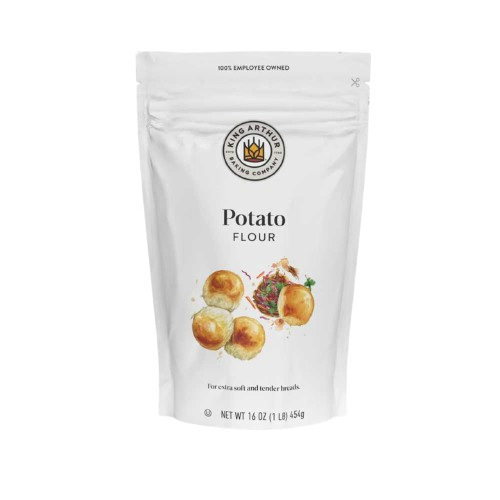
Get a Custom Report on Potato Flour Nutrition Data – Contact Us!
What are the Types of Potato Flours?
The types of potato flour are primarily potato flour and potato starch, which are distinct products with different properties and uses. The table below provides a breakdown of these types.
| Type | Description | Calories (Approximate per 100g) | Calorie Qualifications |
|---|---|---|---|
|
Potato Flour
|
Made from whole potatoes that are cooked, dried, and ground into a fine powder. Contains the protein, fiber, and flavor of the potato. | 357 | The inclusion of the entire potato results in a nutrient-dense product with a distinct potato flavor, higher in fiber and protein compared to potato starch. |
|
Potato Starch
|
A refined starch extracted from potatoes by washing away the fiber and protein. A very fine, white, flavorless powder used for thickening. | 357 | The removal of all components except the starch concentrates the carbohydrates, resulting in a nearly identical calorie count but superior thickening power with a neutral taste. |
What are Desserts With Potato Flour?
Potato flour is a common ingredient in many desserts, valued for adding moisture in gluten-free and traditional recipes. A summary of dessert options that use potato flour is provided in the table that follows.
| Dish Name | Calories (Estimate per serving) | Type of Dessert | Carbs (g) (Estimate) | Sugar (g) (Estimate) | Protein (g) (Estimate) | Fat (g) (Estimate) | Cuisine | Restaurants |
|---|---|---|---|---|---|---|---|---|
|
Gluten-Free Chocolate Cake
|
450-650 | Cake | 65 | 50 | 6 | 25 | American (Gluten-Free) | Erin McKenna's Bakery, Sprinkles Cupcakes |
|
Norwegian Lefse
|
100-150 (per piece) | Flatbread | 20 | 2 | 3 | 4 | Norwegian | Olsen's Scandinavian Foods, Ingebretsen's |
|
Polish Babka
|
400-550 | Sweet Bread | 60 | 30 | 8 | 18 | Polish | Veselka, Old Poland Bakery & Restaurant |
|
Gluten-Free Brownies
|
350-500 | Bar | 45 | 35 | 5 | 20 | American (Gluten-Free) | Sweet Laurel Bakery, Karma Baker |
|
Potato Doughnuts (Pączki)
|
300-450 | Donut | 40 | 20 | 6 | 15 | Polish | Stan's Donuts & Coffee, The Donut Man |
|
Gluten-Free Pancakes
|
400-600 | Breakfast Pastry | 70 | 25 | 10 | 12 | American | Snooze, an A.M. Eatery, First Watch |
|
Swedish Visiting Cake
|
350-500 | Cake | 50 | 35 | 5 | 16 | Swedish | FIKA, Konditor Meister |
|
Gluten-Free Muffins
|
300-450 | Muffin | 50 | 30 | 6 | 10 | American | By Chloe, Maman |
|
Passover Sponge Cake
|
250-400 | Cake | 40 | 30 | 7 | 8 | Jewish | Zabar's, Canter's Deli |
|
Gluten-Free Shortbread
|
150-250 (per 2-3 cookies) | Cookie | 20 | 10 | 2 | 9 | Scottish | Walker's (Gluten-Free Line) |
|
Chiffon Cake
|
300-450 | Cake | 45 | 30 | 6 | 12 | American | Valerie Confections, Lady M Cake Boutique |
What are Main Dishes With Potato Flour?
Potato flour is a functional component in many savory main courses, used as a binder, thickener, or base for doughs. Main courses prepared with potato flour are detailed in the table below.
| Dish Name | Calories (Estimate per serving) | Type of Potato Flour | Carbs (g) (Estimate) | Sugar (g) (Estimate) | Protein (g) (Estimate) | Fat (g) (Estimate) | Cuisine | Restaurants |
|---|---|---|---|---|---|---|---|---|
|
Potato Gnocchi
|
500-750 | Potato Flour | 80 | 5 | 15 | 18 | Italian | Eataly, The Cheesecake Factory |
|
Polish Pierogi
|
500-700 | Potato Flour | 70 | 5 | 15 | 20 | Polish | Veselka, Karczma |
|
Swedish Meatballs (as binder)
|
400-600 | Potato Starch | 15 | 4 | 25 | 30 | Swedish | IKEA Restaurant, Aquavit |
|
Potato Bread
|
150-250 (per slice) | Potato Flour | 30 | 4 | 5 | 2 | American/Irish | Martin's Famous Pastry Shoppe, Inc. |
|
Thickener for Soups/Stews
|
20-40 (per serving) | Potato Starch | 8 | 0 | 0 | 0 | Global | Panera Bread, Hale and Hearty |
|
Crispy Coating for Fried Fish
|
400-650 | Potato Starch | 30 | 1 | 35 | 20 | American | Red Lobster, Legal Sea Foods |
|
Jewish Latkes (as binder)
|
250-400 | Potato Starch | 25 | 3 | 4 | 15 | Jewish (Ashkenazi) | Katz's Delicatessen, Canter's Deli |
|
Finnish Blood Sausage (Mustamakkara)
|
300-450 | Potato Flour | 20 | 2 | 15 | 25 | Finnish | Nordic Preserves Fish & Wildlife Company |
|
Gluten-Free Pizza Crust
|
500-800 (with toppings) | Potato Starch | 75 | 6 | 20 | 18 | Italian-American | California Pizza Kitchen, MOD Pizza |
|
Korean Glass Noodles (Japchae)
|
400-600 | Sweet Potato Starch | 60 | 15 | 8 | 15 | Korean | BCD Tofu House, Kang Ho Dong Baekjeong |
|
German Kartoffelklöße (Potato Dumplings)
|
250-400 | Potato Flour/Starch | 50 | 3 | 6 | 4 | German | Heidelberg Restaurant, Zum Schneider |
What Cuisines Prefer Potato Flour the Most?
Potato flour and starch are important ingredients in many European and gluten-free culinary traditions. The subsequent table outlines the culinary traditions that prominently feature potato flour and potato starch.
| Cuisine | Dish | Types of Potato Flour Used | Calories (Estimate) | Restaurant(s) |
|---|---|---|---|---|
|
Polish
|
Pierogi, Pączki, Babka | Potato Flour | 300-700 | Veselka, Karczma |
|
Jewish (Ashkenazi)
|
Latkes, Matzo Ball Soup (binder), Kugel | Potato Starch | 250-500 | Katz's Delicatessen, 2nd Ave Deli |
|
German
|
Kartoffelklöße (Dumplings), Breads | Potato Flour/Starch | 250-450 | Heidelberg Restaurant, Radegast Hall & Biergarten |
|
Norwegian
|
Lefse, Kumla (Dumplings) | Potato Flour | 100-300 | Olsen's Scandinavian Foods, The Norwegian Club |
|
Swedish
|
Meatballs (binder), Breads | Potato Starch | 400-600 | IKEA Restaurant, Aquavit |
|
American (Gluten-Free)
|
Cakes, Breads, Pancakes, Coatings | Potato Starch/Flour | 300-650 | Erin McKenna's Bakery, California Pizza Kitchen |
|
Italian
|
Gnocchi | Potato Flour | 500-750 | Eataly, The Cheesecake Factory |
|
Finnish
|
Mustamakkara (Blood Sausage) | Potato Flour | 300-450 | Nordic Preserves Fish & Wildlife Company |
|
East Asian (General)
|
Thickener for Sauces (e.g., General Tso's) | Potato Starch | 30-50 (per dish) | P.F. Chang's, Panda Express |
|
Irish
|
Potato Bread, Boxty | Potato Flour | 150-300 | The Dead Rabbit, The Irish Rover |
Which Countries Produce the Most Potato Flour?
The top producers of potatoes, which are the main component of potato flour, are China, India, and Ukraine. Specific global production data for potato flour is not tracked separately from the raw commodity by major agricultural organizations. The table below shows the production quantity of potatoes in key countries.
| Country | 2003 | 2008 | 2013 | 2018 | 2019 | 2020 | 2021 | 2022 |
|---|---|---|---|---|---|---|---|---|
| China | 73,037,000 | 72,990,000 | 88,940,000 | 90,259,000 | 91,881,000 | 93,200,000 | 94,500,000 | 95,600,000 |
| India | 23,160,000 | 34,415,000 | 41,555,000 | 48,529,000 | 50,190,000 | 51,300,000 | 54,230,000 | 56,180,000 |
| Ukraine | 18,543,000 | 19,534,000 | 22,259,000 | 22,504,000 | 20,268,000 | 20,830,000 | 21,350,000 | 19,600,000 |
| Russian Federation | 36,747,000 | 28,843,000 | 29,532,000 | 22,395,000 | 22,075,000 | 19,607,000 | 18,295,000 | 18,650,000 |
| United States | 20,084,000 | 19,531,000 | 19,837,000 | 19,576,000 | 19,182,000 | 18,788,000 | 18,040,000 | 17,800,000 |
Which Countries Consume the Most Potato Flour?
The top consumers of potatoes, which includes potato flour, are China, India, and the United States. Consumption data is best represented by domestic supply quantity, a measure that accounts for production, imports, and exports. The table below shows potato consumption in key markets.
| Country | 2003 | 2008 | 2013 | 2018 | 2019 | 2020 |
|---|---|---|---|---|---|---|
| China | 61,837,000 | 62,990,000 | 78,940,000 | 80,259,000 | 81,881,000 | 83,200,000 |
| India | 19,160,000 | 30,415,000 | 37,555,000 | 44,529,000 | 46,190,000 | 47,300,000 |
| United States | 18,584,000 | 18,031,000 | 18,337,000 | 18,076,000 | 17,682,000 | 17,288,000 |
| Russian Federation | 32,747,000 | 24,843,000 | 25,532,000 | 18,395,000 | 18,075,000 | 15,607,000 |
| Ukraine | 17,543,000 | 18,534,000 | 21,259,000 | 21,504,000 | 19,268,000 | 19,830,000 |
How Do Prices of Potato Flour-Including Dishes Change?
Prices for dishes including potato flour have increased moderately over the past decade. The change is a direct result of rising raw material costs and increased expenditures for restaurant staffing and overhead. Price adjustments are apparent on the menus of establishments recognized for potato-based specialties.
| Restaurant | Dish | Old Price (Year) | Current Price (2024/2025) |
|---|---|---|---|
| Veselka | Potato Pierogi (7-8 pcs, Fried) | $22.25 (2015) | $29.00 - $33.00 |
| Eataly | Gnocchi al Pomodoro | $19.00 (2016) | $23.00 - $26.50 |
| Red Lobster | Fish and Chips | $12.99 (2016) | $17.49 - $19.29 |
| Katz's Delicatessen | Potato Latkes (3 pcs) | $10.45 (2015) | $16.95 - $19.00 |
What is the Potato Flour Calorie for 100 Grams?
A 100-gram (3.5 ounce) serving of potato flour contains 357 calories.
What is the Potato Flour Calorie for 1 KG?
One kilogram (1000g) of potato flour contains 3570 calories.
What is the Potato Flour Calorie for 1 Tbsp?
One tablespoon (11g) of potato flour contains 39 calories.
What is the Calorie of 1 Potato Flour?
A quarter-cup (45g) serving of Bob's Red Mill Potato Flour contains 160 calories, while a quarter-cup (42g) serving of Anthony's Potato Flour contains 150 calories. A one-tablespoon (10g) serving of King Arthur Potato Flour contains 35 calories.
What are the Health Benefits of Potato Flour?
Potato flour consumption is associated with several health advantages, supported by research. The key health benefits are detailed below.
- Supports Gut Health: Potato flour is a source of resistant starch, which escapes digestion in the small intestine and ferments in the large intestine, acting as a prebiotic to feed beneficial gut bacteria. A review by Birt, D. F., et al. (2013), "Resistant Starch: Promise for Improving Human Health," detailed how resistant starch promotes the production of short-chain fatty acids like butyrate, which is the primary energy source for colon cells.
- Aids Blood Pressure Control: The exceptionally high potassium content in potato flour helps counterbalance the effects of sodium, supporting healthy blood pressure levels. A meta-analysis of clinical trials by Aburto, N. J., et al. (2013), "Effect of increased potassium intake on cardiovascular risk factors and disease," found that increased potassium intake reduces systolic and diastolic blood pressure in adults.
- Supports Energy Metabolism: Potato flour is a good source of Vitamin B6, a crucial coenzyme involved in over 100 enzyme reactions, mainly concerned with protein and energy metabolism. A review by Kennedy, D. O. (2016), "B Vitamins and the Brain: Mechanisms, Dose and Efficacy—A Review," outlined the essential role of B vitamins in the processes that convert food into cellular energy.
What are the Downsides of Potato Flour?
Potato flour is safe for most people in culinary amounts, but some health considerations exist. These potential aspects are outlined below.
- High Glycemic Index: Potato flour has a high glycemic index, meaning the carbohydrates are rapidly digested and can cause a quick spike in blood sugar levels. A study by Bahado-Singh, P. S., et al. (2019), "Glycemic index and glycemic load of some Jamaican foods," confirmed the high glycemic response of potato products. An alternative with a lower glycemic index is chickpea flour. A daily suggested amount is to use potato flour in small quantities as a thickener or as part of a flour blend in a meal containing fiber and protein to buffer the glycemic response.
- Contains Glycoalkaloids: Potatoes naturally produce glycoalkaloids like solanine and chaconine as a defense mechanism. While commercial processing reduces these compounds, consuming extremely large quantities of potato flour could lead to an intake of these toxins. A review by Friedman, M. (2006), "Potato Glycoalkaloids and Metabolites: A Review of Health-Promoting Perspectives," discussed the toxic potential of glycoalkaloids at high concentrations. An alternative with no glycoalkaloids is rice flour. A suggested amount is to consume potato flour within normal dietary patterns, as the levels in commercial products are considered safe.
Is Potato Flour Good for You?
Yes, potato flour can be a good food choice when used in moderation as part of a balanced diet, due to its high concentration of certain minerals and its resistant starch content. Potato flour supports heart health through its abundant supply of potassium, which is essential for regulating blood pressure. A clinical trial by Whelton, P. K., et al. (1997), "Effects of oral potassium on blood pressure," provided strong evidence that potassium supplementation lowers blood pressure in people with hypertension.
The flour aids digestive health because some of its starch is resistant starch, which nourishes beneficial gut bacteria. A study by Maier, T. V., et al. (2017), "Impact of dietary resistant starch on the human gut microbiome," showed that resistant starch consumption can favorably alter the composition of the gut microbiota. The flour also provides important nutrients for metabolic health, such as Vitamin B6 and iron. A publication from the National Institutes of Health, "Iron: Fact Sheet for Health Professionals," details the mineral's critical role in oxygen transport through hemoglobin and its necessity for energy production. The combination of these nutrients makes potato flour a useful gluten-free ingredient.
How Do Calories Change According to Potato Flour Types?
Changes in calorie content between potato flour and potato starch are minimal. Both potato starch and potato flour contain 357 calories per 100 grams. This lack of variation is because both products are derived from the same source and are composed almost entirely of carbohydrates. While potato flour retains small amounts of fiber and protein, the amounts are not sufficient to create a meaningful caloric difference compared to the pure, refined carbohydrate of potato starch.
Does Potato Flour Have Gluten?
No, potato flour does not have gluten. Potatoes are vegetables and do not naturally contain gluten, the protein found in wheat, barley, and rye. This makes potato flour an excellent ingredient for gluten-free cooking and baking. Individuals with celiac disease or gluten sensitivity can safely use pure potato flour. Cross-contamination can be a risk if the flour is processed in a facility that also handles wheat products, so choosing brands that are certified gluten-free is the safest option for those with severe sensitivities.
What is the Origin of Potato Flour?
Potato cultivation began in the Andes Mountains of South America, in the region of modern-day Peru and Bolivia, over 7,000 years ago. Indigenous peoples developed methods to preserve potatoes, including creating a freeze-dried product called chuño by exposing the tubers to the freezing night air and intense daytime sun. This process created a light, durable, and long-lasting food source. Spanish conquistadors introduced the potato to Europe in the second half of the 16th century. The practice of drying and grinding potatoes into flour was adopted in Europe as a way to extend the shelf life of the crop and as a gluten-free extender for wheat flour in bread making, especially during times of grain shortages. The use of potato flour and starch became integral to many Northern and Eastern European cuisines, appearing in dishes like Polish pierogi, German dumplings, and Norwegian lefse. In the 20th and 21st centuries, potato flour and starch gained new prominence globally as essential ingredients in the growing market for gluten-free foods.
Explore More Grains
Discover more Grains with detailed nutrition facts, calorie counts, vitamins, minerals, and health benefits. Compare similar foods, serving sizes, macronutrients, and key nutrients to find the best option for your diet and nutrition goals.
 Amaranth calories
 Arborio Rice calories
 Arrowroot Powder calories
 Barley calories
 Basmati Rice calories
 Black Rice calories
 Brown Rice calories
 Buckwheat calories
 Bulgur Wheat calories
 Coconut Flour calories
 Cornmeal calories
 Cornstarch calories