Calories and Nutritions in Semolina
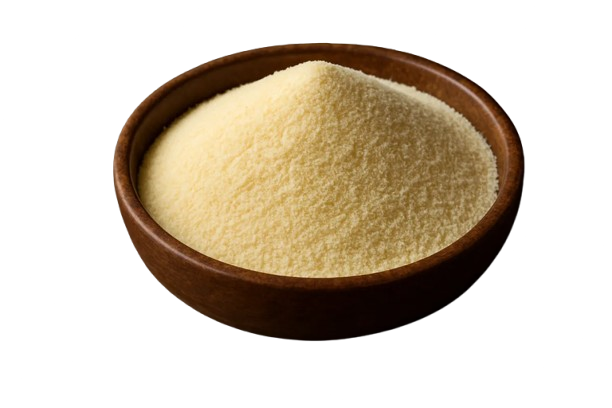
Semolina is a coarse flour derived from durum wheat and used extensively in pasta and couscous production. Calories in semolina vary based on portion size and preparation, with a small serving of raw semolina (42g) containing 151 calories and a large serving (167g) offering 601 calories. A cup of semolina porridge (250g) yields 130 calories due to water absorption. A 100g serving of raw semolina has 360 calories, while a 100g portion of cooked semolina only has 52 calories. Bob's Red Mill Semolina Flour (uncooked) contains 160 calories per 45g serving.
An evaluation of semolina nutrition facts highlights a dense source of complex carbohydrates and plant-based protein. A large serving of raw semolina supplies 121.6g of carbohydrates and 21.2g of protein, with a minimal fat content of 1.8g. A standard 100g portion of raw semolina matches the caloric density of all-purpose wheat flour at approximately 360 calories. The flour is notable for its micronutrient profile, delivering 1.4mg of Thiamin (117% DV) and 7.2mg of iron (40% DV) per large serving to support metabolic function and oxygen transport. The enriched flour is particularly notable for its folate content, providing 236mcg of folic acid to aid in cellular division and DNA synthesis. Semolina benefits extend to antioxidant support, as the grain offers significant levels of selenium and carotenoids like lutein which promote cardiovascular and vision health.
International supply of semolina relies on specialized durum wheat cultivation, with Canada leading global production by harvesting millions of tonnes annually. This output meets substantial demand in the Mediterranean basin, where Italy consumes approximately 23.2kg of pasta per capita each year. Semolina serves as the structural foundation for staples in this region, ranging from Italian fettuccine to Moroccan couscous. The suitability for these dishes stems from the fact that semolina contains a higher concentration of gluten proteins (12% to 15%) compared to regular all-purpose wheat flour (8% to 11%), providing the necessary elasticity for pasta shapes. Rising farming costs and climate instability have driven retail prices upward, with a pound of semolina in the United States increasing from roughly $1.20 in 2004 to over $2.50 in 2024. Menu prices reflect this trend, as a dish of Cacio e Pepe at Maialino moved from $17.00 to between $25.00 and $28.00 in 2024.
Semolina is considered a dietary staple with a high concentration of B-vitamins and lutein. This nutrient profile supports energy metabolism and eye health. Nutritionists advise consuming the dense food in moderation due to the high carbohydrate content. A large serving of semolina (raw) contains 601 calories, an energy amount that necessitates 61 minutes of running or 77 minutes of swimming to burn. People with Celiac disease should avoid the product entirely to minimize potential autoimmune risks.
Semolina nutrition
| Stats | Weight |
|---|---|
| Carbs | 72 grams |
| Protein | 13.3 grams |
| Fats | 1.84 grams |
| Sugars | 0 grams |
- Large Semolina Calories (Nutritional Facts)
- Medium Semolina Calories (Nutritional Facts)
- Small Semolina Calories (Nutritional Facts)
- Porridge Semolina Calories (Nutritional Facts)
- Raw Semolina Nutrition
- Folic Acid in Semolina
- Sodium in Semolina
- Potassium in Semolina
- Sugar in Semolina
- Fiber in Semolina
- Protein in Semolina
- Carbs in Semolina
- Fat in Semolina
- Vitamins in Semolina
- Minerals in Semolina
Large Semolina Calories (Nutritional Facts)
A large serving of raw semolina (167g or 1 cup) contains 601 calories, 21.2g of protein, 1.8g of fat, 121.6g of carbohydrates, 6.5g of fiber, and 2mg of sodium.
A medium serving of raw semolina (84g or 0.5 cup) provides 302 calories, 10.7g of protein, 0.9g of fat, 61.2g of carbohydrates, 3.3g of fiber, and 1mg of sodium.
A small serving of raw semolina (42g or 0.25 cup) contains 151 calories, 5.3g of protein, 0.4g of fat, 30.6g of carbohydrates, 1.6g of fiber, and 0.5mg of sodium.
A serving of cooked semolina porridge (250g or 1 cup) contains 130 calories, 3.8g of protein, 0.4g of fat, 27.4g of carbohydrates, 1.5g of fiber, 0g of sugar, and 0mg of sodium. The cooking process significantly reduces calorie density due to the absorption of water.
A serving of raw semolina (100g or 3.5oz) contains 360 calories, 12.7g of protein, 1.1g of fat, 72.8g of carbohydrates, 3.9g of fiber, 0g of sugar, and 1mg of sodium.
A large serving of raw enriched semolina (167g) provides 236mcg of folic acid. A medium serving of raw enriched semolina (84g) has 119mcg of folic acid. A small serving of raw enriched semolina (42g) contains 59mcg of folic acid. A serving of cooked semolina porridge (250g) contains 58mcg of folic acid.
A large serving of raw semolina (167g) contains 2mg of sodium (0% DV). A medium serving of raw semolina (84g) has 1mg of sodium (0% DV). A small serving of raw semolina (42g) contains 0.5mg of sodium (0% DV). A serving of cooked semolina porridge (250g) contains 0mg of sodium (0% DV).
A large serving of raw semolina (167g) contains 310mg of potassium (6% DV). A medium serving of raw semolina (84g) has 156mg of potassium (3% DV). A small serving of raw semolina (42g) contains 78mg of potassium (1% DV). A serving of cooked semolina porridge (250g) contains 68mg of potassium (1% DV).
A large serving of raw semolina (167g) contains 0g of sugar. A medium serving of raw semolina (84g) has 0g of sugar. A small serving of raw semolina (42g) contains 0g of sugar. A serving of cooked semolina porridge (250g) contains 0g of sugar.
A large serving of raw semolina (167g) provides 6.5g of dietary fiber (23% DV). A medium serving of raw semolina (84g) has 3.3g of fiber (11% DV). A small serving of raw semolina (42g) contains 1.6g of fiber (5% DV). A serving of cooked semolina porridge (250g) contains 1.5g of fiber (5% DV).
A large serving of raw semolina (167g) provides 21.2g of protein (42% DV). A medium serving of raw semolina (84g) has 10.7g of protein (21% DV). A small serving of raw semolina (42g) contains 5.3g of protein (10% DV). A serving of cooked semolina porridge (250g) contains 3.8g of protein (7% DV).
A large serving of raw semolina (167g) contains 121.6g of carbohydrates (44% DV). A medium serving of raw semolina (84g) has 61.2g of carbohydrates (22% DV). A small serving of raw semolina (42g) contains 30.6g of carbohydrates (11% DV). A serving of cooked semolina porridge (250g) contains 27.4g of carbohydrates (10% DV).
A large serving of raw semolina (167g) contains 1.8g of total fat (2% DV). A medium serving of raw semolina (84g) has 0.9g of total fat (1% DV). A small serving of raw semolina (42g) contains 0.4g of total fat (0% DV). A serving of cooked semolina porridge (250g) contains 0.4g of total fat (0% DV).
A large serving of raw enriched semolina (167g) provides 1.4mg of Thiamin (117% DV) and 9.8mg of Niacin (61% DV). A medium serving of raw enriched semolina (84g) has 0.7mg of Thiamin (58% DV) and 4.9mg of Niacin (30% DV). A small serving of raw enriched semolina (42g) contains 0.35mg of Thiamin (29% DV) and 2.4mg of Niacin (15% DV). A serving of cooked semolina porridge (250g) contains 0.3mg of Thiamin (25% DV) and 2.1mg of Niacin (13% DV).
A large serving of raw enriched semolina (167g) provides 7.2mg of iron (40% DV) and 78mg of magnesium (19% DV). A medium serving of raw enriched semolina (84g) has 3.6mg of iron (20% DV) and 39mg of magnesium (9% DV). A small serving of raw enriched semolina (42g) contains 1.8mg of iron (10% DV) and 19mg of magnesium (4% DV). A serving of cooked semolina porridge (250g) contains 1.9mg of iron (11% DV) and 17mg of magnesium (4% DV).
Get a Custom Report on Semolina Nutrition Data – Contact Us!
What Are the Types of Semolina?
The types of semolina are Coarse, Fine (Semola), and Whole Wheat, categorized by the particle size and the inclusion of the bran. The table below details the calorie differences and qualifications for each type.
| Type | Description | Calories (per 100g) | Calorie Qualifications |
|---|---|---|---|
|
Coarse Semolina
|
Large, gritty particles used primarily for dusting, hot cereals, and couscous. | 360 | The standard calorie count reflects the pure endosperm content. |
|
Fine Semolina (Semola)
|
Finely ground texture used for pasta dough, puddings, and batters. | 360 | The milling process reduces particle size but maintains the same energy density as coarse varieties. |
|
Whole Wheat Semolina
|
Includes the bran and germ of the durum wheat kernel. | 339 | The presence of fiber reduces the overall calorie density per gram compared to refined versions. |
|
Semola Rimacinata
|
Double-milled, superfine flour used for specific breads and pizza doughs. | 355 | The extra grinding process results in a texture similar to all-purpose flour with high protein. |
What are Desserts With Semolina?
Semolina appears in avant-garde and high-end desserts, utilizing the flour's granular texture to create dense cakes, puddings, and crisp pastries. Sweet preparations utilizing this ingredient include the ones listed below.
| Dish Name | Calories (Estimate per serving) | Type of Dessert | Carbs (g) (Estimate) | Sugar (g) (Estimate) | Protein (g) (Estimate) | Fat (g) (Estimate) | Cuisine | Restaurants |
|---|---|---|---|---|---|---|---|---|
|
Galaktoboureko
|
550 | Custard Pie | 65 | 40 | 9 | 28 | Greek | Titan Foods (Astoria, NY) |
|
Basbousa
|
420 | Syrup Cake | 58 | 35 | 6 | 18 | Egyptian | Cafe Mogador (New York, NY) |
|
Semolina Halva
|
380 | Confection | 45 | 30 | 5 | 20 | Greek/Turkish | Molyvos (New York, NY) |
|
Sfogliatella
|
330 | Pastry | 35 | 18 | 6 | 18 | Italian | Veniero's (New York, NY) |
|
Rava Kesari
|
350 | Pudding | 55 | 32 | 4 | 12 | South Indian | Saravanaa Bhavan |
|
Revani
|
400 | Sponge Cake | 60 | 40 | 7 | 15 | Turkish | Sip Sak (New York, NY) |
|
Ma'amoul
|
220 | Filled Cookie | 30 | 14 | 3 | 10 | Lebanese | Manousheh (New York, NY) |
|
Layali Lubnan
|
450 | Pudding | 50 | 35 | 8 | 22 | Lebanese | Ilili (New York, NY) |
|
Melomakarona
|
180 | Cookie | 22 | 12 | 2 | 9 | Greek | Pi Bakerie (New York, NY) |
|
Bougatsa
|
480 | Pastry | 52 | 25 | 10 | 26 | Greek | Artopolis (Astoria, NY) |
|
Namoura
|
390 | Cake | 56 | 38 | 5 | 16 | Lebanese | Naya (New York, NY) |
|
Koloocheh
|
340 | Cookie | 48 | 20 | 6 | 14 | Persian | Ravagh Persian Grill (New York, NY) |
|
Shamali
|
360 | Cake | 50 | 32 | 6 | 14 | Armenian | Almayass (New York, NY) |
What Are the Main Dishes With Semolina?
Semolina serves as a centerpiece carbohydrate or a structural component in pasta and dumpling dishes across European and African cuisines. The grain's high protein content provides a firm bite to savory entrees. Savory dishes incorporating the ingredient are listed here.
| Dish Name | Calories (Estimate per serving) | Type of Dish | Carbs (g) (Estimate) | Sugar (g) (Estimate) | Protein (g) (Estimate) | Fat (g) (Estimate) | Cuisine | Restaurants |
|---|---|---|---|---|---|---|---|---|
|
Fresh Fettuccine
|
420 | Pasta | 65 | 2 | 14 | 10 | Italian | Lilia (Brooklyn, NY) |
|
Couscous Royale
|
650 | Stew/Grain | 75 | 6 | 35 | 22 | Moroccan | Cafe Mogador (New York, NY) |
|
Gnocchi alla Romana
|
480 | Baked Dumpling | 42 | 4 | 16 | 28 | Italian | Maialino (New York, NY) |
|
Upma
|
320 | Savory Porridge | 45 | 3 | 8 | 12 | South Indian | Adyar Ananda Bhavan (Global) |
|
Rava Dosa
|
280 | Crepe | 40 | 1 | 6 | 10 | South Indian | NY Dosas (New York, NY) |
|
Malloreddus
|
450 | Pasta | 70 | 3 | 15 | 12 | Sardinian | La Ciccia (San Francisco, CA) |
|
Cavatelli with Broccoli
|
510 | Pasta | 75 | 4 | 18 | 16 | Italian | Frank (New York, NY) |
|
Orecchiette w/ Sausage
|
580 | Pasta | 68 | 3 | 25 | 24 | Italian | Cotogna (San Francisco, CA) |
|
Semolina Bread (Pane)
|
180 | Bread Side | 35 | 1 | 7 | 2 | Italian | Sullivan Street Bakery (New York, NY) |
|
Fregola Sarda w/ Clams
|
460 | Pasta/Soup | 60 | 2 | 22 | 14 | Sardinian | Epistrophy (New York, NY) |
|
Rava Idli
|
150 | Steamed Cake | 28 | 1 | 5 | 2 | South Indian | MTR (Global) |
|
Migas de Harina
|
550 | Fried Flour | 65 | 2 | 12 | 28 | Spanish | Despaña (New York, NY) |
What Cuisines Prefer Semolina the Most?
Semolina functions as a foundational staple in Italian, North African, and South Indian food cultures. The following chart identifies food cultures where this ingredient is essential.
| Cuisine | Dish | Types of Semolina Used | Calories (Estimate) | Restaurant |
|---|---|---|---|---|
|
Italian (Southern)
|
Fresh Pasta (Orecchiette) | Fine Semolina (Semola) | 450 | Eataly (National Locations) |
|
Moroccan
|
Couscous Royale | Coarse Semolina | 650 | Cafe Mogador (New York, NY) |
|
Greek
|
Galaktoboureko | Fine Semolina | 550 | Titan Foods (Astoria, NY) |
|
South Indian
|
Rava Dosa | Coarse Semolina (Sooji) | 280 | Saravanaa Bhavan |
|
Turkish
|
Revani | Coarse Semolina | 400 | Sip Sak (New York, NY) |
|
Tunisian
|
Couscous au Poisson | Coarse Semolina | 580 | Epices & Foie Gras (Specialty) |
|
Algerian
|
Kesra (Semolina Bread) | Medium Semolina | 250 | Nomads (New York, NY) |
|
Lebanese
|
Ma'amoul | Fine/Coarse Blend | 220 | Al Aseel (Houston, TX) |
|
Sardinian
|
Malloreddus | Fine Semolina | 450 | La Ciccia (San Francisco, CA) |
|
Egyptian
|
Basbousa | Coarse Semolina | 420 | Casa La Femme (New York, NY) |
Which Countries Produce the Most Semolina?
The top producers of semolina correspond directly to the major cultivators of Durum wheat, as the flour is the immediate result of milling this specific grain. Canada leads the global market in export volume, while Italy dominates in the processing of the grain into high-quality semolina for pasta. The table below shows the production of Durum wheat, the raw material for semolina, in key countries over the last two decades.
| Country | 2003 | 2008 | 2013 | 2018 | 2019 | 2020 | 2021 | 2022 |
|---|---|---|---|---|---|---|---|---|
| Canada | 4,200 | 5,500 | 6,500 | 5,700 | 4,900 | 6,500 | 3,000 | 5,400 |
| Italy | 3,600 | 4,100 | 4,000 | 4,200 | 4,100 | 3,900 | 3,900 | 3,800 |
| Turkey | 2,500 | 2,200 | 2,800 | 3,000 | 2,900 | 3,200 | 3,100 | 3,300 |
| Algeria | 1,800 | 1,700 | 2,000 | 2,100 | 2,200 | 2,300 | 2,100 | 2,000 |
| United States | 1,600 | 2,200 | 1,500 | 2,100 | 1,500 | 1,900 | 1,000 | 1,700 |
Which Countries Consume the Most Semolina?
The top consumers of semolina are nations with strong pasta and couscous traditions, specifically Italy and the Maghreb region. Consumption is highest in the Mediterranean basin where the ingredient serves as a daily caloric staple. The table below shows the per capita consumption of pasta (the primary semolina product) in key countries.
| Country | 2003 | 2008 | 2013 | 2018 | 2019 | 2020 | 2021 | 2022 |
|---|---|---|---|---|---|---|---|---|
| Italy | 28.0 | 26.0 | 25.3 | 23.0 | 23.1 | 23.5 | 23.5 | 23.2 |
| Tunisia | 15.0 | 16.0 | 16.5 | 17.0 | 17.0 | 17.0 | 17.0 | 17.0 |
| Venezuela | 13.0 | 12.5 | 12.0 | 12.0 | 12.0 | 12.2 | 12.5 | 13.6 |
| Greece | 10.0 | 10.5 | 11.0 | 11.1 | 11.2 | 11.5 | 12.0 | 12.2 |
| United States | 9.0 | 9.0 | 8.8 | 8.8 | 8.8 | 9.0 | 8.8 | 8.8 |
How Do Prices of Semolina-Including Dishes Change?
Menu pricing for dishes containing semolina has increased significantly over the past decade, reflecting higher procurement costs and the volatility of the durum wheat market. The table below displays the price changes for specific menu items.
| Brand/Restaurant | Dish | Old Price (Year) | Current Price (2024/2025) |
|---|---|---|---|
| Lilia (Brooklyn, NY) | Mafaldini / Fettuccine | $22.00 (2016) | $28.00 - $29.00 |
| Cafe Mogador (New York, NY) | Chicken Tagine w/ Couscous | $19.00 (2012) | $24.00 - $28.00 |
| Saravanaa Bhavan | Rava Dosa | $10.00 (2014) | $16.50 - $18.49 |
| Eataly (Retail USA) | Fresh Semolina Pasta (lb) | $6.90 (2015) | $9.90 - $14.29 |
| Maialino (New York, NY) | Cacio e Pepe | $17.00 (2011) | $25.00 - $28.00 |
What is the Semolina Calorie for 100 Grams?
A 100g serving of raw semolina contains 360 calories, while a 100g serving of cooked semolina porridge provides 52 calories.
What is the Semolina Calorie for 1 KG?
One kilogram (1000g) of raw semolina contains 3,600 calories, whereas one kilogram (1000g) of cooked semolina porridge provides 520 calories.
What is the Calorie of 1 Semolina?
A single cup of raw semolina (167g) contains 601 calories. Commercial brands vary in density and serving size, as Bob's Red Mill Semolina Flour (45g) contains 160 calories, while a serving of De Cecco Semolina (40g) provides 140 calories.
What Are the Health Benefits of Semolina?
The nutritional profile of semolina supports cardiovascular function, metabolic energy, and vision health through a dense concentration of minerals and carotenoids.
- Supports Cardiovascular Health: The flour serves as a significant source of selenium, a trace mineral acting as an antioxidant to reduce oxidative stress and inflammation in the cardiovascular system. A study by Rayman, M. P. (2012), "Selenium and human health," established that adequate selenium intake correlates with a reduced risk of cardiovascular disease and supports proper heart function.
- Enhances Metabolic Energy: The grain provides a dense concentration of B-complex vitamins, specifically thiamin and folate, which facilitate the conversion of carbohydrates into glucose for energy. A review by Kennedy, D. O. (2016), "B Vitamins and the Brain: Mechanisms, Dose and Efficacy," confirms that thiamin plays a critical role in cellular metabolism and energy production within the mitochondria.
- Boosts Vision Health: The endosperm of durum wheat contains high levels of lutein and zeaxanthin, carotenoids responsible for the yellow color of the flour and the protection of the eye against light-induced damage. A study by Ndolo, V. U., & Beta, T. (2013), "Distribution of carotenoids in endosperm, germ, and aleurone fractions of cereal grain kernels," highlights that durum wheat products retain significant carotenoid levels beneficial for preventing macular degeneration.
What Are the Downsides of Semolina?
The high gluten content and caloric density of the food present specific health risks for individuals with autoimmune conditions or those managing weight. Specific dietary concerns are outlined here.
- Triggers Celiac Disease and Gluten Sensitivity: The wheat product contains high amounts of gluten, a protein composite that causes intestinal damage in individuals with Celiac disease. A study by Catassi, C., et al. (1996), "The coeliac iceberg in Italy," found that the ingestion of gluten from durum wheat sources triggers an autoimmune response leading to villous atrophy in susceptible populations. A safer alternative for those avoiding gluten is Brown Rice Flour. A suggested daily amount for individuals without gluten sensitivity is to limit consumption to one cooked cup (160g) to manage caloric intake.
- Impacts Glycemic Control: The refined nature of non-whole grain semolina results in a rapid spike in blood glucose levels compared to fiber-rich whole grains. A study by Jenkins, D. J., et al. (2002), "Glycemic index: overview of implications in health and disease," indicates that high-glycemic foods can contribute to insulin resistance when consumed in excess.
Is Semolina Good for You?
Yes, semolina is good for health because the grain offers a rich source of plant-based protein, iron, and lutein that support muscle maintenance, oxygen transport, and eye health. The high protein content aids in satiety and muscle repair, a benefit supported by Paddon-Jones, D., et al. (2008), "Protein, weight management, and satiety." The presence of non-heme iron supports hemoglobin formation, which is essential for preventing anemia, as noted in the research by Abbaspour, N., et al. (2014), "Review on iron and its importance for human health." The food also contributes to long-term eye health due to the accumulation of lutein in the macula, a physiological effect highlighted by Abdel-Aal, E. S., et al. (2013), "Dietary sources of lutein and zeaxanthin carotenoids and their role in eye health."
Does Semolina Contain More Gluten Than Regular Wheat Flour?
Yes, semolina contains a higher concentration of gluten proteins compared to regular all-purpose wheat flour. The product derives from durum wheat, the hardest species of wheat, which possesses a protein content ranging from 12% to 15%, whereas standard soft wheat flour typically contains 8% to 11% protein. This specific gluten structure in semolina exhibits high strength but low elasticity, a characteristic that allows pasta to hold a firm shape during boiling but prevents the flour from producing the light, airy texture required for bread.
How Do Calories Change According to Semolina Types?
The calorie count remains relatively consistent across refined semolina types but decreases slightly in whole grain variations. A serving of Coarse Semolina contains 360 calories per 100 grams, a value identical to Fine Semolina, as the difference lies in particle size rather than composition. Whole Wheat Semolina presents the lowest energy profile at 339 calories per 100 grams, a reduction caused by the insoluble fiber content of the bran which provides bulk without digestible calories. Enriched Semolina generally maintains the standard 360-calorie density but includes added vitamins and minerals.
What Is the Origin of Semolina?
The origin of semolina traces back to the domestication of Durum wheat in the Levant and the Eastern Mediterranean region around 7000 BC. The term derives from the Latin word "simila," meaning flour, which itself originated from the Greek "semidalis," referring to the finest flour. Ancient Romans utilized the hard wheat to create durable staples that could withstand long storage, while North African Berber tribes developed the technique of rolling the granules into couscous as early as the 7th century. The ingredient became central to Italian gastronomy during the Middle Ages when pasta production became standardized in Sicily.
Explore More Grains
Discover more Grains with detailed nutrition facts, calorie counts, vitamins, minerals, and health benefits. Compare similar foods, serving sizes, macronutrients, and key nutrients to find the best option for your diet and nutrition goals.
 Amaranth calories
 Arborio Rice calories
 Arrowroot Powder calories
 Barley calories
 Basmati Rice calories
 Black Rice calories
 Brown Rice calories
 Buckwheat calories
 Bulgur Wheat calories
 Coconut Flour calories
 Cornmeal calories
 Cornstarch calories