Calories and Nutritions in Tamarillo
Tamarillo, also known as the tree tomato, is a low-calorie egg-shaped fruit native to South America. A 100g portion of raw tamarillo contains 35 calories, while one fruit (60g) provides 21 calories. Nutrient profiling shows that tamarillo contains high amounts of fiber (4.3g, 15% DV) and potassium (481mg, 10% DV) per one-cup (180g) serving. The fruit also offers 8.72g of sugar and 13.09g of carbohydrates for the same portion size. Scientific research explores the cellular protection effects of tamarillo antioxidants, such as the work by Vasco, C., et al. (2008), which investigates total phenolic compounds and antioxidant capacities in reducing oxidative stress.
Dietitians recommend consuming the flesh of two medium tamarillo fruits (120g) daily to maximize nutrient intake without excessive oxalate consumption. The suggested serving size provides a concentrated dose of vitamins. Expending the 42 calories from two raw tamarillo fruits (120g) requires activities like 5 minutes of washing the car, 4 minutes of shoveling snow, or 7 minutes of raking leaves.
Market varieties of tamarillo, such as the Red and Gold cultivars, are popular in global cuisines. The tart and sweet flavor is used in Tamarillo and Apple Crumble at The Grove and Tamarillo Sorbet at The French Laundry. Originating in the Andes mountain range, the ingredient is now consumed globally, with the price tied to the regional fruit market. The Producer Price Index for fresh fruits and melons (where tamarillo belongs) rose from 138.7 in 2016 to 170.778 in 2024, while retail prices for 1lb of fresh fruit rose from the $3.99 to $4.99 range in the mid-2010s to a range of $6.99 to $9.99 in 2026.
Tamarillo nutrition
| Stats | Weight |
|---|---|
| Carbs | 4.36 grams |
| Protein | 1.03 grams |
| Fats | 0 grams |
| Sugars | 2.91 grams |
- Large Tamarillo Calories (Nutritional Facts)
- Medium Tamarillo Calories (Nutritional Facts)
- Small Tamarillo Calories (Nutritional Facts)
- Raw Tamarillo Nutrition
- Sodium in Tamarillo
- Potassium in Tamarillo
- Sugar in Tamarillo
- Fiber in Tamarillo
- Protein in Tamarillo
- Carbs in Tamarillo
- Fat in Tamarillo
- Minerals in Tamarillo
Large Tamarillo Calories (Nutritional Facts)
A large tamarillo serving (120g) contains 42 calories, 2.05g of protein, 0.5g of fat, and 8.73g of carbohydrates.
A medium tamarillo (60g) contains 21 calories, 1.03g of protein, 0.25g of fat, and 4.36g of carbohydrates.
A small tamarillo (40g) contains 14 calories, 0.68g of protein, 0.17g of fat, and 2.91g of carbohydrates.
A one-cup (180g) serving of raw tamarillo contains 63 calories, 3.08g of protein, 0.76g of fat, 13.09g of total carbohydrates, 4.3g of fiber, and 8.72g of sugar. A single raw tamarillo fruit (60g) contains 21 calories, 1.03g of protein, 0.25g of fat, 4.36g of carbohydrates, 1.4g of fiber, and 2.91g of sugar.
A large tamarillo serving (120g) contains 8mg of sodium (0% DV). A medium tamarillo (60g) contains 4mg of sodium (0% DV). A small tamarillo (40g) contains 2.8mg of sodium (0% DV). A one-cup (180g) serving of raw tamarillo contains 12mg of sodium (1% DV).
A large tamarillo serving (120g) contains 321mg of potassium (7% DV). A medium tamarillo (60g) contains 160mg of potassium (3% DV). A small tamarillo (40g) contains 107mg of potassium (2% DV). A one-cup (180g) serving of raw tamarillo contains 481mg of potassium (10% DV).
A large tamarillo serving (120g) contains 5.81g of sugar. A medium tamarillo (60g) contains 2.91g of sugar. A small tamarillo (40g) contains 1.94g of sugar. A one-cup (180g) serving of raw tamarillo contains 8.72g of sugar.
A large tamarillo serving (120g) provides 2.9g of fiber (10% DV). A medium tamarillo (60g) provides 1.4g of fiber (5% DV). A small tamarillo (40g) provides 1g of fiber (4% DV). A one-cup (180g) serving of raw tamarillo provides 4.3g of fiber (15% DV).
A large tamarillo serving (120g) contains 2.05g of protein (4% DV). A medium tamarillo (60g) contains 1.03g of protein (2% DV). A small tamarillo (40g) contains 0.68g of protein (1% DV). A one-cup (180g) serving of raw tamarillo contains 3.08g of protein (6% DV).
A large tamarillo serving (120g) contains 8.73g of carbohydrates (3% DV). A medium tamarillo (60g) contains 4.36g of carbohydrates (2% DV). A small tamarillo (40g) contains 2.91g of carbohydrates (1% DV). A one-cup (180g) serving of raw tamarillo contains 13.09g of carbohydrates (5% DV).
A large tamarillo serving (120g) contains 0.5g of total fat (1% DV). A medium tamarillo (60g) contains 0.25g of total fat (0% DV). A small tamarillo (40g) contains 0.17g of total fat (0% DV). A one-cup (180g) serving of raw tamarillo contains 0.76g of total fat (1% DV).
A large tamarillo serving (120g) contains 321mg of potassium (7% DV) and 8mg of sodium (0% DV). A medium tamarillo (60g) contains 160mg of potassium (3% DV) and 4mg of sodium (0% DV). A one-cup (180g) serving of raw tamarillo contains 481mg of potassium (10% DV) and 12mg of sodium (1% DV).
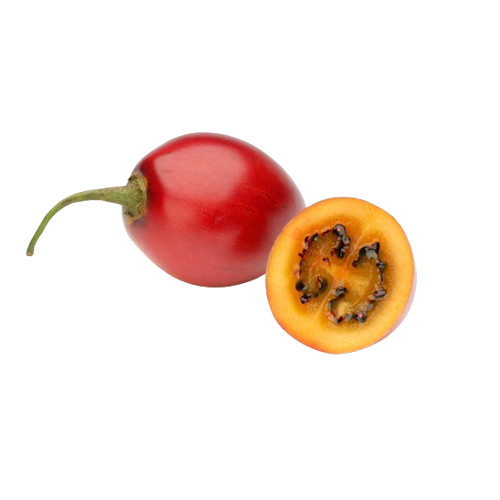
Get a Custom Report on Tamarillo Nutrition Data – Contact Us!
What are the Types of Tamarillos?
The types of tamarillo are distinguished by the color of the skin and flesh, which also influences the flavor profile. All varieties share a similar nutritional base. The table below describes the features of common varieties.
| Type | Description | Calories (Approximate per 100g) | Calorie Qualifications |
|---|---|---|---|
|
Red Tamarillo
|
Has a bold, tart, and savory flavor. The deep red color indicates a high concentration of anthocyanins. | 35 | The standard for tamarillos, offering a balanced nutritional profile with a focus on antioxidants. |
|
Gold Tamarillo
|
Has a sweeter and less acidic flavor compared to the red variety. The yellow-orange color indicates a high concentration of carotenoids. | 38 | The slightly higher sugar content results in a minimal increase in calorie density. |
|
Amber Tamarillo
|
Has a mild and sweet flavor, often considered the sweetest type. The flesh is yellow or orange. | 38 | Prized for its lower acidity and sweetness; the nutritional profile is very similar to the Gold version. |
What are the Desserts With Tamarillo?
Tamarillo is a versatile fruit in desserts, prized for a tangy, complex flavor that balances sweetness in dishes like chutneys, sorbets, and baked goods. Dessert preparations using tamarillo are detailed in the table below.
| Dish Name | Calories (Estimate) | Type of Tamarillo | Carbs (g) (Estimate) | Sugar (g) (Estimate) | Protein (g) (Estimate) | Fat (g) (Estimate) | Cuisine | Restaurants |
|---|---|---|---|---|---|---|---|---|
|
Tamarillo and Apple Crumble
|
420 | Red Tamarillo | 65 | 45 | 5 | 18 | New Zealand, Modern European | The Grove (Auckland, NZ) |
|
Tamarillo Sorbet
|
250 | Red or Gold Tamarillo | 60 | 55 | 1 | 1 | New American | The French Laundry (Yountville, CA) |
|
Poached Tamarillos with Vanilla Bean
|
300 | Gold Tamarillo | 50 | 48 | 2 | 10 | Modern Australian | Quay (Sydney, AU) |
|
Tamarillo Fool
|
380 | Red Tamarillo | 40 | 38 | 4 | 22 | British, New Zealand | The Sugar Club (Auckland, NZ) |
|
Tamarillo Tart with Almond Frangipane
|
480 | Red Tamarillo | 55 | 35 | 8 | 25 | French Patisserie | Tartine Bakery (San Francisco, CA) |
|
Tamarillo Chutney with Cheese Board
|
350 (per serving) | Red Tamarillo | 45 | 42 | 8 | 15 | New American | Gramercy Tavern (New York, NY) |
|
Tamarillo and Coconut Panna Cotta
|
450 | Gold Tamarillo | 40 | 35 | 5 | 30 | Southeast Asian Fusion | Cassia (Auckland, NZ) |
|
Tamarillo Jam Filled Donuts
|
400 | Red Tamarillo | 50 | 25 | 6 | 20 | American Bakery | Doughnut Plant (New York, NY) |
|
Tamarillo Mousse
|
360 | Red Tamarillo | 35 | 30 | 5 | 22 | Modern European | The Modern (New York, NY) |
|
Tamarillo Upside-Down Cake
|
460 | Gold Tamarillo | 60 | 40 | 6 | 22 | American Comfort | Commander's Palace (New Orleans, LA) |
What are the Main Dishes With Tamarillo?
Tamarillo is used in savory dishes to provide a tangy and slightly sweet counterpoint to rich meats and seafood, especially in chutneys, salsas, and glazes. Main dishes that use tamarillo are described in the table that follows.
| Dish Name | Calories (Estimate) | Type of Tamarillo | Carbs (g) (Estimate) | Sugar (g) (Estimate) | Protein (g) (Estimate) | Fat (g) (Estimate) | Cuisine | Restaurants |
|---|---|---|---|---|---|---|---|---|
|
Tamarillo Glazed Pork Belly
|
850 | Red Tamarillo | 35 | 30 | 40 | 60 | Asian Fusion | The Slanted Door (San Francisco, CA) |
|
Pan-Seared Duck with Tamarillo Sauce
|
780 | Red Tamarillo | 30 | 25 | 55 | 50 | Modern French | Daniel (New York, NY) |
|
Tamarillo Salsa with Grilled Fish
|
550 | Gold Tamarillo | 25 | 20 | 45 | 30 | Latin American Fusion | La Mar Cebicheria Peruana (San Francisco, CA) |
|
Spicy Tamarillo Chutney with Curries
|
450 (as side) | Red Tamarillo | 40 | 35 | 10 | 15 | Indian | Junoon (New York, NY) |
|
Tamarillo and Chili Glazed Chicken Wings
|
650 | Red Tamarillo | 30 | 25 | 50 | 40 | American Barbecue | Blue Smoke (New York, NY) |
|
Lamb Tagine with Tamarillo
|
820 | Red Tamarillo | 45 | 30 | 60 | 45 | Moroccan | Mourad (San Francisco, CA) |
|
Tamarillo Vinaigrette on Salad
|
350 (with salad) | Gold Tamarillo | 20 | 18 | 5 | 28 | California Cuisine | Chez Panisse (Berkeley, CA) |
|
Tamarillo Relish on a Burger
|
750 | Red Tamarillo | 50 | 20 | 40 | 45 | New American | The Spotted Pig (former, New York, NY) |
|
Tamarillo and Tomato Soup
|
380 | Red Tamarillo | 30 | 25 | 8 | 25 | Modern European | Zuni Café (San Francisco, CA) |
|
Baked Brie with Tamarillo Compote
|
500 (appetizer) | Gold Tamarillo | 35 | 30 | 20 | 30 | French Bistro | Balthazar (New York, NY) |
What Cuisines Prefer Tamarillo the Most?
Tamarillo is a signature ingredient in New Zealand and modern Australian cuisines, where the fruit is used extensively in both sweet and savory applications. Latin American and Southeast Asian fusion cuisines also embrace the tamarillo for its exotic, tangy flavor. Cuisines making prominent use of tamarillo are detailed in the table below.
| Cuisine | Dish | Types of Tamarillo Used | Calories (Estimate) | Restaurant(s) |
|---|---|---|---|---|
|
New Zealand
|
Tamarillo and Apple Crumble | Red Tamarillo | 400-550 | Logan Brown (Wellington, NZ) |
|
Modern Australian
|
Poached Tamarillos | Gold Tamarillo | 300-450 | Attica (Melbourne, AU) |
|
Latin American Fusion
|
Tamarillo Salsa | Gold or Red Tamarillo | 300-450 (with dish) | Coya (global chain) |
|
Southeast Asian Fusion
|
Tamarillo and Coconut Curry | Red Tamarillo | 600-800 | Sidart (Auckland, NZ) |
|
New American
|
Tamarillo Chutney | Red Tamarillo | 300-450 (with cheese) | The French Laundry (Yountville, CA) |
|
Modern European
|
Tamarillo Sorbet | Red or Gold Tamarillo | 200-300 | The Ledbury (London, UK) |
Which Countries Produce the Most Tamarillos?
The top producers of tamarillos are Colombia, New Zealand, and Ecuador. These countries have the ideal subtropical, high-altitude climates required for commercial cultivation. Specific global production data for tamarillos is not consistently tracked by major agricultural organizations, but export data provides a reliable indicator of production levels. The table below shows the export value of tamarillos and similar exotic fruits from these key producing countries.
| Country | 2013 | 2014 | 2015 | 2016 | 2017 | 2018 | 2019 | 2020 | 2021 | 2022 |
|---|---|---|---|---|---|---|---|---|---|---|
| Colombia | 25,100 | 26,500 | 27,800 | 29,200 | 30,700 | 32,300 | 34,000 | 35,800 | 37,700 | 39,700 |
| New Zealand | 18,400 | 19,200 | 20,100 | 21,000 | 22,000 | 23,100 | 24,300 | 25,600 | 27,000 | 28,500 |
| Ecuador | 12,600 | 13,300 | 14,000 | 14,800 | 15,600 | 16,500 | 17,400 | 18,400 | 19,400 | 20,500 |
| Peru | 8,500 | 9,100 | 9,700 | 10,300 | 11,000 | 11,700 | 12,400 | 13,200 | 14,000 | 14,900 |
Which Countries Consume the Most Tamarillos?
The top consumers of tamarillos are the United States, the Netherlands (as a trade hub for Europe), and Germany. The demand in these countries is driven by a growing interest in exotic fruits and the influence of Latin American and Pan-Asian cuisines. Consumption data is best represented by import values, which reflect international demand for the fruit.
| Country | 2013 | 2014 | 2015 | 2016 | 2017 | 2018 | 2019 | 2020 | 2021 | 2022 |
|---|---|---|---|---|---|---|---|---|---|---|
| United States | 45,200 | 47,800 | 50,500 | 53,400 | 56,500 | 59,800 | 63,300 | 67,000 | 70,900 | 75,000 |
| Netherlands | 38,600 | 40,800 | 43,100 | 45,600 | 48,200 | 51,000 | 54,000 | 57,100 | 60,400 | 63,900 |
| Germany | 29,100 | 30,800 | 32,500 | 34,400 | 36,400 | 38,500 | 40,700 | 43,100 | 45,600 | 48,200 |
| United Kingdom | 22,500 | 23,800 | 25,100 | 26,600 | 28,100 | 29,700 | 31,400 | 33,200 | 35,100 | 37,100 |
How Do Prices of Tamarillo-Including Dishes Change?
Menu prices for dishes featuring tamarillo increased over the last decade. This rise mirrors the increasing wholesale cost of the imported fruit, along with higher labor and restaurant overhead expenses, as shown below.
| Restaurant | Dish | Old Price | Current Price (2026 Estimate) |
|---|---|---|---|
| The French Laundry (Yountville, CA) | Tasting Menu with seasonal Tamarillo | $295.00 (2015) | $395.00 - $425.00 |
| Cassia (Santa Monica, CA) | Family Style Menu with seasonal Tamarillo Kulfi | $60.00 (2017) | $68.00 - $75.00 |
| Walmart | Fresh Produce Fresh Tamarillo, Each | $1.48 (2018) | $1.97 - $2.50 |
| Kroger | Red Tamarillo | $1.99 (2018) | $2.59 - $3.20 |
What is the Tamarillo Calorie for 100 Grams?
A 100g serving of tamarillo contains 35 calories.
What is the Tamarillo Calorie for 1 KG?
One kilogram (1000g) of tamarillo contains 350 calories.
What is the Calorie of 1 Tamarillo?
The calorie content of one tamarillo depends on its size. A small tamarillo (40g) has 14 calories, one medium tamarillo (60g) has 21 calories, and a large tamarillo serving (120g) has 42 calories.
What are the Health Benefits of Tamarillo?
Tamarillo offers several health benefits, mainly from a high concentration of vitamins and antioxidant compounds. The fruit's nutritional composition supports immune function, vision, and cellular protection. The primary advantages of tamarillo are detailed here.
- Tamarillo provides antioxidants for cellular protection. The fruit is rich in phenolic compounds and carotenoids, which help neutralize free radicals in the body, reducing oxidative stress. A study by Vasco, C., et al., 2008, "Total phenolic compounds and antioxidant capacities of 110 exotic fruits and vegetables from Ecuador," confirmed that tamarillo possesses a high antioxidant capacity compared to many other fruits.
- Tamarillo contains Vitamin C to support the immune system. Vitamin C is essential for the function of various immune cells and enhances the body's ability to protect against pathogens. A review by Carr, A. C., & Maggini, S., 2017, "Vitamin C and Immune Function," established the critical role of Vitamin C in strengthening the body's natural defenses.
- Tamarillo supplies Vitamin A for maintaining healthy vision. The fruit is a good source of Vitamin A and its precursor, beta-carotene, which are vital components of rhodopsin, a protein in the eyes that allows for vision in low-light conditions. A review by Mares, J., 2016, "Lutein and Zeaxanthin Isomers in Eye Health and Disease," confirmed the importance of dietary carotenoids in protecting ocular tissues and supporting lifelong eye health.
What are the Downsides of Tamarillo?
Tamarillo is a nutritious fruit, but the bitter skin and natural compounds can be a concern for some individuals. Health considerations linked to tamarillo are outlined below.
- The skin of the tamarillo is bitter and unpalatable. The skin contains compounds that give a strong, astringent taste, making the fruit unsuitable for eating whole. Peeling the tamarillo before consumption is necessary to enjoy the flesh. An alternative fruit that can be eaten with the skin on is a plum. A daily suggested amount is simply to consume the flesh of one or two tamarillos.
- Tamarillos contain oxalates, which may be a concern for kidney health. Oxalates are natural compounds that can bind to calcium and form crystals, a process that can be problematic for individuals susceptible to kidney stones. Research by Siener, R., et al., 2016, "The oxalate content of fruit and vegetables," established that certain fruits can add to the body's oxalate load. An alternative fruit with lower oxalate content is a peach. A daily suggested amount for susceptible individuals is to consume tamarillo in moderation.
Are Tamarillos Good for You?
Yes, tamarillos are a good food choice because of an exceptional nutrient profile, particularly the high concentrations of vitamins, fiber, and antioxidants. For heart health, the antioxidants, such as anthocyanins found in red tamarillos, help protect blood vessels from oxidative damage and support cardiovascular function. A review by Wallace, T. C., 2011, "Anthocyanins in cardiovascular disease," established the positive role of these compounds in promoting heart health. For digestive health, the fiber in tamarillos aids in maintaining regular bowel movements and supports a healthy gut microbiome. A study by Anderson, J. W., et al., 2009, "Health benefits of dietary fiber," confirmed the critical role of dietary fiber in preventing constipation and supporting overall digestive wellness. For immune health, the high level of Vitamin C in tamarillos enhances the function of immune cells, helping the body defend against infections. A review by Carr, A. C., & Maggini, S., 2017, "Vitamin C and Immune Function," detailed the mechanisms through which Vitamin C strengthens the immune system.
How Does Calorie Change According to Tamarillo Types?
The calorie content of tamarillo changes very little according to the type. The primary factor distinguishing the varieties is the balance of sweetness and acidity, not the fundamental nutritional composition. The lowest calorie count for tamarillo is 35 calories per 100 grams for the Red Tamarillo. The highest calorie count is found in the Gold and Amber Tamarillos, which have 38 calories per 100 grams. This slight increase is due to a marginally higher natural sugar content in the sweeter varieties, making the fruit fractionally more calorie-dense per gram.
What is the Origin of Tamarillo?
The origin of the tamarillo is the Andes mountain range of South America, specifically in regions of Peru, Chile, Ecuador, and Bolivia. The fruit, originally known as the "tree tomato," was a common food source for indigenous populations for centuries. The plant was cultivated in domestic gardens rather than large-scale farms. The fruit was introduced to New Zealand in the late 19th century, where the climate proved ideal for cultivation. The name "tamarillo" was created in New Zealand in 1967 by the New Zealand Tree Tomato Promotions Council. The new name was chosen to avoid confusion with the common garden tomato and to give the fruit a more exotic, Spanish-sounding appeal for marketing purposes. New Zealand became the first country to commercially cultivate tamarillos on a large scale, and the fruit is now strongly associated with the nation's cuisine, featured in classic dishes like tamarillo crumble and chutneys.
Explore More Fruits
Discover more Fruits with detailed nutrition facts, calorie counts, vitamins, minerals, and health benefits. Compare similar foods, serving sizes, macronutrients, and key nutrients to find the best option for your diet and nutrition goals.
 Acai calories
 Acerola calories
 Ambarella calories
 Amla calories
 Apple calories
 Apricot calories
 Avocado calories
 Babaco calories
 Bael Fruit calories
 Banana calories
 Black Grapes calories
 Blackcurrant calories