Calories and Nutritions in Teff Flour
Teff flour is used to make injera, a spongy and fermented flatbread popular in Ethiopian cuisine. Teff calories vary based on preparation and serving size, with a small serving of brown teff flour (1 tablespoon or 11.75g) providing 45 calories and cooked teff grain (¼ cup or 63g) with 64 calories, while a ¼ cup serving of uncooked teff grain (48g) contains 177 calories. A ¼ cup (48g) serving from Maskal Teff has 180 calories, while a 30g serving from Anthony's Goods teff flour has 110 calories.
The teff nutrition facts reveal a flour rich in fiber, protein, and essential minerals. A medium ¼ cup serving of brown teff flour (47g) provides 5g of protein (10% DV), 1g of fat (1% DV), and 38g of carbohydrates (14% DV), which includes 5g of dietary fiber (18% DV). A study on gluten-free grains established that teff is a superior source of minerals, providing 7.6mg of iron per 100g of uncooked teff.
Common forms such as ivory (white) and brown (dark) teff flour have made the grain a staple in Ethiopia and Eritrea, and also as a popular gluten-free alternative worldwide. This global popularity is supported by the leading producer, Ethiopia, and major consumers in North America and Europe. With the grain's rising status as a health food, the price has increased substantially over the last 20 years, climbing from a niche product to over $7.00 per pound in many markets after 2010.
The high fiber content in teff prompts health recommendations for a gradual dietary introduction, with a person able to safely consume one to two ¼-cup servings (47-94g) daily. The main downside is the presence of phytic acid, which can slightly inhibit mineral absorption. A medium ¼-cup serving of brown teff flour (47g) delivers 180 calories, which can be expended doing 18 minutes of running or 23 minutes of swimming.
Teff Flour nutrition
| Stats | Weight |
|---|---|
| Carbs | 14 grams |
| Protein | 3 grams |
| Fats | 0 grams |
| Sugars | 0.3 grams |
- Large Teff Flour Calories (Nutritional Facts)
- Medium Teff Flour Calories (Nutritional Facts)
- Small Teff Flour Calories (Nutritional Facts)
- Raw Teff Flour Nutrition
- Sodium in Teff Flour
- Potassium in Teff Flour
- Sugar in Teff Flour
- Fiber in Teff Flour
- Protein in Teff Flour
- Carbs in Teff Flour
- Fat in Teff Flour
- Vitamins in Teff Flour
- Minerals in Teff Flour
Large Teff Flour Calories (Nutritional Facts)
A large serving of brown teff flour (½ cup or 94g) contains 360 calories, 10g of protein (20% DV), 2g of fat (3% DV), 76g of carbohydrates (28% DV), 10g of fiber (36% DV), 2g of sugar, and 11.2mg of sodium (0% DV). A large serving of uncooked teff grain (1 cup or 193g) contains 708 calories, 25.7g of protein, 4.6g of fat, 141.1g of carbohydrates, 15.4g of fiber, 3.6g of sugar, and 23.2mg of sodium. A large serving of cooked teff grain (1 cup or 252g) has 255 calories, 9.8g of protein, 1.6g of fat, 50g of carbohydrates, 7.1g of fiber, 0g of sugar, and 20.2mg of sodium.
A medium serving of brown teff flour (¼ cup or 47g) contains 180 calories, 5g of protein (10% DV), 1g of fat (1% DV), 38g of carbohydrates (14% DV), 5g of fiber (18% DV), 1g of sugar, and 5.6mg of sodium (0% DV). A medium serving of uncooked teff grain (½ cup or 96.5g) has 354 calories, 12.9g of protein, 2.3g of fat, 70.6g of carbohydrates, 7.7g of fiber, 1.8g of sugar, and 11.6mg of sodium. A medium serving of cooked teff grain (½ cup or 126g) contains 128 calories, 4.9g of protein, 0.8g of fat, 25g of carbohydrates, 3.6g of fiber, 0g of sugar, and 10.1mg of sodium.
A small serving of brown teff flour (1 tablespoon or 11.75g) contains 45 calories, 1.3g of protein (3% DV), 0.3g of fat (0% DV), 9.5g of carbohydrates (3% DV), 1.3g of fiber (5% DV), 0.3g of sugar, and 1.4mg of sodium (0% DV). A small serving of uncooked teff grain (¼ cup or 48g) has 177 calories, 6.4g of protein, 1.1g of fat, 35.3g of carbohydrates, 3.9g of fiber, 0.9g of sugar, and 5.8mg of sodium. A small serving of cooked teff grain (¼ cup or 63g) contains 64 calories, 2.5g of protein, 0.4g of fat, 12.5g of carbohydrates, 1.8g of fiber, 0g of sugar, and 5.1mg of sodium.
A ¼ cup serving of raw, uncooked teff grain (48g) has 177 calories, 6.4g of protein, 1.1g of fat, 35.3g of carbohydrates, 3.9g of fiber, 0.9g of sugar, 5.8mg of sodium, and 206mg of potassium.
A large serving of brown teff flour (94g) contains 11.2mg of sodium (0% DV), a large serving of uncooked teff grain (193g) contains 23.2mg of sodium (1% DV), and a large serving of cooked teff grain (252g) has 20.2mg of sodium (1% DV). A medium serving of brown teff flour (47g) has 5.6mg of sodium (0% DV), a medium serving of uncooked teff grain (96.5g) has 11.6mg of sodium (1% DV), and a medium serving of cooked teff grain (126g) has 10.1mg of sodium (0% DV). A small serving of brown teff flour (11.75g) contains 1.4mg of sodium (0% DV), a small serving of uncooked teff grain (48g) has 5.8mg of sodium (0% DV), and a small serving of cooked teff grain (63g) has 5.1mg of sodium (0% DV).
A large serving of brown teff flour (94g) contains 400.4mg of potassium (9% DV), a large serving of uncooked teff grain (193g) contains 824.1mg of potassium (18% DV), and a large serving of cooked teff grain (252g) has 269.6mg of potassium (6% DV). A medium serving of brown teff flour (47g) has 200.2mg of potassium (4% DV), a medium serving of uncooked teff grain (96.5g) has 412.1mg of potassium (9% DV), and a medium serving of cooked teff grain (126g) has 134.8mg of potassium (3% DV). A small serving of brown teff flour (11.75g) contains 50.1mg of potassium (1% DV), a small serving of uncooked teff grain (48g) has 205.1mg of potassium (4% DV), and a small serving of cooked teff grain (63g) has 67.4mg of potassium (1% DV).
A large serving of brown teff flour (94g) contains 2g of sugar, and a large serving of uncooked teff grain (193g) contains 3.6g of sugar. A medium serving of brown teff flour (47g) has 1g of sugar, and a medium serving of uncooked teff grain (96.5g) has 1.8g of sugar. A small serving of brown teff flour (11.75g) contains 0.3g of sugar, and a small serving of uncooked teff grain (48g) has 0.9g of sugar. Cooked teff grain contains 0g of sugar.
A large serving of brown teff flour (94g) provides 10g of dietary fiber (36% DV), a large serving of uncooked teff grain (193g) provides 15.4g of fiber (55% DV), and a large serving of cooked teff grain (252g) has 7.1g of fiber (25% DV). A medium serving of brown teff flour (47g) has 5g of fiber (18% DV), a medium serving of uncooked teff grain (96.5g) has 7.7g of fiber (28% DV), and a medium serving of cooked teff grain (126g) has 3.6g of fiber (13% DV). A small serving of brown teff flour (11.75g) contains 1.3g of fiber (5% DV), a small serving of uncooked teff grain (48g) has 3.8g of fiber (14% DV), and a small serving of cooked teff grain (63g) has 1.8g of fiber (6% DV).
A large serving of brown teff flour (94g) provides 10g of protein (20% DV), a large serving of uncooked teff grain (193g) provides 25.7g of protein (51% DV), and a large serving of cooked teff grain (252g) has 9.8g of protein (20% DV). A medium serving of brown teff flour (47g) has 5g of protein (10% DV), a medium serving of uncooked teff grain (96.5g) has 12.9g of protein (26% DV), and a medium serving of cooked teff grain (126g) has 4.9g of protein (10% DV). A small serving of brown teff flour (11.75g) contains 1.3g of protein (3% DV), a small serving of uncooked teff grain (48g) has 6.4g of protein (13% DV), and a small serving of cooked teff grain (63g) has 2.5g of protein (5% DV).
A large serving of brown teff flour (94g) contains 76g of carbohydrates (28% DV), a large serving of uncooked teff grain (193g) contains 141.1g of carbohydrates (51% DV), and a large serving of cooked teff grain (252g) has 50g of carbohydrates (18% DV). A medium serving of brown teff flour (47g) has 38g of carbohydrates (14% DV), a medium serving of uncooked teff grain (96.5g) has 70.6g of carbohydrates (26% DV), and a medium serving of cooked teff grain (126g) has 25g of carbohydrates (9% DV). A small serving of brown teff flour (11.75g) contains 9.5g of carbohydrates (3% DV), a small serving of uncooked teff grain (48g) has 35.1g of carbohydrates (13% DV), and a small serving of cooked teff grain (63g) has 12.5g of carbohydrates (5% DV).
A large serving of brown teff flour (94g) contains 2g of total fat (3% DV), a large serving of uncooked teff grain (193g) contains 4.6g of fat (6% DV), and a large serving of cooked teff grain (252g) has 1.6g of fat (2% DV). A medium serving of brown teff flour (47g) has 1g of total fat (1% DV), a medium serving of uncooked teff grain (96.5g) has 2.3g of fat (3% DV), and a medium serving of cooked teff grain (126g) has 0.8g of fat (1% DV). A small serving of brown teff flour (11.75g) contains 0.3g of total fat (0% DV), a small serving of uncooked teff grain (48g) has 1.1g of fat (1% DV), and a small serving of cooked teff grain (63g) has 0.4g of fat (1% DV).
A 100g serving of uncooked teff grain provides 0.4mg of thiamin (Vitamin B1) (33% DV), 0.3mg of Vitamin B6 (18% DV), and 3.4mg of niacin (Vitamin B3) (21% DV).
A 100g serving of uncooked teff grain provides 7.6mg of iron (42% DV), 180mg of calcium (14% DV), and 9.2mg of manganese (400% DV). A 100g serving of brown teff flour contains 8.5mg of iron (47% DV) and 128mg of calcium (10% DV). Cooking the grain reduces mineral density due to water absorption, with a 100g serving of cooked teff providing 2.1mg of iron (12% DV) and 49mg of calcium (4% DV).
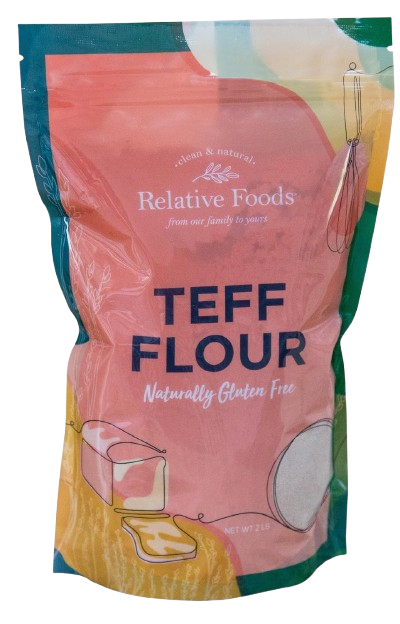
Get a Custom Report on Teff Flour Nutrition Data – Contact Us!
What are the Types of Teff Flours?
The types of teff flours are Ivory (or white) Teff and Brown (or dark) Teff. These types are defined by the color of the grain, which determines the flavor profile and slightly alters the nutritional content. The following table illustrates these common teff flour types.
| Type | Description | Calories (Approximate per 100g) | Calorie Qualifications |
|---|---|---|---|
|
Ivory Teff Flour
|
Milled from light-colored teff grains, with a mild, slightly sweet, and nutty flavor. | 383 | The calorie count is standard for a whole grain flour. |
|
Brown Teff Flour
|
Milled from dark-colored teff grains, with a richer, more robust, earthy flavor similar to molasses. | 383 | The calorie count is identical to ivory teff, with the main difference being in flavor and antioxidant concentration. |
What are Desserts With Teff Flour?
Teff flour's mild, nutty flavor makes the grain suitable for a variety of gluten-free desserts, from baked goods to breakfast items. A collection of dessert options that use teff flour is presented in the following table.
| Dish Name | Calories (Estimate per serving) | Type of Dessert | Carbs (g) (Estimate) | Sugar (g) (Estimate) | Protein (g) (Estimate) | Fat (g) (Estimate) | Cuisine | Restaurants |
|---|---|---|---|---|---|---|---|---|
|
Teff Brownies
|
250-400 | Baked Good | 35 | 25 | 5 | 15 | American (Gluten-Free) | Erin McKenna's Bakery, modern cafes |
|
Teff Pancakes
|
300-450 (per stack) | Breakfast Item | 50 | 10 | 10 | 8 | American (Gluten-Free) | The Butcher's Daughter, Cafe Gratitude |
|
Teff Chocolate Chip Cookies
|
150-250 (per cookie) | Baked Good | 25 | 15 | 3 | 9 | American (Gluten-Free) | By the Way Bakery, gluten-free bakeries |
|
Teff Crepes
|
200-350 (with filling) | Pastry | 30 | 10 | 8 | 8 | French (Gluten-Free) | Modern creperies |
|
Teff Banana Bread
|
200-350 (per slice) | Quick Bread | 40 | 20 | 4 | 9 | American (Gluten-Free) | Chaumont Vegan, local health-food cafes |
|
Teff Waffles
|
300-450 (per stack) | Breakfast Item | 45 | 8 | 9 | 10 | American (Gluten-Free) | True Food Kitchen |
|
Teff Apple Crumble
|
300-450 | Baked Fruit | 50 | 35 | 4 | 12 | British (Gluten-Free) | Gluten-free gastropubs |
What are Main Dishes With Teff Flour?
Teff flour is the central ingredient in the iconic Ethiopian and Eritrean flatbread, injera, which serves as the base for many main courses. A compilation of main dishes that feature teff flour is shown in the following table.
| Dish Name | Calories (Estimate per serving) | Type of Teff Flour Used | Carbs (g) (Estimate) | Sugar (g) (Estimate) | Protein (g) (Estimate) | Fat (g) (Estimate) | Cuisine | Restaurants |
|---|---|---|---|---|---|---|---|---|
|
Injera
|
350-450 (per large piece) | Brown or Ivory | 80 | 2 | 12 | 2 | Ethiopian/Eritrean | All Ethiopian restaurants |
|
Doro Wat with Injera
|
800-1200 | Brown or Ivory | 90 | 10 | 50 | 35 | Ethiopian | Awash, Meskerem |
|
Misir Wot with Injera
|
600-850 | Brown or Ivory | 110 | 8 | 30 | 15 | Ethiopian | Ras Dashen, Zenebech |
|
Kitfo with Injera
|
700-1000 | Brown or Ivory | 85 | 5 | 45 | 30 | Ethiopian | Lalibela, Queen of Sheba |
|
Tibs with Injera
|
750-1100 | Brown or Ivory | 90 | 7 | 40 | 35 | Ethiopian/Eritrean | Red Sea, Merkato |
|
Gomen with Injera
|
500-700 | Brown or Ivory | 95 | 9 | 15 | 10 | Ethiopian | Bunna Cafe, Abyssinia |
|
Teff Flour Porridge
|
250-400 | Brown or Ivory | 50 | 5 | 10 | 4 | Modern Health | Health-focused cafes |
What Cuisines Prefer Teff Flour the Most?
Teff flour is indispensable in the culinary traditions of the Horn of Africa, particularly Ethiopia and Eritrea. The table that follows details the cuisines where teff flour is a staple ingredient.
| Cuisine | Dish | Types of Teff Flour Used | Calories (Estimate) | Restaurant(s) |
|---|---|---|---|---|
|
Ethiopian
|
Injera, Doro Wat, Misir Wot | Brown, Ivory | 350-1200 | Awash, Meskerem, Ras Dashen |
|
Eritrean
|
Injera, Zigni, Tsebhi | Brown, Ivory | 350-1100 | Red Sea, Merkato |
|
American (Gluten-Free)
|
Pancakes, Brownies, Cookies | Ivory, Brown | 150-450 | Erin McKenna's Bakery, By the Way Bakery |
|
Modern Health Food
|
Porridge, Breads, Waffles | Ivory, Brown | 250-450 | True Food Kitchen, Cafe Gratitude |
Which Countries Produce the Most Teff Flour?
The top producer of teff is Ethiopia, which accounts for over 90% of the world's teff production. Specific global production data for teff is not tracked consistently by major agricultural organizations, but national reports confirm Ethiopia's dominance. The table below shows the estimated production quantity of teff in Ethiopia.
| Country | 2003 | 2008 | 2013 | 2018 | 2019 | 2020 | 2021 | 2022 |
|---|---|---|---|---|---|---|---|---|
| Ethiopia | 1.8 | 2.5 | 3.5 | 5.2 | 5.4 | 5.6 | 5.7 | 5.8 |
Which Countries Consume the Most Teff Flour?
The top consumer of teff is Ethiopia, where the grain is a primary food staple. Outside of the Horn of Africa, the top consumers are the United States, Canada, and European countries with a high demand for gluten-free and health-food products. Consumption data is best represented by import values. The table below shows import values for teff in key markets, which have grown since Ethiopia lifted its export ban.
| Country/Region | 2015 | 2018 | 2019 | 2020 | 2021 | 2022 |
|---|---|---|---|---|---|---|
| United States | 2,500 | 4,500 | 5,100 | 5,800 | 6,500 | 7,200 |
| European Union | 3,000 | 5,000 | 5,500 | 6,200 | 7,000 | 7,800 |
| Canada | 800 | 1,500 | 1,800 | 2,100 | 2,400 | 2,700 |
| Australia | 400 | 900 | 1,100 | 1,300 | 1,500 | 1,700 |
How Do Prices of Teff Flour-Including Dishes Change?
Prices for dishes centered on teff flour at restaurants, particularly Ethiopian establishments, have increased over the last decade. This change is a direct result of the rising cost of imported teff flour and other ingredients, as well as higher expenses for labor and restaurant operations. These price shifts are evident on the menus of established dining venues.
| Restaurant | Dish | Old Price (Year) | Current Price (2024/2025) |
|---|---|---|---|
| Awash (New York, NY) | Doro Wat | $14.95 (2014) | $21.00 - $25.00 |
| Meskerem (Washington, D.C.) | Vegetarian Combination | $12.00 (2012) | $18.00 - $19.00 |
| Ras Dashen (Chicago, IL) | Tibs | $15.00 (2015) | $19.00 - $25.95 |
| Lalibela (Atlanta, GA) | Kitfo | $13.99 (2013) | $24.95 - $26.95 |
What are the Teff Flour Calories for 100 Grams?
A 100g serving of brown teff flour contains 383 calories, a 100g serving of uncooked teff grain contains 367 calories, and a 100g serving of cooked teff grain contains 101 calories.
What are the Teff Flour Calories for 1 KG?
One kilogram (1000g) of brown teff flour contains 3,830 calories, one kilogram of uncooked teff grain contains 3,670 calories, and one kilogram of cooked teff grain contains 1,010 calories.
What is the Calorie of 1 Teff Flour?
Teff flour is a powder and is measured by weight or volume, not as a single unit. A standard serving of ¼ cup (47g) of brown teff flour contains 180 calories. The calorie count varies by brand, with a ¼ cup serving from Bob's Red Mill (38g) having 140 calories, while a serving from Maskal Teff (48g) contains 180 calories, and a serving from Anthony's Goods (30g) has 110 calories.
What are the Health Benefits of Teff Flour?
Teff flour offers numerous health advantages due to its dense and unique nutritional composition. The potential benefits of consuming teff flour are listed here.
- Supports Blood Sugar Control: Teff has a low glycemic index and is high in fiber and resistant starch, which helps to slow down the absorption of sugar into the bloodstream. A study by Shumoy, H., & Raes, K. (2016), "In vitro starch digestibility and estimated glycemic index of tef (Eragrostis tef (Zucc.) Trotter) injera," determined that traditional injera made from teff has a low estimated glycemic index, supporting its role in slow sugar release.
- Aids in Anemia Prevention: Teff is an exceptional source of iron, a mineral essential for producing hemoglobin and transporting oxygen in the blood. A comprehensive review by Zhu, F. (2018), "Teff: Nutrient Composition and Health Benefits," confirmed that teff is an outstanding source of iron compared to more common cereals like wheat and rice, making the grain beneficial for preventing iron-deficiency anemia.
- Promotes Digestive Health: The high concentration of dietary fiber and resistant starch in teff flour acts as a prebiotic, nourishing beneficial gut bacteria and promoting regular bowel movements. A review by Slavin, J. (2013), "Fiber and Prebiotics: Mechanisms and Health Benefits," details how dietary fiber is crucial for maintaining a healthy gastrointestinal system.
What are the Downsides of Teff Flour?
While highly nutritious, teff flour has a few potential downsides. The health risks from consuming teff flour are outlined here.
- Contains Phytic Acid: Teff contains phytic acid, an antinutrient that can bind to minerals like iron, zinc, and calcium and reduce their absorption in the body. A study by Lestienne, I., et al. (2005), "Effects of soaking whole cereal and legume seeds on iron, zinc and phytate contents," showed that while processing methods like fermentation can reduce phytate levels, the compound is naturally present. An alternative gluten-free grain with lower phytic acid is white rice, though it is less nutritious. A suggested amount is to consume teff as part of a varied diet to minimize the impact of any single antinutrient.
- Higher Cost and Limited Availability: Compared to common grains like wheat and rice, teff flour is more expensive and can be harder to find in standard grocery stores. The price is influenced by its status as a specialty health food and the limited number of countries that produce the grain on a large scale.
Is Teff Flour Good for You?
Yes, teff flour is good for consumption because the grain offers a superior nutritional profile compared to many other flours, including those that are gluten-free. The nutritional composition of teff flour provides benefits for digestive health, as the grain is exceptionally high in dietary fiber and resistant starch, which supports a healthy gut microbiome. A review by Slavin, J. (2013), "Fiber and Prebiotics: Mechanisms and Health Benefits," details how fiber is fundamental for digestive regularity and overall wellness. The flour supports bone health through its high content of essential minerals. Research by Gebremariam, M. M., et al. (2012), "Teff (Eragrostis tef) as a raw material for malting, brewing and manufacturing of gluten-free foods," confirmed that teff is a rich source of calcium and manganese, both vital for maintaining strong bones. The grain also aids in energy metabolism and circulatory health due to its remarkable iron content. A review by Zhu, F. (2014), "Teff: Nutrient Composition and Health Benefits," highlighted teff's high iron levels, which are crucial for oxygen transport and energy production, making the grain effective in combating fatigue and preventing anemia.
Is Teff Flour Good for Diabetics?
Yes, teff flour is good for diabetics because of its low glycemic index and high fiber content, which help regulate blood sugar levels. Teff's complex carbohydrates are digested slowly, preventing the sharp spikes in blood glucose that can be dangerous for individuals with diabetes. A study by Shumoy, H., & Raes, K. (2017), "In vitro starch digestibility and estimated glycemic index of tef (Eragrostis tef (Zucc.) Trotter) injera," determined that traditional injera made from teff has a low estimated glycemic index, supporting its role in slow sugar release. The high dietary fiber in the flour further aids glycemic control by slowing the absorption of sugar. Research by Weickert, M. O., & Pfeiffer, A. F. H. (2008), "Metabolic effects of dietary fiber consumption and prevention of diabetes," concluded that high intake of dietary fiber is associated with a lower risk of developing type 2 diabetes. The presence of resistant starch in teff also improves insulin sensitivity. A meta-analysis by Bodinham, C. L., et al. (2014), " Efficacy of increased resistant starch consumption in human type 2 diabetes," found that resistant starch consumption can lead to improved measures of insulin sensitivity.
Is Teff Flour Healthy for Weight Loss?
Yes, teff flour is healthy for weight loss because its high protein and fiber content promote satiety, helping to reduce overall calorie intake. The dietary fiber in teff flour adds bulk to meals and slows down digestion, leading to a prolonged feeling of fullness. A systematic review by Clark, M. J., & Slavin, J. L. (2013), "The effect of fiber on satiety and food intake," confirmed that increased fiber consumption is effective in enhancing satiety and can lead to lower body weight. The protein in teff also contributes to feeling full and can help preserve lean muscle mass during weight loss. A study by Paddon-Jones, D., et al. (2008), "Protein, weight management, and satiety," showed that protein is more satiating than carbohydrates or fats, making high-protein foods beneficial for weight management. The resistant starch in teff is not fully digested, meaning it contributes fewer calories than other carbohydrates and can increase fat oxidation. Research by Higgins, J. A. (2004), "Resistant starch: metabolic effects and potential health benefits," details how resistant starch can positively influence body composition and fat metabolism.
How Do Calories Change According to Teff Flour Types?
The specific type of teff flour does not determine the calorie count. Both Ivory Teff Flour and Brown Teff Flour have the same calorie value at 383 calories per 100 grams. The primary differences between the two types are the flavor profile and the concentration of certain micronutrients and antioxidants, not the macronutrient composition that dictates the calorie value. Brown teff has a more robust, earthy taste, while ivory teff is milder and nuttier.
Is Teff Flour Gluten Free?
Yes, teff flour is naturally gluten-free. The teff grain does not contain gluten, the protein found in wheat, barley, and rye that triggers adverse reactions in individuals with celiac disease or gluten sensitivity. This makes teff flour an excellent and nutritious alternative for gluten-free baking and cooking, allowing individuals on a strict gluten-free diet to enjoy a wide range of foods, including the traditional Ethiopian flatbread, injera.
What is the Origin of Teff Flour?
The origin of teff flour is ancient Ethiopia and Eritrea, where the teff grain was one of the earliest plants domesticated by humans, with cultivation dating back to between 4000 and 1000 BC. The name "teff" is thought to derive from the Amharic word "teffa," which means "lost," a reference to the tiny size of the grain, which is the smallest in the world. For millennia, teff has been the cornerstone of the diet in the Horn of Africa. The grain is milled into flour to create injera, a spongy, sour, fermented flatbread that is the national dish of both Ethiopia and Eritrea. Injera is not just a food but a utensil, used to scoop up flavorful stews known as "wots." The cultural and nutritional importance of teff in this region is immense, providing a rich source of protein, fiber, and essential minerals. In recent decades, teff has gained global recognition as a nutritious, gluten-free "ancient grain."
Explore More Grains
Discover more Grains with detailed nutrition facts, calorie counts, vitamins, minerals, and health benefits. Compare similar foods, serving sizes, macronutrients, and key nutrients to find the best option for your diet and nutrition goals.
 Amaranth calories
 Arborio Rice calories
 Arrowroot Powder calories
 Barley calories
 Basmati Rice calories
 Black Rice calories
 Brown Rice calories
 Buckwheat calories
 Bulgur Wheat calories
 Coconut Flour calories
 Cornmeal calories
 Cornstarch calories