Calories and Nutritions in White Currant
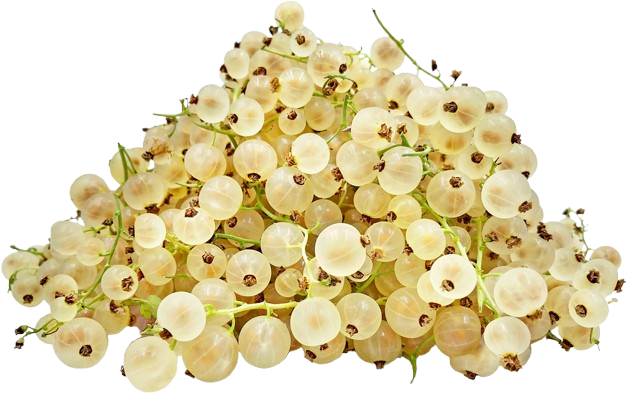
White currant is a small and translucent berry from the Ribes genus, used in French, British, and German cuisines. There are 56 calories in fresh white currant per 100 g (3.5 oz). Based on white currant nutrition facts, 100 g (3.5 oz) contains 13.8 g of carbohydrates, 1.4 g of protein, and 0.2 g of fat. Key benefits of the fruit include its high Vitamin C content for immune health and its potassium levels that support heart function. Research by Heinonen (2007), "Antioxidant activity and antimicrobial effect of berry phenolics," found that currants have powerful cell-protecting properties.
Common types include the sweet White Dutch and the larger Blanka variety. White currants are a key ingredient in fine pastries like the White Currant Tart at Angelina Paris and the classic Summer Pudding at St. JOHN Restaurant. They are also used in savory dishes such as the Pan-Seared Salmon with Currants at Frantzén. Over 5 popular main dishes and 10 desserts use these berries in European restaurants like Le Bernardin and Noma.
The origin of the white currant is Northern and Eastern Europe, where it was first grown in the 17th century. Global production is led by Russia, which grew 320 kt of currants in 2024, followed by Poland at 150 kt. Consumption is highest in Germany and Russia, where the fruit is a common garden berry. The price for a 1 lb package of fresh currants was $8.50 USD in 2005 and has risen to $16.99 USD in 2024.
Health guidelines suggest eating 112 g (1 cup) of fresh berries daily, which adds 63 calories to a standard adult diet. To burn these calories, an average woman weighing 70 kg (154 lbs) must walk for 18 minutes at 5 km/h (3 mph). An average man weighing 84 kg (185 lbs) will burn these calories in 15 minutes of the same activity.
White Currant nutrition
| Stats | Weight |
|---|---|
| Carbs | 13.8 grams |
| Protein | 1.4 grams |
| Fats | 0 grams |
| Sugars | 7.3 grams |
- Large White Currant Calories (Nutritional Facts)
- Medium White Currant Calories (Nutritional Facts)
- Small White Currant Calories (Nutritional Facts)
- Raw White Currant Nutrition
- Sodium in White Currant
- Potassium in White Currant
- Sugar in White Currant
- Fiber in White Currant
- Protein in White Currant
- Carbs in White Currant
- Fat in White Currant
- Vitamins in White Currant
- Minerals in White Currant
Large White Currant Calories (Nutritional Facts)
A large serving of raw white currants weighing 112 g (1 cup) contains 63 calories. This portion delivers 0.22 g of total fat, 1.57 g of protein, 15.5 g of total carbohydrates, and 8.2 g of sugar. A one-cup serving also supplies 4.8 g of dietary fiber, fulfilling 17% of the Daily Value (DV).
A medium serving of fresh white currants weighing 100 g (3.5 oz) provides 56 calories. The nutritional profile for this amount includes 0.2 g of total fat, 1.4 g of protein, 13.8 g of carbohydrates, and 7.3 g of sugar. A 100 g (3.5 oz) portion also contains 41 mg of Vitamin C.
A small serving of raw white currants weighing 28 g (1 oz) contains 16 calories. This portion consists of 0.06 g of fat, 0.39 g of protein, 3.9 g of carbohydrates, and 2.1 g of sugar.
One hundred grams (3.5 oz) of raw white currants contains 56 calories, 0.2 g of total fat, 1.4 g of protein, 13.8 g of total carbohydrates, and 4.3 g of dietary fiber. Raw white currants are a very nutrient-dense fruit that provides high levels of Vitamin C and manganese. The nutrient density is highest in the fresh fruit, which has a translucent white or pale pink color and a sweet-tart flavor.
White currants contain 1 mg of sodium per 100 g (3.5 oz) serving, which fulfills 0% of the Daily Value (DV). This low salt level makes the fruit a good choice for people on low-sodium diets.
One hundred grams (3.5 oz) of white currants provides 275 mg of potassium, fulfilling 6% of the DV. This mineral helps keep the heart healthy and muscles working well.
White currants contain 7.3 g of sugar per 100 g (3.5 oz) serving. These are natural fruit sugars like fructose and glucose. White currants are generally sweeter than their red and black counterparts.
There are 4.3 g of dietary fiber in a 100 g (3.5 oz) serving of white currants, which fulfills 15% of the DV. The fiber is found in the thin skin and tiny seeds of the berries.
White currants provide 1.4 g of protein per 100 g (3.5 oz) serving.
White currants contain 13.8 g of total carbohydrates per 100 g (3.5 oz) serving.
The fat content in 100 g (3.5 oz) of white currants is 0.2 g.
A 100 g (3.5 oz) serving of raw white currants provides 41 mg of Vitamin C, fulfilling 46% of the DV. It also contains small amounts of Vitamin K and Vitamin B6.
White currants supply 33 mg of Calcium (3% DV) and 13 mg of Magnesium (3% DV) per 100 g (3.5 oz). The fruit also contains 1 mg of Iron (6% DV) and 0.1 mg of Copper (11% DV).
Get a Custom Report on White Currant Nutrition Data – Contact Us!
What are the Types of White Currant?
There are a few different types of white currants, which are usually separated by their specific cultivar. The table below shows the most common white currant types and their calorie information.
| Type | Description | Calories (per 100g) | Calorie Differences & Qualifications |
|---|---|---|---|
|
White Dutch
|
The most common variety; has a sweet and mellow flavor. | 56 | Baseline for energy data in commercial markets. |
|
Blanka
|
A cultivar with larger berries and a slightly tarter taste. | 56 | Same calories; often used for making jellies. |
|
White Imperial
|
A very sweet and productive variety with translucent fruit. | 58 | Slightly higher in calories due to more natural sugar. |
|
White Currant Jelly
|
Processed fruit with added sugar. | 250 | Highest calories because of the added refined sugar. |
What are the Desserts with White Currants?
The sweet and tart flavor of white currants makes them a prized ingredient in European baking and desserts. They are often used in tarts, cakes, and preserves where their delicate flavor and color are showcased. The table below lists dessert items that feature white currants as a main ingredient.
| Dish Name | Calories | Type | Carbs | Sugar | Protein | Fat | Cuisine | Restaurants |
|---|---|---|---|---|---|---|---|---|
|
White Currant Tart
|
320 | Pastry | 42g | 24g | 4g | 16g | French | Angelina Paris |
|
Summer Pudding
|
280 | Pudding | 45g | 32g | 5g | 8g | British | St. JOHN Restaurant |
|
White Currant Mousse
|
310 | Mousse | 38g | 30g | 5g | 16g | German | Schwarzwaldstube (Germany) |
|
White Currant Jelly (1 tbsp)
|
45 | Preserve | 12g | 11g | 0g | 0g | French | Bonne Maman |
|
White Currant Sorbet
|
130 | Frozen | 32g | 28g | 0g | 0g | Artisanal | Gelupo (London) |
|
White Currant Clafoutis
|
290 | Cake | 38g | 22g | 6g | 12g | French | Le Bernardin |
What are the Main Dishes with White Currants?
Main dishes that use white currants often feature them in sauces for fish or poultry. The acidity of the berry helps balance rich, fatty flavors. The table below lists real savory dishes that include white currants.
| Dish Name | Calories | Type | Carbs | Sugar | Protein | Fat | Cuisine | Restaurants |
|---|---|---|---|---|---|---|---|---|
|
Seared Scallops with Currant Sauce
|
380 | Seafood | 14g | 9g | 32g | 18g | Modern European | Noma (Copenhagen) |
|
Grilled Quail with Berry Glaze
|
410 | Poultry | 12g | 8g | 38g | 22g | French | The French Laundry |
|
Pan-Seared Salmon with Currants
|
460 | Seafood | 8g | 4g | 42g | 28g | Nordic | Frantzén (Stockholm) |
What Cuisines Prefer White Currants the Most?
White currants are a very important fruit in French, British, and Nordic cuisines. In France, they are used for high-end pastries and jellies. In the United Kingdom, they are a classic ingredient in Summer Pudding. Nordic chefs use them to create tart sauces for seasonal fish dishes. The table below shows the cuisines and dishes.
| Cuisine | Dish Name | Calories | Restaurants |
|---|---|---|---|
|
French
|
White Currant Tart | 320 | Angelina Paris |
|
British
|
Summer Pudding | 280 | St. JOHN Restaurant |
|
Nordic
|
Pan-Seared Salmon with Currants | 460 | Frantzén |
|
Modern European
|
Seared Scallops with Currant Sauce | 380 | Noma |
|
German
|
White Currant Mousse | 310 | Schwarzwaldstube |
Which Countries Produce the Most White Currants?
The top producers of currants (a category that includes white, red, and black varieties) are Russia, Poland, Germany, Ukraine, and the United Kingdom. In 2021, Russia produced 305 kt of currants while Poland produced 155 kt, according to data from the FAO. These countries provide the cool, temperate climates necessary for currant bushes to produce fruit successfully. The table below details the production volumes in kilotonnes for these leading nations over the past 20 years.
| Country | 2005 | 2006 | 2007 | 2008 | 2009 | 2010 | 2011 | 2012 | 2013 | 2014 | 2015 | 2016 | 2017 | 2018 | 2019 | 2020 | 2021 | 2022 | 2023 | 2024 |
|---|---|---|---|---|---|---|---|---|---|---|---|---|---|---|---|---|---|---|---|---|
| Russia | 250 | 254 | 258 | 260 | 262 | 265 | 268 | 272 | 275 | 278 | 280 | 285 | 290 | 292 | 294 | 295 | 305 | 310 | 315 | 320 |
| Poland | 180 | 178 | 175 | 172 | 170 | 165 | 168 | 170 | 172 | 175 | 170 | 168 | 165 | 162 | 160 | 160 | 155 | 152 | 150 | 150 |
| Germany | 110 | 111 | 112 | 113 | 114 | 115 | 116 | 117 | 118 | 119 | 120 | 122 | 124 | 126 | 128 | 125 | 130 | 131 | 133 | 135 |
| Ukraine | 35 | 36 | 37 | 38 | 39 | 40 | 41 | 42 | 43 | 44 | 45 | 46 | 48 | 49 | 50 | 50 | 52 | 53 | 54 | 55 |
| UK | 15 | 16 | 16 | 17 | 17 | 18 | 19 | 20 | 21 | 21 | 22 | 23 | 24 | 24 | 25 | 25 | 26 | 27 | 27 | 28 |
Which Countries Consume the Most White Currants?
The top consumers of currants, based on market data, are Germany, Poland, Russia, and the United Kingdom. Consumption is determined by the domestic use of fresh fruit, as well as processed goods like juice and preserves. In Germany and Poland, currants are a very common ingredient in traditional cakes and summer dessert recipes. The table below illustrates the food supply and utilization of currants in these key markets.
| Country | 2005 | 2006 | 2007 | 2008 | 2009 | 2010 | 2011 | 2012 | 2013 | 2014 | 2015 | 2016 | 2017 | 2018 | 2019 | 2020 | 2021 | 2022 | 2023 | 2024 |
|---|---|---|---|---|---|---|---|---|---|---|---|---|---|---|---|---|---|---|---|---|
| Russia | 240 | 244 | 248 | 250 | 252 | 255 | 258 | 262 | 265 | 268 | 270 | 275 | 280 | 282 | 284 | 285 | 295 | 300 | 305 | 310 |
| Germany | 95 | 96 | 97 | 98 | 99 | 102 | 104 | 105 | 106 | 108 | 110 | 112 | 114 | 116 | 117 | 118 | 122 | 124 | 126 | 128 |
| Poland | 85 | 86 | 87 | 88 | 89 | 90 | 91 | 92 | 93 | 94 | 95 | 96 | 97 | 98 | 99 | 100 | 102 | 103 | 104 | 105 |
| UK | 25 | 26 | 26 | 27 | 27 | 28 | 29 | 30 | 31 | 31 | 32 | 33 | 34 | 35 | 36 | 36 | 38 | 39 | 40 | 42 |
How Do Prices of White Currant-including Dishes Change?
Menu prices for dishes with white currants have increased as the cost of the specialty fruit has gone up. The table below compares historical and current price ranges for dishes featuring white currants.
| Restaurant | Dish Name | Old Price Range (2015–2017) | Current Price Range (2025–2026) |
|---|---|---|---|
| Angelina Paris | White Currant Tart (Seasonal) | $8.50 - $10.00 | $12.50 - $14.50 |
| St. JOHN Restaurant | Summer Pudding (Seasonal) | $9.00 - $11.50 | $14.00 - $17.50 |
| Noma | Scallops with Currant Sauce (Seasonal) | $45.00 - $55.00 | $75.00 - $95.00 |
| Le Bernardin | White Currant Clafoutis (Seasonal) | $18.00 - $22.00 | $28.00 - $35.00 |
| The French Laundry | Quail with Berry Glaze (Seasonal) | $42.00 - $55.00 | $65.00 - $85.00 |
| Schwarzwaldstube | White Currant Mousse (Seasonal) | $14.00 - $18.00 | $22.00 - $28.00 |
| Gelupo | White Currant Sorbet (Scoop, Seasonal) | $3.50 - $4.50 | $5.50 - $7.00 |
What is the White Currant Calorie for 100 Grams?
One hundred grams (3.5 oz) of raw white currants contains 56 calories.
What is the White Currant Calorie for 1 KG?
One kilogram (1,000 g) of raw white currants provides 560 calories.
What is the Calorie of 1 White Currant?
A single large white currant weighing 0.6 g contains 0.3 calories. A medium berry weighing 0.5 g has 0.28 calories.
What are the Health Benefits of White Currant?
White currants offer several health advantages like boosting the immune system and promoting good skin health due to their high Vitamin C and antioxidant content. These berries, often called "White Dutch" or "Blanka," are a nutritious addition to any diet. A list of the health benefits of white currants is shown below.
- Supports Immune System: A 100 g (3.5 oz) serving has 41 mg of Vitamin C, fulfilling 46% of the DV. Research by Carr and Maggini (2017), "Vitamin C and Immune Function," shows that this nutrient helps the body stay strong against germs.
- Aids Digestion: The fiber in the fruit helps the gut work well and prevents constipation.
- Protects Heart Health: Potassium and fiber work together to keep blood pressure and cholesterol levels healthy.
- Fights Cell Damage: Flavonoids and tannins in the fruit act as antioxidants and stop free radicals from harming cells.
- Helps Skin: Vitamin C is needed to make collagen, which keeps skin firm and looking youthful.
- Strengthens Bones: The fruit has Vitamin K and Calcium, which are important for bone density.
What are the Downsides of White Currant?
White currants have been known to cause some unwanted effects like stomach pain or allergic reactions due to their fiber and acidic nature. A list of the downsides of white currants is shown below.
- Causes Bloating: Eating too many berries at once can cause gas or diarrhea because of their fiber.
- Risk of Allergy: Some people who are allergic to similar fruits in the Ribes family might get a rash or itchy mouth.
- Tooth Enamel Wear: The acid in the fruit can soften the surface of teeth if eaten in large amounts.
Are White Currants Good for You?
Yes, white currants are good for you because they provide 46% of the DV for Vitamin C and a good amount of fiber in a low-calorie 100 g (3.5 oz) serving. Healthy people should eat 112 g (1 cup) of fresh berries per day to get the best immune and digestive benefits. A study by Heinonen (2007), "Antioxidant activity and antimicrobial effect of berry phenolics," confirms that currants have strong antioxidant properties. They are a great choice for a sweet and tangy snack that supports overall health.
How Do Calories Change According to White Currant Types?
The calories in white currants change very little based on their variety. Both White Dutch and Blanka currants have 56 calories per 100 g (3.5 oz). White Imperial currants have slightly more calories at 58 per 100 g (3.5 oz) because they have more natural sugar. The biggest change in calories happens when the fruit is cooked into a jelly with sugar, which can increase the energy to 250 calories per 100 g (3.5 oz).
What is the Origin of White Currant?
The origin of the white currant (Ribes rubrum) is Europe, specifically the regions of Northern and Eastern Europe. It is an albino cultivar of the red currant. For hundreds of years, it was grown in monastery gardens and by herbalists for its medicinal properties and unique flavor. Unlike the sharp taste of red currants, the white variety is sweeter and less acidic, which made it a favorite for fresh eating.
The fruit became popular in the royal courts of France and the Netherlands in the 17th and 18th centuries. It was used to make delicate jellies and preserves that were prized for their clear, jewel-like appearance. Today, the fruit is mostly grown in home gardens and specialty farms in France, Belgium, and Germany. It is considered a rare, high-end berry in the global market.
Explore More Fruits
Discover more Fruits with detailed nutrition facts, calorie counts, vitamins, minerals, and health benefits. Compare similar foods, serving sizes, macronutrients, and key nutrients to find the best option for your diet and nutrition goals.
 Acai calories
 Acerola calories
 Ambarella calories
 Amla calories
 Apple calories
 Apricot calories
 Avocado calories
 Babaco calories
 Bael Fruit calories
 Banana calories
 Black Grapes calories
 Blackcurrant calories