Calories and Nutritions in Macadamia Milk
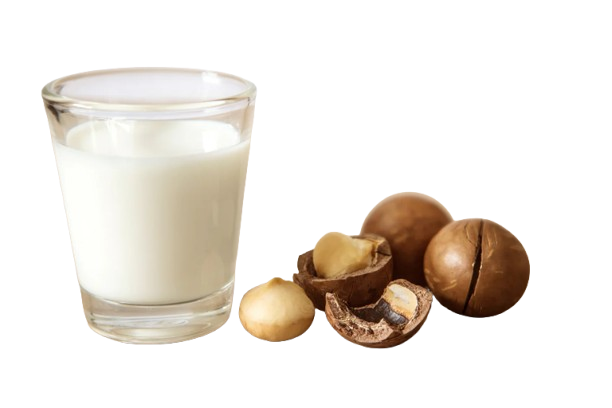
Macadamia milk is a creamy, plant-based beverage produced from soaked and blended macadamia nuts. There are 21 calories in macadamia milk per 100 g (3.5 oz) for the standard unsweetened variety. Frequently referred to by names such as macadamia nut milk, buttery milk, or creamy keto milk, this liquid is significantly less energy-dense than whole cow milk, which provides 61 calories per 100 g (3.5 oz). A small 240 g (8 oz) serving of unsweetened macadamia milk contains 50 calories, while a medium 355 g (12 oz) portion provides 74 calories and a large 473 g (16 oz) serving offers 99 calories.
According to macadamia milk nutrition data, a 100 g (3.5 oz) portion of the unsweetened type provides 0.4 g of carbohydrates, 0.4 g of protein, and 2.1 g of fat. For retail products, a 240 mL (8.1 oz) serving of Milkadamia Unsweetened Macadamia Milk contains 50 calories, whereas a 240 mL (8.1 oz) serving of Sunmi Macadamia Milk provides 90 calories and a 240 mL (8.1 oz) serving of House of Macadamias Unsweetened Macadamia Milk offers 50 calories. Research by Griel et al. (2008), "A macadamia nut-rich diet reduces total and LDL-cholesterol in mildly hypercholesterolemic men and women," found that the monounsaturated fats in the nut base support cardiovascular health. Other restaurants featuring the milk include Blue Bottle Coffee for its Iced Macadamia Milk Matcha and Nekter Juice Bar for its Macadamia Milk Acai Bowl.
Common types include the pure unsweetened version, sweetened varieties, barista-style blends for coffee, and flavored options such as vanilla or chocolate. The rich, buttery profile of the liquid is utilized in savory and health-focused main dishes such as the Macadamia Nut Overnight Oats at Pressed, which contains 340 calories, and the Tropical Protein Bowl at Vitality Bowls. Popular desserts incorporating the nut milk include the Strawberry Macadamia Freeze at Pressed and the Macadamia White Chocolate Ice Blended at The Coffee Bean & Tea Leaf, which ranges from $6.25 to $7.45 USD.
The origin of the macadamia nut is Australia, where it has been a vital food source for Aboriginal populations for thousands of years before being commercialized in Hawaii in the late 19th century. Global production of the macadamia milk base is led by South Africa, which produced 75.1 kt as of 2024, followed by Australia at 58.2 kt. Consumption is highest in the United States, where utilization reached 60.8 kt in 2024, followed by China. The retail price for a 32 oz (946 mL) carton of unsweetened macadamia milk has risen from $3.25 USD in 2005 to $5.49 USD in 2024. Health guidelines suggest a recommended daily intake of 240 mL (8.1 oz), which contributes 50 calories to a standard adult diet.
To burn the 50 calories provided by a small 240 g (8 oz) serving of unsweetened macadamia milk, a person weighing 70 kg (154 lbs) must engage in 14 minutes of moderate walking at 5 km/h (3 mph). For those consuming a large 473 g (16 oz) sweetened serving containing 158 calories, the energy expenditure requires 45 minutes of moderate walking. Alternatively, the same individual can perform 14 minutes of vigorous swimming or 18 minutes of cycling at a speed of 20 km/h (12 mph) to offset the caloric intake from a large portion. Normal daily metabolic activity successfully utilizes the 21 calories found in a 100 g (3.5 oz) serving within 6 minutes of brisk movement.
Macadamia Milk nutrition
| Stats | Weight |
|---|---|
| Carbs | 1.5 grams |
| Protein | 1.5 grams |
| Fats | 0 grams |
| Sugars | 0 grams |
- 8oz Macadamia Milk Calories (Nutritional Facts)
- 12oz Macadamia Milk Calories (Nutritional Facts)
- 16oz Macadamia Milk Calories (Nutritional Facts)
- Plain Macadamia Milk Nutrition
- Sodium in Macadamia Milk
- Potassium in Macadamia Milk
- Sugar in Macadamia Milk
- Fiber in Macadamia Milk
- Protein in Macadamia Milk
- Carbs in Macadamia Milk
- Fat in Macadamia Milk
- Vitamins in Macadamia Milk
- Minerals in Macadamia Milk
8oz Macadamia Milk Calories (Nutritional Facts)
A small 240g (8oz) serving of unsweetened macadamia milk, also known as macadamia nut milk, provides 50 calories. This portion contains 5g of total fat, 1g of carbohydrates, 0g of sugar, and 1g of protein. A small 240g (8oz) serving of sweetened macadamia milk contains 80 calories. This portion delivers 5g of total fat, 8g of carbohydrates, 7g of sugar, and 1g of protein. A small 240g (8oz) serving of vanilla-flavored macadamia milk contains 80 calories.
A medium 355g (12oz) serving of unsweetened macadamia milk contains 74 calories. This portion includes 7.4g of total fat, 1.5g of carbohydrates, 0g of sugar, and 1.5g of protein. A medium 355g (12oz) serving of sweetened macadamia milk provides 118 calories. A medium 355g (12oz) serving of barista-style macadamia milk contains 118 calories.
A large 473g (16oz) serving of unsweetened macadamia milk provides 99 calories. This serving offers 9.8g of total fat, 2g of carbohydrates, 0g of sugar, and 2g of protein. A large 473g (16oz) serving of sweetened macadamia milk contains 158 calories. A large 473g (16oz) serving of chocolate-flavored macadamia milk provides 217 calories.
A 100g (3.5oz) serving of plain unsweetened macadamia milk provides 21 calories, 2.1g of total fat, 0.4g of protein, 0.4g of carbohydrates, and 0g of sugar. A 100g (3.5oz) serving of plain sweetened macadamia milk provides 33 calories, 2.1g of total fat, 0.4g of protein, 3.3g of carbohydrates, and 2.9g of sugar. Plain macadamia milk serves as a low-calorie, dairy-free alternative with a rich, buttery texture.
Macadamia milk contains 42mg of sodium per 100g (3.5oz) serving, which fulfills 2% of the Daily Value (DV). This mineral content supports electrolyte balance in a healthy diet.
A 100g (3.5oz) serving of macadamia milk provides 21mg of potassium, which represents 0% of the Daily Value (DV). This mineral level provides minor support for nerve and muscle function.
Plain unsweetened macadamia milk contains 0g of sugar per 100g (3.5oz) serving. Sweetened macadamia milk contains 2.9g of added sugar per 100g (3.5oz) serving. Vanilla-flavored macadamia milk contains 2.9g of sugar per 100g (3.5oz) serving. Chocolate macadamia milk contains 4.2g of sugar per 100g (3.5oz) serving.
Macadamia milk provides 0.4g of dietary fiber per 100g (3.5oz) serving, which fulfills 1% of the Daily Value (DV). This fiber content assists with digestive processes.
Macadamia milk provides 0.4g of protein per 100g (3.5oz) serving.
Unsweetened macadamia milk contains 0.4g of total carbohydrates per 100g (3.5oz) serving. Sweetened macadamia milk contains 3.3g of total carbohydrates per 100g (3.5oz) serving.
Macadamia milk contains 2.1g of total fat per 100g (3.5oz) serving. The fat content is primarily composed of monounsaturated fatty acids which are beneficial for heart health.
A 100g (3.5oz) serving of fortified macadamia milk provides 0.6mcg of Vitamin B12 (25% DV) and 1.1mcg of Vitamin D (5% DV). It also delivers 1.4mg of Vitamin E (9% DV) and 46mcg of Vitamin A (5% DV). These vitamins are essential for supporting immune function and cellular health.
A 100g (3.5oz) serving of fortified macadamia milk provides 187mg of Calcium (14% DV). It also contains 4mg of Magnesium (1% DV) and 0.1mg of Iron (1% DV). High calcium levels are important for supporting bone density.
Get a Custom Report on Macadamia Milk Nutrition Data – Contact Us!
What are the Types of Macadamia Milk?
There are 5 different types of macadamia milk such as unsweetened and chocolate-flavored varieties. The table below shows the most common macadamia milk types and their calorie information.
| Type | Description | Calories (per 100 g / 3.5 oz) | Calorie Differences & Qualifications |
|---|---|---|---|
|
Unsweetened
|
Pure nut base with water and zero added sugar. | 21 | Lowest energy density for strict keto diets. |
|
Sweetened
|
Nut base with added cane sugar or coconut nectar. | 33 | Higher carbohydrate content due to the 3 g of sugar. |
|
Barista Edition
|
Higher nut concentration with added oils for frothing. | 33 | Creamier texture designed for coffee applications. |
|
Vanilla Flavored
|
Nut base infused with vanilla extract and sweeteners. | 33 | Identical energy to sweetened but with aromatic additives. |
|
Chocolate Flavored
|
Nut base mixed with cocoa powder and sugar. | 46 | Highest calorie density due to cocoa and extra sugar. |
What are the Desserts with Macadamia Milk?
Dessert menus at health-forward chains and specialty vegan bakeries increasingly feature macadamia milk due to its natural richness and buttery flavor profile that mimics heavy cream. These confections often cater to individuals seeking plant-based alternatives that maintain a high lipid content for a superior mouthfeel in frozen and chilled formats. The table below lists the nutritional facts for popular desserts and sweet beverages that utilize macadamia milk as a primary ingredient across specific restaurant entities.
| Dish Name | Calories | Type | Carbs | Sugar | Protein | Fat | Cuisine | Restaurants |
|---|---|---|---|---|---|---|---|---|
|
Vanilla Macadamia Soft Serve
|
150 | Frozen | 24g | 20g | 1g | 6g | American | Pressed |
|
Strawberry Macadamia Freeze
|
160 | Frozen | 26g | 22g | 1g | 6g | American | Pressed |
|
Macadamia White Chocolate Ice Blended
|
380 | Blended | 52g | 48g | 3g | 18g | Modern American | The Coffee Bean & Tea Leaf |
|
Iced Macadamia Milk Matcha
|
180 | Beverage | 22g | 18g | 2g | 10g | Fusion | Blue Bottle Coffee |
|
Chocolate Macadamia Nut Milk Drink
|
110 | Beverage | 13g | 11g | 1g | 6g | American | Milkadamia |
|
Salted Caramel Macadamia Smoothie
|
420 | Blended | 64g | 42g | 8g | 15g | American | Juice Press |
|
Blue Majik Macadamia Smoothie
|
360 | Blended | 48g | 32g | 6g | 16g | Modern American | Moon Juice |
|
Macadamia Milk Chocolate Pudding
|
320 | Pudding | 45g | 28g | 4g | 14g | American | Erewhon |
|
Vegan Macadamia Nut Mousse
|
280 | Mousse | 32g | 21g | 3g | 16g | Fusion | Cafe Gratitude |
|
Salted Macadamia Milk Shake
|
510 | Frozen | 74g | 58g | 6g | 22g | American | Kreation Organic |
|
Macadamia Nut Milk Hot Chocolate
|
240 | Beverage | 31g | 26g | 2g | 12g | American | Milkadamia |
|
Macadamia Milk Tiramisu
|
450 | Cake | 44g | 32g | 6g | 28g | Italian Fusion | Cafe Gratitude |
What are the Main Dishes with Macadamia Milk?
Some of the most widespread main dishes that contain macadamia milk are Acai Bowls, Macadamia Milk Porridge, and Tropical Protein Bowls found primarily on breakfast and wellness menus. While macadamia milk is a staple beverage, its culinary application in savory main courses remains limited to specialized vegan fusion restaurants where it is used to create creamy, dairy-free sauces. In most fast-casual environments, it serves as the essential liquid base for nutrient-dense breakfast entrees that provide sustained energy through healthy fats. The table below lists the nutritional facts for popular savory-leaning breakfast mains and health bowls that feature macadamia milk.
| Dish Name | Calories | Type | Carbs | Sugar | Protein | Fat | Cuisine | Restaurants |
|---|---|---|---|---|---|---|---|---|
|
Macadamia Milk Acai Bowl
|
460 | Breakfast | 82g | 42g | 12g | 11g | American | Nekter Juice Bar |
|
Macadamia Nut Overnight Oats
|
340 | Breakfast | 54g | 12g | 14g | 11g | Modern American | Pressed |
|
Tropical Protein Bowl
|
520 | Health Bowl | 68g | 32g | 22g | 19g | Fusion | Vitality Bowls |
|
Macadamia Berry Porridge
|
380 | Breakfast | 54g | 12g | 14g | 11g | Belgian | Le Pain Quotidien |
|
Macadamia Nut Granola Bowl
|
410 | Breakfast | 58g | 18g | 12g | 16g | American | Cafe Gratitude |
|
Keto Macadamia Bowl
|
480 | Health Bowl | 18g | 4g | 24g | 36g | Modern American | Erewhon |
|
Macadamia Chia Seed Pudding
|
280 | Breakfast | 24g | 14g | 8g | 18g | American | Juice Press |
|
Macadamia Yogurt Bowl
|
350 | Breakfast | 42g | 18g | 10g | 16g | American | SunLife Organics |
|
Macadamia Milk Green Smoothie Meal
|
310 | Meal Replacement | 42g | 34g | 11g | 12g | American | Clean Juice |
|
Macadamia Cream Curry Bowl
|
620 | Entree | 52g | 8g | 18g | 38g | Fusion | Modern Vegan |
What Cuisines Prefer Macadamia Milk the Most?
Macadamia milk is a defining element of Modern American and Western Wellness cuisines where it is valued for its low-carbohydrate profile and suitability for ketogenic diets. While the macadamia nut is indigenous to Australia, its transition into a liquid dairy alternative has been most effectively utilized in Hawaiian and North American plant-based culinary traditions. The table below outlines the specific culinary styles and dining contexts where macadamia milk is a prominent featured offering.
| Cuisine | Dish Name | Calories | Restaurants |
|---|---|---|---|
|
Modern American
|
Macadamia Milk Latte | 140 | Blue Bottle Coffee |
|
Western Wellness
|
Macadamia Nut Overnight Oats | 340 | Pressed |
|
Hawaiian Fusion
|
Macadamia Milk Acai Bowl | 460 | Nekter Juice Bar |
|
Vegan Fusion
|
Macadamia Cream Curry Bowl | 620 | Modern Vegan |
|
Australian Cafe
|
Flat White with Macadamia | 120 | Specialty Australian Cafes |
|
Modern Italian
|
Macadamia Milk Tiramisu | 450 | Cafe Gratitude |
Which Countries Produce the Most Macadamia Milk?
The top producers of macadamia nuts, the primary agricultural base for macadamia milk, globally are South Africa, Australia, Kenya, China, and the United States. In 2021, South Africa produced 53.34 kilotonnes of macadamias while Australia produced 51.50 kilotonnes based on data from the International Nut and Dried Fruit Council (INC) and FAOSTAT. Production is concentrated in tropical and subtropical regions where the Macadamia integrifolia tree thrives. The global supply has expanded significantly over the last two decades as new orchards in China and Kenya reached maturity to meet the rising demand for plant-based dairy alternatives. The table below displays the production volumes for these leading nations over a 20-year period in kilotonnes.
| Year | South Africa | Australia | Kenya | China | USA |
|---|---|---|---|---|---|
| 2005 | 16.50 | 38.50 | 12.10 | 1.20 | 25.40 |
| 2006 | 18.20 | 36.20 | 13.50 | 1.50 | 22.80 |
| 2007 | 19.80 | 34.10 | 15.20 | 1.90 | 21.50 |
| 2008 | 22.40 | 32.50 | 16.80 | 2.40 | 19.80 |
| 2009 | 24.10 | 35.80 | 18.50 | 2.80 | 18.50 |
| 2010 | 26.50 | 40.20 | 20.40 | 3.50 | 22.40 |
| 2011 | 28.40 | 42.50 | 22.10 | 4.20 | 20.50 |
| 2012 | 30.50 | 45.00 | 24.50 | 5.10 | 19.10 |
| 2013 | 35.40 | 42.00 | 27.20 | 6.50 | 18.50 |
| 2014 | 41.20 | 44.50 | 30.10 | 8.80 | 17.80 |
| 2015 | 46.80 | 48.00 | 33.50 | 11.20 | 16.50 |
| 2016 | 48.20 | 52.00 | 35.80 | 15.40 | 15.10 |
| 2017 | 50.10 | 54.50 | 38.20 | 21.20 | 14.80 |
| 2018 | 53.50 | 52.80 | 42.40 | 26.80 | 14.20 |
| 2019 | 58.40 | 43.50 | 45.10 | 32.50 | 13.80 |
| 2020 | 48.90 | 50.50 | 48.20 | 38.20 | 13.10 |
| 2021 | 53.34 | 51.50 | 51.00 | 44.50 | 12.50 |
| 2022 | 68.84 | 53.00 | 54.20 | 50.20 | 11.80 |
| 2023 | 72.50 | 55.40 | 58.10 | 55.40 | 10.90 |
| 2024 | 75.10 | 58.20 | 62.40 | 61.20 | 10.20 |
Which Countries Consume the Most Macadamia Milk?
Based on data from the Helgi Library and market analysis reports, the top consumers of macadamia nuts and derived milk products are the United States, China, Australia, Japan, and Germany. Consumption is calculated by the domestic disappearance of macadamia kernels utilized for retail bottling and culinary applications. The United States remains the largest market due to the high integration of premium nut milks in the specialty coffee industry and wellness sectors. Australia shows the highest per capita consumption as the native source of the nut. The table below represents the apparent food supply and utilization of macadamia products in these leading nations.
| Year | USA | China | Australia | Japan | Germany |
|---|---|---|---|---|---|
| 2005 | 18.50 | 2.10 | 4.80 | 3.20 | 1.80 |
| 2006 | 19.20 | 2.40 | 5.00 | 3.30 | 1.90 |
| 2007 | 20.10 | 2.80 | 5.20 | 3.50 | 2.10 |
| 2008 | 21.50 | 3.20 | 5.40 | 3.70 | 2.20 |
| 2009 | 22.80 | 3.80 | 5.70 | 4.00 | 2.40 |
| 2010 | 24.40 | 4.50 | 6.10 | 4.20 | 2.60 |
| 2011 | 25.80 | 5.50 | 6.40 | 4.50 | 2.80 |
| 2012 | 27.20 | 6.80 | 6.80 | 4.80 | 3.10 |
| 2013 | 29.50 | 8.20 | 7.20 | 5.10 | 3.40 |
| 2014 | 32.10 | 10.50 | 7.60 | 5.50 | 3.80 |
| 2015 | 35.80 | 13.50 | 8.10 | 5.90 | 4.20 |
| 2016 | 38.20 | 17.20 | 8.50 | 6.20 | 4.60 |
| 2017 | 41.50 | 21.80 | 9.00 | 6.70 | 5.10 |
| 2018 | 44.20 | 26.50 | 9.50 | 7.20 | 5.50 |
| 2019 | 47.10 | 30.20 | 10.10 | 7.60 | 6.00 |
| 2020 | 49.50 | 34.50 | 10.50 | 7.90 | 6.40 |
| 2021 | 51.80 | 38.20 | 10.90 | 8.30 | 6.80 |
| 2022 | 54.20 | 42.40 | 11.40 | 8.70 | 7.20 |
| 2023 | 57.50 | 46.10 | 12.00 | 9.20 | 7.70 |
| 2024 | 60.80 | 50.40 | 12.70 | 9.80 | 8.20 |
How Do Prices of Macadamia Milk-including Dishes Change?
Menu prices for dishes that feature macadamia milk as a primary ingredient have seen steady upward adjustments due to the rising procurement costs for premium nuts and increased labor overhead. Establishments in the health and wellness sector frequently apply a surcharge for macadamia milk compared to standard soy or almond alternatives due to its higher market value. The table below provides a comparison of price ranges for specific menu items from the 2017–2019 period to current 2025–2026 market estimates.
| Restaurant | Dish Name | Old Price Range (2017–2019) | Current Price Range (2025–2026) |
|---|---|---|---|
| Nekter Juice Bar | Macadamia Milk Acai Bowl | $9.95 - $11.50 | $13.50 - $15.95 |
| The Coffee Bean & Tea Leaf | Macadamia White Chocolate Ice Blended | $4.50 - $5.25 | $6.25 - $7.45 |
| Pressed | Strawberry Macadamia Freeze | $5.00 - $6.25 | $7.50 - $8.95 |
| Blue Bottle Coffee | Iced Macadamia Milk Matcha | $5.50 - $6.25 | $7.25 - $8.50 |
| Juice Press | Salted Caramel Macadamia Smoothie | $9.25 - $10.50 | $12.50 - $14.25 |
| Vitality Bowls | Tropical Protein Bowl | $10.50 - $12.25 | $14.95 - $17.50 |
| Le Pain Quotidien | Macadamia Berry Porridge | $8.25 - $9.50 | $11.50 - $13.25 |
| Cafe Gratitude | Macadamia Nut Granola Bowl | $12.00 - $14.00 | $16.50 - $18.95 |
What is the Macadamia Milk Calorie for 2 Cans?
Two 330mL (11.1oz) cans of unsweetened macadamia milk contain 138 calories. Two 330mL (11.1oz) cans of sweetened macadamia milk provide 221 calories.
What is the Macadamia Milk Calorie for 1 Glass?
One 240g (8oz) glass of unsweetened macadamia milk provides 50 calories. One 240g (8oz) glass of sweetened macadamia milk contains 80 calories. One 240g (8oz) glass of barista-series macadamia milk provides 80 calories. One 240g (8oz) glass of chocolate macadamia milk contains 110 calories.
What is the Calorie of 1 Macadamia Milk?
A 240mL (8.1oz) serving of Milkadamia Unsweetened Macadamia Milk contains 50 calories. One 240mL (8.1oz) portion of Milkadamia Sweetened Macadamia Milk provides 70 calories. A 240mL (8.1oz) serving of Milkadamia Barista Series Macadamia Milk delivers 80 calories. One 240mL (8.1oz) cup of Sunmi Macadamia Milk contains 90 calories. A 240mL (8.1oz) serving of House of Macadamias Unsweetened Macadamia Milk offers 50 calories. One 240mL (8.1oz) serving of Royal Hawaiian Orchards Unsweetened Macadamia Milk contains 50 calories. A 240mL (8.1oz) serving of Nutty Bruce Activated Macadamia & Coconut Milk provides 110 calories.
What are the Health Benefits of Macadamia Milk?
Macadamia milk provides some health benefits like reducing cholesterol levels and providing essential micronutrients due to its high concentration of monounsaturated fatty acids and fortified vitamin complexes. This beverage, frequently called "macadamia nut milk," "buttery milk," or "creamy keto milk," serves as a functional dairy alternative in low-carbohydrate diets. A list of the health benefits of macadamia milk are shown below.
- Supports Cardiovascular Health: The monounsaturated fats in the liquid assist in lowering LDL cholesterol. A study by Griel et al. (2008), "A macadamia nut-rich diet reduces total and LDL-cholesterol in mildly hypercholesterolemic men and women," found that incorporating these nuts into a diet reduces markers of heart disease.
- Reduces Oxidative Stress: Macadamia milk contains manganese and selenium which act as cofactors for antioxidant enzymes. Research by Garg et al. (2007), "Macadamia nut consumption lowers inflammation and oxidative stress in hypercholesterolemic subjects," demonstrated that regular consumption significantly decreases oxidative stress and inflammation markers in the blood.
- Promotes Bone Mineral Density: Fortified versions provide 187 mg of Calcium per 100 g (3.5 oz) serving, fulfilling 14% of the Daily Value (DV) for supporting skeletal strength.
- Enhances Neurological Function: The presence of Vitamin B12, providing 0.6 mcg (25% DV) per 100 g (3.5 oz), is vital for maintaining the health of nerve cells and supporting a healthy diet.
- Supports Weight Management: The high fat-to-carbohydrate ratio increases satiety and prevents insulin spikes. Unsweetened versions contain only 50 calories per 240 g (8 oz) glass, making it a low-energy density choice for weight control.
- Protects Cellular Integrity: Vitamin E content of 1.4 mg (9% DV) per 100 g (3.5 oz) helps protect cell membranes from free radical damage.
What are the Downsides of Macadamia Milk?
Macadamia milk has been known to cause some unwanted effects like intestinal inflammation and nutritional gaps due to its use of food additives and low natural protein content. A list of the downsides of macadamia milk are shown below.
- Triggers Intestinal Irritation: Many commercial brands use thickeners like carrageenan which can disrupt gut health. A study by Martino et al. (2017), "The Role of Food Additives in Inflammatory Bowel Disease: The Case of Carrageenan," linked this additive to increased intestinal permeability and inflammation.
- Provides Minimal Protein: Unlike cow milk or soy milk, a 240 g (8 oz) glass contains only 1 g of protein, which is insufficient for muscle repair if used as a primary protein source.
- Poses Risks for Tree Nut Allergy Sufferers: Individuals with sensitivities to tree nuts can experience severe anaphylactic reactions upon ingestion.
- Contains Added Sugars in Flavored Varieties: Sweetened types contain 7 g of sugar per 240 g (8 oz) serving, contributing to an increased glycemic load.
Is Macadamia Milk Good for You?
Yes, macadamia milk is good for you because it provides 14% of the DV for Calcium and high levels of heart-healthy monounsaturated fats in every 240 mL (8.1 oz) serving. Healthy individuals should consume 240 mL (8.1 oz) to 480 mL (16.2 oz) per day to gain the benefits of fortified Vitamin D and B12 without excessive caloric intake. The major benefits include the reduction of systemic inflammation and the provision of 100% of the daily Vitamin E requirement in fortified large servings. It is an ideal addition to a keto or vegan diet for those seeking a rich, creamy texture with minimal carbohydrates.
How Do Calories Change According to Macadamia Milk Types?
The calories in macadamia milk change based on the concentration of nuts and the volume of added sweeteners or flavoring agents. Unsweetened macadamia milk contains 21 calories per 100 g (3.5 oz), but when cane sugar is added to create the sweetened version, the count increases to 33 calories per 100 g (3.5 oz) because each gram of sugar adds 4 calories. Barista varieties also contain 33 calories per 100 g (3.5 oz) because they utilize added dipotassium phosphate and sunflower oil to ensure the milk does not curdle in coffee. Chocolate-flavored varieties represent the most significant increase, reaching 46 calories per 100 g (3.5 oz) due to the combined energy of the cocoa solids and higher sucrose levels. Home-made versions typically contain 60 calories per 100 g (3.5 oz) because they lack the high water-to-nut dilution found in commercial processing.
How Do Calories in Macadamia Milk Compare to Almond Milk?
Macadamia milk contains slightly more calories than almond milk, providing 50 calories per 240 mL (8.1 oz) glass compared to 30 calories in the same volume of unsweetened almond milk. Almond milk is lower in calories and fat because it contains a higher water-to-nut ratio and fewer monounsaturated fats than the macadamia variety. Unsweetened macadamia milk provides 5 g of fat per cup, while unsweetened almond milk delivers 2.5 g of fat per cup. Calorie differences vary by brand and additives, as some almond milks are thickened with rice starch which can increase their energy count to 45 calories per cup, nearly equalizing the two beverages. Despite the higher caloric weight, macadamia milk provides a creamier mouthfeel and more Manganese than standard almond milk.
What is the Origin of Macadamia Milk?
The origin of macadamia milk is rooted in the indigenous history of Australia, where the macadamia tree is native to the rainforests of Queensland and New South Wales. For thousands of years, Aboriginal Australians utilized the calorie-dense nuts as a vital food source, often grinding them into pastes for consumption. The commercial cultivation of the nuts shifted to Hawaii in the late 19th century, where the industry expanded globally, eventually leading to the development of macadamia milk as a boutique dairy alternative during the "third wave" coffee movement of the early 2010s.
The formalization of macadamia milk as a mainstream retail product was pioneered by the company Milkadamia, which began large-scale production in 2015 using nuts grown in family-owned orchards in Australia. Unlike almond milk, which has a longer commercial history in the United States, macadamia milk gained immediate popularity within the wellness sector due to its high concentration of omega-7 fatty acids and its distinctively creamy texture. Today, the beverage is a global staple in specialty cafes and health food stores, recognized as one of the most eco-friendly plant milks because the trees require significantly less water than almond orchards.
Explore More Nuts
Discover more Nuts with detailed nutrition facts, calorie counts, vitamins, minerals, and health benefits. Compare similar foods, serving sizes, macronutrients, and key nutrients to find the best option for your diet and nutrition goals.
 Almond Flour calories
 Almonds calories
 Brazil Nut calories
 Cashew calories
 Hazelnut calories
 Macadamia Nuts calories
 Nuts calories
 Peanuts calories
 Pecans calories
 Pine Nut calories
 Pistachio calories
 Walnut calories