Calories and Nutritions in Peanuts
Peanut calories are notably high due to their rich fat content, with a 100g (3.5 oz) serving of raw peanuts containing 567 calories; a standard one-ounce (28.35g) serving provides 161 calories. Peanut nutrition facts reveal that this 100g portion of raw peanuts is packed with 25.8g of protein (52% Daily Value/DV), 49.2g of fat (63% DV, mostly monounsaturated and polyunsaturated), 16.1g of carbohydrates (6% DV), and 8.5g of dietary fiber (30% DV). Peanuts are also an excellent source of niacin (76% DV) and folate (60% DV). Research suggests that regular, moderate consumption of peanuts may be associated with improved heart health markers and can be part of a healthy dietary pattern despite their caloric density (Jiang, R., et al., 2002, "Nut and peanut butter consumption and risk of type 2 diabetes in women").
The calories in peanuts remain relatively consistent across the main market types—Runner, Virginia, Spanish, and Valencia, all providing around 567 calories per 100g raw. Processing methods alter calorie counts; oil-roasted peanuts contain 587 calories per 100g, while dry-roasted versions have 585 calories per 100g. China and India are the world's largest producers of peanuts, and these nations, along with countries in West Africa and the United States, are significant consumers. The price of peanuts has fluctuated over the past two decades, with U.S. farm prices for in-shell peanuts often ranging from $0.15 to over $0.30 per pound, influenced by global supply and demand.
Peanuts are a key ingredient in many popular dishes such as Pad Thai at Thai restaurants, Kung Pao Chicken at establishments like Panda Express, and various peanut butter-based desserts like those found at The Cheesecake Factory. A common recommended serving size for peanuts is one ounce (28.35g, 161 calories). Burning the 161 calories from an ounce of raw peanuts might require activities such as 15-20 minutes of jogging, 20-25 minutes of brisk walking, or about 25 minutes of cycling at a moderate intensity.
Peanuts nutrition
| Stats | Weight |
|---|---|
| Carbs | 26.5 grams |
| Protein | 23.2 grams |
| Fats | 43.3 grams |
| Sugars | 0 grams |
- Roasted Peanuts Calories (Nutritional Facts)
- Soaked Peanuts Calories (Nutritional Facts)
- Fried Peanuts Calories (Nutritional Facts)
- Raw Peanuts Calories
- Sodium in Peanuts
- Potassium in Peanuts
- Sugar in Peanuts
- Fiber in Peanuts
- Protein in Peanuts
- Carbs in Peanuts
- Fat in Peanuts
- Vitamins in Peanuts
- Minerals in Peanuts
Roasted Peanuts Calories (Nutritional Facts)
A 100g (3.5 oz) serving of oil-roasted peanuts (salted) contains 587 calories. One ounce (28.35g, 1 oz) of oil-roasted salted peanuts provides 166 calories. A 100g (3.5 oz) serving of dry-roasted peanuts (salted) contains 585 calories. Oil-roasted peanuts (100g) contain 23.7g of protein, 18.7g of carbohydrates, and 50g of total fat. Dry-roasted peanuts (100g) contain 24.4g of protein, 21.5g of carbohydrates, and 49.7g of total fat.
Soaked peanuts, which are raw peanuts that have absorbed water, will have a lower calorie density per 100g compared to raw, unsoaked peanuts due to the increased water weight. If 100g of raw peanuts (567 calories) absorbs enough water to weigh 150g, then 100g of soaked peanuts would contain 378 calories. The exact calorie count depends on the amount of water absorbed. Soaked peanuts (100g, assuming a 33% increase in weight due to water) would contain 16.7g of protein, 10.7g of carbohydrates, and 32.7g of fat, based on the nutrient profile of raw peanuts diluted by water.
A 100g (3.5 oz) serving of fried peanuts can contain between 590 and 630 calories, depending on the amount of oil absorbed during frying. One ounce (28.35g, 1 oz) of fried peanuts provides 167 to 179 calories. Fried peanuts (100g) contain 22-25g of protein, 16-20g of carbohydrates, and 50-55g of total fat. The fat content is higher than roasted peanuts due to oil absorption.
A 100g (3.5 oz) serving of raw peanuts (all common varieties) contains 567 calories. One ounce (28.35g, 1 oz) of raw peanuts provides 161 calories. A single raw peanut kernel (0.6g, 0.02 oz) contains 3.4 calories. Raw peanuts (100g) contain 25.8g of protein, 16.1g of carbohydrates, and 49.2g of total fat.
Raw peanuts contain 18mg of sodium per 100g (1% DV). Oil-roasted salted peanuts (100g) provide 416mg of sodium (18% DV). Dry-roasted salted peanuts (100g) contain 418mg of sodium (18% DV). Unsalted roasted peanuts have sodium levels similar to raw peanuts.
Raw peanuts provide 705mg of potassium per 100g (15% DV). Oil-roasted peanuts (100g) contain 658mg of potassium (14% DV). Dry-roasted peanuts (100g) provide 674mg of potassium (14% DV).
Raw peanuts contain 4.7g of total sugars per 100g. Oil-roasted peanuts (100g) contain 4.1g of total sugars. Dry-roasted peanuts (100g) provide 4.9g of total sugars.
Raw peanuts provide 8.5g of dietary fiber per 100g (30% DV). Oil-roasted peanuts (100g) offer 8.4g of dietary fiber (30% DV). Dry-roasted peanuts (100g) contain 8g of dietary fiber (29% DV).
Raw peanuts contain 25.8g of protein per 100g (52% DV). Oil-roasted peanuts (100g) provide 23.7g of protein (47% DV). Dry-roasted peanuts (100g) offer 24.4g of protein (49% DV).
Raw peanuts have 16.1g of total carbohydrates per 100g (6% DV). Oil-roasted peanuts (100g) contain 18.7g of total carbohydrates (7% DV). Dry-roasted peanuts (100g) provide 21.5g of total carbohydrates (8% DV).
Raw peanuts contain 49.2g of total fat per 100g (63% DV), which includes 6.3g of saturated fat, 24.4g of monounsaturated fat, and 15.6g of polyunsaturated fat. Oil-roasted peanuts (100g) provide 50g of total fat (64% DV), with 7.1g of saturated fat. Dry-roasted peanuts (100g) offer 49.7g of total fat (64% DV), with 7.7g of saturated fat.
A 100g (3.5 oz) serving of raw peanuts is an excellent source of Niacin (Vitamin B3), providing 12.1mg (76% DV), and Folate (Vitamin B9) at 240µg (60% DV). It is also a good source of Thiamin (Vitamin B1) at 0.64mg (53% DV), Vitamin E at 8.33mg (56% DV), and Vitamin B6 at 0.348mg (20% DV). Roasted peanuts retain significant amounts of these vitamins, though some losses can occur with heat.
A 100g (3.5 oz) serving of raw peanuts is an excellent source of Manganese, providing 1.93mg (84% DV), and Magnesium at 168mg (40% DV). It is also a good source of Phosphorus at 376mg (54% DV), Copper at 1.14mg (127% DV), and Zinc at 3.27mg (30% DV). Roasted peanuts also provide these minerals in substantial amounts.
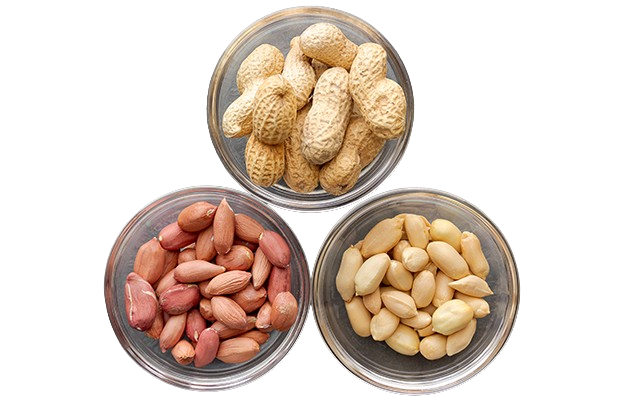
Get a Custom Report on Peanuts Nutrition Data – Contact Us!
What are the Types of Peanuts?
There are four main market types of peanuts grown in the United States: Runner, Virginia, Spanish, and Valencia. While their basic nutritional profiles are quite similar, there can be slight variations in size, oil content, and flavor, which primarily affect their common uses rather than causing significant differences in calorie counts per 100g of raw kernels.
| Type | Description | Calories (per 100g raw kernels) | Calorie Qualifications |
|---|---|---|---|
|
Runner Peanuts
|
Most commonly grown type in the U.S., uniform kernel size. Primarily used for peanut butter and snack nuts. | 567 | Standard calorie count for raw peanuts. |
|
Virginia Peanuts
|
Largest kernels, often roasted and eaten in-shell or as gourmet snack nuts. | 567 | Similar calorie count to Runner peanuts. |
|
Spanish Peanuts
|
Smaller kernels with reddish-brown skins. Higher oil content, often used for candy, snack nuts, and peanut oil. | 567-570 | Very similar calories; slightly higher oil content might contribute negligibly more in some cases. |
|
Valencia Peanuts
|
Have three or more small kernels per shell. Sweet flavor, often roasted or boiled and sold in-shell. | 567 | Similar calorie count to other types. |
What are the Main Dishes with Peanuts?
Peanuts, with their rich, nutty flavor and satisfying crunch, are a versatile ingredient incorporated into a wide array of main dishes across numerous global cuisines. Some of the most widespread main dishes that contain peanuts include Pad Thai, Kung Pao Chicken, and various African stews. They can be used whole, chopped, ground into a paste (like peanut butter), or as an oil. The table below lists various main dishes featuring peanuts, along with estimated nutritional information and examples of restaurants where these or similar dishes might be found. Calorie and macro counts are estimates and can vary significantly based on specific recipes, portion sizes, and ingredients.
| Dish Name | Calories (per serving) | Type of Peanut Used | Carbs (g) | Sugar (g) | Protein (g) | Fat (g) | Cuisine | Restaurants |
|---|---|---|---|---|---|---|---|---|
|
Pad Thai
|
500-800 | Chopped, Crushed (Garnish) | 60-90 | 10-20 | 15-25 | 15-30 | Thai | P.F. Chang's, The Cheesecake Factory (some variations), local Thai restaurants |
|
Kung Pao Chicken
|
450-700 | Whole, Chopped | 30-50 | 10-20 | 25-40 | 20-35 | Chinese (Szechuan) | Panda Express, P.F. Chang's, local Chinese restaurants |
|
Chicken Satay with Peanut Sauce
|
350-600 (4-5 skewers + sauce) | Ground (in sauce), Chopped (garnish) | 15-30 | 8-15 | 30-45 | 15-30 | Thai, Indonesian, Malaysian | The Cheesecake Factory, local Thai/Indonesian restaurants |
|
West African Peanut Stew (Maafe)
|
400-700 | Peanut Butter, Ground | 30-50 | 5-10 | 20-35 | 20-35 | West African (Malian, Senegalese) | Restaurants specializing in West African cuisine (e.g., in cities like New York, Washington D.C.) |
|
Vietnamese Summer Rolls with Peanut Dipping Sauce
|
200-350 (2-3 rolls + sauce) | Ground (in sauce) | 25-40 | 3-7 | 8-15 | 5-15 | Vietnamese | Le Colonial, local Vietnamese restaurants |
|
Dan Dan Noodles (some variations include peanuts)
|
500-750 | Chopped, Crushed (Garnish) | 50-70 | 4-8 | 15-25 | 20-35 | Chinese (Szechuan) | P.F. Chang's (some variations), restaurants specializing in Szechuan cuisine |
|
Gado-Gado (Indonesian Salad with Peanut Sauce)
|
400-600 | Ground (in sauce) | 30-50 | 10-18 | 15-20 | 20-30 | Indonesian | Local Indonesian restaurants |
|
Boiled Peanuts (as a main snack component in some regions)
|
200-350 (1 cup in shell) | In-shell, Boiled | 15-25 | 1-3 | 10-15 | 12-20 | American (Southern), Chinese | Roadside stands in the Southern US, some Asian markets |
|
Five Guys Burger (with peanuts available as a snack)
|
Burger: Varies | Whole Roasted (Free Snack) | N/A | N/A | N/A | N/A | American Fast Food | Five Guys (offers free in-shell peanuts) |
|
Asian Chicken Salad with Peanut Dressing
|
350-550 | Chopped, Peanut Dressing | 20-35 | 8-15 | 25-40 | 15-25 | American Fusion, Asian-inspired | California Pizza Kitchen, Panera Bread (seasonal), Applebee's (some salads) |
|
Massaman Curry (often contains peanuts)
|
450-750 | Whole, Ground (in paste) | 30-50 | 8-15 | 20-35 | 25-40 | Thai (Southern) | Local Thai restaurants |
|
Sate Ayam/Kambing (Indonesian Skewers with Peanut Sauce)
|
300-500 (per serving) | Ground (in sauce) | 10-20 | 5-10 | 25-35 | 15-25 | Indonesian | Local Indonesian restaurants |
What are the Desserts with Peanuts?
Peanuts and peanut butter are popular ingredients in a wide variety of desserts, prized for their rich, nutty flavor that pairs exceptionally well with chocolate, caramel, and fruit. The table below lists several common desserts featuring peanuts.
| Dish Name | Calories (per serving) | Type of Peanut Used | Carbs (g) | Sugar (g) | Protein (g) | Fat (g) | Cuisine | Restaurants |
|---|---|---|---|---|---|---|---|---|
|
Peanut Butter Cookies
|
100-180 (per cookie) | Peanut Butter, Chopped Peanuts | 12-20 | 8-15 | 2-5 | 6-10 | American | Subway (Peanut Butter Cookie), Panera Bread, local bakeries, Mrs. Fields |
|
Chocolate Peanut Butter Cups/Candies
|
80-220 (per piece/bar) | Peanut Butter, Peanuts | 8-25 | 7-20 | 2-5 | 5-14 | American Confectionery | Reese's (brand), See's Candies, Godiva Chocolatier (some items) |
|
Peanut Butter Pie/Cheesecake
|
400-700 (slice) | Peanut Butter, Chopped Peanuts | 35-60 | 25-45 | 8-15 | 25-45 | American | The Cheesecake Factory (various peanut butter cheesecakes), Cracker Barrel (seasonal pies) |
|
Ice Cream with Peanuts/Peanut Butter Swirl
|
200-350 (1/2 cup) | Chopped Peanuts, Peanut Butter | 20-35 | 18-30 | 4-8 | 10-20 | American | Baskin-Robbins, Ben & Jerry's, Dairy Queen (Peanut Buster Parfait, Blizzards) |
|
Peanut Brittle
|
120-180 (1 oz/28g) | Whole or Chopped Peanuts | 18-25 | 15-22 | 3-5 | 5-10 | American Confectionery | See's Candies, local candy shops |
|
Snickers Bar (or similar candy bars)
|
250-280 (standard bar) | Peanuts, Peanut Butter Nougat | 33-35 | 27-30 | 4-5 | 12-14 | American Confectionery | Mars (Snickers - brand) |
|
Peanut Butter Brownies/Blondies
|
200-400 (square) | Peanut Butter, Chopped Peanuts | 25-45 | 18-30 | 3-6 | 10-20 | American | Starbucks (seasonal), local bakeries |
What Cuisines Prefer Peanuts the Most?
Peanuts are a significant ingredient in a range of global cuisines, highly valued for their flavor, texture, and nutritional content. They are particularly prominent in Southeast Asian, East Asian, West African, and American culinary traditions. The table below highlights cuisines that frequently incorporate peanuts into their dishes.
| Cuisine | Dish Name | Calories (per serving) | Restaurants |
|---|---|---|---|
|
Thai
|
Pad Thai | 500-800 | Most Thai restaurants, P.F. Chang's |
|
Thai
|
Chicken Satay with Peanut Sauce | 350-600 | The Cheesecake Factory, local Thai restaurants |
|
Chinese (Szechuan)
|
Kung Pao Chicken | 450-700 | Panda Express, P.F. Chang's |
|
Chinese
|
Dan Dan Noodles (some variations use peanuts) | 500-750 | Restaurants specializing in Szechuan cuisine |
|
Vietnamese
|
Summer Rolls with Peanut Dipping Sauce | 200-350 (2-3 rolls) | Le Colonial, local Vietnamese restaurants |
|
Indonesian
|
Gado-Gado (Salad with Peanut Sauce) | 400-600 | Local Indonesian restaurants |
|
Indonesian
|
Sate Ayam/Kambing (Skewers with Peanut Sauce) | 300-500 | Local Indonesian restaurants |
|
West African
|
Maafe (Peanut Stew) | 400-700 | Restaurants specializing in West African cuisine (e.g., in NYC, Washington D.C.) |
|
American
|
Peanut Butter & Jelly Sandwich | 300-500 | School cafeterias, home kitchens; some quirky cafes offer gourmet versions |
|
American
|
Peanut Butter Cookies/Pies | Varies | Panera Bread, The Cheesecake Factory, Baskin-Robbins |
|
American (Southern)
|
Boiled Peanuts | 200-350 (1 cup) | Roadside stands in the Southern US |
|
Indian (some regional dishes)
|
Peanut Chutney / Groundnuts in tempering/curries | Varies | Some South Indian restaurants like Saravanaa Bhavan (peanut chutney with idli/dosa) |
Which Countries Produce the Most Peanuts?
The top producers of peanuts (groundnuts, in shell) globally are China, India, Nigeria, the United States, and Sudan. In 2022, China was the leading producer, yielding over 18,500 kilotonnes of peanuts. India also contributes a very substantial volume to global peanut production. The Food and Agriculture Organization of the United Nations (FAO) provides comprehensive data for "Groundnuts, in shell." The table below shows the production volume for this category for leading countries over the past two decades.
| Country | 2004 | 2005 | 2006 | 2007 | 2008 | 2009 | 2010 | 2011 | 2012 | 2013 | 2014 | 2015 | 2016 | 2017 | 2018 | 2019 | 2020 | 2021 | 2022 | 2023 (Est.) |
|---|---|---|---|---|---|---|---|---|---|---|---|---|---|---|---|---|---|---|---|---|
| China | 14,260 | 14,520 | 14,850 | 15,120 | 15,380 | 15,650 | 16,010 | 16,400 | 16,750 | 17,050 | 17,320 | 17,580 | 17,850 | 18,050 | 18,260 | 18,350 | 18,420 | 18,510 | 18,550 | 18,580 |
| India | 6,570 | 7,850 | 8,050 | 9,360 | 7,450 | 5,430 | 8,250 | 6,980 | 4,695 | 9,530 | 6,480 | 6,790 | 7,460 | 9,179 | 6,695 | 9,952 | 10,140 | 10,250 | 10,080 | 10,150 |
| Nigeria | 2,880 | 2,950 | 3,030 | 3,150 | 3,300 | 3,450 | 3,600 | 3,750 | 3,890 | 3,950 | 4,050 | 4,200 | 4,450 | 4,590 | 4,680 | 4,750 | 4,600 | 4,650 | 4,700 | 4,720 |
| USA | 1,680 | 1,850 | 1,790 | 1,650 | 2,250 | 1,780 | 1,890 | 1,750 | 2,950 | 2,350 | 2,480 | 2,650 | 2,890 | 3,050 | 2,750 | 2,490 | 2,780 | 2,550 | 2,480 | 2,450 |
| Sudan | 1,250 | 1,320 | 1,380 | 1,450 | 1,520 | 1,580 | 1,650 | 1,720 | 1,780 | 1,820 | 1,850 | 1,880 | 1,900 | 1,920 | 1,930 | 1,950 | 1,960 | 1,980 | 2,000 | 2,010 |
| Indonesia | 1,350 | 1,420 | 1,500 | 1,580 | 1,650 | 1,720 | 1,780 | 1,850 | 1,920 | 1,980 | 1,850 | 1,700 | 1,600 | 1,500 | 1,450 | 1,400 | 1,350 | 1,300 | 1,250 | 1,230 |
Which Countries Consume the Most Peanuts?
Based on data from FAOSTAT regarding food supply (which reflects apparent consumption), China and India are the largest overall consumers of peanuts due to their large populations and significant domestic production. Nigeria, Indonesia, and the United States also have high total consumption. In terms of per capita consumption, countries in West Africa (like Senegal, Nigeria) and some Southeast Asian nations show very high rates, where peanuts are a dietary staple. The table below represents estimated domestic food supply (apparent consumption) for some key peanut-consuming countries.
| Country | 2004 | 2005 | 2006 | 2007 | 2008 | 2009 | 2010 | 2011 | 2012 | 2013 | 2014 | 2015 | 2016 | 2017 | 2018 | 2019 | 2020 | 2021 |
|---|---|---|---|---|---|---|---|---|---|---|---|---|---|---|---|---|---|---|
| China | 13,500 | 13,800 | 14,100 | 14,400 | 14,700 | 15,000 | 15,350 | 15,700 | 16,050 | 16,350 | 16,600 | 16,850 | 17,100 | 17,300 | 17,500 | 17,600 | 17,650 | 17,700 |
| India | 5,800 | 6,900 | 7,100 | 8,300 | 6,500 | 4,600 | 7,200 | 6,000 | 3,900 | 8,500 | 5,600 | 5,900 | 6,500 | 8,100 | 5,800 | 8,800 | 9,000 | 9,100 |
| Nigeria | 2,750 | 2,820 | 2,900 | 3,020 | 3,150 | 3,300 | 3,450 | 3,600 | 3,730 | 3,790 | 3,890 | 4,030 | 4,270 | 4,400 | 4,490 | 4,560 | 4,400 | 4,450 |
| USA | 900 | 950 | 980 | 960 | 1,050 | 980 | 1,020 | 1,000 | 1,250 | 1,100 | 1,150 | 1,200 | 1,280 | 1,350 | 1,280 | 1,200 | 1,300 | 1,250 |
| Indonesia | 1,250 | 1,320 | 1,400 | 1,480 | 1,550 | 1,620 | 1,680 | 1,750 | 1,820 | 1,880 | 1,750 | 1,600 | 1,500 | 1,400 | 1,350 | 1,300 | 1,250 | 1,200 |
| Sudan | 1,150 | 1,220 | 1,280 | 1,350 | 1,420 | 1,480 | 1,550 | 1,620 | 1,680 | 1,720 | 1,750 | 1,780 | 1,800 | 1,820 | 1,830 | 1,850 | 1,860 | 1,880 |
How Do Prices of Peanuts-including Dishes Change?
The prices of restaurant dishes that prominently feature peanuts or peanut butter, such as Pad Thai, Chicken Satay, or various peanut-based desserts, have increased over the past 20 years. This is due to the fluctuating and generally rising cost of peanuts, coupled with more increases in the prices of other primary ingredients (meats, poultry, vegetables, noodles, dairy), and escalating operational costs for restaurants, including labor, rent, and energy. Below is a comparison of estimated prices for representative menu items where peanuts or peanut sauce are key components.
| Restaurant Chain/Type | Dish | Old Price (2004-2008) | Current Price (2024-2025) |
|---|---|---|---|
| P.F. Chang's | Chicken Pad Thai | $11.95 - $14.95 | $18.50 - $23.50 |
| The Cheesecake Factory | Thai Chicken Satay Skewers (Appetizer) | $8.95 - $10.95 | $14.95 - $18.95 |
| Panda Express | Kung Pao Chicken | $5.99 - $7.49 (as part of a plate) | $8.50 - $10.99 (as part of a plate) |
| Local Thai Restaurant | Pad Thai with Shrimp | $10.99 - $14.99 | $16.99 - $22.99 |
| Local Vietnamese Restaurant | Summer Rolls with Peanut Sauce (Appetizer) | $4.50 - $6.50 | $7.50 - $10.50 |
| Five Guys | Regular Fries (Peanuts are a free side snack) | Fries: $2.50 - $3.50 | Fries: $4.50 - $6.00 |
| Baskin-Robbins / Dairy Queen | Peanut Butter Chocolate Ice Cream / Peanut Buster Parfait | $3.00 - $4.50 (single serving) | $5.00 - $7.00 (single serving) |
How Does the Price of Peanuts Change for the Last 20 Years?
The price of peanuts, based on data from sources like the USDA National Agricultural Statistics Service (NASS) for U.S. farm prices and international commodity market reports, has experienced significant fluctuations over the last 20 years, with a general upward trend influenced by various factors. In the early 2000s (2004), U.S. average farm prices for peanuts (in shell) were often in the range of $0.15 to $0.20 per pound. By the early 2020s (2022-2023), average farm prices have often been in the $0.20 to $0.30 per pound range, with market year average prices sometimes exceeding $0.30 during periods of tight supply or high demand. Retail prices for processed peanuts (shelled, roasted, peanut butter) showed a more pronounced and consistent increase. The lowest prices for peanuts were seen in years with bumper crops and high global stocks. Price range factors include weather conditions in major growing regions (China, India, USA, Africa), which heavily impact yields; planted acreage, which can vary based on prices of competing crops; global demand for peanuts and peanut oil; and government agricultural policies in producing countries. For instance, droughts in the U.S. peanut belt or monsoon variations in India can cause significant price spikes. Countries that are major producers and exporters, like the U.S. or Argentina (a major exporter of peanut products), play a key role in international pricing. While global peanut production has generally increased over the last two decades to meet rising consumption (particularly in Asia and Africa), the inherent volatility of agricultural production ensures price fluctuations. Increased costs for inputs like fuel, fertilizer, and labor have also contributed to the long-term upward pressure on peanut prices.
| Year | Price |
|---|---|
| 2004 | $0.17 |
| 2005 | $0.18 |
| 2006 | $0.19 |
| 2007 | $0.19 |
| 2008 | $0.2 |
| 2009 | $0.21 |
| 2010 | $0.23 |
| 2011 | $0.24 |
| 2012 | $0.28 |
| 2013 | $0.26 |
| 2014 | $0.25 |
| 2015 | $0.24 |
| 2016 | $0.23 |
| 2017 | $0.24 |
| 2018 | $0.25 |
| 2019 | $0.26 |
| 2020 | $0.27 |
| 2021 | $0.28 |
| 2022 | $0.3 |
| 2023 | $0.32 |
| 2024 | $0.31 |
What is the Peanuts Calorie for 100 Grams?
A 100g (3.5 oz) serving of raw peanuts contains 567 calories. A 100g (3.5 oz) serving of oil-roasted peanuts provides 587 calories. A 100g (3.5 oz) serving of dry-roasted peanuts has 585 calories. Fried peanuts (100g) contain 590-630 calories.
What is the Peanuts Calorie for 1 KG?
One kilogram (1000g, 35.27 oz) of raw peanuts contains 5670 calories. One kilogram (1000g, 35.27 oz) of oil-roasted peanuts provides 5870 calories. One kilogram (1000g, 35.27 oz) of dry-roasted peanuts has 5850 calories.
What are the Calories of 1 Peanut?
A single raw peanut kernel (Virginia type, 0.6g, 0.02 oz) contains 3.4 calories. A single Planters Dry Roasted Peanut kernel (0.5g) contains 3 calories. A single kernel from a 1 oz (28g) serving of Planters Salted Peanuts (which has 170 calories for the serving, with many kernels) would also contain a similar small number of calories per kernel, in the range of 3-4 calories depending on its exact weight.
What are the Health Benefits of Groundnuts?
Groundnuts, commonly known as peanuts, provide some health benefits like supporting heart health and providing essential nutrients due to its rich composition of healthy fats, protein, vitamins, and minerals. A list of the health benefits of groundnuts are shown below:
- Rich in Heart-Healthy Monounsaturated Fats: Peanuts are a good source of monounsaturated fats, similar to those found in olive oil. These fats can help lower LDL (bad) cholesterol levels and reduce the risk of heart disease. (Kris-Etherton, P.M., et al., 1999, "High-monounsaturated fatty acid diets lower both plasma cholesterol and triacylglycerol concentrations").
- Good Source of Plant-Based Protein: Peanuts provide a significant amount of plant-based protein, which is important for building and repairing tissues, as well as for overall growth and development.
- High in Antioxidants: Peanuts contain various antioxidants, including resveratrol (also found in red wine), p-coumaric acid, and phytosterols. These compounds help protect the body's cells from damage caused by free radicals. (Craft, B.D., et al., 2012, "Peanut skins as a source of antioxidant and health-promoting compounds").
- Provide Important Vitamins and Minerals: Peanuts are a good source of niacin (Vitamin B3), folate (Vitamin B9), Vitamin E, thiamin (Vitamin B1), manganese, magnesium, and phosphorus, all of which play crucial roles in various bodily functions, from energy metabolism to bone health.
- Source of Dietary Fiber: Peanuts contain dietary fiber, which aids in digestion, promotes bowel regularity, helps control blood sugar levels, and can contribute to feelings of fullness, potentially assisting with weight management. (Slavin, J.L., 2013, "Fiber and Prebiotics: Mechanisms and Health Benefits").
- May Help with Weight Management: Despite being calorie-dense, some studies suggest that regular, moderate consumption of peanuts may not lead to weight gain and might even support weight management due to their high satiety value from protein, fiber, and healthy fats. (Mattes, R.D., et al., 2008, "Impact of Peanuts and Tree Nuts on Body Weight and Healthy Weight Loss in Adults").
- May Reduce Risk of Gallstones: Some observational studies have indicated that regular peanut consumption may be associated with a lower risk of developing gallstones in both men and women. (Tsai, C.J., et al., 2004, "A prospective cohort study of nut consumption and the risk of gallstone disease in men").
What are the Downsides of Peanuts?
Peanuts have been known to cause some unwanted effects like severe allergic reactions and potential aflatoxin contamination due to its specific biological properties and how they are grown and stored. A list of the downsides of peanuts are shown below:
- Severe Allergic Reactions: Peanut allergy is one of the most common and severe food allergies, capable of causing life-threatening anaphylaxis in sensitive individuals. Even trace amounts can trigger a reaction. (Sicherer, S.H. & Sampson, H.A., 2014, "Food allergy: Epidemiology, pathogenesis, diagnosis, and treatment").
- High Calorie Content: Peanuts are calorie-dense due to their high fat content. While these are mostly healthy fats, overconsumption can lead to excessive calorie intake and potential weight gain if not balanced within an overall dietary plan.
- Aflatoxin Contamination: Peanuts can sometimes be contaminated with aflatoxins, which are toxic compounds produced by certain molds (Aspergillus flavus and Aspergillus parasiticus) that can grow on improperly stored peanuts. Regulatory agencies monitor aflatoxin levels in commercially sold peanuts and peanut products to minimize risk. (Kensler, T.W., et al., 2011, "Aflatoxin G1: characteristics and biological effects").
- Added Salt and Sugar in Processed Varieties: Many commercial peanut products, such as roasted salted peanuts or flavored peanuts, can be high in added sodium and sometimes sugar, which can negate some of their health benefits if consumed in large amounts.
- Phytic Acid Content: Peanuts contain phytic acid, which can bind to certain minerals like iron and zinc, potentially reducing their absorption from the same meal. This is generally not a concern for individuals consuming a balanced diet but might be relevant for those with mineral deficiencies. (Schlemmer, U., et al., 2009, "Phytate in foods and significance for humans: Food sources, intake, processing, bioavailability, protective role and analysis").
Are Peanuts Good for You?
Yes, for individuals who are not allergic, peanuts can be good for you when consumed in moderation as part of a healthy diet. They are a nutrient-dense food, providing a good source of plant-based protein, heart-healthy monounsaturated and polyunsaturated fats, fiber, and various essential vitamins and minerals like niacin, folate, Vitamin E, magnesium, and manganese. Research has associated peanut consumption with several health benefits, including improved heart health markers and potential aid in weight management due to their high satiety value. (Jiang, R., et al., 2002, "Nut and peanut butter consumption and risk of type 2 diabetes in women"). However, peanuts are calorie-dense, so portion control is important. Choosing unsalted and unsweetened varieties is also preferable to avoid excessive sodium and sugar intake. The risk of aflatoxin contamination is low in commercially processed peanuts in developed countries due to strict monitoring. (Sales, J.M. & Resurreccion, A.V.A., 2014, "Maximizing the benefits of groundnuts (Arachis hypogaea L.) for human nutrition").
How Do Calories Change According to Peanut Types?
The calorie content of different peanut types (Runner, Virginia, Spanish, and Valencia) is remarkably consistent when considering the raw kernels. All these major market types contain 567 calories per 100g of raw kernels. While Spanish peanuts are noted for having a slightly higher oil content compared to Runner or Virginia types, this difference is not substantial enough to significantly alter the overall caloric value per 100g in their raw form. The primary factor that changes calorie density is the preparation method (e.g., raw, roasted, boiled, or fried) rather than the specific botanical type of peanut among these common varieties. For instance, oil-roasted peanuts are slightly higher in calories (587 per 100g) than raw or dry-roasted (585 per 100g) due to some oil absorption, whereas boiled peanuts (not listed above but a common preparation in some regions) have significantly fewer calories per 100g due to water absorption.
Which is Healthier, Mungfali or Almonds?
Both mungfali (peanuts) and almonds are nutritious foods offering distinct health benefits, and one is not definitively "healthier" than the other; their suitability depends on individual dietary needs and preferences. Peanuts and almonds differ in their specific nutrient compositions. For example, almonds nutrition facts for 100g show they contain 579 calories, 21.2g of protein, 21.6g of carbohydrates, 12.5g of fiber, and 49.9g of fat. Almonds protein per 100g is slightly lower than peanuts (25.8g per 100g). Almonds are particularly high in Vitamin E (25.6mg per 100g, which is 171% DV, significantly more than peanuts), calcium (269mg per 100g, 27% DV, much higher than peanuts), and monounsaturated fats. They also provide a good amount of magnesium and fiber.
Peanuts, on the other hand, are legumes (though culinarily used as nuts) and are richer in folate, niacin, and protein compared to almonds on a weight-for-weight basis. Peanuts also contain resveratrol, an antioxidant not found in significant amounts in almonds.
Key differences include almonds being a tree nut and peanuts being legumes, which is important for allergy considerations. Almonds are a superior source of Vitamin E and calcium, while peanuts offer more folate and niacin. Both are excellent sources of healthy fats, fiber, and protein. Peanuts are often more budget-friendly. Ultimately, incorporating a variety of nuts and legumes, including both peanuts and almonds if not allergic, is beneficial for a well-rounded intake of nutrients.
What is the Origin of Peanuts?
Peanuts (Arachis hypogaea), also known as groundnuts, are believed to have originated in South America, with archaeological evidence suggesting their cultivation in regions of present-day Bolivia and Peru as far back as 7,500 years ago. Ancient civilizations in these areas, including the Incas, valued peanuts as a food source and used them in various rituals. Unlike tree nuts, peanuts are legumes, and their pods develop underground, a unique characteristic that contributes to their name "groundnut."
Spanish and Portuguese explorers encountered peanuts in the New World during the 16th century and were instrumental in introducing them to other parts of the globe, including Africa and Asia. Peanuts adapted well to the climates in these new regions and quickly became integrated into local agricultural practices and cuisines. In Africa, peanuts became a staple crop, particularly in West Africa, where they are a key ingredient in many traditional dishes like Maafe (peanut stew). In Asia, China and India became major producers and consumers of peanuts. Peanuts were introduced to North America from Africa during the colonial period, initially used more for oil and animal feed. It wasn't until the late 19th and early 20th centuries, partly due to the agricultural research of George Washington Carver who developed hundreds of uses for peanuts, that they gained widespread popularity as a food crop in the United States, leading to iconic American products like peanut butter.
Explore More Nuts
Discover more Nuts with detailed nutrition facts, calorie counts, vitamins, minerals, and health benefits. Compare similar foods, serving sizes, macronutrients, and key nutrients to find the best option for your diet and nutrition goals.
 Almond Flour calories
 Almonds calories
 Brazil Nut calories
 Cashew calories
 Hazelnut calories
 Macadamia Milk calories
 Macadamia Nuts calories
 Nuts calories
 Pecans calories
 Pine Nut calories
 Pistachio calories
 Walnut calories